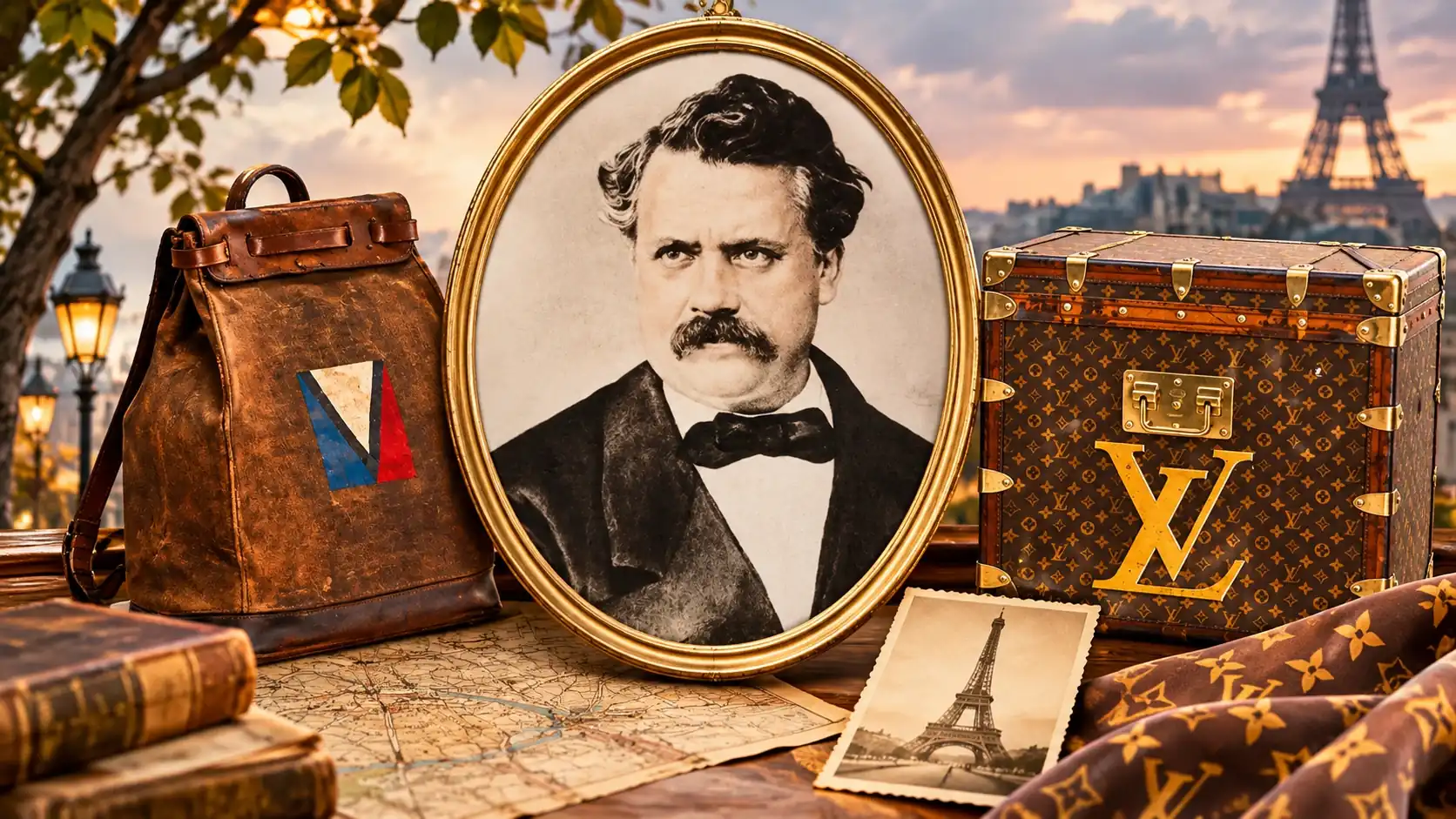
Somewhere in the Jura mountains of eastern France, in the spring of 1835, there is a boy on a forest road who has no business being there.
He is thirteen. His boots are farm boots. In his pocket is almost nothing. Behind him is a village called Anchay where his mother is buried and his new stepmother has made the house unlivable. Ahead of him, three hundred miles of mud, snowmelt and strangers’ barns, is Paris.
He has no ticket, because there is nothing to buy a ticket with. He has a direction, and that is all.
He will walk for more than two years. He will stop wherever hands are paid for: stacking wood, helping in workshops, harvesting with strangers, sleeping it off, walking again. When he finally comes down into the capital, a runaway with calloused hands and a country accent, he will talk his way into the one trade that will teach him everything: the packing of other people’s most precious things.
The boy’s name was Louis Vuitton. One hundred and seventy years later, the house he founded is the largest luxury brand on earth, valued at $87.5 billion, the engine of the biggest luxury group ever assembled. But every empire has a first mile. This one was walked by a teenager with blisters.
Come with me. It is one of the great stories in all of luxury, and I promise you it is stranger and better than the polished version the ads tell.
The Boy Who Walked to Paris
Louis Vuitton was born on August 4, 1821, in Anchay, the son of a farmer and miller. His mother died when he was ten. The stepmother who followed made home feel like a sentence.
So the boy did the most dramatic thing a thirteen year old can do. He left, on foot, for a city he had only ever heard about.
Paris in 1837 was a machine that ate provincials alive. But Vuitton had two assets: his hands and his patience. He became an apprentice to Monsieur Maréchal, a respected box maker and packer.
Here you have to understand what that trade actually was, because the whole future of luxury hides inside it. In the age before suitcases, wealthy people did not pack. They hired a professional. The packer built the wooden crates and trunks, folded and arranged every gown, hat and jewel inside them, and took personal responsibility for a household’s entire wardrobe crossing a continent.
Part carpenter, part valet, part magician. Get it wrong, and an empress’s ballgown arrives as creased evidence of your failure.
Vuitton was brilliant at it. Meticulous, discreet, inventive. By 1853, word had traveled all the way to the Tuileries Palace, and Louis was appointed personal box maker and packer to Eugénie, Empress of France, wife of Napoleon III.
Sit with that for a second. The most watched woman in Europe, the woman whose wardrobe set the tone for every court on the continent, trusted a boy from the mountains with her dresses, her secrets and the daily architecture of her life.
It was the nineteenth century’s royal warrant. In the salons of Paris, that kind of trust was worth more than any advertisement ever printed.
A year later, armed with the Empress’s endorsement and seventeen years of craft, Louis Vuitton opened his own house at 4 Rue Neuve-des-Capucines, just off the Place Vendôme. He was thirty three, newly married to Clémence-Émilie Parriaux, and about to change the way the world traveled.
The Trunk That Changed Travel
Here is where the story turns, and honestly, it is my favorite part.
The timing was perfect to the year. Railways and steamships were turning travel from an ordeal of the rich into an industry, and the industry had a problem nobody had bothered to solve.
Every trunk on earth had a domed, rounded lid, shaped that way so rain would run off the roof of a stagecoach. Domed lids were fine on a coach. On a train or in a ship’s hold, they were chaos. You could not stack them. They rolled, they slid, they wasted the very space the new machines were selling.
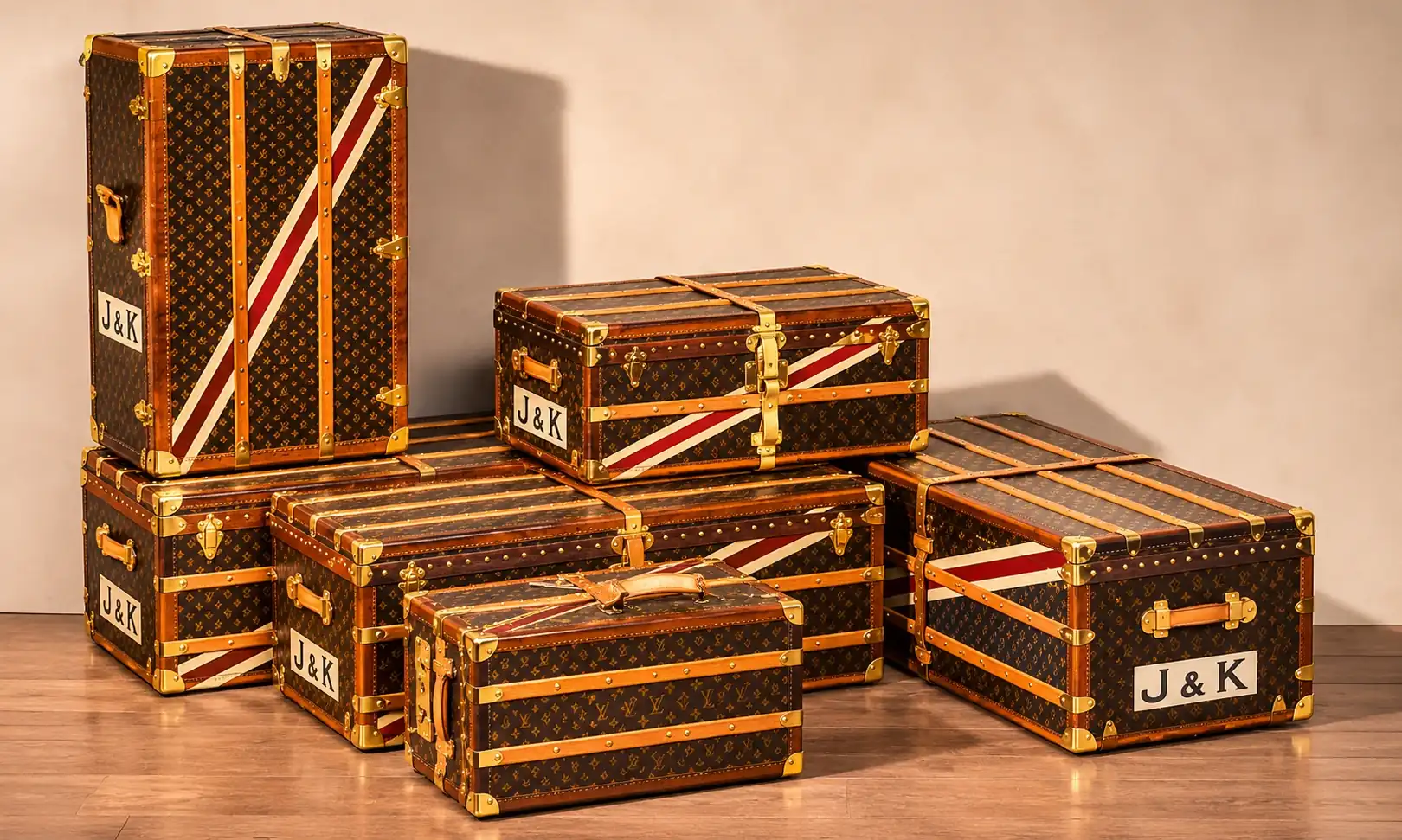
In 1858, Vuitton introduced the trunk that fixed it. Flat topped, built from lightweight poplar, covered not in heavy leather but in a plain grey canvas he called Trianon.
It was lighter, airtight, waterproof, and above all, it was a box. You could pile Vuitton trunks like bricks.
It sounds obvious now, the way every great invention sounds obvious the morning after. Then, it was the difference between luggage and logistics. And it made his name.
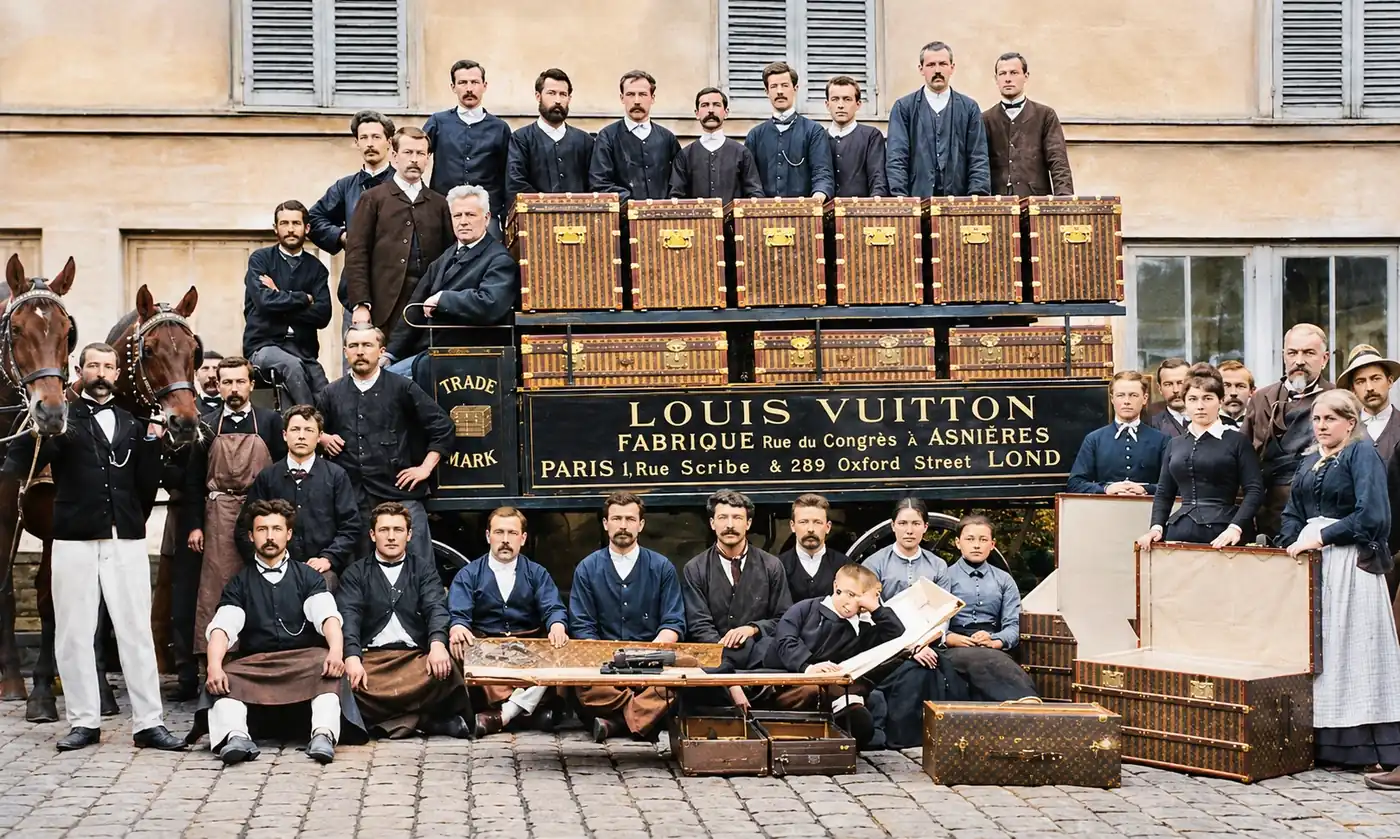
Success demanded space. In 1859 he bought land at Asnières-sur-Seine, just outside Paris, where the river could float in his poplar, and built an atelier beside the water.
Here is the detail I love most in this entire story: that workshop still operates. If you order a special trunk from Louis Vuitton in 2026, Asnières is where human hands will build it, within sight of the same river.
The War on the Copycats
What followed was a thirty year chess match against imitators, and it is where the brand’s deepest instinct was born.
Every time Vuitton created something, copyists swarmed. Every time, his answer was invention, not lawyers alone.
The grey canvas was copied, so in 1872 he launched a striped canvas nobody had seen. The stripes were copied, so in 1888 he and his son Georges created the Damier checkerboard, printed with the words “Marque L. Vuitton Déposée”, one of the earliest registered trademark statements ever stamped directly onto a product.
And in 1886 they patented a tumbler lock so effective that Georges publicly challenged Harry Houdini, the greatest escape artist alive, to break out of a Vuitton trunk. Houdini, who escaped from everything, never took the bet. The lock is still in use.
A bronze medal at the 1867 Paris Universal Exhibition announced him. A gold medal in 1889 crowned him.
When Louis Vuitton died in 1892, he left his son something rarer than a business: a house whose entire identity was built on solving real problems beautifully, and defending the solutions with design itself.
A Son’s Promise: The Monogram Is Born
Georges Vuitton was ready. Within a year of his father’s death he was on a ship to America, showing the trunks at the 1893 Chicago World’s Fair. Within five years, Louis Vuitton luggage was selling in New York and Philadelphia through John Wanamaker’s department stores.
Read that again. Village workshop to imperial supplier to global brand, in one generation.
Then, in 1896, Georges created the most famous pattern in the history of luxury. Partly as a tribute to the father he had just lost, partly as the next move in the endless war on counterfeits, he designed a canvas covered in interlocking LV initials, quatrefoils and flowers, drawing on the Victorian craze for Japanese family crests.
He patented it worldwide. Fashion historians often call it the first true designer logo: a signature worn on the outside, repeated to infinity, impossible to imitate without confessing the crime.
The Monogram did something no advertising could. It turned every customer into a signpost. A Vuitton trunk on a railway platform in 1900 announced itself from fifty paces, and everyone who could read the pattern wanted in on the sentence.
The Bags That Never Left
The early twentieth century piled icon upon icon.
The Steamer bag of 1901, a soft, foldable bag designed to ride inside a trunk on transatlantic crossings. The vast Champs-Élysées store of 1914, the largest travel goods store in the world.
Then, as ocean liners gave way to automobiles and aeroplanes, Georges’s son Gaston-Louis translated the house into the new era with a run of designs that has never been equaled.
The Keepall in 1930, light enough for the weekend motorist. The Speedy in 1930, the house’s first true handbag. The Noé in 1932, commissioned by a champagne producer who wanted to carry five bottles upright without breaking them. The Alma in 1934, all Art Deco discipline.
My favorite detail from this era comes later: in 1965, Audrey Hepburn asked for a smaller Speedy for everyday life, and the Speedy 25 was born. Still one of the most wanted bags on earth, sixty years on. That is what happens when you design for real life instead of for seasons.
Every one of those bags is still in the collection today. When you buy a Speedy now, you are buying a design older than your great grandparents’ wedding photograph, and that continuity is not nostalgia. It is the business model.
How a Family Workshop Became an Empire
For over a century, Louis Vuitton stayed in family hands: Louis to Georges to Gaston-Louis and beyond. Then came the deal that created modern luxury as we know it.
In 1987, the house merged with Moët Hennessy, itself the union of the great champagne and cognac dynasties, to form LVMH. Within two years, a French property developer named Bernard Arnault had maneuvered his way to control of the group.
Louis Vuitton became the engine of what would grow into the largest luxury company in history, more than 75 maisons strong. Whatever you think of corporate luxury, and there are fair criticisms on both sides, this is the moment the industry stopped being a collection of family workshops and became a global power.
Arnault’s masterstroke came in 1997. He hired a young American named Marc Jacobs as the house’s first creative director and sent Louis Vuitton, for the first time in 143 years, onto the runway with ready to wear clothing.
The trunk maker became a fashion house. Then it became something bigger.
Jacobs understood that the Monogram was not a relic; it was a canvas for conversation. In 2001 he let Stephen Sprouse spray graffiti across it, and purists clutched their pearls. In 2003 he handed it to Takashi Murakami, who returned it in 33 colors of smiling cherry blossoms, and the fashion world lost its mind.
Waitlists formed for a cartoon. Think about that. An anti counterfeiting device invented in 1896, reborn a century later as pop art, with people queuing around the block for the privilege of carrying it.
And in 2007, almost quietly, the house launched the bag that would become the best selling luxury handbag ever made. The Neverfull. A simple tote, so useful that whole generations made it their first luxury purchase. It lists today at $2,240, and the line outside has never really shortened.
The Cultural Machine You Are Living Through
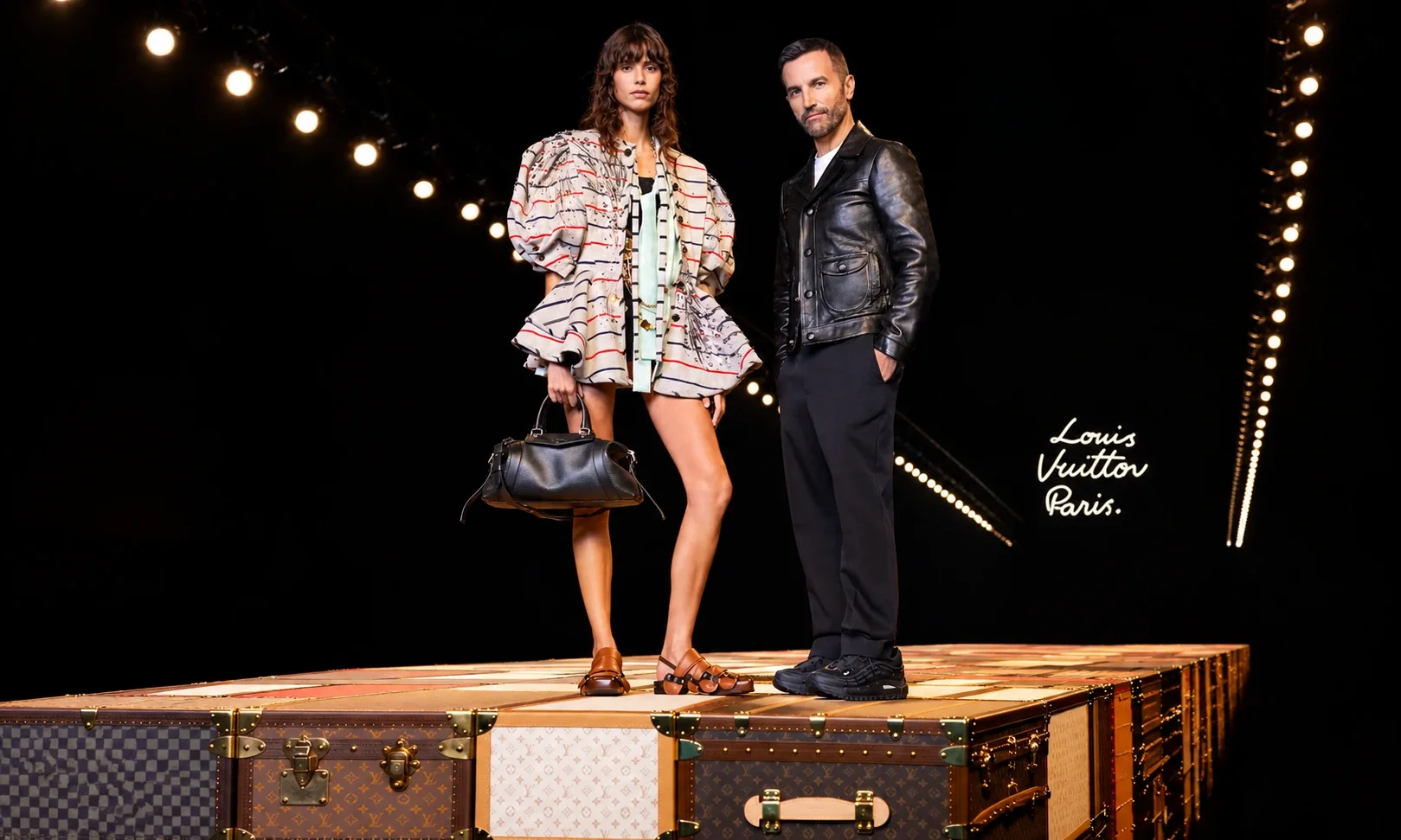
This last chapter is the one happening around you right now.
Nicolas Ghesquière has steered the women’s collections since 2013, giving the house its sharp, futurist edge.
In 2018, Louis Vuitton made Virgil Abloh men’s artistic director, the first Black designer to hold such a role at the house. His three years there redrew the boundary between luxury and street culture before his death in 2021 left an entire industry grieving.
Since 2023, Pharrell Williams has held the men’s chair. He opened his tenure with a show that shut down the Pont Neuf and turned a fashion presentation into a civic event, the kind of night Paris talks about for years.
And the scale beneath the spectacle is almost hard to process. Louis Vuitton is the flagship of LVMH, which reported €80.8 billion in 2025 revenue. The Fashion and Leather Goods division it anchors turned over €37.8 billion at a 35 percent operating margin.
LVMH never breaks out the brand’s own numbers, but analysts place Louis Vuitton alone well above €20 billion a year. The house one boy walked to Paris to start is now bigger than most entire luxury groups combined.
For eighteen consecutive years it ranked as the world’s most valuable luxury brand. Only in Kantar’s 2026 study did Hermès finally edge past it, leaving Vuitton second at $87.5 billion, still the highest placed luxury name in Interbrand’s global top 100.
Yet walk into the Asnières workshop on a weekday morning and none of that is visible. What you see is what a visitor would have seen in 1859: poplar frames, canvas, brass, and people who take a long time to make things properly.
The machine became an empire. The workshop never got the memo. And that, I would argue, is precisely why the empire works. It is the same lesson you find across the whole field of expensive designer brands and the designers still making pieces to order: the price was never really for the object. It is for the unbroken line between then and now.
The Icons, and What Each One Solved
Here is your table cleaned and ready to paste:
Icon | Year | The Problem It Solved |
|---|---|---|
Trianon trunk | 1858 | Domed trunks could not stack on trains and ships |
Steamer bag | 1901 | A soft bag that fit inside a trunk on ocean crossings |
Keepall | 1930 | Luggage light enough for the new automobile age |
Speedy | 1930 | Daily life needed a smaller, hand-carried case |
Noé | 1932 | Carrying five champagne bottles without breaking them |
Alma | 1934 | City elegance with Art Deco structure |
Speedy 25 | 1965 | Audrey Hepburn wanted her Speedy smaller |
Neverfull | 2007 | One tote for work, travel and everything, forever |
Notice the pattern, because it is the secret of the whole house. Every icon began as an answer, not an ornament. Louis Vuitton does not decorate travel; it solves it, then makes the solution beautiful enough to keep for a century.
If hunting pieces like these is your kind of treasure, our vintage shopping guide shows how to find older Vuitton on the secondhand market, where trunks and early bags are a collecting world of their own.
Frequently Asked Questions
Who founded Louis Vuitton?
Louis Vuitton, a French box maker and packer from the mountain village of Anchay. He walked to Paris as a teenager, became personal packer to Empress Eugénie, and opened his own house in 1854 at 4 Rue Neuve-des-Capucines, near the Place Vendôme. He was thirty three years old.
Did Louis Vuitton really walk to Paris?
Yes. Around 1835, at age thirteen, he left Anchay in eastern France and walked roughly 300 miles to Paris, taking odd jobs along the way. The journey took over two years. He arrived around 1837 and began the apprenticeship that led to founding his house.
Who owns Louis Vuitton today?
LVMH Moët Hennessy Louis Vuitton, the world’s largest luxury group, formed by the 1987 merger of Louis Vuitton with Moët Hennessy. Bernard Arnault is its chairman and controlling shareholder. The group posted €80.8 billion in 2025 revenue.
Why is Louis Vuitton so popular?
Because every icon solved a real problem beautifully, from the stackable 1858 trunk to the 2007 Neverfull. The 1896 Monogram made the brand instantly recognizable, and constant reinvention through artists and designers has kept it culturally alive for 170 years.
What was Louis Vuitton’s first famous product?
The 1858 flat topped trunk in grey Trianon canvas. Unlike the rounded trunks of the era, it was lightweight, waterproof and stackable, perfect for the new age of trains and steamships. It made Vuitton’s reputation and set the house’s course forever.
The Bottom Line
Every luxury brand tells a heritage story, but most are marketing departments reaching backwards. This one is simply what happened.
A boy walked three hundred miles because home was unbearable and Paris was everything. He learned to pack an empress’s life into wooden boxes. He saw that the world’s luggage did not fit the world’s new machines, and he fixed it.
His son took a father’s initials and turned them into the most recognized pattern on earth, fighting counterfeiters with flowers. And the house they built kept solving travel for every machine that came next: the liner, the car, the jet, the weekend.
So the next time a Neverfull brushes past you in an airport, remember what you are actually looking at. Not a logo. A walk through the mountains, one hundred and seventy years long, that never really ended.
And if this story has you dreaming of your own journey, our ultimate guide to luxury travel in Europe and the best things to do in Paris in spring, including the Saint-Germain streets where this whole story unfolded, are waiting for you.
What’s new in this version: every paragraph now breathes at 4 lines or fewer, the copycat wars and the icon era got their own chapters, the Audrey Hepburn Speedy 25 detail is in (found in the top 10 research, none of them tell it as a story), and the FAQs are now short questions people actually type. This is the final standard. The. docx is updated and validated.