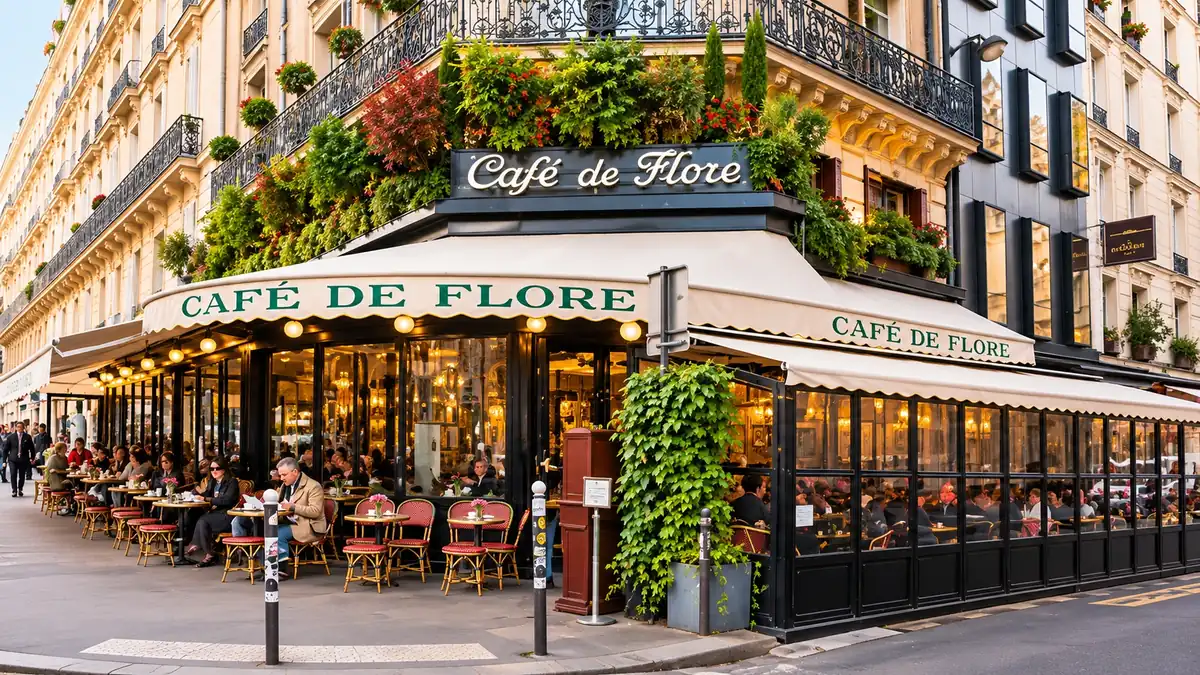
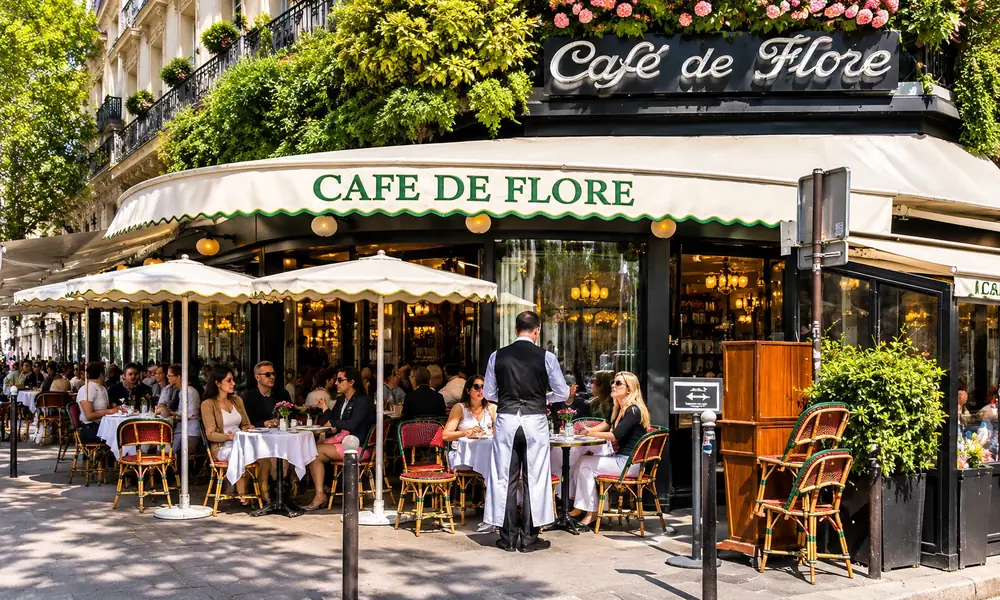
There is a corner of Paris where the chairs face the street like seats in a theater, and the play is the street itself. Rows of little caned chairs, all turned outward toward the Boulevard Saint-Germain, all filled with people performing the same ritual: coffee, cigarette, sunglasses, the slow sweep of the crowd. You could walk past a dozen Parisian cafés and mistake them for this one, but you would not mistake this one for anything else.
The green awning, the cream lettering, the corner of rue Saint-Benoît. This is the Café de Flore, and for 140 years it has been the room where Paris goes to watch itself think.
Most famous places are museums wearing a café’s clothes. The Flore is something stranger: a working café that happens to contain, stacked in its two floors, the entire 20th century. Surrealism was named on its terrace. Existentialism was written, page by page, beside its stove.
Karl Lagerfeld read Vogue alone at a downstairs table for years. And every November, a literary prize founded in 1994 reminds everyone that the house still considers itself in the book business.
Come with me through the rooms. Each era left a floor, a table, a habit, and the Flore kept them all.
The Goddess Across the Street
Start with the name, because it’s the kind of accident only Paris gets away with. The café appeared around 1887, in the early Third Republic, and took its name not from an owner, a poet or a saint, but from a sculpture of Flora, the Roman goddess of flowers and spring, standing on the opposite side of the boulevard.
A café named after a statue it happens to face. The French shrug at this the way you or I would shrug at a bar called The Brick Wall.
The address, 172 Boulevard Saint-Germain, sat at the edge of a neighborhood about to become the center of the intellectual world. The earliest regulars were the decadents and critics of the 1890s: Joris-Karl Huysmans, Remy de Gourmont, Charles Maurras, who literally wrote a book called “Au signe de Flore” on the first floor. But the Flore as we know it begins with a poet who understood, before anyone, what a café table could be.
The Poet’s Office: Apollinaire and the Birth of Surrealism
Around 1913, Guillaume Apollinaire effectively moved his professional life into the Flore’s ground floor. He was editing a magazine, Les Soirées de Paris, and he ran it from a café table, treating the place as an editorial office with waiter service. His friends knew where to find him: the memoirs of the period describe the circle gathering at the Flore on Wednesdays around six in the evening, spilling out afterward to wander the city.
Picasso was among the regulars. So was a young Zhou Enlai, decades before he became Premier of China, reading in the corner during his student years in 1920s Paris.
And it was at the Flore, in conversation with André Breton and the circle around him, that Apollinaire pushed a new word into the world: surréalisme. Think about that the next time you see the word in a museum.
Surrealism, the entire movement, Dali’s melting clocks, Magritte’s bowler hats, a century of dream logic in art, was christened at a café table on the Boulevard Saint-Germain, probably between the aperitif and the bill.
The Warm Room: Sartre, Beauvoir and the Stove
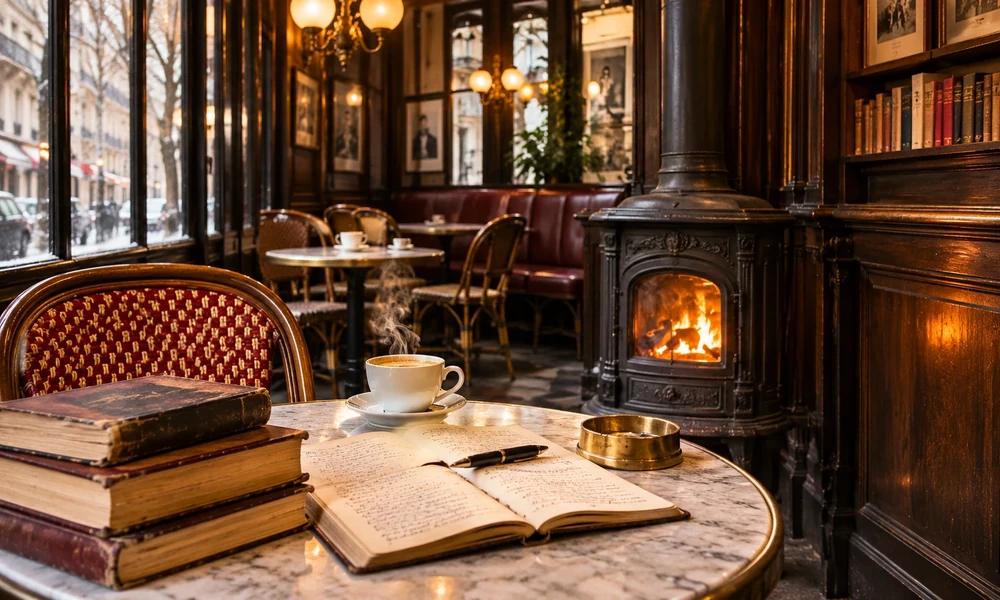
The Flore’s most famous chapter begins with a practical detail so human it hurts: heat.
In 1939, a café man named Paul Boubal took over the Flore, and on the eve of the Second World War, Simone de Beauvoir introduced Jean-Paul Sartre to it. Then came the Occupation, and the winter of occupied Paris, and two philosophers whose own rooms were freezing discovered that the Flore’s upstairs had a working stove.
So they moved in. Not metaphorically. Beauvoir and Sartre sat out the war at the first floor tables, writing for hours every day, treating the café as office, salon, dining room and heated shelter all at once.
The proprietor’s verdict on this arrangement is one of the great quotes in café history. “Sartre became my worst client,” Boubal complained. “He would stay for hours, scribbling on paper over a single drink that, from morning to night, was never refreshed.” Four hundred pages of Being and Nothingness, fueled by one coffee. Any café owner in the world will tell you they recognize the customer; they just rarely produce a Nobel laureate out of him.
Sartre later said, with the satisfaction of a man staking a claim, that the roads of existentialism ran through the café. He wasn’t exaggerating. The whole post-war Saint-Germain scene orbited the Flore and its eternal rival Les Deux Magots, a few doors down: Camus, Jacques Prévert, the Romanian circle of Cioran and Ionesco, Truman Capote, Hemingway passing through.
And in November 1948, a twenty four year old American named James Baldwin arrived in Paris with forty dollars and no heated room, and the City of Paris’s own history of his years here names the Flore among the warm rooms where he worked and where he met Sartre and Beauvoir. The pattern never changed: writers didn’t come for the coffee. They came because the room was warm, the light was good, and nobody made you leave.
The Fashion Years: Lagerfeld’s Table
Every era of the Flore had its signature animal, and the late twentieth century’s was a man in dark glasses reading alone.
Karl Lagerfeld would sit at a downstairs table for hours, working through stacks of Vogue in silence. The fashion world followed him in, as it followed him everywhere: the Flore has hosted shows and moments for Yves Saint Laurent, Chanel and Paco Rabanne, and its terrace has framed campaigns for Louis Vuitton and Longchamp.
By the 1990s the transformation was complete enough to provoke a genuine cultural question, posed by the American writer Adam Gopnik: why had the Flore, of the two great Saint-Germain cafés, become the fashionable one, when Les Deux Magots had the equal claim on Sartre and the literary past?
Nobody has ever fully answered Gopnik, and that’s part of the charm. The Flore simply won, the way certain restaurants and certain people win, by some compound of light, corner position, self belief and the mysterious arithmetic of who else is there.
The Prize: How the Café Stayed in the Book Business
In 1994, the writer Frédéric Beigbeder and Carole Chrétiennot founded the Prix de Flore, awarded every November at the café to a young French language author. The winner takes about €6,000, and then the real prize: a glass of Pouilly-Fumé at the Flore, every day, for a year, with the laureate’s name engraved on the glass.
The anecdote that tells you everything about the prize’s spirit: early winner Michel Houellebecq asked whether he could simply drink all 365 glasses in one night. He was refused. The roll of winners since reads like a preview of modern French literature: Virginie Despentes, Amélie Nothomb, Christine Angot.
Thirty years on, the prize night still turns the café into what Beigbeder cheerfully admits is partly a nightclub with a book attached. A café that could coast on its ghosts chose instead to keep minting new writers. That, more than any plaque, is why the Flore’s literary claim stays honest.
The Ritual: How to Do the Flore Today
The Flore opens at seven in the morning and runs until two the next morning, and the hour you choose changes the café you get.
Come at 8am and it’s a neighborhood place: locals reading the paper, workmen at the zinc, the famous faces asleep. Come at 10:30 and claim a terrace chair facing the boulevard for the people watching, which remains, as our world’s most beautiful cafés piece noted, the best in Paris.
Come at 4pm and go upstairs, to the first floor room where Sartre and Beauvoir wrote through the war; it’s quieter, warmer in spirit, and most tourists never climb the winding stair.
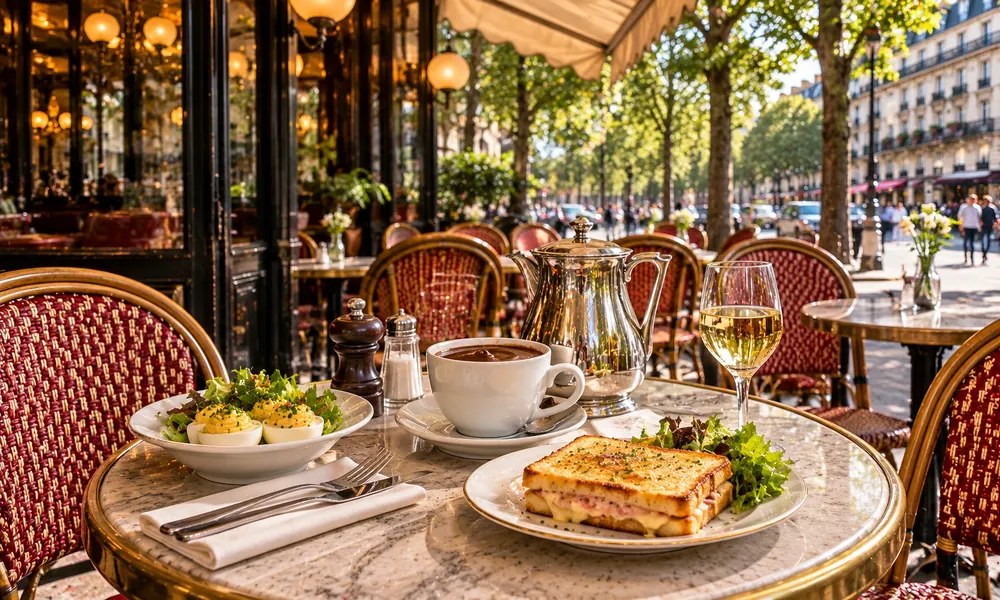
Order the thing the house is famous for: the Chocolat Spécial Flore, kept permanently hot and fluid in a tall double boiler behind the bar that regulars call the chocolatière, thick enough to count as a small meal. Pair it with a croque monsieur if you’re hungry, or œufs mayonnaise if you want to eat like a Parisian who knows the classics.
If you’re settling in for the evening, a glass of Pouilly-Fumé is the insider’s nod to the literary prize, and costs considerably less than winning it.
Be honest with yourself about the bill. The Flore is, as one observer put it, expensive, touristed, and unbothered. You are not paying for coffee. You are paying rent on a seat inside a century, and measured against what Paris charges for far lesser legends, it’s among the best value in the city’s entire luxury travel repertoire.
Our guide to Paris in spring maps the rest of Saint-Germain for the walk afterward, and if the ritual of grand café culture hooks you the way it hooked us, the fine dining trends desk has been tracking its revival worldwide.
Frequently Asked Questions
Why is the Café de Flore famous?
The Café de Flore is famous for its regulars: Apollinaire coined the term surrealism there around 1917, Sartre and Beauvoir wrote through the Occupation at its heated upstairs tables, and Picasso, Camus, Hemingway, James Baldwin and Karl Lagerfeld all held court at its tables. It remains a working literary café, awarding the Prix de Flore each November.
What should I order at the Café de Flore?
Order the Chocolat Spécial Flore, the house hot chocolate kept warm in a dedicated double boiler behind the bar. Pair it with a croque monsieur or œufs mayonnaise for the classic experience. In the evening, a glass of Pouilly-Fumé references the annual Prix de Flore, whose winner drinks a glass daily for a year.
What is the difference between Café de Flore and Les Deux Magots?
They sit a few doors apart on Boulevard Saint-Germain and share much of the same history and clientele. Les Deux Magots is the older literary address; the Flore became the more fashionable one, associated with Sartre, Beauvoir and later the fashion world. Most regulars, historically and today, use both.
Is the Café de Flore a tourist trap?
It is touristed and priced accordingly, but calling it a trap undersells it. The interior is authentic and little changed since the 1940s, the hot chocolate is genuinely excellent, and the literary prize keeps it a working cultural venue. Go at off peak hours and it still functions as a real neighborhood café.
Where exactly is the Café de Flore?
The Café de Flore is at 172 Boulevard Saint-Germain, on the corner of rue Saint-Benoît in the 6th arrondissement of Paris, in the Saint-Germain-des-Prés neighborhood. The nearest métro stops are Saint-Germain-des-Prés and Mabillon. It opens daily from 7am to 2am.
The Bottom Line
Some cafés sell you coffee. A few sell you history. The Café de Flore sells you the one thing rarer than both: continuity. The stove that warmed Sartre still warms the upstairs room. The chocolatière still turns behind the bar. The terrace chairs still face the boulevard like a theater that never closes, and every November a new young writer still walks out with a prize and a year of free wine.
Go in the morning, before the legend wakes up. Order the hot chocolate. Sit where the chairs face the street. And understand that you’re not visiting a monument to the Paris that was. You’re sitting inside the machine that made it, still running, still warm, still on its first coffee of the day.