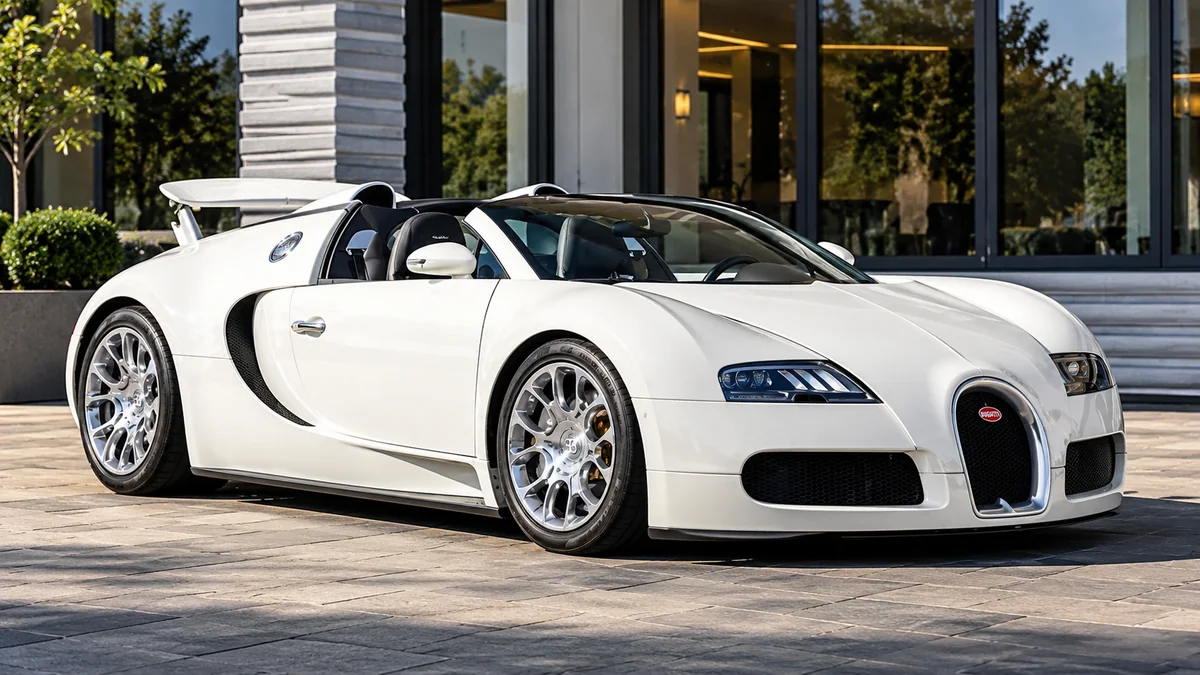
The Bugatti Veyron changed the automotive world when it arrived as one of the first modern hypercars capable of exceeding 400 km/h. Combining an extraordinary 8.0-liter W16 engine, four turbochargers, advanced engineering, and exceptional luxury, it established a new benchmark for high-performance road cars.
The standard Bugatti Veyron 16.4 has an official top speed of 407 km/h (253 mph). Its more powerful Super Sport version went even further, achieving an officially recognized production-car speed record of 431.072 km/h (267.856 mph) in 2010.
Even years after production ended, the Veyron remains one of the most important vehicles in Bugatti’s history.
What Is the Top Speed of the Bugatti Veyron?
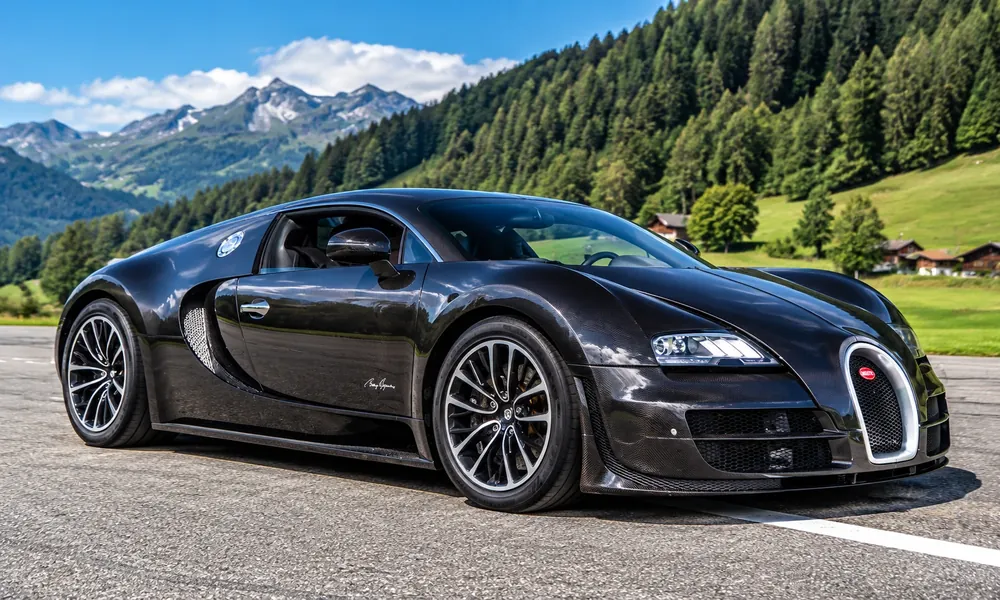
The original Bugatti Veyron 16.4 has a manufacturer-specified top speed of 407 km/h, approximately 253 mph.
When it entered production in 2005, it became the first series-production car to break the 400 km/h barrier. Reaching that speed required an entirely new approach to engine development, aerodynamics, cooling, tires, and vehicle stability.
The Veyron also introduced a distinctive approach to performance: delivering extraordinary speed without sacrificing the comfort and refinement expected from a luxury automobile.
Bugatti Veyron Top Speed by Model
Bugatti produced several Veyron versions during its production run, including coupes, roadsters, and more powerful performance editions.
| Bugatti model | Top speed |
| Veyron 16.4 | 407 km/h (253 mph) |
| Veyron Grand Sport | 407 km/h (253 mph) |
| Veyron Super Sport | 415 km/h (258 mph) customer-car limit |
| Veyron Super Sport World Record Edition | 431.072 km/h (267.856 mph) record |
| Veyron Grand Sport Vitesse | 410 km/h (255 mph) standard configuration |
| Veyron Grand Sport Vitesse World Record Car | 408.84 km/h (254.04 mph) record |
The figures reflect different configurations and record attempts. In particular, the Super Sport’s 431.072 km/h record was achieved by a specially prepared record-setting car, while customer versions were limited to 415 km/h. This distinction is important when comparing high-performance supercars with luxury sedans.
Bugatti Veyron Engine and Horsepower
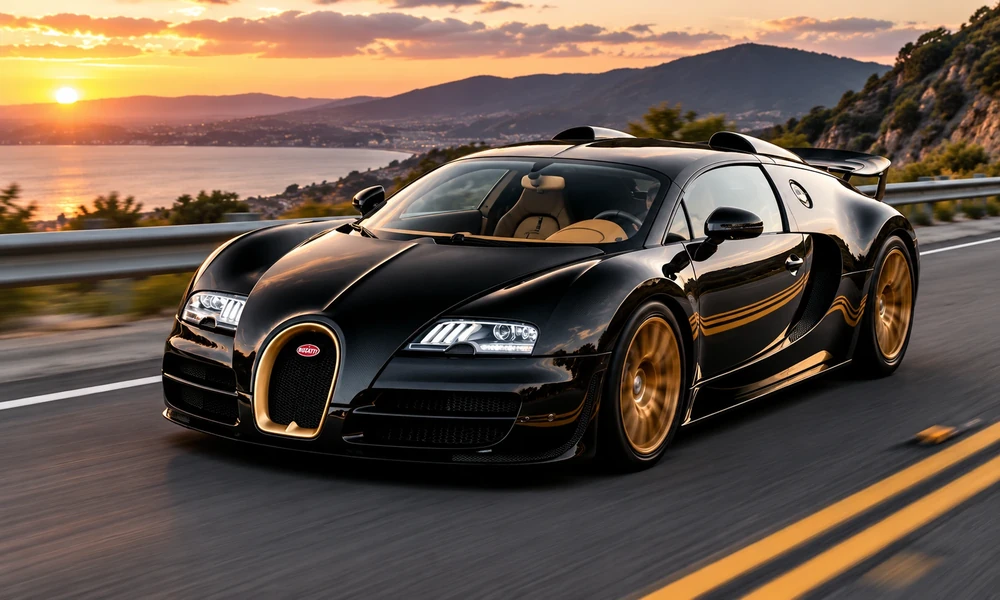
The Veyron’s engine is one of the most recognizable parts of its engineering story.
It uses an 8.0-liter W16 engine with four turbochargers. The unusual 16-cylinder configuration allows the vehicle to produce enormous power while maintaining the compact packaging required for a mid-engine hypercar.
The original Veyron 16.4 specifications include:
| Specification | Bugatti Veyron 16.4 |
| Engine | 8.0-liter W16 |
| Turbochargers | Four |
| Maximum power | 1,001 PS |
| Maximum torque | 1,250 Nm |
| Transmission | Seven-speed dual-clutch |
| Drivetrain | Permanent all-wheel drive |
| 0–100 km/h | 2.5 seconds |
| Top speed | 407 km/h |
The Super Sport increased output to 1,200 PS, making it significantly more powerful than the original model.
How Fast Is the Bugatti Veyron From 0–100 km/h?
The original Veyron can accelerate from 0 to 100 km/h in approximately 2.5 seconds.
Its acceleration figures were extraordinary for a road car when it launched.
| Acceleration | Time |
| 0–100 km/h | 2.5 seconds |
| 0–200 km/h | 7.3 seconds |
| 0–300 km/h | 16.7 seconds |
The combination of four-wheel drive, a powerful W16 engine, and a fast-shifting dual-clutch transmission helps the Veyron deliver its power efficiently.
Its acceleration is especially impressive considering that the car was designed as a luxury road-going hypercar rather than a dedicated racing machine.
Bugatti Veyron Super Sport: The 431 km/h Record
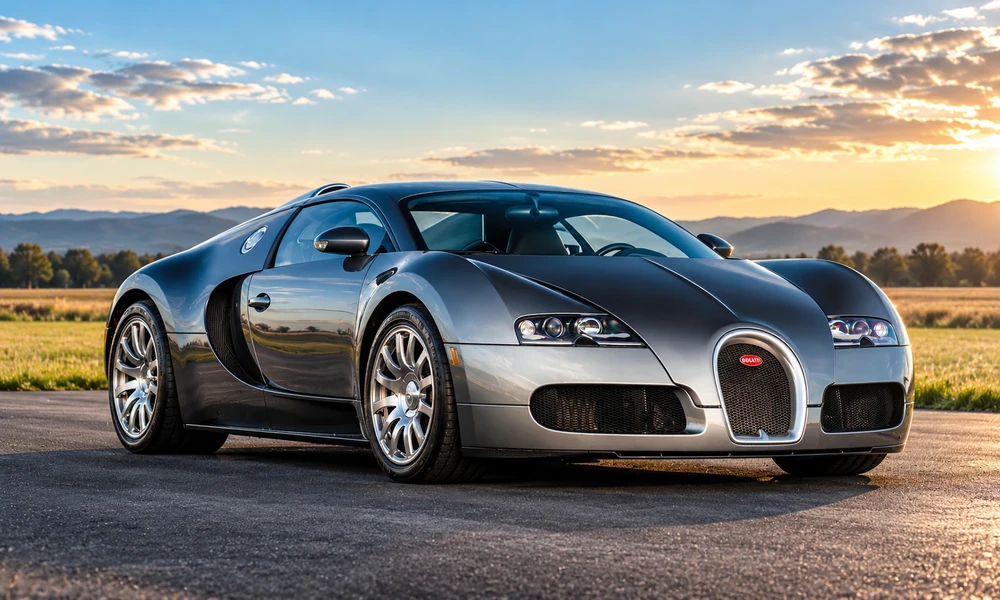
The Bugatti Veyron Super Sport took the original Veyron concept to another level.
Introduced in 2010, the Super Sport received a more powerful version of the W16 engine, producing 1,200 PS. Bugatti also improved the aerodynamics and other components to support its higher performance.
During its 2010 record attempt, the Veyron Super Sport achieved an average speed of 431.072 km/h.
The record was measured in two opposite-direction runs and officially confirmed, establishing the car as the fastest series-production car at that time.
What Made the Veyron Super Sport Faster?
Several engineering improvements helped the Super Sport reach its higher speeds:
- Increased engine output to 1,200 PS
- Larger turbochargers and intercoolers
- Revised aerodynamic bodywork
- Improved cooling systems
- Enhanced engine and transmission calibration
- High-performance tires designed for extreme speeds
The Super Sport was not simply a more powerful Veyron. It was a carefully developed package designed to improve performance while maintaining stability.
Bugatti Veyron Grand Sport and Grand Sport Vitesse
The Veyron was also available as an open-top roadster, allowing owners to experience its performance with the roof removed.
Bugatti Veyron Grand Sport
The Grand Sport brought the Veyron’s performance and luxury to an open-top configuration.
It retained the original 1,001 PS engine and had a manufacturer-specified maximum speed of 407 km/h with the roof installed. Its performance characteristics were adjusted to accommodate the roadster’s construction.
Bugatti Veyron Grand Sport Vitesse
The Grand Sport Vitesse combined the open-top design with the more powerful 1,200 PS engine from the Super Sport.
It became one of the most powerful roadsters of its era.
In 2013, the Grand Sport Vitesse World Record Car reached 408.84 km/h (254.04 mph), setting a record for open-top production sports cars.
This achievement demonstrated that Bugatti could deliver exceptional performance even in an open-top vehicle.
How Did the Bugatti Veyron Break the 400 km/h Barrier?
Reaching more than 400 km/h requires far more than installing a powerful engine.
At these speeds, aerodynamic drag increases dramatically, tires experience enormous forces, and even small changes in vehicle movement can affect stability.
Bugatti developed several systems specifically for high-speed operation.
Active Aerodynamics
The Veyron uses adjustable aerodynamic components to manage airflow and stability.
At higher speeds, the rear wing, diffuser, and vehicle ride height adjust to reduce drag while maintaining the necessary aerodynamic balance.
Special Speed Key
The original Veyron uses a separate Speed Key to activate its highest-speed configuration.
Before reaching top-speed mode, the vehicle checks that specific operating conditions are satisfied. Once activated, the suspension and aerodynamic settings change to support high-speed driving.
Advanced Tire Engineering
The tires are among the most important components of a hypercar capable of exceeding 400 km/h.
They must withstand enormous rotational forces, heat, and pressure while maintaining grip and structural integrity.
Advanced Cooling
The W16 engine produces substantial heat, especially under sustained high-performance driving.
The Veyron uses a complex cooling arrangement to manage temperatures across the engine and other mechanical systems.
Bugatti Veyron vs. Bugatti Chiron
The Chiron succeeded the Veyron and continued Bugatti’s pursuit of extraordinary performance.
Both models use an 8.0-liter W16 engine with four turbochargers, but the Chiron benefits from further development, increased power, and updated engineering.
| Specification | Veyron 16.4 | Chiron |
| Engine | 8.0L W16 | 8.0L W16 |
| Turbochargers | Four | Four |
| Power | 1,001 PS | 1,500 PS |
| Torque | 1,250 Nm | 1,600 Nm |
| 0–100 km/h | 2.5 seconds | Approximately 2.4 seconds |
| Top speed | 407 km/h | 420 km/h |
The Veyron established the modern Bugatti hypercar formula, while the Chiron developed it further with more power, updated technology, and improved performance.
How Much Does a Bugatti Veyron Cost Today?
The Bugatti Veyron was an exceptionally expensive car when new, with original prices varying according to the version, market, and specification.
Today, it is a highly collectible hypercar. Its resale value depends on several factors:
- Model and special-edition status
- Mileage and overall condition
- Original specification and customization
- Service and ownership history
- Production rarity
- Collector demand
Special editions and record-related versions can command particularly high prices. Since the Veyron is no longer in production, prospective buyers generally encounter it through specialist dealers and the collector-car market, reflecting the growing appeal of luxury cars in modern lifestyles.
Frequently Asked Questions
What is the top speed of the original Bugatti Veyron?
The original Bugatti Veyron 16.4 has a manufacturer-specified top speed of 407 km/h (253 mph).
What is the fastest Bugatti Veyron?
The Veyron Super Sport achieved an officially recognized production-car record of 431.072 km/h (267.856 mph) in 2010.
How much horsepower does a Bugatti Veyron have?
The original Veyron produces 1,001 PS, while the more powerful Veyron Super Sport and Grand Sport Vitesse produce 1,200 PS.
How fast does a Bugatti Veyron accelerate from 0 to 100 km/h?
The original Veyron accelerates from 0 to 100 km/h in approximately 2.5 seconds.
What engine does the Bugatti Veyron use?
It uses an 8.0-liter W16 engine with four turbochargers. The original model produces 1,001 PS and 1,250 Nm of torque.
How many Bugatti Veyrons were made?
Bugatti produced a total of 450 Veyron vehicles, including 300 coupes and 150 roadsters.
Is the Bugatti Veyron faster than the Chiron?
The standard Chiron has a higher manufacturer-specified top speed of 420 km/h compared with the original Veyron’s 407 km/h. The Veyron Super Sport, however, achieved a higher record speed of 431.072 km/h during its 2010 record attempt.
When did Bugatti stop making the Veyron?
Bugatti completed production of the 450th and final Veyron in 2015. The Chiron subsequently became its successor.
Final Thoughts
The Bugatti Veyron remains a landmark in automotive engineering. Its 407 km/h top speed, 1,001 PS W16 engine, and ability to accelerate from 0 to 100 km/h in just 2.5 seconds helped redefine what a production road car could achieve.
The Super Sport pushed those limits even further, reaching 431.072 km/h and creating a new chapter in the history of high-speed automobiles.
More than a decade after production ended, the Veyron remains an important symbol of Bugatti’s ambition to combine extraordinary performance with luxury and engineering precision, qualities that continue to define the world of modern hypercars.