A stiff back after sitting or waking up can make even a simple stretch feel like a big ask. These best yoga stretches offer ten beginner-accessible poses, with breathing and adjustment cues to help you get started. You do not need to touch your toes or know how your body will respond. Each pose can be made smaller, held briefly, or skipped when it does not feel right.
You can use the routine to ease stiffness, work on flexibility, and make movement a calmer part of your day. A full sequence may suit a quiet morning, while two or three poses can fit a busy afternoon. Choose a mat and a little floor space, then give yourself enough time to move without rushing. Your practice can change with the day. A few steady breaths and a comfortable range of motion are enough to begin.
Key Takeaways
- Pick a few poses that feel steady and comfortable.
- Move with your breath instead of forcing depth.
- Use a cushion, block, or chair for support.
- Rest when a pose feels painful or tiring.
- Short, repeatable practice can fit a busy day.
How to Choose the Best Yoga Stretches for Flexibility
A useful flexibility practice works several areas at a controlled pace instead of forcing one deep stretch. Range of motion means how far a joint can move in its usual directions. Choose poses that let you move comfortably through more than one area. That gives you a balanced start without chasing extreme depth.
Cat-cow, low lunge, and downward dog are good stretches for yoga because they involve the spine, hips, and legs. Hatha, Vinyasa, and Yin classes can all include flexibility work. The best yoga for stretching depends on your comfort and the class pace. Hatha classes often move at a steady pace, while Vinyasa links poses with movement. Yin classes usually hold poses longer.
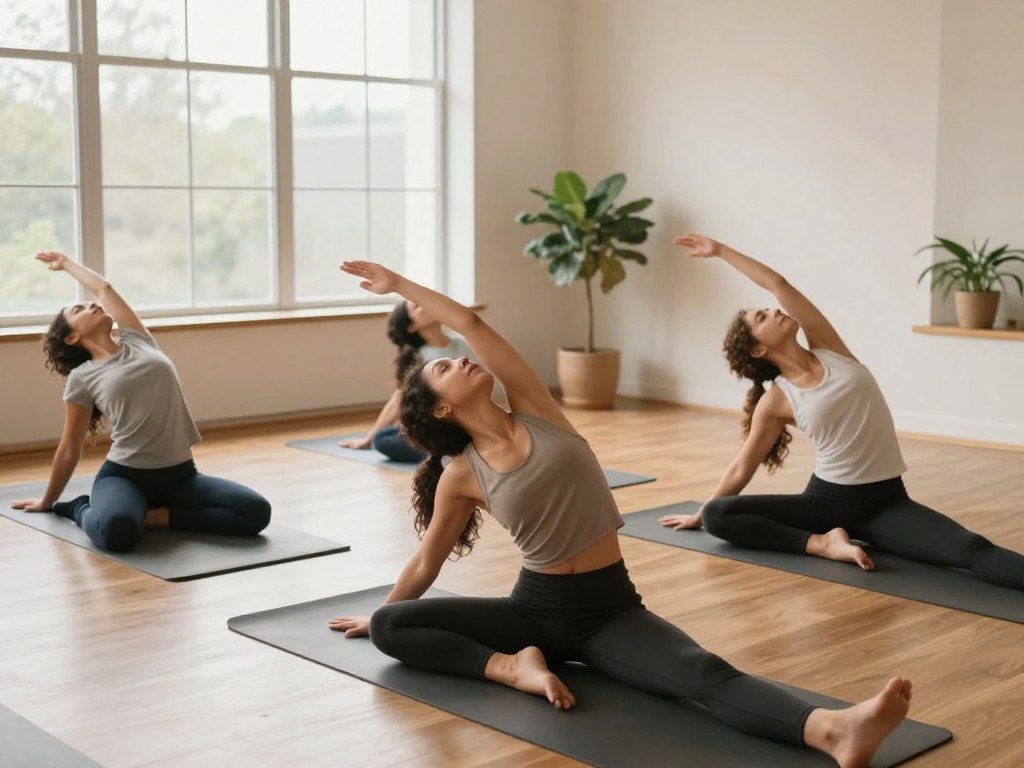
A small study followed 14 male college athletes who practiced yoga twice weekly for 10 weeks. Another 12 athletes did not add yoga to their routine. The yoga group gained flexibility in two tests and improved balance in a third.
| Measure | Yoga-group result | P value |
|---|---|---|
| Sit-and-reach flexibility | Significant gain | 0.01 |
| Shoulder flexibility | Significant gain | 0.03 |
| Stork-stand balance | Significant gain | 0.05 |
The results describe those athletes, not a promise of the same change for everyone. The 10-week college-athlete study also tracked how yoga affected balance. Flexible movement can support strength, too, since many poses ask you to hold your body in place.
Pick a class or sequence that gives you room to adjust the pose and keep breathing.
Some classes move faster or hold poses longer than others. Ask about the pace before joining, then choose a class or home sequence that lets you breathe steadily and adjust each pose.
How Can Beginners Practice Yoga Safely?
A beginner class or a short home session gives you room to learn the basics without rushing. Start slowly, and choose a level-appropriate class or a simple home routine. Stop and rest if you feel pain, dizziness, or unusual fatigue. A stable mat and clear floor space can make movement feel more secure.
Most yoga classes last 45-90 minutes, while a suggested home starting routine is 10-15 minutes daily. Hot yoga uses a set series of poses in a heated room, so its setting may feel quite different from home practice.
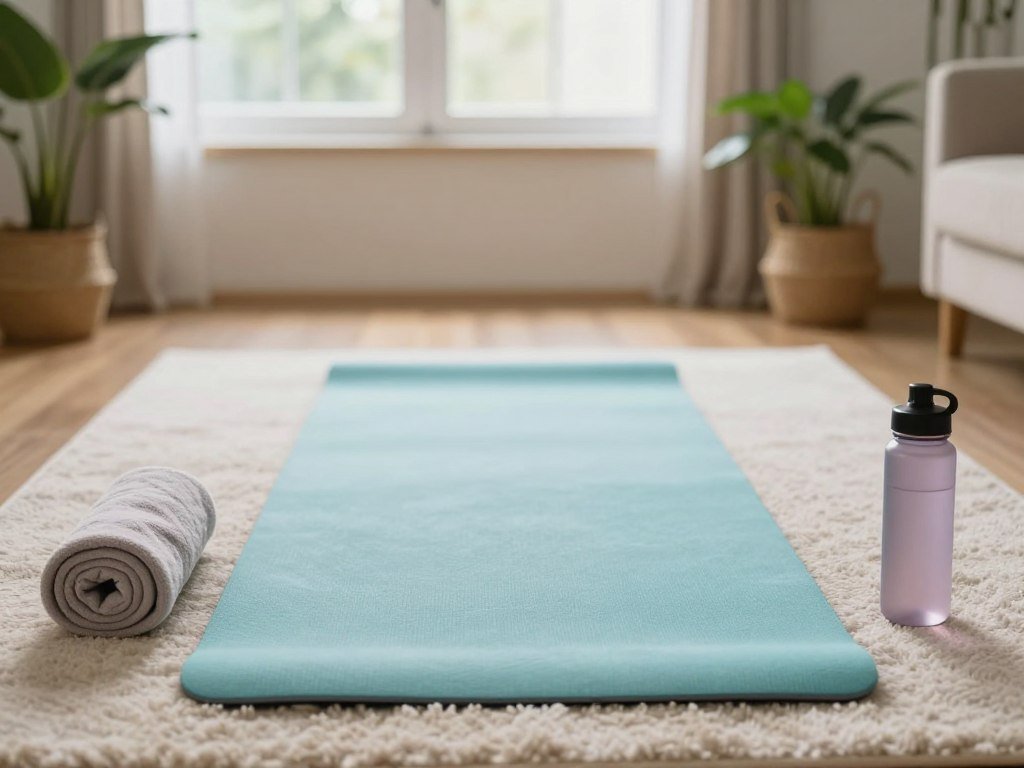
Choose a class or home setting that fits
A regular class can provide a teacher and a group pace. Home practice lets you move on your own schedule. Hot yoga adds heat, so bring water and pay attention to how you feel.
| Setting | Duration or format | Practical detail |
|---|---|---|
| Standard class | 45-90 minutes | Choose a beginner level |
| Hot yoga | 26 poses; 95°F-100°F (35°C-37.8°C) | Bring water |
| Home practice | 10-15 minutes daily | Start with a short routine |
At home, leave enough room to extend your arms and legs without hitting furniture. A mat with steady grip and cushioning can help you feel settled, especially on a hard floor.
Tell the instructor about health conditions
Some health conditions can change which poses are suitable. MedlinePlus advises asking a health care provider about poses to avoid and telling the instructor about health conditions or injuries. Mention them before class begins, so the teacher can offer guidance.
- Pregnancy
- High blood pressure
- Glaucoma
- Sciatica
- Arthritis
These conditions may call for pose changes, but individual needs differ. If you practice hot yoga, take water with you and leave the room if you feel unwell. Ask a health care provider which poses to avoid if a health condition or injury could affect your practice.
Which Gentle Moves Warm Up the Spine and Shoulders?
Start with movement that warms the spine before asking the shoulders to hold a longer stretch. Cat-cow uses a slow shift between an arched back and a rounded one. Keep the motion gentle, and match each change to your breathing.
Begin on all fours, with your wrists under your shoulders and knees under your hips. As you inhale, let your back arch gently. As you exhale, round your spine. Repeat five times, moving with each breath. Keep your head in line with your spine rather than tossing it back.
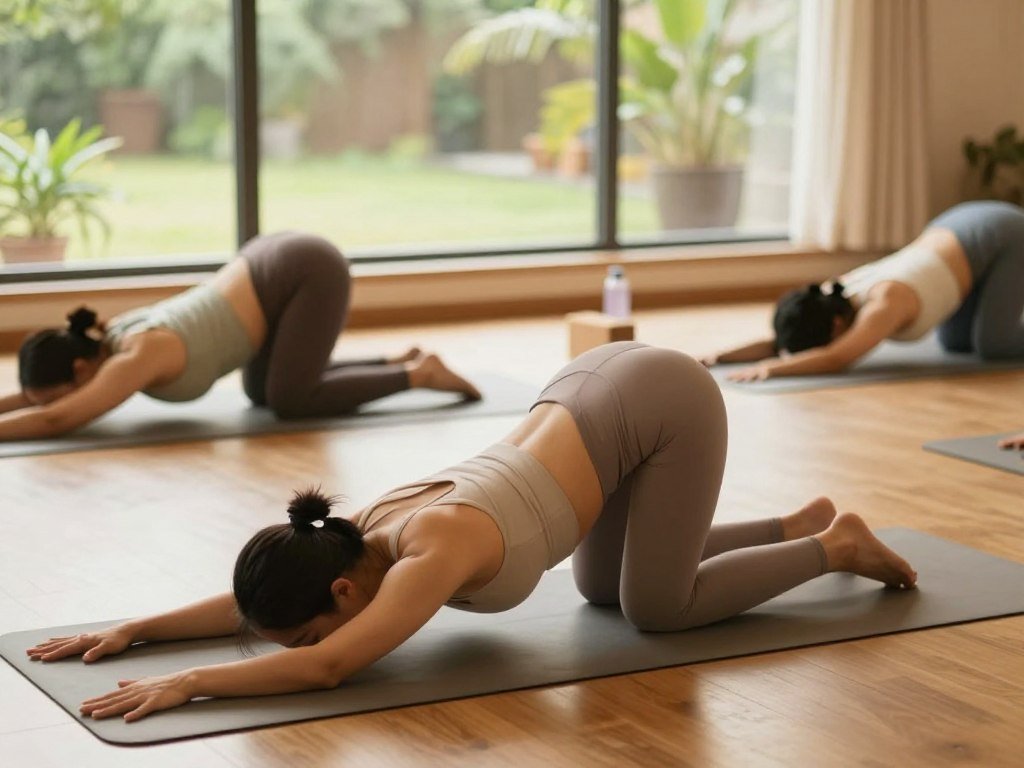
Puppy pose follows from the same hands-and-knees position. Keep your hips above your knees as you walk your hands forward. Then lower your chest toward the mat, only as far as feels comfortable.
Your arms reach ahead while the chest moves closer to the floor. The shoulders and upper back get a gentle stretch, but the pose should not become a push for more depth. Use a cushion under your chest if the reach feels too strong.
Hold puppy pose for five breaths. Let your hands stay planted and keep the breath smooth as you settle. If your shoulders feel pinched, walk your hands closer to your knees and ease out of the position.
Cat-cow brings motion to the spine, while puppy pose holds the shoulders in a longer, gentle reach. You can pause between them or do only the first movement when you have little time. Keep both movements gentle enough that your breath stays even.
How Does Low Lunge Stretch Tight Hip Flexors?
If sitting leaves the front of your hips feeling tight, a grounded low lunge gives you a controlled way to lengthen that area. The pose stretches the hip flexors and quadriceps at the front of your hip and thigh. Stay low and steady rather than pushing the hips forward.
Start on all fours, then bring one foot forward while the other knee stays on the mat. Set the front foot where it feels stable. You can place a folded mat, cushion, or blanket under the back knee if it feels pressured.
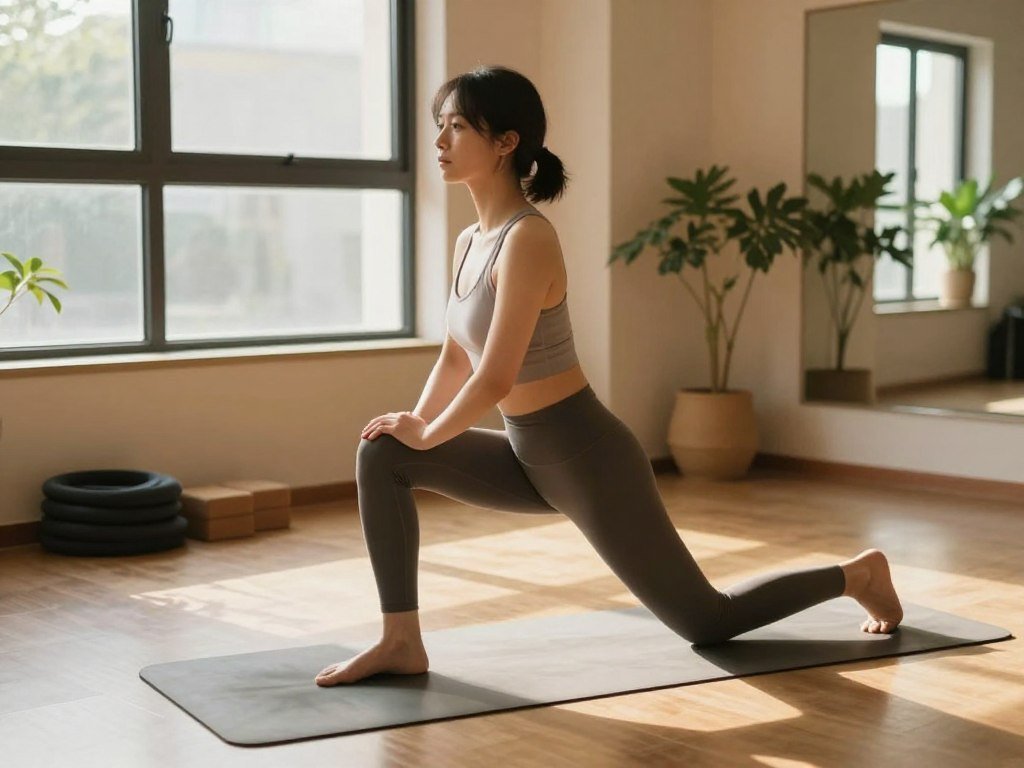
- Set up on all fours with your hands beneath your shoulders.
- Step one foot forward, keeping the opposite knee grounded.
- After a few breaths, switch sides and repeat.
Once the front foot lands, keep it planted as you settle into the stretch. The grounded knee supports the pose, while the front leg helps you control how far you move. A folded mat, cushion, or blanket can ease pressure under the back knee.
Keep your torso upright if leaning forward makes your balance feel less steady. The front of the grounded hip may feel a mild stretch. If the feeling turns sharp or painful, come out of the pose instead of trying to hold it.
Hips naturally differ in shape, and a stretch will not change the bones that shape them. For context on natural hip structure, read about hip dips and body shape. Keep the front foot planted as you switch sides rather than rushing through the transition.
When Is Child’s Pose Useful for Rest?
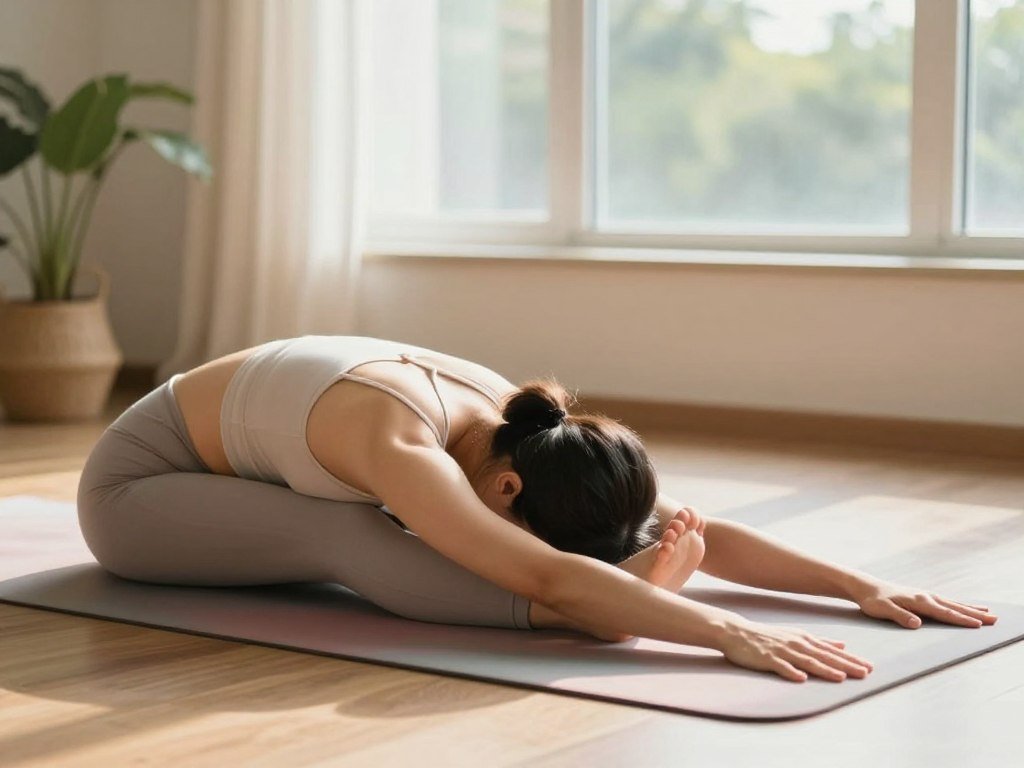
A resting pose can be part of a useful stretch routine, not a break from it. Child’s pose gives your back and shoulders a gentle stretch while you pause. Use it when the sequence feels demanding, or when you want a quieter position between poses.
Start on all fours, then bring your bottom toward your heels and fold over your thighs. Let your arms rest where they feel comfortable. Move your hips toward your heels only as far as feels comfortable. Your body does not need to reach a particular shape.
Rest your forehead on the mat if it reaches without strain. If the floor feels too far away, put a cushion beneath your forehead. This support can help you relax your neck instead of holding your head above the ground.
The pose can be a pause after an active movement or a place to settle when you feel tired. Stay for a few breaths, or leave sooner if your knees or hips feel uncomfortable. It is fine to sit up and rest in another position.
Child’s pose does not have to be a long hold to be useful. Even a brief pause can give you time to notice how your back and shoulders feel before you continue. Let the forehead rest on a cushion if reaching the floor makes the position uncomfortable.
Why Is Downward-Facing Dog a Full-Body Stretch?
Downward dog gives you an active pose that can stretch your calves and hamstrings while your arms support your weight. It also asks the arms and shoulders to work. Spread your weight between your hands and feet instead of loading one area.
Begin on hands and knees, then lift your hips up and back. Keep your hands and feet on the mat, and make the shape comfortable rather than aiming for straight legs. Hold for five breaths with weight shared between your hands and feet.
Bend one knee gently, then the other, while you remain in the pose. This small change can ease the backs of your legs. Bent knees are an acceptable adjustment, not a sign that you are doing the pose incorrectly.
In a 10-week study of male college athletes, yoga participants showed changes in right-knee and right-hip extension, plus right-shoulder flexion, in downward dog. The right-side joint-angle changes describe the measures seen in that group. They do not show that the pose prevents injury or reveal an exact size of change.
The position combines leg stretching with arm strength, so you may feel more than one area working. If your wrists feel sore, leave the pose and rest rather than pressing through discomfort. Keep a soft bend in the knees if straightening them makes your back or legs feel strained.
How Can a Standing Forward Fold Lengthen the Legs?
A forward fold can stretch the backs of your legs even when your knees stay softly bent. Hinge at your hips, then let your torso fold over your thighs. Let gravity do the work instead of pulling yourself down.
Keep a slight bend in your knees as you fold. This can help you find a comfortable position without asking your legs or back to reach farther than they want. The hamstrings and calves are the main leg areas stretched.
The fold also gives the spine a chance to release. Let your head and arms hang only if that feels comfortable. Your hands can rest on your thighs, shins, ankles, or wherever they reach without strain.
Rest your hands where they reach comfortably, rather than using them to pull your body lower. This keeps the stretch within your control. If your lower back feels strained, come up a little and bend your knees more.
There is no need for your fingertips to touch the floor. The position can still stretch the backs of your legs with your hands resting above your ankles. Hold for five breaths without pulling yourself deeper.
What Does Warrior II Stretch and Strengthen?
Warrior II pairs a grounded stance with a clear stretch across the hips and chest. Your legs hold the position while your arms reach out to the sides. Keep the stance steady, and bend the front knee only as far as you can control.
Stand with your feet wide apart and turn one foot outward. Bend that front knee over the foot, then reach both arms horizontally. Look toward the hand above the bent leg if your neck feels comfortable.
The legs do the strengthening work as you hold the pose. Your hips and chest open across the wide stance. Hold for five breaths on each side, keeping the front knee aligned over the foot.
A smaller bend can make the pose easier to steady. Your knee does not need to reach a deep angle to make the position useful. If your legs begin to shake or your breath becomes strained, reduce the bend or come out.
When you switch sides, turn your feet and reset your stance rather than twisting through the knees. Check that the front knee stays aligned over the foot before holding the pose.
How Does Triangle Pose Open the Legs and Chest?
Triangle Pose gives the inner legs and hamstrings a stretch while the chest turns open. A wide stance creates space for the side reach. Reach long first, then lower your hand only as far as feels steady.
Turn your front foot outward and extend both arms to the sides. Reach along the front leg, then rest your lower hand on your shin or another reachable support. Lift the upper arm toward the ceiling.
Let your chest rotate open without collapsing your spine. Your upper arm rises as your lower hand rests on your leg or support. Hold for five breaths on each side. Keep the pose at a height where you can breathe easily.
The stretch may reach the inner leg and hamstrings, while the turn brings the chest into the movement. You do not need to touch the floor with your lower hand. A hand on the shin is a full option, not a lesser version.
Move slowly when leaving the pose. Come out by bending the front knee before switching sides.
What Does a Wide-Legged Forward Fold Target?
A wide stance changes the forward fold into a stretch across the backs of both legs. The pose also releases the spine and neck as your upper body folds. Share your weight between both feet to keep the stance even.
Stand with your feet wide apart and knees slightly bent. Hinge forward from your hips, letting your upper body relax toward the floor. Do not lock your knees as you settle into the stretch.
Your hands can rest on your thighs, shins, feet, or the mat. Choose a place that lets your weight stay balanced through both feet. Keep the knees softly bent and distribute your weight evenly.
The fold targets the backs of the legs while your spine and neck relax. Your head can hang only if that feels comfortable. If you feel dizzy or strained, rise partway and take a pause.
To come out, bring your hands to your thighs and rise with care. Soften the knees before rolling back up from the fold.
How Does Bridge Pose Stretch the Front of the Hips?
Bridge Pose works the glutes and legs while opening the front of the hips. The pose strengthens the legs and activates the glutes while lengthening the hip flexors and quadriceps. Keep the lift comfortable, rather than turning it into a high backbend.
Lie on your back with your knees bent and feet planted on the mat. Press through your feet and lift your hips. Keep your shoulders grounded as your chest opens.
Bridge Pose is one option for yoga poses that support flexibility and strength. Your legs and glutes work to hold the lift, while the front of your thighs and hips lengthen. It also opens the chest and can help improve spinal range of motion.
Lift only as high as you can without strain. Your hips do not need to rise to a set height. If the position feels uncomfortable, lower partway or rest with your back on the mat.
Keep your feet planted and your shoulders on the floor as you hold the pose. Lower your hips slowly to the mat instead of dropping out of the lift.
How Can You Build a Short Daily Yoga Routine?
A short routine is easier to repeat when it has a gentle start, a few active poses and a clear stopping point. Controlled yoga movement takes joints through a functional range of motion at steady speeds. A little practice counts, especially when it fits your day.
A 2023 Human Factors study found that 10 minutes of yoga a day reduced physical discomfort and improved mood among people working from home. That finding applies to that group, not every person or setting. A 10-minute practice is a reasonable place to start.
Begin with gentle movement on the mat
Start with cat-cow, then move into puppy pose and child’s pose. The early movement helps you notice how your body feels before adding standing poses. A few minutes can be enough to begin, even if you do not finish a longer sequence.
Keep the practice simple enough to remember. A steady routine may also work well alongside other small daily habits, such as walking or taking scheduled downtime.
Add standing stretches, then finish with rest
One example sequence uses low lunge, downward dog, standing forward fold, and a supine rest. Add Warrior II when you want a standing strength pose. The order is a guide, not a test you need to pass.
| Sequence point | Pose | Dose | Focus |
|---|---|---|---|
| 1 | Cat-cow | Five repetitions | Spine movement |
| 2 | Puppy pose | Five breaths | Shoulders |
| 3 | Downward dog | Five breaths | Legs and arms |
| 4 | Standing forward fold | Five breaths | Backs of legs |
| 5 | Warrior II | Five breaths each side | Leg strength |
The five-part table is a menu, not a fixed 10-minute timing prescription. You can pause longer, leave a pose out, or end with a comfortable rest.
- Choose a time you can repeat.
- Set out your mat before practice.
- Pick poses that suit your energy that day.
- Mark the session complete, even when it is brief.
A consistent mix of controlled movement and strengthening poses, such as Bridge Pose, can address flexibility and strength. Gentle mobility practice also appears among wellness trends for 2026. Choose a time you can keep returning to, rather than saving practice only for days with a long free window.
How Can You Modify Stretches for Tightness?
A stretch is easier to adapt when you change the support or range before trying to reach farther. Modify the pose early if your hand does not reach the floor or your body feels tense. A smaller version can still give you a useful stretch.
Props can bring support closer without changing the goal of the pose. A block, cushion, or sturdy chair can support your hand or torso. Use a prop to make the position feel steady, not to push yourself deeper.
Use a prop to bring the floor closer
Place a block beside your foot in Triangle Pose, then rest your hand on it. A cushion can support your torso in a seated or floor position. A sturdy chair can give your hand a higher place to rest during a forward fold.
Choose a support that will not slide or tip as you move. If the chair feels unstable, use a block or cushion instead. A prop should let you settle into the pose without holding your breath.
Adjust the pose instead of forcing depth
Bend your knees, shorten your stance, or reduce the range of motion when a pose feels too deep. People new to a pose can start with 10-20-second holds, then gradually work toward longer holds. Build the hold only while your breathing stays normal.
A manageable stretch feels mild and lets you stay present. Forcing your body into a shape may feel sharp, painful, or hard to control. Ease out when the feeling stops being comfortable.
Thread the Needle can be an optional choice for upper-back mobility. A supported figure-four may offer another option for hip mobility. These alternatives can add variety without becoming required parts of the ten-pose routine.
The floor does not need to be within reach for a stretch to count. Bring support to your hand or torso, then keep the range small enough to control. Keep the version that lets you hold steady and breathe normally.
Can Yoga Reduce Belly Size?
One 12-week trial found a measurable difference in waist circumference, but that does not mean yoga can flatten everyone’s belly. Yoga may contribute to a smaller waist for some people, but it cannot promise a flat belly or targeted fat loss. The trial involved women with abdominal obesity.
Researchers assigned 60 women to yoga or a waiting list. The yoga group had 40 participants, and the waiting-list group had 20. The yoga group’s waist circumference fell 3.8 cm more than the waiting-list group’s.
| Trial detail | Yoga group | Waiting-list group | Result |
|---|---|---|---|
| Duration and group size | 12 weeks; 40 women | 12 weeks; 20 women | 60 women total |
| Waist circumference | Yoga practice | Waiting list | 3.8 cm greater decrease with yoga; 95% CI, -6.1 to -1.5 cm; P = 0.001 |
| Supervised attendance | Mean 30.2±9.2 hours; maximum 42 hours | Waiting list | No serious adverse events |
| Other measures | Yoga group showed changes | Comparison group | Moderate between-group differences |
The group also showed moderate between-group differences in several other reported outcomes:
- Waist-to-hip ratio
- Body weight
- Body mass index, or BMI
- Body-fat percentage
- Mental or physical well-being
The findings apply to women with abdominal obesity in this trial, not every reader. They do not show that yoga alone caused the same result for all bodies or routines. Treat waist change as one possible outcome, not the only reason to practice.
Which Advanced Yoga Poses Need More Preparation?
A pose that demands an inversion, deep hip opening, or substantial shoulder strength needs preparation beyond a beginner stretch routine. Build support first, then work toward the full pose gradually. Warm up before deep stretching and never force depth.
Three groups call for extra care: inversions, deep hip openers, and shoulder stand. Each asks for a different mix of strength, balance, and mobility. A teacher can help you build the steps before you try a full version.
- Inversions: Handstand preparation uses wall-facing drills to build wrist and shoulder strength. Forearm stand also needs scapular stability, forearm conditioning, and core control.
- Deep hip openers: King Pigeon Pose benefits from supported variations and preparatory backbends.
- Shoulder stand: Sarvangasana is nicknamed the “queen” or “mother” of all asanas.
Salamba Sarvangasana means “supported” for Salamba, “all limbs” or “the whole body” for Sarvanga, and “posture,” “position,” or “seat” for asana. Shoulder stand is an inversion, so it asks your body to hold weight in an unfamiliar position.
Shoulder stand is among the yoga poses most often reported as causing injury. Folded blankets can support the shoulders, and a beginner may lift with bent legs. Those changes are adaptations, not guarantees of safety.
Before attempting any of these poses, build the strength and control the position requires. Work with a qualified instructor when you are learning an inversion or deep backbend. Build the supporting strength and control before attempting the full pose.
Conclusion
A comfortable, repeatable selection is a sensible place to start building flexibility and mobility. Your range of motion may change from day to day, so adjust each pose to how your body feels now. The routine does not need to look the same every time.
Keep the movements that feel useful and leave out any that cause pain. A few minutes can make practice easier to return to than a long session you keep postponing. Pick two or three poses for your next practice, set aside a few minutes and notice how your body feels.
FAQ
What are the five best yoga stretches?
What are 10 yoga poses I should do every day?
What is the mother of all yoga poses?
Is 10 minutes of yoga a day enough?
Can yoga flatten your belly?
What not to do after yoga?
What happens to your body after 30 days of yoga?