Twelve miles from Midtown Manhattan, across the George Washington Bridge in Bergen County, New Jersey, sits an airport that most New Yorkers have never noticed and almost none have ever used. It has no airline terminal, no TSA lines, no boarding announcements, and no commercial departures of any kind.
Yet on a peak Friday afternoon, more private jets land and depart from its runways than from the private terminals of most American cities combined, and the occupants of those jets, founders, celebrities, fund managers, and families whose names appear on hospital wings, clear customs in minutes, step into waiting SUVs, and reach their Manhattan hotel suites, the ones in our most expensive hotel suites feature, before their luggage would have reached the carousel at JFK.
This is Teterboro Airport, designated TEB, the general aviation reliever airport for the New York metropolitan area and the busiest private jet facility in America by total operations. It is, by any honest measure, the most important airport in the country that the general public has never heard of, and understanding how it works is the first lesson of New York private aviation.
Here is the inside guide to the airport that runs Manhattan’s private sky.
The Reliever That Became the Hub
Teterboro’s story begins with a bet made a century ago. The field was established in 1919 on land owned by the Hasbrouck family and was soon acquired by the Wright Aeronautical Corporation, which used it as a testing ground for early aircraft engines.
Through the middle decades of the 20th century it passed through several owners, including the Rockefeller family’s Intercontinental Hotels, before the Port Authority of New York and New Jersey purchased it in the 1970s with a specific mandate: relieve the region’s commercial airports of general aviation traffic so that JFK, LaGuardia, and Newark could concentrate on airlines.
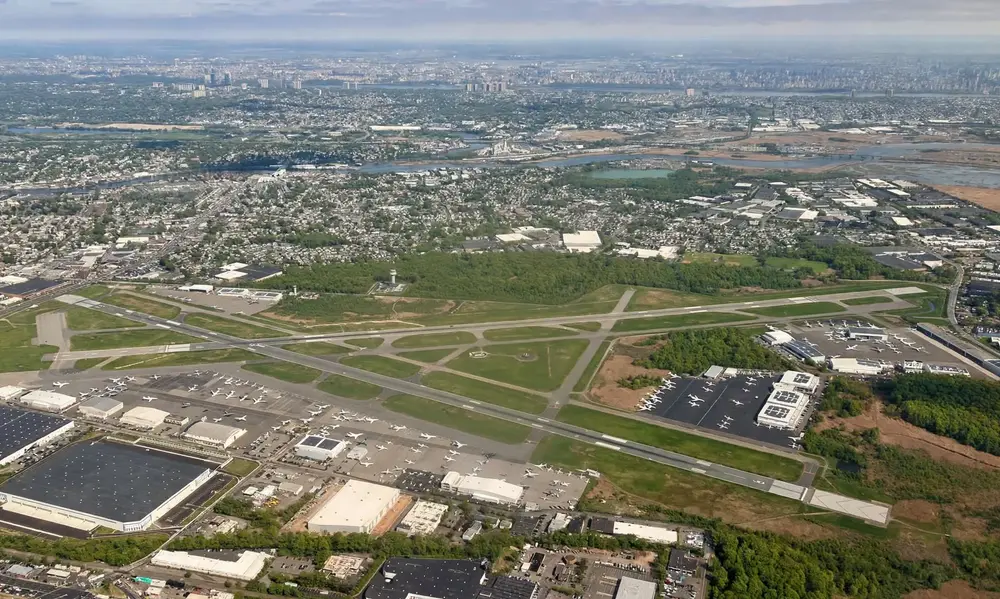
That mandate created the anomaly that defines Teterboro today. It exists so that private aircraft do not clog the commercial hubs, which means its entire reason for being is the traffic it serves. Roughly five hundred aircraft operations a day pass through its two runways during peak periods, and the airport consistently ranks among the busiest general aviation airports in the country.
Yet it handles all of this on 827 acres, a footprint a fraction of any commercial airport’s, with a tower that manages one of the most complex airspaces in the world, hemmed in by LaGuardia’s final approaches, Newark’s departures, and Manhattan’s vertical skyline.
The practical translation for passengers: Teterboro is close, roughly a 25 to 45 minute drive to Midtown in normal traffic, and for the traveler already committed to private aviation, it is the default New York gateway.
The Ramp: Signature, Meridian, and the FBO Culture
There are no terminals at Teterboro in the airline sense. Instead, the airport’s five runways of infrastructure are wrapped in fixed base operators, the FBOs, private terminal operators that handle everything from fuel to customs to the catering that arrives in insulated cases minutes before departure.
The two dominant names are Signature Flight Support and Meridian Teterboro, whose modern terminal opened in 2020 and immediately set the market’s standard, along with Jet Aviation and a handful of smaller operators.
For the passenger, the FBO is the entire airport experience, and it is engineered to be the anti-airport. You drive onto the ramp or are met at the door. There is no security line because security is the manifest itself, vetted in advance.
The lounges are quiet, the WiFi is fast, the staff greet you and your crew by name, and when your aircraft is ready, a line service technician escorts you the thirty paces across the ramp to the door. The entire choreography, from car door to seat belt, can take under ten minutes. It is the closest thing in modern travel to walking out your front door and being airborne, which is precisely the point of the product.
Slots, Curfews, and the Friday Problem

Teterboro’s greatest luxury, its proximity, is also its greatest constraint. The airport operates under a slot reservation system for arrivals and departures, and during peak periods, the Friday afternoon exodus being the canonical example, slots are among the most contested commodities in American aviation.
A summer Friday departure to the Hamptons or Nantucket requires planning days ahead, and experienced operators treat slot acquisition as a core skill, sometimes building itineraries around slot availability rather than the reverse.
The airport also observes noise abatement procedures and operating restrictions that shape its personality. Certain aircraft categories face curfews, and the surrounding communities of Teterboro, Hasbrouck Heights, and Hackensack have spent decades pressing for tighter limits, making Teterboro a front line in the same noise politics that define East Hampton’s airport battles.
The Port Authority has responded with preferred noise routes, which push departures over industrial corridors rather than residential streets, and the modern quiet aircraft, the Gulfstream G700 and its peers, face fewer constraints than the older, louder generation they replaced.
The Fleet on the Ramp

Walk the Teterboro ramp on any weekday and you are looking at a cross section of the global business jet fleet. Light jets, Phenoms and Citations, shuttle regional principals. Super midsize aircraft, Challenger 350s and Praetors, handle the coast to coast capable missions.
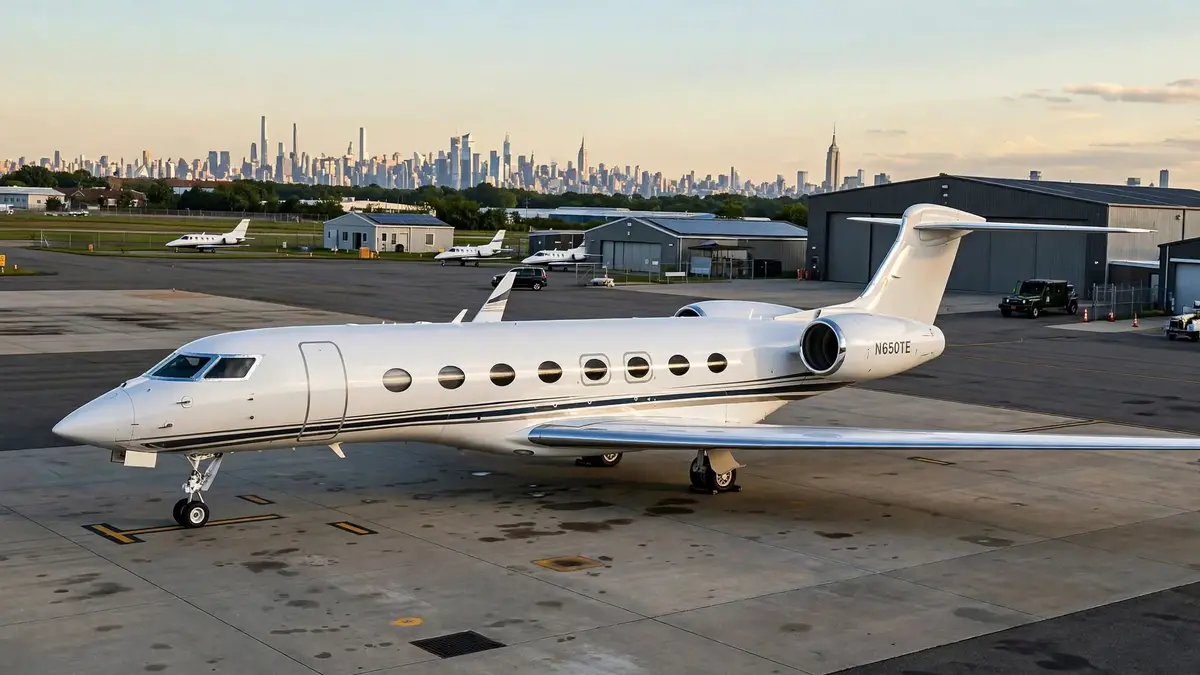
And the heavy iron dominates the signature views: Gulfstream G650s, G700s as deliveries scale, Global 7500s and 8000s, and the occasional Boeing Business Jet whose tail rises over the FBO like a building.
The ramp doubles as a rolling showroom, because owners stage their aircraft at Teterboro precisely so the market can see them, and the charter brokers who keep offices near the airport read the ramp the way other traders read a tape.
For buyers and sellers, Teterboro is also a transactional hub. The airport hosts more pre-buy inspections, deliveries, and sales viewings than perhaps any other field in the country, and the network of charter operators, management companies, and maintenance facilities that cluster around its perimeter constitutes the densest private aviation ecosystem in the United States.
Our guide to the pre-owned jet market describes the due diligence that accompanies many of those ramp transactions.
Why Teterboro Beats the Alternatives

New York’s private flyers have other gateways. Westchester County Airport to the north serves the Connecticut and Westchester crowd. Republic Airport on Long Island feeds the Hamptons traffic. Newark’s private terminal and JFK’s suites handle some international arrivals.
But Teterboro endures as the default for a simple reason: it is the only field that optimizes for Manhattan itself. The drive time, the FBO density, the customs efficiency, and the sheer gravitational pull of the ramp’s ecosystem mean that, for the traveler whose destination is the city rather than the suburbs, Teterboro is rarely the wrong answer.
The counterweights are real. Peak slot scarcity demands planning. Ground traffic over the George Washington Bridge can turn the 12 mile drive into an hour on a bad afternoon. And for the traveler whose trip ends on Long Island’s forks or the Cape and islands, routing to a closer field saves the transfer entirely.
But on most days, for most New York private missions, the math still lands on TEB, and the town car still pulls up to the Signature terminal with minutes to spare. For those deciding whether the private gateway justifies its premium over the airlines, our features on owning versus chartering versus jet cards and the true cost of private flying in America lay out the full decision.
FAQs
Where is Teterboro Airport and how far is it from Manhattan?
Teterboro sits in Bergen County, New Jersey, about 12 miles from Midtown Manhattan, across the George Washington Bridge. The drive typically takes 25 to 45 minutes depending on traffic, making it the closest dedicated general aviation airport to the city.
Why do private jets use Teterboro instead of JFK or Newark?
Teterboro exists as the region’s designated reliever airport for general aviation, allowing private aircraft to avoid the congestion, slots, and airline infrastructure of the commercial hubs. Its FBOs, customs facility, and proximity make it faster and more efficient for private travel into Manhattan.
What is an FBO?
A fixed base operator is the private terminal company that provides services at a general aviation airport: passenger lounges, fuel, hangar space, catering coordination, customs, and ground handling. At Teterboro, Signature Flight Support and Meridian are the dominant FBOs, each operating full service terminals.
Do I need to reserve a slot at Teterboro?
During peak periods, yes. The airport uses a slot reservation system for arrivals and departures, and slots on peak summer Fridays can be scarce. Your charter operator or management company handles reservations, but itineraries should be planned days in advance for peak travel times.
Are there customs facilities at Teterboro?
Yes. Teterboro has a full customs and border protection facility for international arrivals, one of the most efficient in the country, with clearance times typically measured in minutes rather than the hour or more common at commercial airports.
Can large jets like the Gulfstream G700 or Global 8000 use Teterboro?
Yes. The airport’s longest runway, at just over 7,000 feet, accommodates large cabin aircraft including G650s, G700s, and Global 7500s, with weight and performance planning appropriate to conditions. Very large aircraft like Boeing Business Jets use the airport subject to specific operational limits.
Why is Teterboro controversial with local residents?
Surrounding communities have long objected to aircraft noise, and the airport operates under a negotiated set of noise abatement procedures including preferred routes and restrictions on certain operations. The debate mirrors similar disputes over East Hampton’s airport, and pressure for tighter limits is a permanent feature of the airport’s politics.
What are the alternatives to Teterboro for flying privately into New York?
Westchester County Airport serves northern suburbs and Connecticut. Republic Airport on Long Island feeds Hamptons traffic. JFK and Newark offer private terminals for some international arrivals. Each has a niche, but Teterboro remains the default for Manhattan bound private flights due to its proximity, FBO density, and customs efficiency.