An airline carry-on luggage size guide is useful only if it helps you answer four separate questions: does the bag fit, is it light enough, how many pieces can you bring, and does your ticket include them?
A suitcase can pass one test and fail another. A cabin bag accepted on one flight may exceed the dimensions allowed on your connection.
For several major US airlines, 22 × 14 × 9 inches is a familiar overhead-bag limit. It is not a worldwide standard, and a luggage label saying “international carry-on” cannot replace your airline’s rules.
The simplest approach is to check every flight, measure your packed bag, and keep your essentials ready if it needs to leave your side. A little preparation at home makes the airport feel considerably less complicated.
What size carry-on luggage can you take?
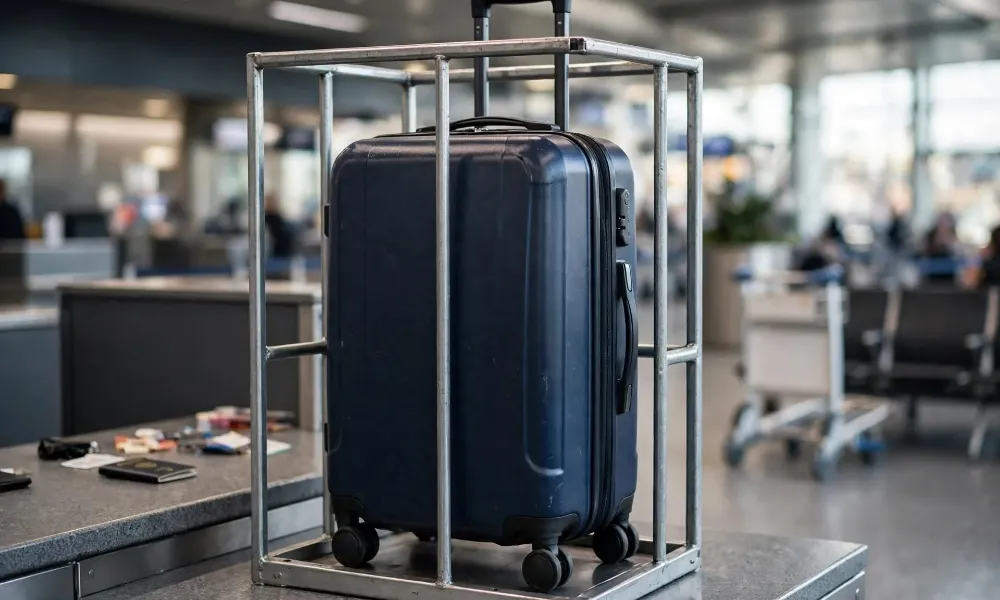
Start with the airline operating each flight and the baggage entitlement attached to your reservation.
Then check the permitted dimensions, weight, and number of pieces. Read any exceptions for your route, cabin, aircraft, or fare.
The table below summarises selected official policies checked on November 22, 2026. It focuses on standard overhead-bag dimensions, with important qualifications alongside them. Recheck your booking before departure.
| Airline | Published overhead carry-on limit | Important qualification |
| American Airlines | 22 × 14 × 9 inches, including handles and wheels | Bag must fit the airport sizer; some airports and aircraft have additional restrictions |
| Delta Air Lines | 22 × 14 × 9 inches; also a 45-linear-inch limit | Handles and wheels count; limited aircraft storage can require checking |
| Southwest Airlines | 24 × 16 × 10 inches | Wheels, handles, and attachments count; one carry-on and one personal item permitted |
| British Airways | 56 × 45 × 25 cm, including wheels and handles | You must be able to lift the cabin bag unassisted; it may need to travel in the hold |
| Emirates, Economy | 55 × 38 × 22 cm | Standard allowance is one carry-on piece up to 7 kg; route exceptions may apply |
| Qatar Airways, Economy | 50 × 37 × 25 cm | Standard allowance is one piece up to 7 kg; specified route exceptions apply |
Measurements appear in the units used for this comparison. Avoid treating a rounded conversion as extra room in the sizer.
These are selected airlines, not a promise that one suitcase will work on every carrier. Use the table to begin your check, then consult the exact booking.
Why does a bag sold as “carry-on” sometimes fail?
The retail description tells you how the manufacturer positions the bag. It does not establish acceptance across airlines.
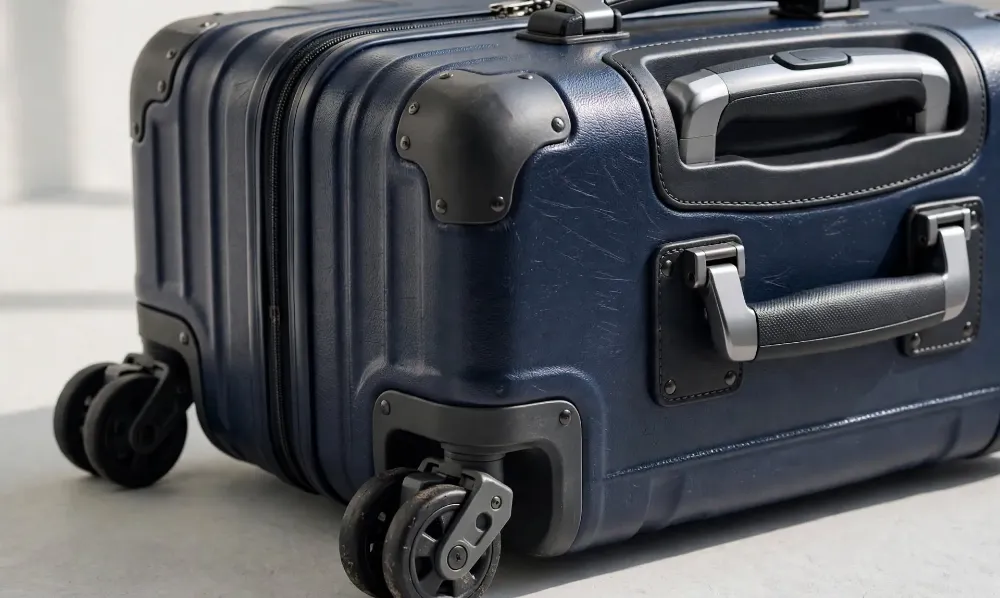
A product name may refer to a nominal size, while the complete exterior includes wheels, handles, feet, and pockets. Expansion can change the dimensions again.
Look for overall external measurements and the empty weight before buying. If the listing provides only the body dimensions, ask for clarification.
A beautiful suitcase should suit the journeys you actually take. Our guide to modern luxury travel considers that relationship between the experience you want and the practical choices supporting it.
How should you measure a carry-on bag?
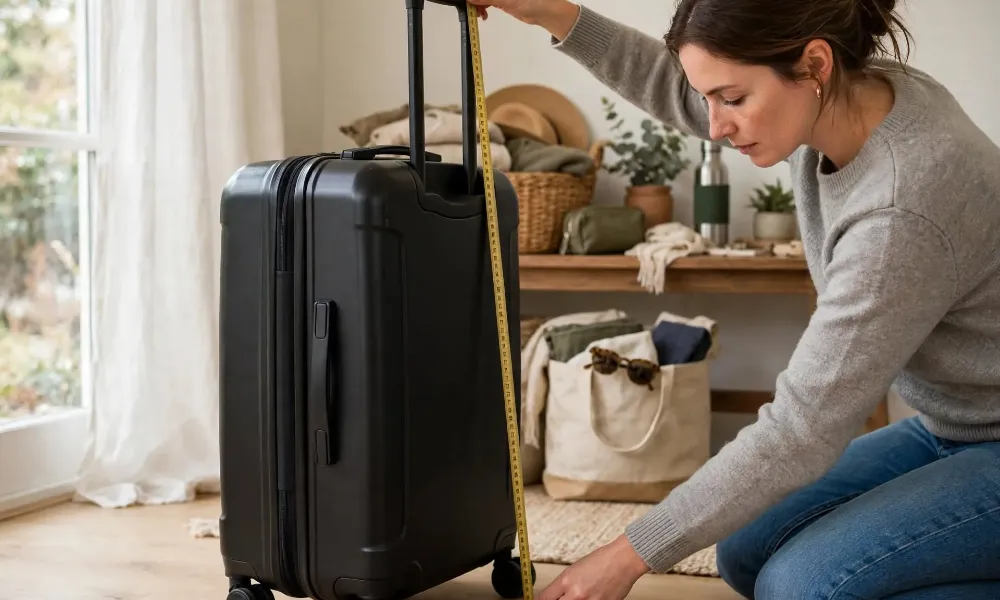
Pack it as you intend to travel, close it normally, and retract the telescoping handle. Measure the complete exterior at its furthest points.
For airlines that include wheels and handles, those parts belong in the measurement. Include any protruding fixed handles and packed exterior pockets.
A soft bag deserves the same attention. Its empty shape does not tell you how far it bulges once you add shoes, toiletries, and a laptop.
Record three dimensions separately. Do not substitute a volume in litres for the shape the airline permits.
Do you need to check both side lengths and total dimensions?
If the airline publishes both requirements, check both.
Delta, for example, states an individual limit of 22 × 14 × 9 inches and a combined limit of 45 linear inches. That does not mean any shape adding up to 45 inches qualifies.
A hypothetical bag measuring 24 × 12 × 9 inches totals 45 inches, but its 24-inch side exceeds the stated 22-inch limit.
The arithmetic is useful only when you apply every condition.
What is the difference between a carry-on and a personal item?
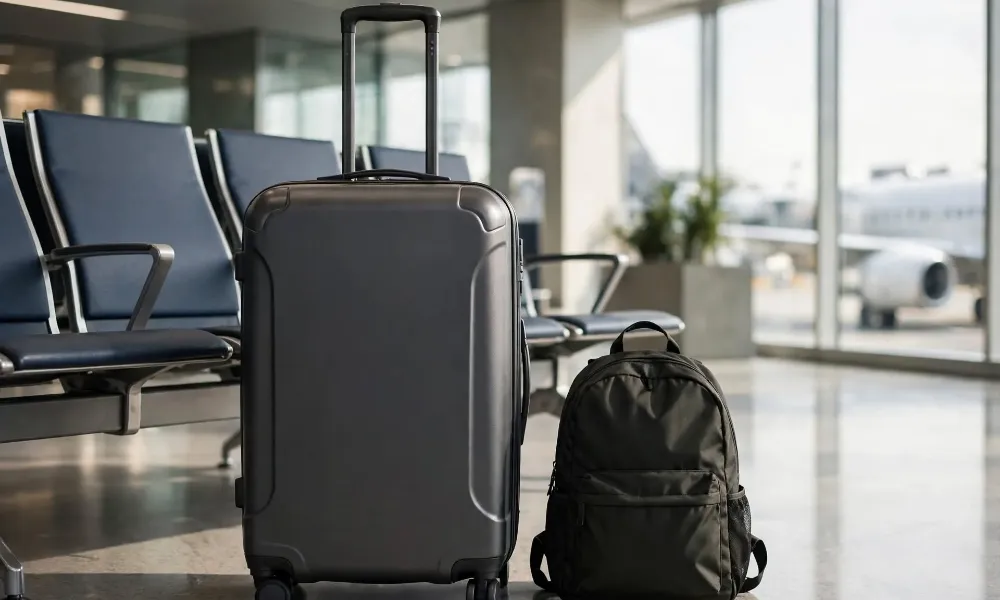
A carry-on commonly refers to the larger cabin bag intended for overhead storage. A personal item is generally a smaller piece that fits beneath the seat ahead.
The airline defines the allowance. A handbag, backpack, and laptop case do not become separate free items simply because they serve different purposes.
American publishes a personal-item limit of 18 × 14 × 8 inches. British Airways specifies 40 × 30 × 15 cm for its smaller hand bag.
Other airlines use different wording or restrictions. Do not assume that a tote accepted under one seat will qualify on your next flight.
Count the pieces you will actually carry
Before leaving home, place every intended cabin item beside the suitcase. Include a handbag, laptop bag, shopping bag, or other separate piece.
Then compare the arrangement with the airline’s allowance and exemptions. Where necessary, consolidate items within the permitted pieces before reaching boarding.
This is particularly relevant when buying something at the airport. Security clearance and baggage-piece permission are different questions.
How much does carry-on luggage weight matter?
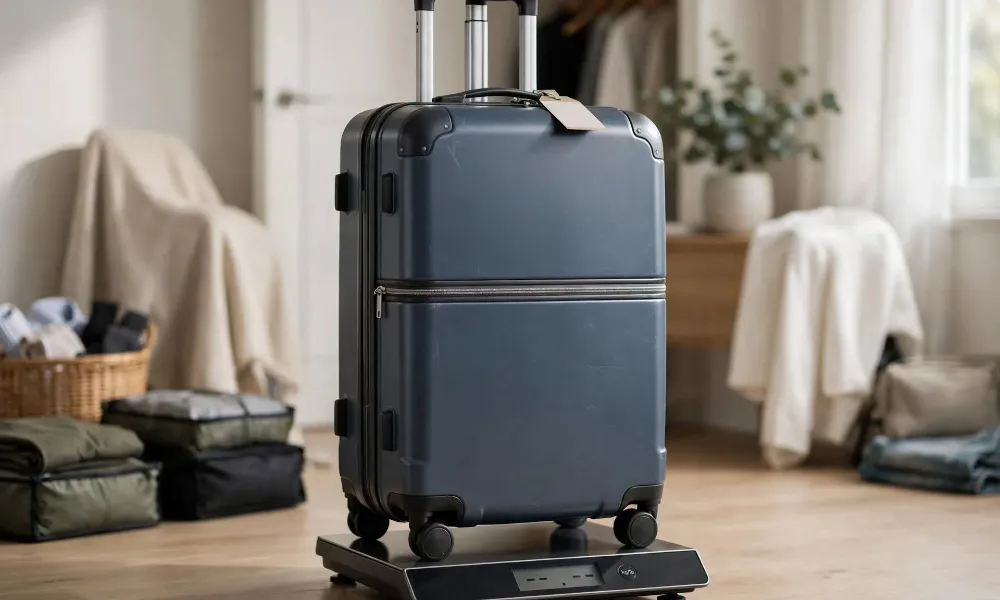
It can determine what you can pack even when the suitcase has room left.
Emirates’ standard Economy allowance is 7 kg for one carry-on piece. Qatar Airways also publishes a standard Economy allowance of one piece up to 7 kg, with specified exceptions such as Brazil services.
Check whether an airline applies a limit per piece or across a combined allowance. Read the rules for additional personal articles rather than assuming they are always outside the weight calculation.
Compare usable weight, not just capacity
Imagine two hypothetical bags for a flight allowing 7 kg.
One weighs 3.2 kg empty, leaving 3.8 kg for contents. The other weighs 1.8 kg, leaving 5.2 kg.
The lighter bag provides 1.4 kg more packing allowance under that same limit. These figures are illustrative, not product specifications.
That trade-off may matter more than an extra compartment. Compare empty weight alongside construction, handling, and the features you value.
Does Economy always include an overhead bag?
Do not infer baggage entitlement from the word “Economy” alone. The reservation’s fare rules matter.
Look for an explicit statement of what is included, whether a larger cabin bag requires payment, and whether any status or membership benefit applies to that booking.
An airline’s maximum dimensions tell you what an eligible bag may measure. They do not automatically tell you that your particular fare includes it.
Save the relevant allowance with your booking details. It is easier to resolve a question when you have the actual terms available.
Which rules apply on connecting flights?

Identify the operating carrier for every sector, including flights sold under another airline’s code.
Review each sector’s cabin-baggage conditions. If they differ, plan a bag that satisfies all applicable requirements, or arrange another baggage solution in advance.
For example, a suitcase within Southwest’s 24 × 16 × 10-inch limit would not necessarily meet American’s smaller limit. Acceptance on the first flight does not make the second airline’s dimensions disappear.
Be especially careful with separately booked journeys. You need a workable plan for the whole route, rather than a reassuring answer for its longest flight.
What if two airlines allow different shapes?
Do not compare only the total size or volume. Check each dimension against both sets of limits.
Our suggested method is to write one row per flight with four fields: dimensions, weight, pieces, and ticket entitlement. Resolve the tightest requirements before packing.
This is a practical planning framework, not a replacement for an airline’s own interpretation of its rules.
Can a compliant carry-on still be checked at the gate?
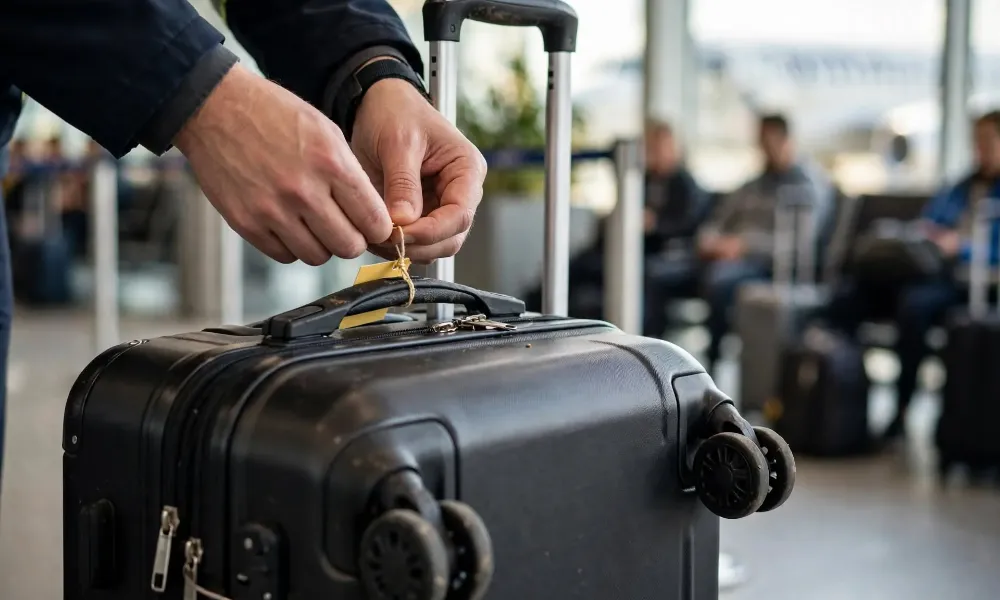
Yes. Meeting the dimensions does not guarantee overhead space on every aircraft.
Delta explains that limited cabin storage and full flights can lead to gate checking. British Airways also warns that its larger cabin bag may need to travel in the hold.
Pack with that possibility in mind. Keep documents, essential medication, valuables, and items you need during the flight accessible in your permitted smaller bag.
Ask where the checked item will be returned: at the aircraft, at baggage reclaim, or another collection point. Follow the instructions attached to your particular flight.
What must you remove if the bag is gate-checked?
Under FAA guidance, spare lithium batteries and power banks must be removed from a carry-on that is checked at the gate or planeside and kept in the cabin.
Check current capacity, quantity, and packing restrictions for your airline as well. The FAA notes that airlines can impose stricter limits.
A small, accessible essentials pouch makes this change easier. It helps you avoid searching through a tightly packed case while boarding is underway.
Are liquid rules part of the baggage-size allowance?

No. Security restrictions and airline baggage allowances are separate checks.
A bottle may fit inside your bag while failing the security rules at the checkpoint. Equally, an item cleared by security still needs to fit within your permitted cabin-baggage arrangement.
Check the security authority for every airport where you will be screened, particularly during international connections. Do not assume a rule you encountered at departure applies everywhere else.
Duty-free purchases also deserve a connection check before you pay, especially if another security screening is involved.
Should you choose hard-shell or soft-sided luggage?
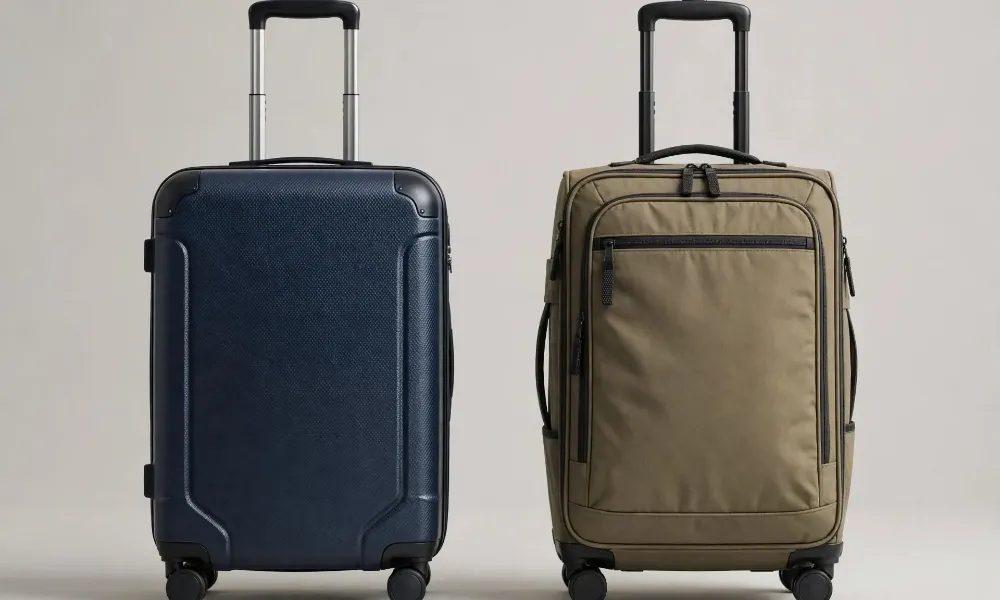
Choose around your priorities, then assess the exact bag.
For either type, compare overall measurements, empty weight, closure, handle position, and how you will use the interior. Do not assume that one material category automatically meets airline rules.
A soft exterior can change shape when overpacked. An expandable case can become larger than the allowance when opened.
If cabin compliance is the reason for buying, use the bag in the configuration you have actually measured. Leave expansion for a situation in which the revised dimensions are permitted.
Your before-departure carry-on checklist
Complete this with the bag packed:
- I have checked every operating airline.
- My ticket includes the cabin pieces I intend to bring.
- Overall dimensions include the required protruding parts.
- Every dimension meets the applicable limits.
- Packed weight meets the relevant allowance.
- My personal item satisfies its separate requirements.
- Additional purchases fit within the permitted arrangement.
- Essentials are accessible if the larger bag is checked.
- Power banks and spare batteries can remain in the cabin.
- I have checked security rules for screening points on the route.
Frequently asked questions
Is 22 × 14 × 9 inches a universal carry-on size?
No. Several US airlines use that limit, but other airlines publish different dimensions, weights, and piece allowances.
Do wheels count in carry-on measurements?
For the airline policies in this guide that specify handles and wheels, yes. Measure the full bag and follow the exact carrier’s wording.
Is a slightly oversized bag usually accepted?
This guide does not promise tolerance. Pack to the published requirements rather than relying on previous exceptions or another traveller’s experience.
Does first or business class remove size limits?
Do not assume so. A premium cabin may offer a different allowance, but you still need to check its dimensions, weight, and piece rules.
Can I use an expandable suitcase as a carry-on?
Potentially, if its actual packed dimensions and weight meet your allowance. The expanded version needs its own measurement.
The editorial read
The pleasure of travelling light is having fewer things to manage. That begins before the airport, with a bag that suits the route and a packing plan you understand.
Choose luggage you enjoy using, then let the booking determine what it needs to do. Measure once it is packed, keep the essentials close, and leave yourself room to move through the journey calmly.
A carry-on should make the trip easier from the moment you leave home.