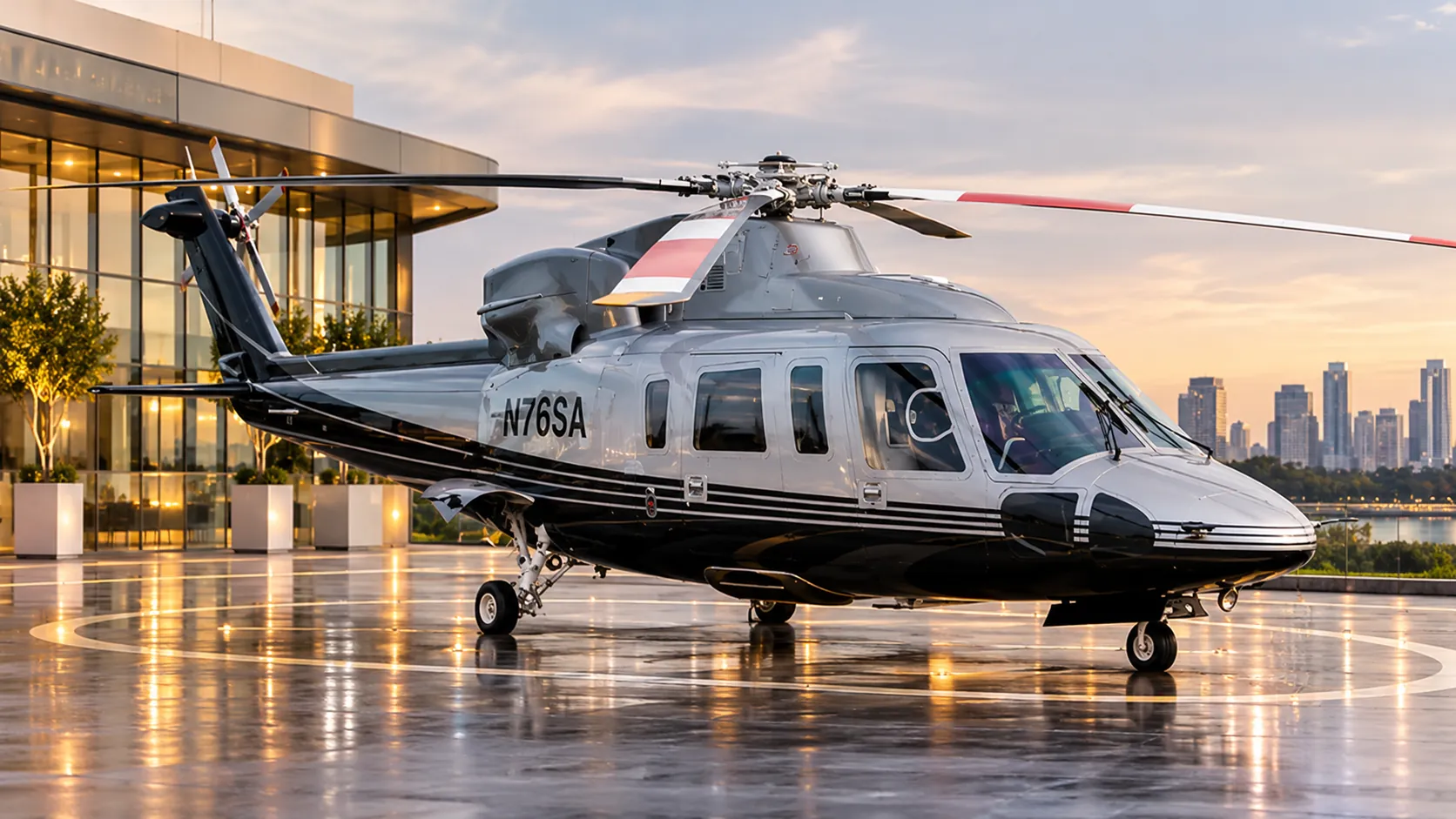
The Sikorsky S-76 is the most successful corporate helicopter ever built, a machine that has spent nearly five decades carrying board members, heads of state, medical teams, and offshore crews with a reliability that made it the default choice of the Fortune 500. Since its first flight in 1977, the S-76 family has accumulated millions of flight hours and a reputation for discretion that money alone cannot buy.
It is not the newest helicopter in the sky, nor the largest, nor the fastest. It is something more valuable in the world of executive aviation: the known quantity, the machine that flight departments choose when the passengers are too important for experiments.
Designed for a Specific Passenger
Most helicopters of the 1970s were working aircraft adapted, with varying success, to carry people who wore suits. Sikorsky approached the S-76 from the opposite direction.
Announced in 1975 and flown in 1977, it was conceived from the outset with the corporate market in mind, a twin-engine machine intended to move business leaders between city centers, suburban estates, and regional airports at the pace their schedules demanded.
The design priorities followed from that mission. The cabin was shaped for conversation, with noise and vibration levels engineered down to standards that earlier helicopters had never attempted.
The twin Turbomeca engines, later succeeded by Pratt and Whitney Canada powerplants in the C and D variants, provided the redundancy that corporate insurers and chief pilots require before a chairman steps aboard. The four-bladed main rotor delivered the smooth ride that separates an executive shuttle from a utility machine.
The market’s answer was immediate and lasting. Corporate flight departments adopted the S-76 in numbers no rival could match, and the type became a fixture of the American business landscape, as recognizable on the helipads of Manhattan as the limousines idling below them.
The Machine That Kept Improving
A great helicopter is never finished, and the S-76’s longevity rests on Sikorsky’s discipline in evolving it. The original A model gave way to improved variants across the decades, each addressing the lessons of the fleet’s growing experience. The S-76B brought more powerful engines and refined systems.
The S-76C series introduced the Turbomeca Arriel engines and progressively better avionics. The S-76D, certified in 2012, completed the transformation with Pratt and Whitney PW210 engines, composite rotor blades, and the Thales TopDeck avionics suite, bringing the venerable design fully into the glass-cockpit era.
Through every variant, the essentials remained constant: the cabin proportions that passengers trusted, the flight characteristics that pilots praised, and the maintenance logic that kept fleets flying. In aviation, this kind of continuity is not stagnation.
It is the compounding of decades of operational wisdom into a machine that has very few surprises left, and among the luxury helicopter models available to private buyers, that predictability carries a premium all its own.
Beyond the Boardroom
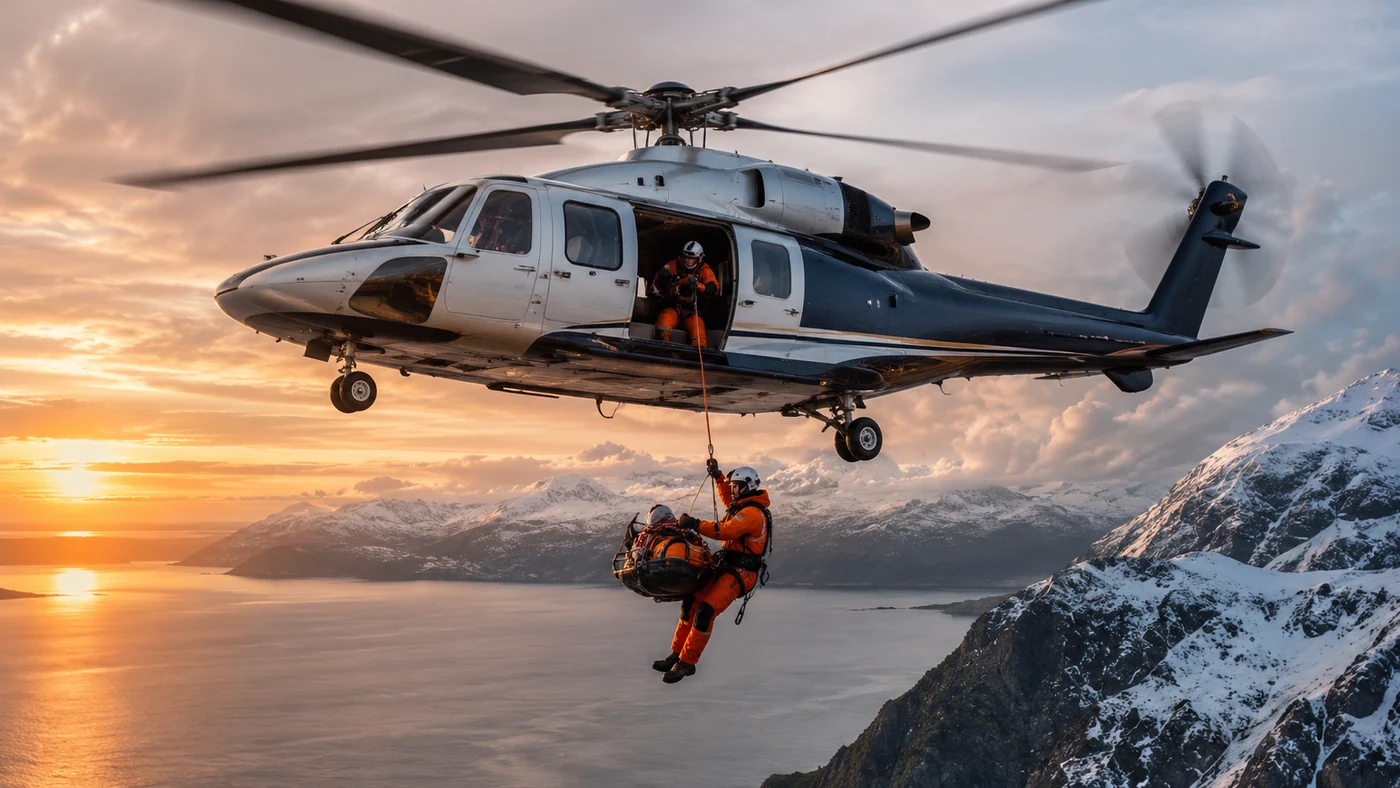
The S-76’s corporate fame has obscured the breadth of its service, which tells the fuller story of the design’s quality. Emergency medical services across North America have operated the type for decades, trusting it to carry patients and flight crews through nights when nothing else would fly.
Offshore operators have run S-76s to oil and gas platforms across the Gulf of Mexico and beyond. Government fleets, including royal households and head-of-state services in several countries, have selected the type for official transport.
The search and rescue record deserves particular mention. S-76s equipped for rescue work have hoisted sailors from storm seas and carried the injured from mountainsides, service far removed from mahogany-paneled executive cabins yet essential to understanding the machine.
A helicopter trusted with those missions brings an inheritance of proven hardship to every charter flight, the same deep reassurance that distinguishes genuinely great aircraft from merely comfortable ones.
The Economics of the Known Quantity
For a buyer entering the market today, the S-76 presents an unusual proposition. New production of the type has wound down as Sikorsky concentrates on newer programs, but the worldwide fleet numbers in the hundreds, and a mature market for pre-owned aircraft offers well-maintained examples at prices far below newer rivals.
A carefully selected S-76 with strong maintenance records can deliver genuine twin-engine executive capability for a fraction of the cost of a new super-medium machine.
The support picture remains strong. Sikorsky, now part of Lockheed Martin, continues to back the fleet, and a global network of service centers, parts inventories, and experienced engineers has grown around the type across its decades of service.
For flight departments and private owners alike, this ecosystem is the aircraft’s quiet superpower: there is almost no S-76 problem that someone, somewhere, has not already solved.
Buyers weighing the type against the alternatives in private jet aviation for their regional travel should remember the helicopter’s irreplaceable advantage: it does not need a runway.
The S-76’s natural territory, city helipads, private estates, hospital roofs, and corporate campuses, is territory no jet can reach, and for journeys under a few hundred miles it routinely beats the combination of car, commercial terminal, and highway that even private jet charter cannot fully escape.
The Honest Balance Sheet
Candor requires acknowledging what the S-76 is not. Its cabin, generous by the standards of its birth, is more compact than the newest generation of super-medium twins, and its cruise speed, while entirely adequate, trails the fastest modern machines. The winding down of new production means buyers are choosing from a fleet whose youngest members are now maturing, making maintenance history and refit quality the decisive factors in any purchase.
For many buyers, these trade-offs are features rather than flaws. The S-76’s maturity means its costs are predictable, its weaknesses documented, and its capabilities proven across nearly half a century. In a market where new designs carry new risks, the old workhorse offers the luxury of certainty.
The Legacy
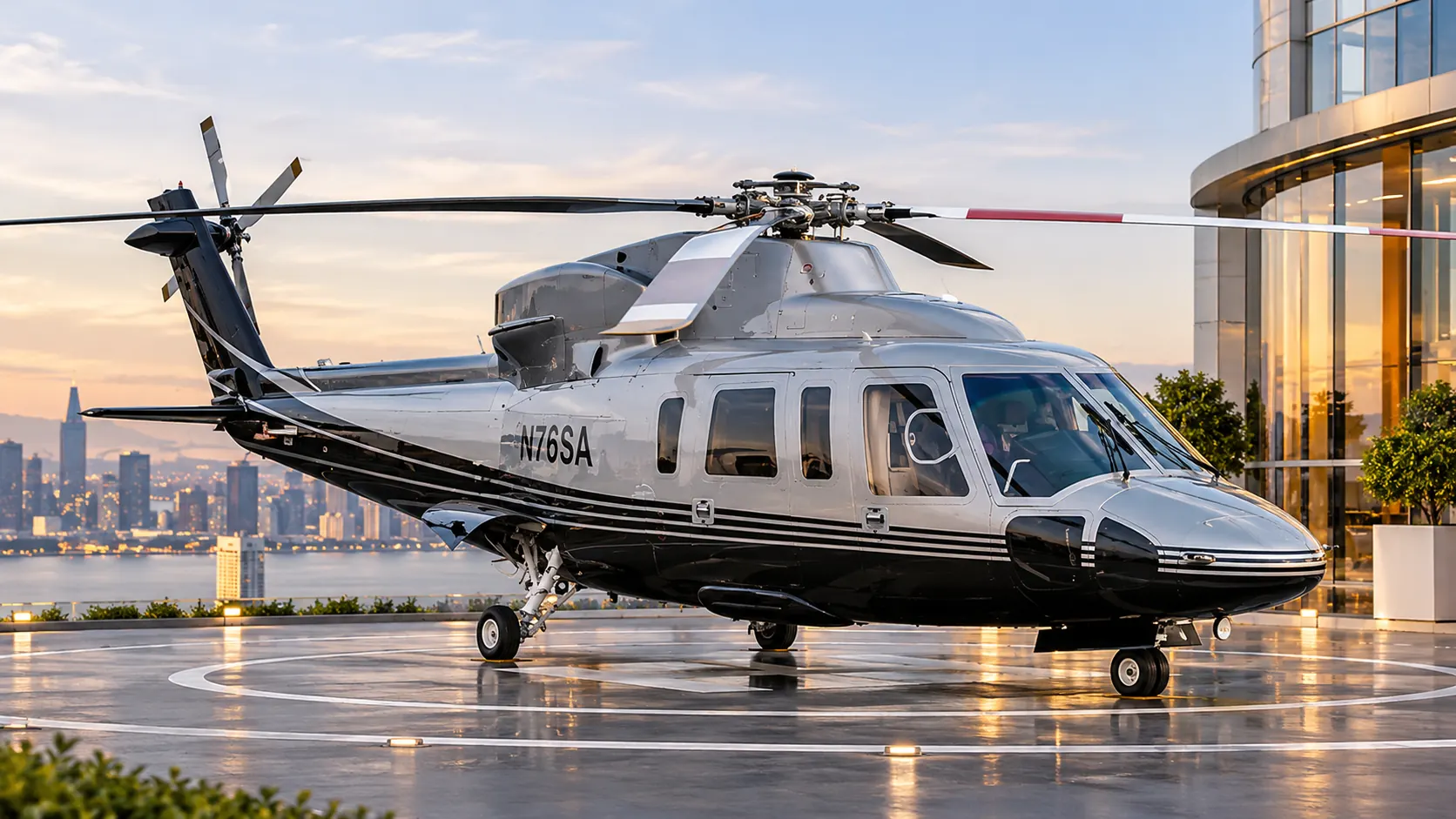
The S-76’s place in aviation history is secure. It proved that the corporate helicopter was a category worth designing for rather than adapting toward, and in doing so it created the market that newer machines now contest. Every modern executive helicopter, from the AW109 to the ACH160, competes in a space the S-76 defined.
Its quieter legacy lives in the accumulated trust of the people who fly it. Ask chief pilots of long-established flight departments what they want on a difficult night, and the S-76’s name still surfaces with remarkable consistency, spoken with the particular affection professionals reserve for machines that have never let them down. In the end, that is the only review that matters, and it is written in flight hours rather than brochures.
FAQs
What is the Sikorsky S-76 used for?
The S-76 serves primarily as a corporate and VIP transport helicopter, with major additional roles in emergency medical services, offshore energy support, and government and head-of-state fleets.
When did the Sikorsky S-76 first fly?
The S-76 first flew in 1977 and entered service in 1979, beginning a production run that spanned four decades and multiple improved variants.
How many passengers does the S-76 carry?
Typical corporate configurations seat four to six passengers in comfort, while utility layouts can accommodate up to twelve.
Is the Sikorsky S-76 still in production?
New production has wound down as Sikorsky focuses on newer programs, but the worldwide fleet remains extensive and fully supported, with a healthy market for pre-owned aircraft.
What engines power the S-76?
The variants progressed from original Turbomeca engines through the Arriel series in the C models to Pratt and Whitney Canada PW210 engines in the final S-76D.
How much does a pre-owned Sikorsky S-76 cost?
Prices vary widely with variant, age, and maintenance history, but well-kept examples can represent genuine twin-engine executive capability at a fraction of the cost of new super-medium helicopters.
Is the S-76 safe?
The type has accumulated millions of flight hours across nearly fifty years of corporate, medical, and offshore service, with twin-engine redundancy and a support network that keeps the fleet current with modern safety standards.
How does the S-76 compare to newer helicopters?
Newer super-medium twins offer larger cabins, higher speeds, and newer avionics. The S-76 counters with proven reliability, lower acquisition cost, and an unmatched ecosystem of parts, service, and operational experience.