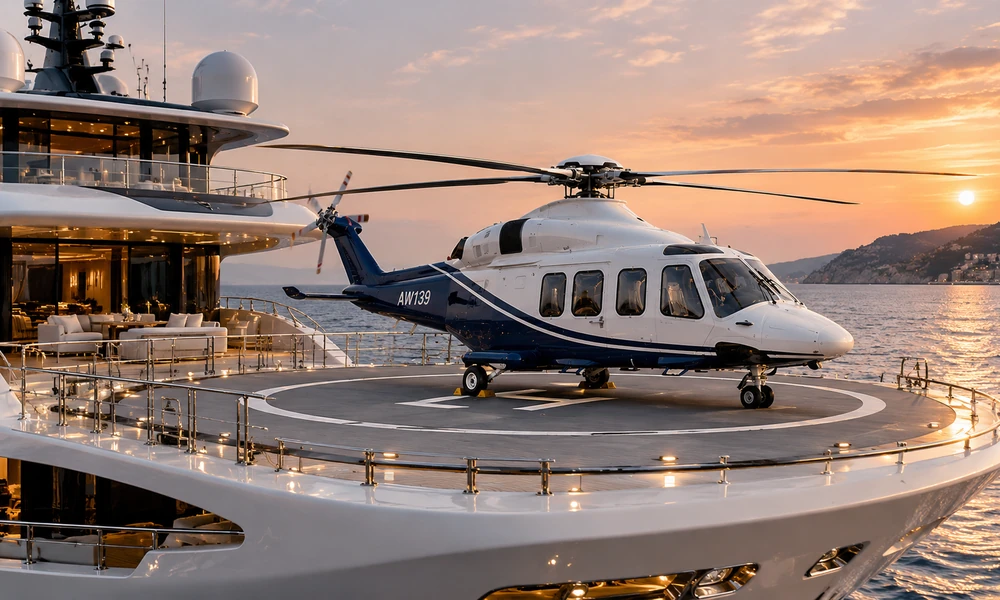
The Leonardo AW139 is the most successful medium twin-engine helicopter of its generation, with more than a thousand aircraft delivered to operators in dozens of countries since it entered service in the mid-2000s. It flies heads of state, Fortune 500 boards, offshore energy crews, and charter guests with equal ease, and it has become the default answer when the world’s wealthiest travelers ask for a helicopter.
Numbers like those in the helicopter world are not popularity. They are a verdict, delivered by the most demanding customers in aviation. Understanding why the AW139 earned that verdict reveals a great deal about what private flight actually values.
Born From an Unusual Partnership
The AW139 began life as a joint project between Italy’s Agusta and America’s Bell, a rare transatlantic collaboration in rotorcraft, initially known as the AB139. When Bell withdrew to concentrate on other programs, Agusta carried the design forward alone, through the corporate evolutions that turned Agusta into AgustaWestland and finally, since 2016, into Leonardo Helicopters.
What the partners had drawn was genuinely new: a medium twin-engine helicopter sized between the light twins that dominate charter work and the heavy machines that serve militaries and monarchies. That middle ground turned out to be exactly where the money was.
The gap in the market that the two companies identified has since become the most contested territory in the industry, and the machine that opened it still leads it, as any survey of the world’s leading luxury helicopter models will confirm.
The Engineering Case
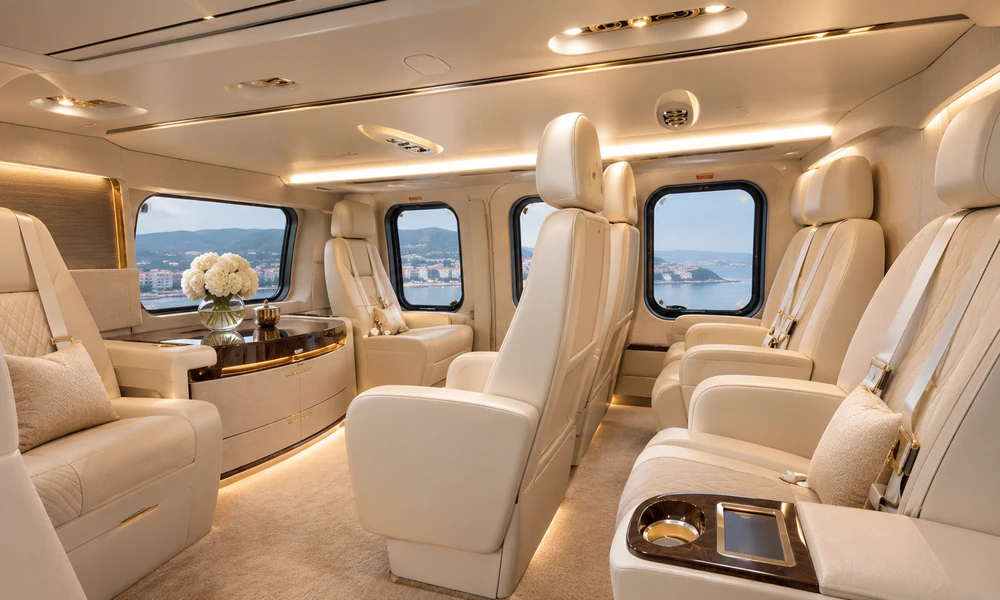
A helicopter earns VIP work the way a hotel earns five stars: no single feature achieves it, but everything must be right at once. The AW139’s case rests on four pillars, and each deserves examination.
The cabin. The AW139 offers the largest cabin in its class, roughly six square meters of floor space in corporate configurations, with a flat floor, wide sliding doors, and enough headroom that a tall passenger can move without folding in half.
In executive layouts that typically means four to six club seats in hand-stitched leather, cabinetry in fine veneers, and acoustic treatment that brings cabin noise down to conversation level. The space feels designed rather than adapted, because it was.
The speed. Cruising at around 165 knots, the AW139 ranks among the fastest helicopters in its category, fast enough that the Nice to Monaco run takes about seven minutes and a Manhattan to Hamptons hop stays well under an hour. In the private market, speed is not a bragging right but a conversion of hours into usefulness, and the 139 converts generously.
Two engines, real margins. Twin Pratt and Whitney Canada PT6C engines with full authority digital engine control give the aircraft genuine single-engine performance, the capability that separates machines permitted to fly over cities and water at night from those that are not. For operators and insurers alike, this is the specification that decides everything else.
Proven bones. The same airframe serves search and rescue squadrons, coast guards, and air ambulance services, customers who fly in the worst weather on the worst nights. For a private owner, that heritage is the quietest possible reassurance, the knowledge that the machine beneath the leather was built for conditions far harder than any charter flight.
Why Operators Love It
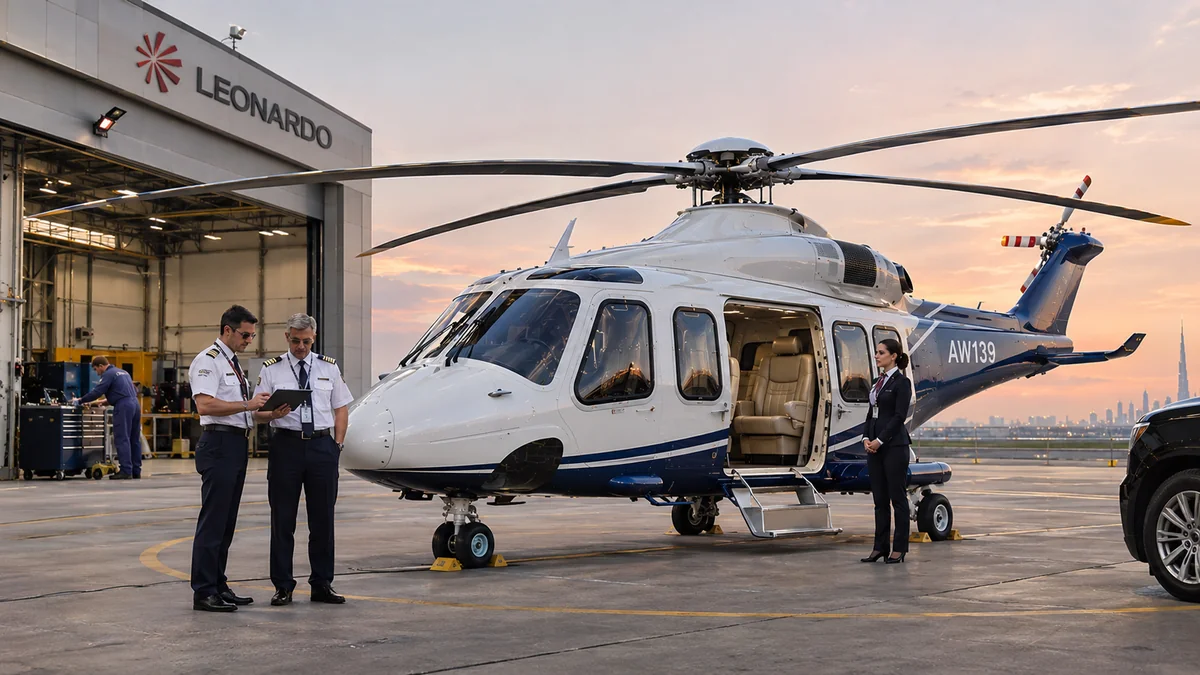
The AW139’s dominance is also, and perhaps primarily, an accounting story, and this is the dimension most luxury coverage misses entirely.
Charter and corporate operators run on dispatch reliability: an aircraft that cancels trips is a machine that refunds money and loses clients. The type’s maintenance program, global support network, and parts availability keep utilization high and downtime low, which is why fleet after fleet has standardized on it.
An operator in Dubai can support a 139 as readily as one in Dallas, and pilots trained on the type can be found on every continent.
The consequence for charter guests is invisibility, the highest compliment in service. When a client charters a helicopter in Hong Kong or São Paulo or Lagos, the odds are good they will step into a 139 without ever knowing its name, and the flight will proceed with the unremarkable smoothness that only enormous preparation can produce.
Leonardo has kept the design current through continuous investment: increased weight limits, improved avionics, and the development of the stretched AW189, which extends the family’s logic upward.
The production line’s life has stretched far beyond what the original partners imagined, and the aircraft continues to win orders against much newer rivals.
Life at Sea
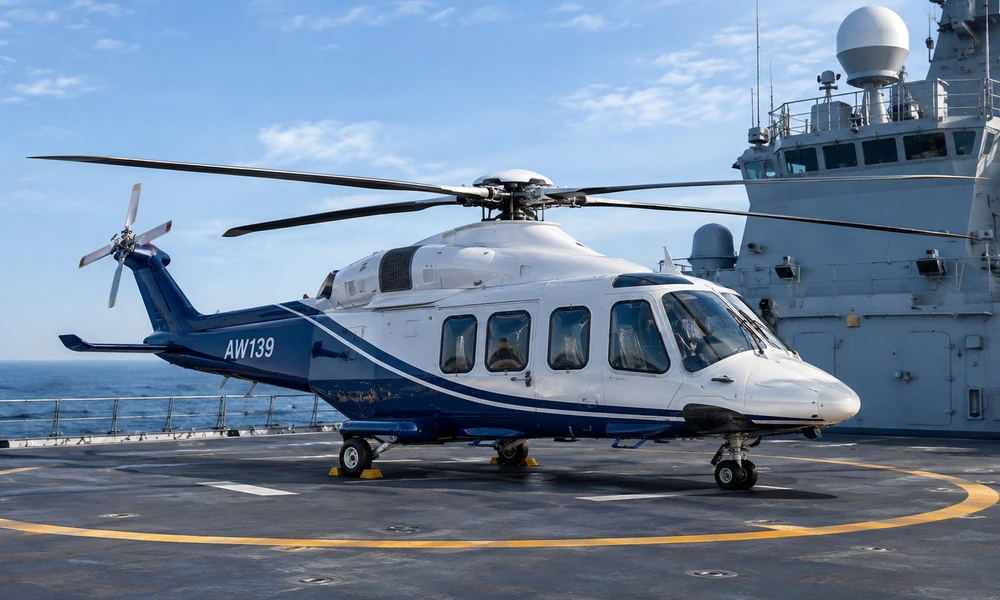
The AW139 has also become the helicopter of choice for the superyacht world, a role that tests a rotorcraft in unique ways. Operations from a vessel at anchor demand compact dimensions, folding rotor blades, corrosion resistance against salt air, and the ability to operate from a deck that moves beneath the wheels.
The 139 answers each requirement well enough that it appears on the helidecks of many of the world’s great yachts, serving as the ship-to-shore limousine that transforms an anchorage into a gateway.
Owners exploring that world will find our coverage of the luxury yacht experience a natural companion, and our examination of superyacht engineering explains why the marriage of hull and helicopter has become one of the defining design challenges of modern yacht building.
The Honest Limitations
No aircraft is universal, and the AW139’s reputation deserves the balance of its trade-offs. It is not the cheapest twin to buy or to run: a well-equipped executive example lists in the mid-teens of millions of dollars, and operating costs sit accordingly.
Its cabin, while generous for a helicopter, remains a helicopter cabin, and luggage capacity on a full passenger load is real but finite, which is why experienced yacht captains plan baggage transfers separately. In the plushest VIP completions, the installed weight of cabinetry and entertainment systems eats into range, a trade that every completion house discusses with owners before the first panel is cut.
None of this has slowed the machine. If anything, the clarity of its compromises is part of its appeal. The AW139 never promised to be a flying palace. It promised to be a superbly built instrument that shows up every day in every climate, and the market has spent two decades rewarding exactly that.
The Verdict
In private aviation, fashions come and go, but the AW139 has achieved something rarer than fashion: it has become infrastructure. It is the machine that other machines are measured against, the default that must be argued away rather than argued for.
For owners weighing a first helicopter, and for guests who will simply board whatever waits on the pad, that quiet ubiquity is the deepest luxury the aircraft offers. The best journeys, as with the best service, are the ones you never have to think about.
FAQs
How much does a Leonardo AW139 cost?
New executive-configured examples typically list in the range of 13 to 16 million dollars depending on specification, with pre-owned aircraft varying widely by age, hours, and maintenance history.
How many passengers does the AW139 carry?
The cabin seats up to fifteen in utility layouts and four to six in typical VIP club configurations with full cabin amenities.
What is the range of the AW139?
Approximately 570 nautical miles with standard fuel, comfortably covering city pairs such as New York to Washington or London to Paris with reserves.
How fast is the Leonardo AW139?
The aircraft cruises at around 165 knots, roughly 190 miles per hour, placing it among the fastest helicopters in its class.
Who uses the AW139?
Corporate flight departments, charter operators, heads of state, offshore energy companies, search and rescue services, and air ambulances across dozens of countries.
Can the AW139 land on a yacht?
Yes. The type operates regularly from superyacht helidecks, subject to the deck’s certification and the aircraft’s weight configuration, and it has become a favorite of the yachting world.
What engines power the AW139?
Twin Pratt and Whitney Canada PT6C engines with full authority digital engine control, providing genuine single-engine capability for operations over cities and water.
How does the AW139 compare to the Airbus H160?
The AW139 offers two decades of fleet maturity and the deepest global support network in its class, while the H160 counters with newer aerodynamics and lower noise. The choice typically turns on cabin size, support, and completion preferences.