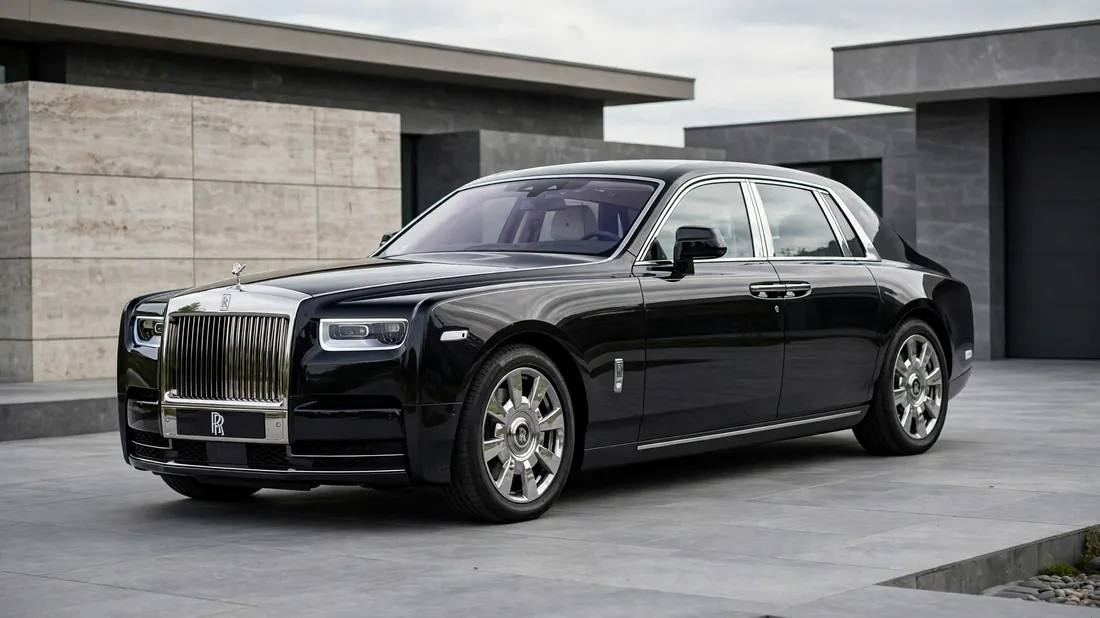
There are cars that announce themselves, and then there is the Rolls-Royce Phantom. It arrives the way weather changes over a still lake almost without announcement, a long shadow of black or midnight blue gliding past, the only sound the faint sigh of its tyres.
The Rolls-Royce Phantom has carried that reputation for a century, and the current eighth-generation car, in Series II form, is proof that silence can be engineered, polished, and priced. This is not a car you buy to be noticed. It is a car you buy so that the world, for once, leaves you alone.
From the outside, the Phantom is unmistakable: the tall Pantheon grille, the Spirit of Ecstasy leaning into the wind, the upright, almost architectural proportions. From the inside, it is something stranger a room that happens to move.
What follows is the story of its hundred-year lineage, the engineering of its silence, the cabin Rolls-Royce calls a gallery, and the question of who spends half a million dollars on a car designed to be heard as little as possible.
A Century of Silence: From 1925 to the Present Day

The first Phantom appeared in 1925, successor to the Silver Ghost, and inherited the older car’s famous claim to near-silence. Rolls-Royce had built its reputation on refinement the Silver Ghost of 1906 was already being described as the best car in the world and the Phantom carried that torch through seven further generations.
The Phantom II of 1929 refined the chassis; the Phantom III of 1936 brought the marque’s first V12; the Phantom IV, built between 1950 and 1956, was made in just eighteen examples, reserved almost entirely for royalty and heads of state. The Phantom V and VI, spanning 1959 to 1990, became the default transport of monarchs, presidents, and film stars.
Then came the long pause. After the Phantom VI ended production in 1990, the nameplate rested for thirteen years the longest silence in the Phantom’s own history, and an oddly fitting one.
When it returned in 2003, BMW owned the marque, a new factory had been built at Goodwood, and the Phantom VII was an entirely new car on an aluminium spaceframe. Yet the brief was the same as in 1925: build the most refined motor car in the world, and let the noise stay outside.
The Eighth-Generation Phantom and the Series II Refresh
The eighth-generation Phantom arrived in 2017, built on Rolls-Royce’s own Architecture of Luxury, an all-aluminium spaceframe that also underpins the Ghost and the Cullinan.
The Series II, unveiled in May 2022, brought a lightly revised face an illuminated grille surround, new headlights with laser-cut bezels, a starlight effect in the lamps themselves and a darkened chrome option for owners who prefer their grandeur in a minor key.
A century after the first Phantom, the name still sits at the top of the Rolls-Royce range, and of the luxury car world.
The 6.75-Litre V12: Power You Never Hear

Under the Phantom’s long bonnet sits a 6.75-litre twin-turbocharged V12, an engine Rolls-Royce describes not in terms of speed but in terms of effortlessness.
It produces 563 horsepower and 664 lb-ft of torque, enough to move a car weighing more than two and a half tonnes to 60 mph in around five and a half seconds a figure the company treats as almost beside the point.
The Phantom is not fast the way a sports car is fast. It is fast the way a tide comes in: steadily, silently, and without visible exertion.
That effortlessness is deliberate. Torque arrives low and stays there, so the eight-speed automatic rarely needs to hurry, and the satellite-aided transmission reads the road ahead, pre-selecting gears before corners and gradients. There is no sport mode, no launch control, no exhaust note engineered to bark. The engineers’ task was the opposite: to make 563 horsepower disappear.
It is worth remembering how different this philosophy is from the rest of the supercar world. Bugatti, the marque that taught the world what 300 mph looks like, chases numbers that border on the absurd; the Phantom chases the absence of numbers altogether. Where other makers publish Nürburgring lap times, Rolls-Royce publishes the decibel reading of its cabin at cruising speed.
The Engineering of Quiet
Rolls-Royce calls the Phantom the quietest car in the world, and the claim is a specification, not a slogan. Around 130 kilograms of sound insulation are layered through the car: acoustic glass in every window, foam-filled tyres, seals and damping materials fitted to the body, roof, floor, and doors.
The cabin is so quiet at motorway speed that engineers reportedly had to remove certain noises entirely the faint whine of the air conditioning, the tick of a relay because once the road noise was gone, the smallest sounds became audible.
The suspension plays its part. The Phantom rides on air springs with a system Rolls-Royce calls the Planar suspension, which uses a stereo camera the Flagbearer system to read the road ahead and prepare for bumps before the wheels reach them.
The effect is the famous “Magic Carpet Ride”: the car seems to float over broken tarmac, the body staying level while the wheels do the work underneath. It is the oldest trick in the Rolls-Royce book, and still the most impressive.
The tuning tells the same story. The steering is light, the responses unhurried, the body roll carefully managed rather than eliminated. The Phantom is not trying to be a driver’s car in the sporting sense. It is trying to be a room and rooms do not handle.
The Gallery: A Dashboard Like No Other
Open the front doors and the first thing you notice, after the smell of the leather, is the dashboard. In the Phantom, the fascia is not a slab of wood or a screen; it is the Gallery, a single pane of glass running the full width of the cabin, behind which a commissioned work of art sits on permanent display.
It may be a hand-painted silk panel, a sculpture in porcelain or metal, embroidery, or an arrangement of feathers, mother-of-pearl, or gold leaf. The Gallery is lit from within and entirely unique to the car the owner chooses the artist, the medium, and the subject, and the result can never be repeated.
The Gallery matters because it tells you what the Phantom is for. Most luxury cars fill the dashboard with technology: bigger screens, more menus, more modes. The Phantom’s dashboard is, deliberately, a piece of art.
The infotainment screen is there a 12.3-inch display that retracts behind a veneer panel when not in use but the car’s centre of attention is something made by hand, chosen by its owner, and visible only to the people inside.
That choice reflects a broader truth about the marque: its technology is present but hidden, its craftsmanship visible. The Gallery is the clearest expression of that priority an interior treated as a private collection rather than a cockpit.
The Starlight Headliner and the Cabin Within
Look up in a Phantom and you will see the night sky or rather, 1,340 fibre-optic lights, each hand-threaded through the perforated leather of the headliner, arranged into constellations of the owner’s choosing.
The lights can be configured to show the stars as they appeared on a particular date and in a particular place a birth, a wedding, a first meeting and optional shooting stars drift across the roof at intervals, as if the car were moving through its own weather.
Below the stars, the cabin is finished in materials chosen with almost monastic attention. The leather comes from bulls raised without barbed wire, so the hides are free of small scars.
The wood veneers are book-matched consecutive slices from the same tree, opened like a book so the grain mirrors itself. The lambswool rugs are deep enough to lose a shoe in, because carpet, in the Rolls-Royce view, is a place where feet rest.
The rear seats are the heart of the car: a pair of individual chairs, reclining, heated, cooled, and massaging, separated by a fixed centre console with a drinks cabinet, champagne flutes, and a coolbox.
In the Extended Wheelbase model 220 millimetres longer, at 5,982 millimetres overall the rear becomes a genuine lounge, with room to stretch out fully. The rear doors are coach doors: rear-hinged, opening to reveal the cabin like the entrance to a drawing room, and closing at the touch of a button, powered and silent.
Coach Doors and the Theatre of Arrival
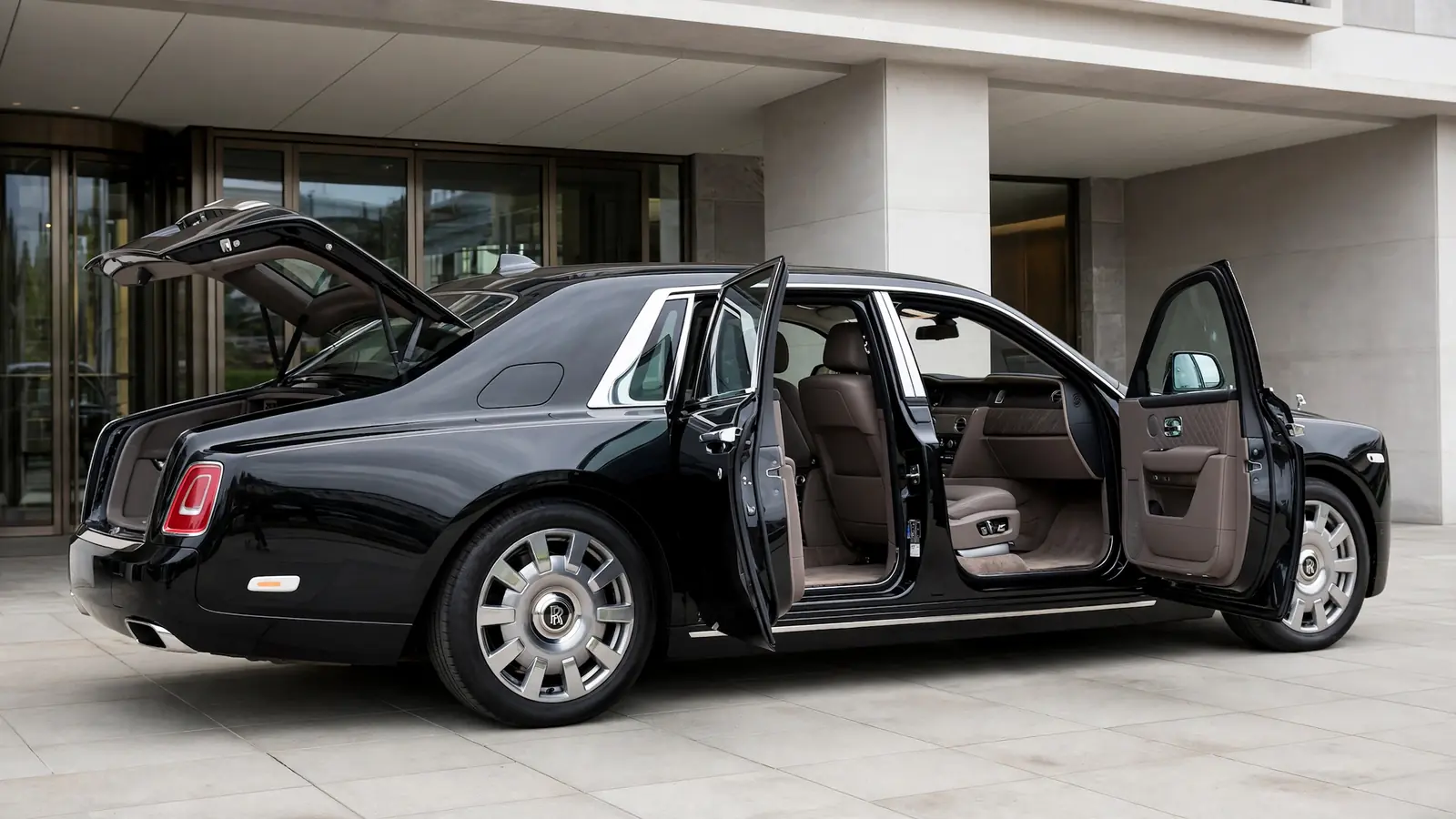
The coach doors are the Phantom’s most theatrical feature, and also its most practical. Rear-hinged since the Phantom’s earliest days, they open wide almost ninety degrees so a passenger steps out forwards, gracefully, rather than squeezing around a pillar.
On arrival at a hotel or a theatre, the effect is unmistakable: the door swings open, the cabin light spills out, and the passenger emerges as if from a private room rather than a vehicle.
The theatre is engineered down to the smallest detail. The doors are power-assisted in both directions, closable from a button on the C-pillar, the driver’s seat, or the key.
Umbrellas are hidden in the doors themselves the famous teflon-coated umbrellas that dry inside their own compartments and the door pockets are lined in leather rather than plastic. Even the Spirit of Ecstasy retracts into the bonnet when the car is parked, a small piece of theatre that also deters theft.
These details are the point. The Phantom does not reward its owner with speed or handling; it rewards its owner with ceremony. Every arrival is staged, every departure unhurried, and the car insists that getting there is not the same as arriving.
Bespoke: When One Phantom Is Not Enough

Every Phantom is built to order, and the Bespoke programme exists for owners for whom even that is not enough. A Bespoke Phantom begins with a conversation sometimes lasting months — between the owner and the designers at Goodwood, and it can end almost anywhere.
The Phantom Syntopia of 2023, created with Dutch fashion designer Iris van Herpen, carried a flowing water-inspired motif across its paint, its Gallery, and its headliner, which used 162 delicate glass petals.
The Phantom Goldfinger, unveiled in 2024 to mark sixty years of the James Bond film, recreated the 1937 Phantom III Sedanca de Ville from the movie in miniature detail, with gold accents, a solid gold bar in the console, and a map of the Furka Pass the scene of the film’s most famous chase picked out in the headliner.
These commissions are not marketing exercises; they are the reason the factory exists in its current form. Goodwood is not a production line in the conventional sense.
Cars move slowly through the building, spending hundreds of hours in the hands of craftspeople who paint, stitch, polish, and assemble by hand, and the coachlines the fine pinstripe along the body are still painted freehand by a single craftsman, Mark Court, whose lines deviate by millimetres over the length of the car.
The result is that no two Phantoms are alike, and the most ambitious are effectively unique objects. Maserati and the trident’s hundred years show how a marque can survive on heritage alone; Rolls-Royce shows something rarer a heritage that is still being written, one commission at a time, by owners who want a car that exists nowhere else on earth.
The Price, and Who Buys One
A Rolls-Royce Phantom starts at around $500,000, a figure best understood as a floor rather than a price. The Extended Wheelbase adds roughly $50,000 before options, and a serious Bespoke commission can add six figures more the Goldfinger car was valued well into seven figures. Most Phantoms leave Goodwood at somewhere between $550,000 and $700,000, and the most elaborate one-offs have no meaningful ceiling.
Who buys a car like this? Phantom owners are, overwhelmingly, people who are driven rather than people who drive: heads of state, royalty, founders and family offices, hotel groups, and embassies.
The car is the default state transport of monarchies from London to the Gulf, and the choice of anyone whose arrival needs to be both understated and unmistakable. Many owners never sit in the driver’s seat at all; the Phantom is, first and foremost, a car to be ridden in.
That changes what the car is. A Phantom is not a toy, and it is not a status symbol in the ordinary sense a status symbol is meant to be seen, and the Phantom is designed to be experienced from the inside. It is, instead, a working tool for people whose time is the scarcest thing they own: a quiet room that moves, a private office with a view. The price is the price of silence, and of the hours that silence buys back.
Phantom, Ghost, and Cullinan: Three Ways to Be a Rolls-Royce

Rolls-Royce’s current range can be confusing at first glance, because all three of its large cars share the same Architecture of Luxury and the same 6.75-litre V12. The differences are not mechanical; they are philosophical.
The Ghost, in its current form since 2020, is the smaller, more driver-focused car shorter, lighter, aimed at owners who drive themselves. It is, in Rolls-Royce’s own word, “post-opulent”: luxurious, but in a quieter, less formal register, priced from around $355,000. It is the Rolls-Royce for the person who wants the refinement without the ceremony.
The Cullinan, the marque’s SUV, is the most practical of the three: higher, more versatile, able to carry a family and their luggage over rough roads, and priced from around $390,000.
It is the Rolls-Royce for the owner whose life does not fit in a sedan, and it has become the marque’s best-selling model a fact that would have astonished the company’s founders, and which they would probably have accepted with good grace.
The Phantom stands apart from both. It is the longest, the most formal, the most expensive, and the only one of the three that is designed first for the rear seat. Lamborghini, the tractor maker who told Ferrari off, built its legend on rivalry and noise; the Phantom’s legend is built on the opposite on being the car that the others are measured against, and on never needing to raise its voice to prove it.
If the Ghost is the car you drive and the Cullinan is the car you use, the Phantom is the car you arrive in.
Goodwood: The Factory That Builds Silence
All of this is made at Goodwood, on the edge of the Goodwood Estate in West Sussex, in a building designed by Nicholas Grimshaw to sit low in the landscape, its roof planted with sedum.
The factory opened in 2003 with the Phantom VII, and it remains the only place in the world where a Rolls-Royce is built. Around two thousand people work there, and the atmosphere is closer to a workshop than a plant: quiet, clean, unhurried, with craftspeople working on one car at a time.
The leather shop cuts and stitches every panel by hand; the wood shop book-matches veneers and polishes them to a mirror finish; the paint shop applies layer after layer until the surface reads as liquid.
A Phantom takes months from order to delivery, much of it waiting for paint to cure, for veneer to settle, for a Bespoke commission to be finished by the single craftsperson qualified to do it. The factory’s pace is the car’s pace: unhurried, deliberate, and entirely unconcerned with volume.
There is a quiet symbolism in the building itself. It sits beside the Goodwood motor circuit, where racing cars have run since 1948, and yet the factory makes no sound at all. The contrast is the story of the Phantom in miniature: a century of speed and noise on one side of the fence, and on the other, people making silence.
A Hundred Years On
The Phantom has survived a century that killed almost every other car of its kind the Depression, the war, the collapse of the British motor industry, the sale of the company, and the arrival of the electric age by refusing to change its mind about what matters. It has never been the fastest, the most powerful, or the most technologically advanced in its class. It has simply been the quietest, the most comfortable, and the most considered, and that has been enough.
The electric age will test that resolve. Rolls-Royce has already shown the Spectre, its first electric car, and the silence of an electric motor is a natural fit for a marque that has spent a century chasing quiet.
The question is not whether the Phantom will become electric it almost certainly will, in time but whether the change will feel like a loss or a liberation. A V12 has a presence no electric motor can match; but the Phantom’s silence was never really about the engine. It was about the room, the materials, the pace, and the decision to value calm over noise. Those things do not need petrol.
The Rolls-Royce Phantom: A Century of Silence and Timeless Luxury
For now, the Series II Phantom remains what it has always been: the flagship of the world’s oldest luxury carmaker, the quietest car in the world, and the most convincing argument that luxury is not about having more, but about being disturbed less. A century after the first Phantom, the brief has not changed. Only the silence has improved.
Close the coach door of a Phantom and the world does not so much disappear as politely step aside. That is the car’s true gift, and it is one worth remembering the next time the noise of the day feels like too much. May your own journeys, wherever they take you, leave you a little of that stillness to carry with you.