The story begins with a walk. In 1835, a fourteen-year-old boy left his village in the Jura mountains of eastern France and set out for Paris on foot, a journey of some 400 kilometers that took him the better part of two years, financed by odd jobs along the way. His name was Louis Vuitton, and the city he finally reached was about to fall in love with travel.
That detail a boy walking toward the capital of movement is almost too perfect. But it is documented, and it explains everything that followed. Louis Vuitton did not build a fashion brand. He built a company around a single insight: the way people carry their lives is a craft worth perfecting.
The Packer’s Apprentice
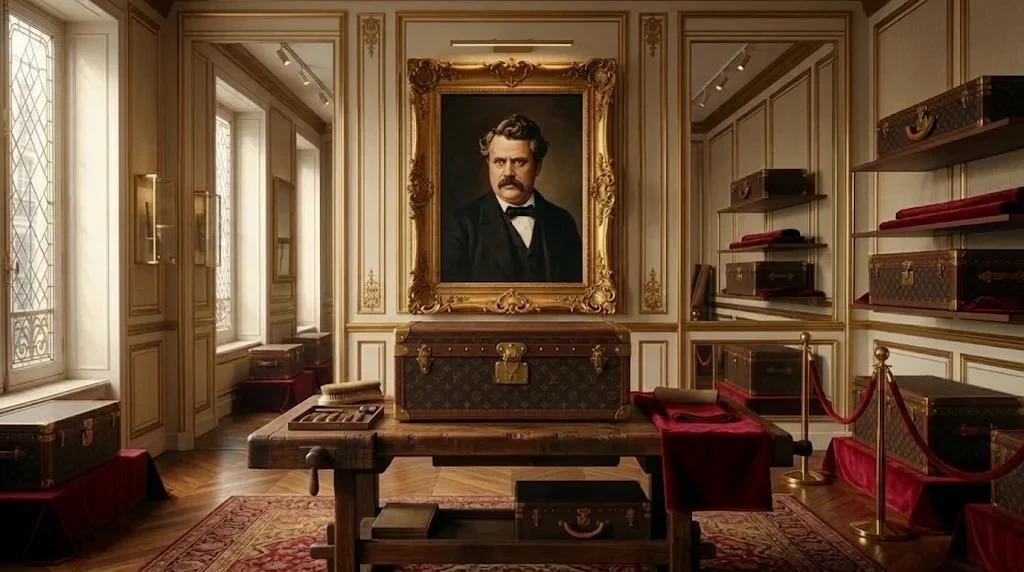
In Paris, Vuitton apprenticed with Monsieur Maréchal, a successful layetier-emballeur a trunk maker and packer, a trade that in the age of horse-drawn travel was closer to engineering than to retail. Packing a lady’s wardrobe for a season at a spa town meant understanding fabrics, weight, balance, and the brutal physics of a coach roof.
He spent seventeen years learning it. When he opened his own workshop in 1854, on rue Neuve-des-Capucines deliberately near Place Vendôme, where the new luxury hotels were rising, he was not a novice with a famous name to come. He was a master at the height of his trade.
The Flat Trunk That Changed Everything
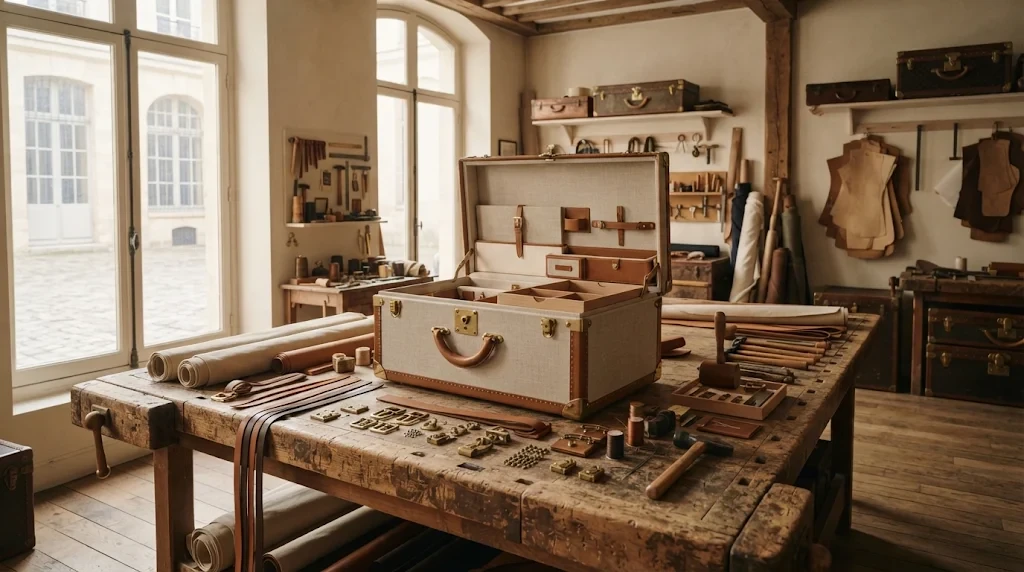
Before Vuitton, trunks had rounded lids, designed to shed water on the roofs of coaches. Elegant, perhaps but impossible to stack. In 1858, Vuitton introduced the flat-topped trunk in grey Trianon canvas: light, airtight, and stackable. It arrived at precisely the moment the railway and the steamship were shrinking the world, and it spread through the traveling classes like good news.
The invention sounds modest. Its consequences were not. The flat trunk is the direct ancestor of every suitcase in every airport today and it made Vuitton’s name. Empress Eugénie, wife of Napoleon III, appointed him her personal packer and trunk maker, and royal and imperial clients across Europe followed. Within a generation, the Louis Vuitton story had become the story of travel itself.
A Family That Kept Building
Louis’s son Georges inherited the house in 1892 and made two moves that still define it. The first was the famous Monogram canvas of 1896 the interlaced LV and floral motifs, created partly as a tribute to his father and partly as a weapon against the counterfeiters who had already begun copying the Vuitton checkered canvas. Few branding systems in history have done their job so well for so long.
The second was the Steamer bag of 1901, a soft, squashable bag designed to hang inside a trunk the true ancestor of the modern handbag, and the founding object of the tradition that leads, through the Keepall of 1930, to the house’s place in any serious conversation about luxury luggage.
The twentieth century brought the modern empire: the Champs-Élysées flagship in 1913 (then the largest travel-goods store in the world), global expansion under the Vuitton generations, and in 1987 the merger with Moët Hennessy that created LVMH. Under creative directors from Marc Jacobs to Nicolas Ghesquière and Pharrell Williams, the house became a fashion power without ever abandoning the trunk maker’s identity the “art of travel” remains its official creed.
The Question Worth Asking
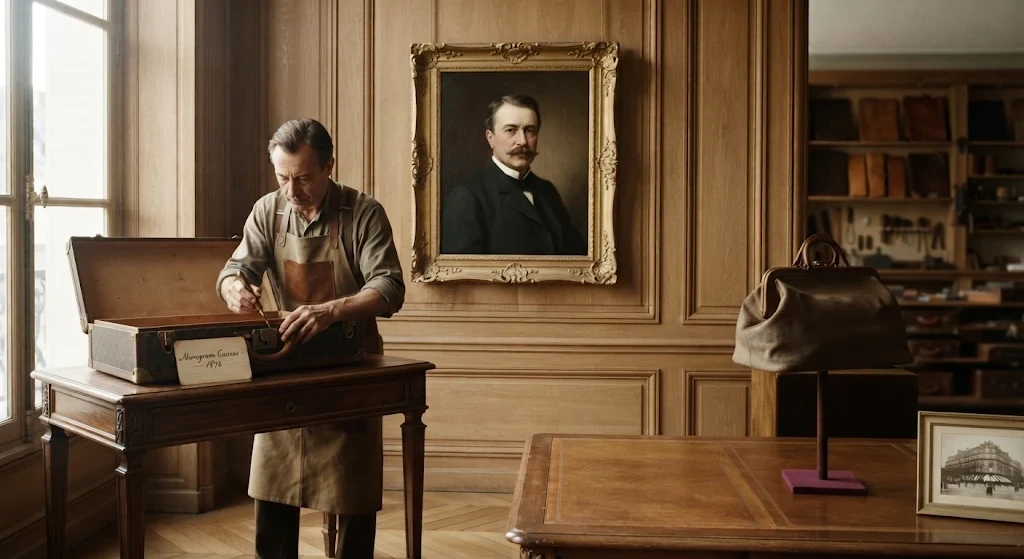
Louis Vuitton is now the most valuable luxury brand in the world, and it is fair to ask what a walk-in boutique on Fifth Avenue has to do with a workshop on rue Neuve-des-Capucines. The honest answer is: more than you might think. The house still makes hard-sided trunks, by hand, at the family home and atelier in Asnières, where special-order library trunks, watch trunks, and trunks for everything from champagne to footballs are still built much as they were in 1859.
Luxury brands constantly promise heritage. Vuitton’s version can be audited: same trade, same town, same hands-on bench, a hundred and seventy years on. In an industry where “legacy” is often a mood board, a working workshop is a rarer thing than a monogram.
That is the real trunk story. Not a logo, but a boy who walked to Paris and spent his life making sure that everything people love could travel with them.
FAQs
When was Louis Vuitton founded?
In 1854, when Louis Vuitton opened his own trunk-making workshop on rue Neuve-des-Capucines in Paris, after seventeen years as an apprentice packer.
What did Louis Vuitton invent?
The flat-topped, stackable trunk (1858), the Monogram canvas (created by his son Georges in 1896), and the Steamer bag (1901) the ancestor of the modern handbag.
Are Louis Vuitton trunks still made by hand?
Yes. Hard-sided trunks and special orders are still built by artisans at the historic Asnières atelier outside Paris.
Why is the LV monogram everywhere?
Georges Vuitton created it in 1896 partly to defeat counterfeiters making it one of the oldest anti-fake designs in luxury history.