Van Cleef & Arpels began with a marriage, and perhaps that is why everything the maison has created since feels like a love story told in stones. In 1895, Estelle Arpels, daughter of a family of precious stone dealers, married Alfred Van Cleef, son of a diamond cutter, in Paris.
Eleven years later, in 1906, the couple and Estelle’s brothers opened a boutique at 22 Place Vendôme, the most prestigious jewelry address in the world, where the maison remains today. From that address, Van Cleef & Arpels built something no competitor has ever successfully imitated: a jewelry house whose signature is not opulence but poetry.
Fairies, ballerinas, lucky clovers, and lovers meeting on a bridge populate its creations, and its most famous design, the Alhambra, became the single most recognized motif in modern jewelry. This is how a family marriage became the most romantic name in the entire luxury landscape.
Place Vendôme and the Art of Invention

The early decades established Van Cleef & Arpels as the jeweler of innovation. The house earned royal warrants and the patronage of Europe’s grandest families, but its restless technical imagination set it apart.
In 1933 the maison patented the Mystery Set, a setting technique in which stones are slid onto hidden rails so that no prongs or metal are visible from the surface, allowing sapphires and rubies to form unbroken rivers of color.
The technique remains one of the most demanding in all of jewelry, reserved for the maison’s most exceptional pieces and virtually impossible to counterfeit.
The inventions kept coming. In the 1950s, the house transformed the humble zipper into a high jewelry necklace that could be worn open around the neck or zipped closed as a bracelet, a creation born when the Duchess of Windsor reportedly suggested the idea.
Ballerina clips with rose cut diamond faces captured mid century elegance. The minaudière, a precious vanity case, answered the practical needs of elegant evenings.
Each creation carried the same signature: technical wizardry placed in service of charm rather than display, a philosophy that distinguishes the maison among the world’s great luxury jewelry houses.
1968: The Clover That Conquered the World
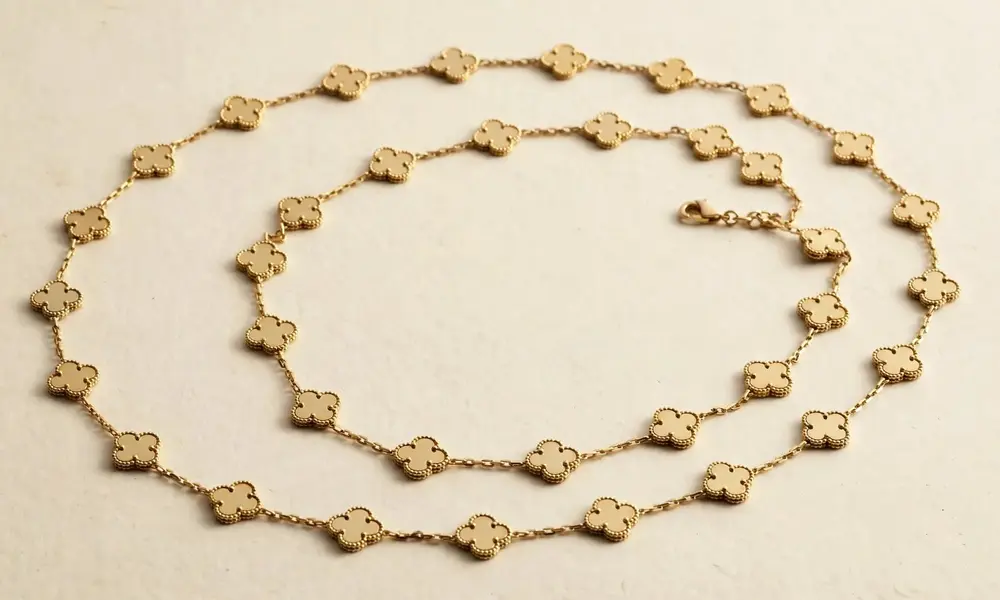
The Alhambra collection was born in 1968, created by Jacques Arpels, Estelle’s nephew, a man who lived by the conviction that luck rewards those who believe in it.
His design took the quatrefoil, a four lobed motif found in Moorish architecture and echoing the arches of the Alhambra palace in Granada, and rendered it as a simple beaded edged clover in yellow gold.
The first piece was a long necklace of twenty motifs, and it was an immediate triumph: elegant women of the era, from Françoise Hardy to Grace Kelly’s circle, adopted it as a talisman of effortless chic.
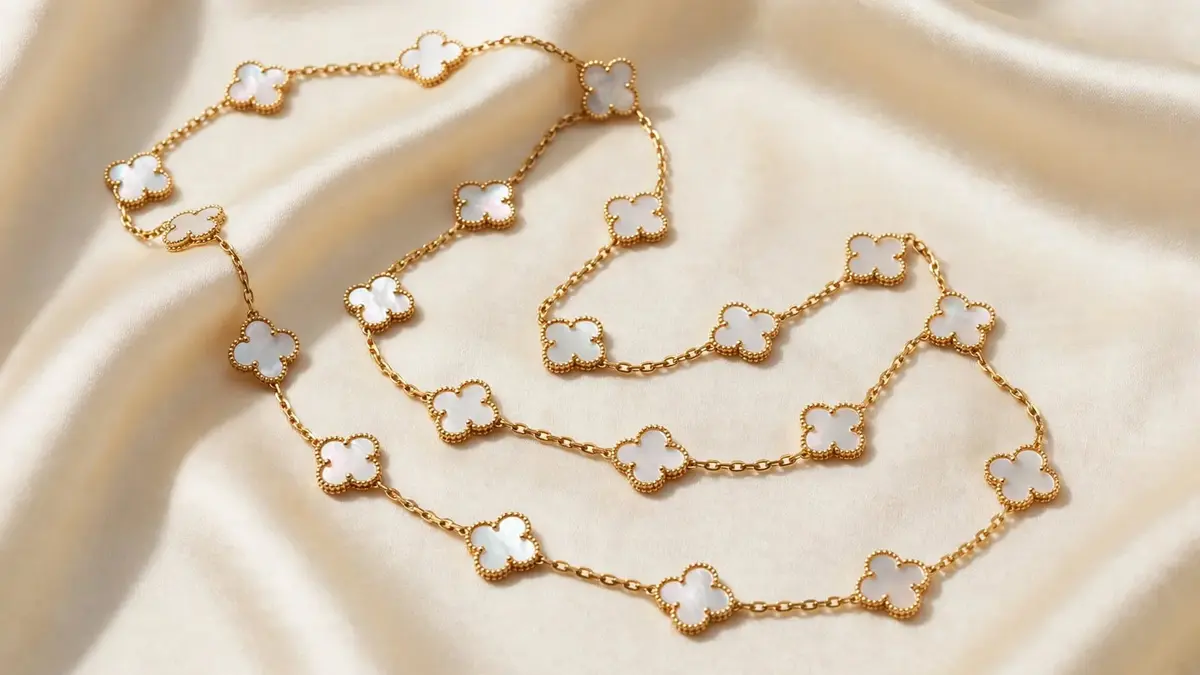
More than half a century later, the Alhambra is arguably the most successful jewelry design ever created. It exists in mother of pearl, onyx, carnelian, malachite, tiger’s eye, guilloché gold, and diamonds, in sizes from delicate Sweet Alhambra studs to twenty motif sautoirs.
It has survived every trend cycle since 1968 without a single redesign, and it anchors the fortunes of the maison, driving waiting lists at boutiques worldwide.
Few objects in luxury can claim what the Alhambra can: grandmothers, mothers, and daughters wear the same design by choice, a multigenerational embrace that places it at the center of the world’s most coveted fine jewelry.
A Maison of Stories: Fairies, Ballerinas, and Lovers
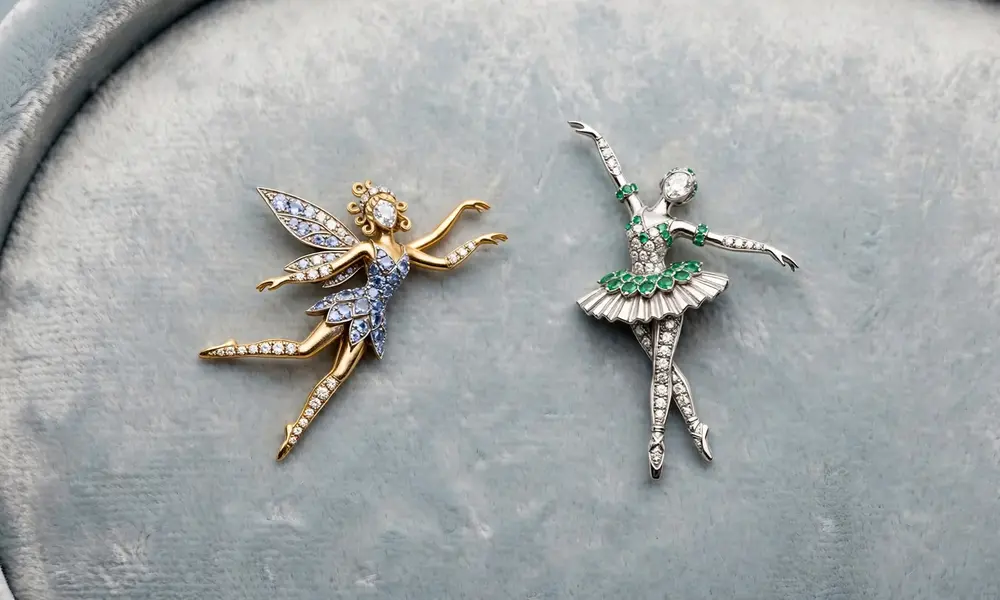
Beyond the clover, the maison’s high jewelry reads like an enchanted library. The fairy and ballerina clips, which began in the 1940s, continue today as winged figures with rose cut faces.
Collections draw on literature, from Shakespeare’s A Midsummer Night’s Dream to Jules Verne, and on nature rendered with botanist’s precision in the Frivole and Lotus lines.
The Perlée collection translates the beaded edge of the Alhambra into golden spheres, and the Between the Finger rings let butterflies and flowers rest between digits as if just landed.
The same storytelling extended into watchmaking, where Van Cleef & Arpels created the Poetry of Time concept.
The Lady Arpels Pont des Amoureux, introduced in 2010, depicts two lovers on a Paris bridge who move toward each other as the hours pass, meeting for a kiss at noon and midnight before parting again.
It is less a watch than a mechanical poem, and it earned the maison a devoted following among collectors who normally care only for calibers, securing its place in conversations about the most iconic watches ever made.
Grace Kelly, Royalty, and the Riviera Connection

No account of the maison is complete without its royal chapter. Van Cleef & Arpels became the official jeweler of the Principality of Monaco, and Princess Grace was among its most devoted clients, wearing Alhambra pieces with a naturalness that made the clover synonymous with Riviera elegance. The relationship between the maison and the Grimaldi court endures, with the house creating pieces for royal occasions across generations.
Royal patronage mattered because it confirmed what the design already suggested: this was jewelry for women who did not need to prove anything. The Alhambra in particular offered an alternative to the aggressive sparkle of pure diamonds, a design that whispered.
In an industry where value is often measured in carats, the maison built its empire partly on mother of pearl and onyx, proving that desire responds to meaning as much as material, a lesson visible across the tier rankings in our guide to the most expensive jewelry brands.
The Quiet Giant of Richemont
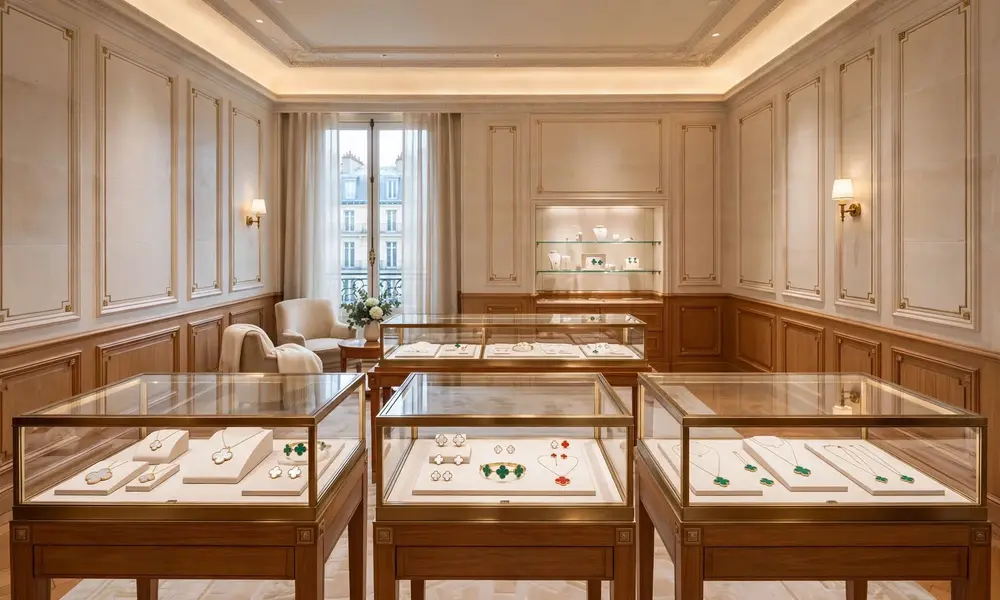
Today Van Cleef & Arpels operates within the Richemont group, and by the measures that matter, it has become one of the most powerful jewelry businesses on earth. Industry analysts consistently rank the maison at or near the top of global jewelry sales, a position achieved with remarkably restrained distribution and almost no discounting of any kind.
The Alhambra boutiques maintain waiting lists, the high jewelry ateliers above Place Vendôme continue the Mystery Set tradition, and L’École, the school of jewelry arts founded by the maison in 2012, teaches the public the crafts behind the magic in Paris, New York, Hong Kong, and beyond.
What the modern maison protects above all is tone. Visit any boutique worldwide and the experience is consistent: serene, unhurried, slightly enchanted. The clover’s promise, luck for those who believe in it, has proven to be sound business. One hundred and thirty years after a marriage joined two jewelry families, the maison they founded remains the proof that in luxury, tenderness is a strategy, and poetry, patiently practiced, compounds like capital.
FAQs
When was Van Cleef & Arpels founded?
Van Cleef & Arpels was founded in 1906 at 22 Place Vendôme in Paris by Alfred Van Cleef and Estelle Arpels, along with her brothers. Their marriage in 1895 brought together two families involved in the diamond trade.
What is the Van Cleef & Arpels Alhambra?
The Alhambra is the maison’s signature jewelry collection, introduced in 1968. It features a four-leaf clover motif surrounded by golden beads, symbolizing luck. The collection includes necklaces, bracelets, earrings, and watches made with materials such as mother-of-pearl and diamonds.
Why is the Alhambra so popular?
The Alhambra remains popular because of its timeless clover design, symbolic meaning, and versatility. Its availability in different materials and sizes appeals to multiple generations, while limited distribution keeps demand high.
What is the Mystery Set?
The Mystery Set is a patented jewelry technique introduced by Van Cleef & Arpels in 1933. It uses hidden rails to hold gemstones without visible prongs or metal, creating a smooth surface of uninterrupted color.
Who owns Van Cleef & Arpels?
Van Cleef & Arpels is owned by the Swiss luxury group Richemont, which also owns Cartier. The maison continues to operate as one of the world’s leading luxury jewelry brands.
What is the Pont des Amoureux watch?
The Lady Arpels Pont des Amoureux is a poetic watch introduced in 2010. It features two lovers meeting on a Paris bridge and sharing a kiss at noon and midnight, reflecting the maison’s creative approach to watchmaking.
Did royalty wear Van Cleef & Arpels?
Yes, Van Cleef & Arpels has a long history of serving royal clients, including Monaco’s royal family. Princess Grace was a devoted Alhambra collector, while the Duchess of Windsor also inspired some of the maison’s famous jewelry designs.
Is the Alhambra a good investment?
Alhambra jewelry can retain its value because of its recognizable design, strong demand, and controlled supply. Resale prices depend on the piece’s condition, materials, rarity, and whether original packaging and certificates are included.