In 1904, King Edward VII of England reportedly called the House of Cartier “the jeweler of kings and the king of jewelers.” It is one of the great phrases in luxury history, quoted so often it has become wallpaper.
What is rarely explained is how a family of modest Parisian craftsmen earned it in barely two generations, and why the answer has less to do with gemstones than with geography, timing, and three brothers who divided the world between them.
Cartier’s rise is the clearest example in luxury history of a brand built not on a single invention but on a strategy one deliberate enough to still be running today.
A Workshop, Not a Palace
Louis-François Cartier was a watchmaker’s apprentice who took over his master’s small workshop at 29 rue Montorgueil, Paris, in 1847. Nothing about the beginning was grand. Paris was a city of workshops, and jewelry was a trade of credit, connections, and patience a world away from the palatial boutiques the name now commands.
What Louis-François understood, and what he passed to his son Alfred, was that jewelry is ultimately a business of trust between the maker and the very rich.
The Cartiers cultivated the wives of the Second Empire elite, moved the shop steadily toward the fashionable heart of the city, and survived the catastrophes that destroyed lesser houses: the Franco-Prussian War, the Siege of Paris, the Commune.
By the time Alfred’s three sons came of age, the family had something more valuable than a famous name they had a client list.
Three Brothers, Three Capitals
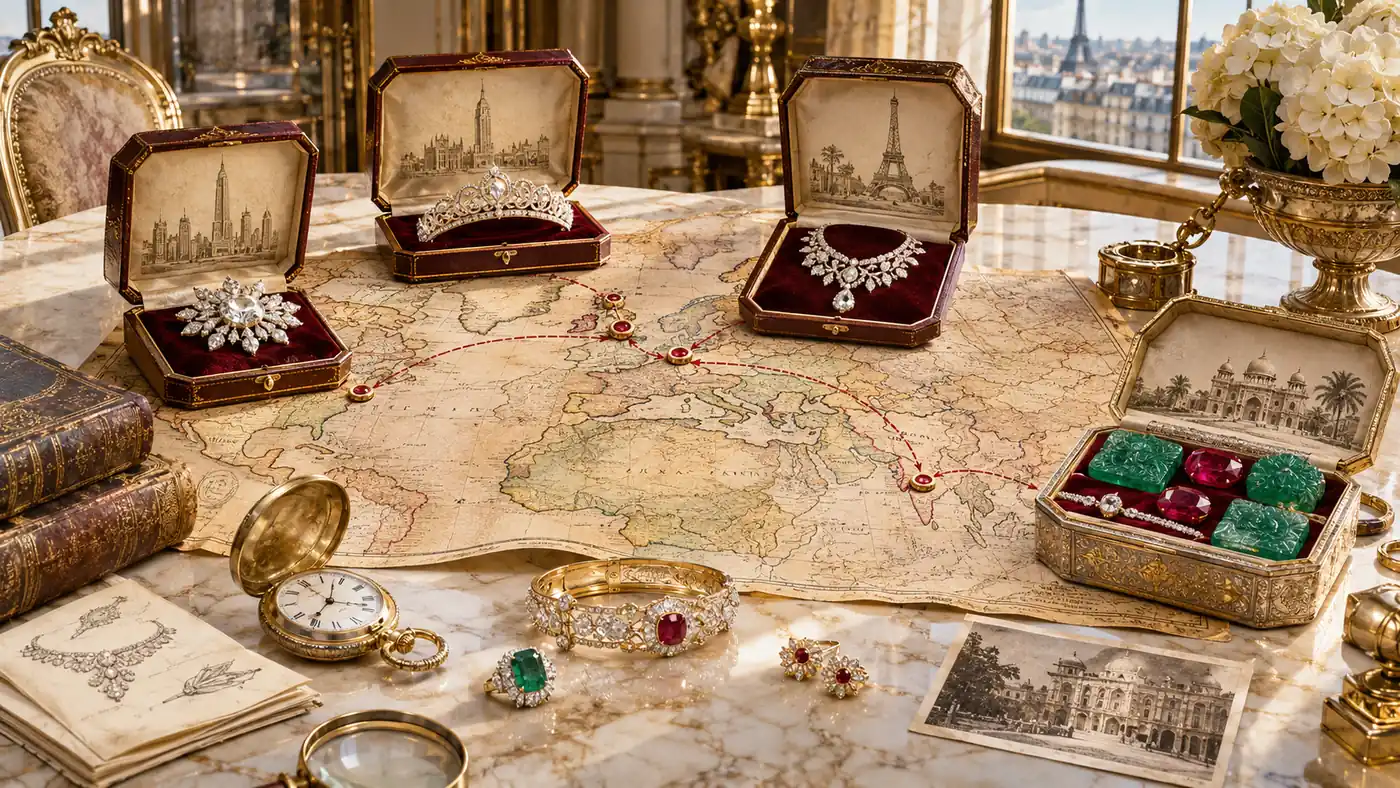
The founding generation’s masterstroke was a map. Around the turn of the twentieth century, the three Cartier brothers divided the world’s luxury markets among themselves, each taking a capital.
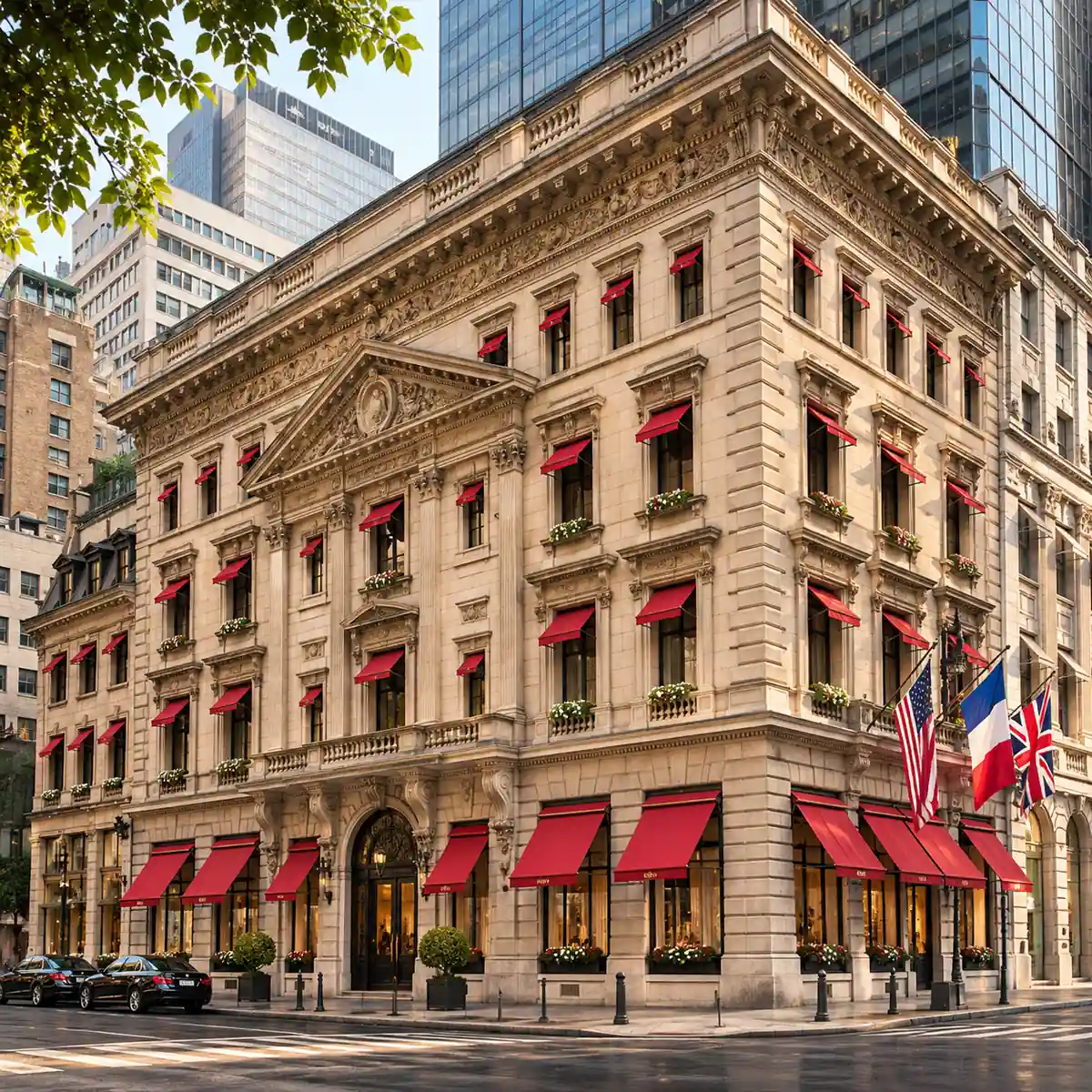
Louis stayed in Paris the creative soul of the house and, by common consent, one of the greatest jewelry designers who ever lived. Pierre took London in 1902, and then, decisively, New York in 1909, planting the house on Fifth Avenue in 1917 in a Renaissance-style mansion acquired, according to well-documented legend, in exchange for a double strand of natural pearls valued at the time at over a million dollars.
Jacques, the youngest, ran London and spent his winters in India, where he bought carved emeralds and rubies from maharajas stones that would flow back to Paris and re-emerge as the Tutti Frutti jewels that remain among the most recognizable designs ever made.
It is hard to overstate how modern this was. A Parisian creative center, a beachhead in London, a mansion on Fifth Avenue, and a sourcing network reaching into the treasuries of India: Cartier had built, by 1910, something like the first global luxury brand decades before the phrase existed.
The Royal Warrant Machine
The “jeweler of kings” was not poetry. It was a business model. Edward VII granted Cartier a royal warrant in 1904, and the house pursued the strategy systematically: warrants followed from the courts of Spain, Portugal, Russia, Siam, Greece, Serbia, Belgium, Romania, Egypt, and Monaco, among others.
Each warrant was both an honor and an advertisement a seal of approval that told every arriviste industrialist in Europe and America exactly where crown-worthy jewels came from.
Cartier was not the only jeweler with royal clients. It was the jeweler who understood royal clients as a system and in doing so it wrote the playbook that luxury houses still follow: secure the apex of society, and the aspirational market takes care of itself.
The Designs That Became Permanence
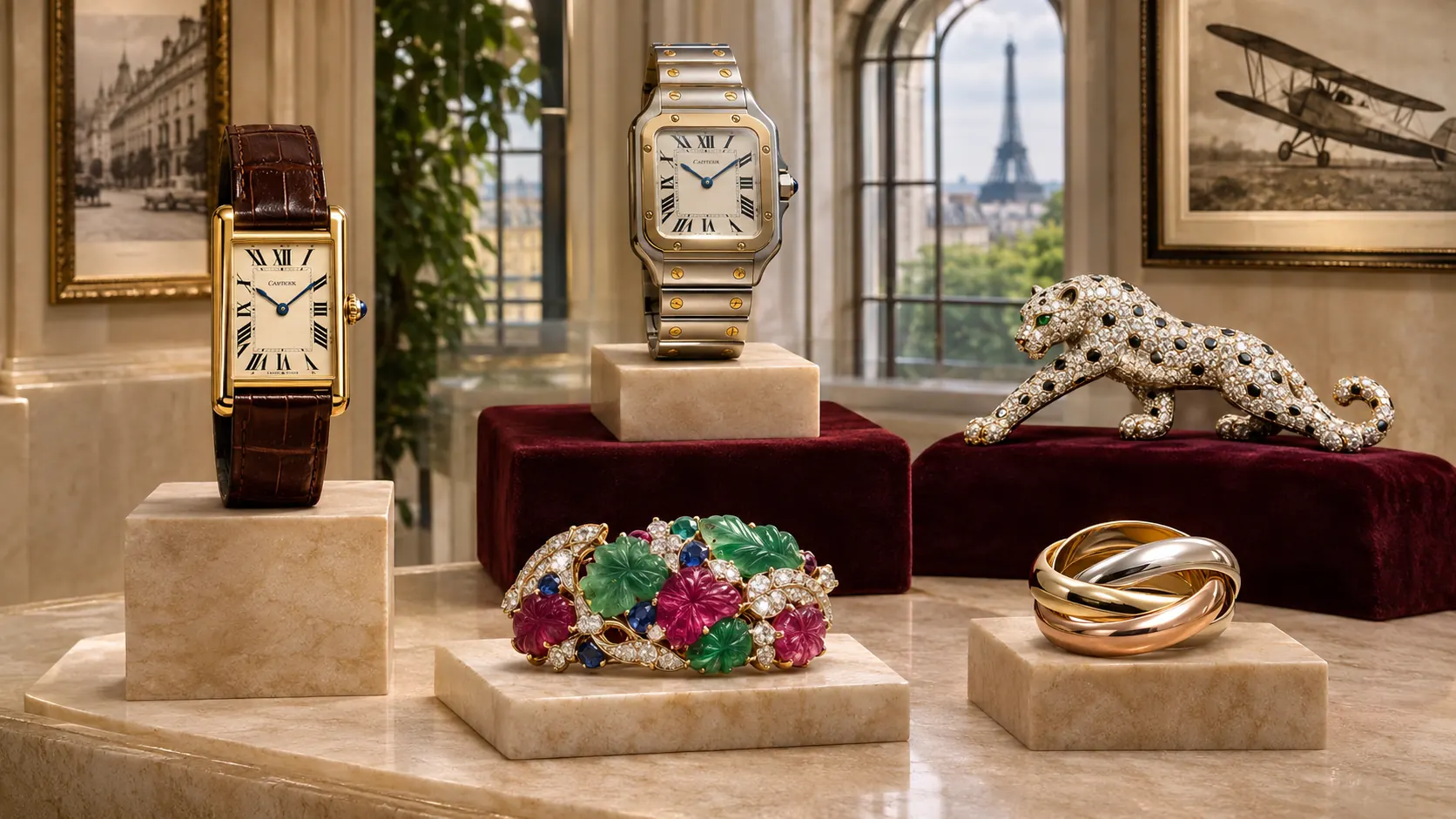
Genius at retailing would have meant nothing without the objects, and here Louis Cartier’s Paris atelier delivered a run of designs unmatched in the industry’s history.
The Santos wristwatch of 1904 created for the aviator Alberto Santos-Dumont, who needed to check the time without letting go of his aircraft’s controls is often called the first purpose-designed men’s wristwatch, and it began the century-long migration of the watch from pocket to wrist. The Tank of 1917, its rectangular case said to be inspired by the Renault tanks of the Western Front, established the grammar of the dress watch.
The panthère motif the slinking, spotted cat that became the house’s emblem emerged in the 1910s and found its greatest champion in Jeanne Toussaint, the formidable creative director whose taste shaped Cartier for decades. The Tutti Frutti jewels turned Jacques’s Indian stones into a riot of carved color.
The Love bracelet of 1969 locked onto the wrist with a tiny screwdriver arrived a generation later and proved the house could still invent icons, and the Trinity ring, three interlaced bands of yellow, white, and rose gold, has been quietly selling since 1924.
A pattern runs through all of them: strong geometry, legible design, and ideas bold enough to remain current for a century. In the conversation about which houses deserve the title of most expensive jewelry brand, Cartier’s case rests less on price than on this extraordinary shelf-life of design.
Surviving the Century
The twentieth century tested every great house, and Cartier nearly failed the test. After the brothers’ generation passed, the business fragmented Paris, London, and New York were separately owned and by the 1960s and 70s the name risked dilution.
The rescue came from a group of investors led by Robert Hocq, who bought the New York branch in 1972 and launched “Les Must de Cartier,” a more accessible line that put the name back in front of a new generation, before the three branches were reunited.
In 1993 the house became part of what is now the Richemont group, where it anchors the portfolio of fine jewelers and consistently ranks among the leaders of any honest ranking of luxury jewelry brands.
The modern Cartier has also been careful with its own history: the Cartier Collection, assembled from the 1970s onward, buys back and preserves historic pieces, and its exhibitions in the world’s great museums treat the archive as scholarship rather than nostalgia.
What the Three Brothers Actually Teach
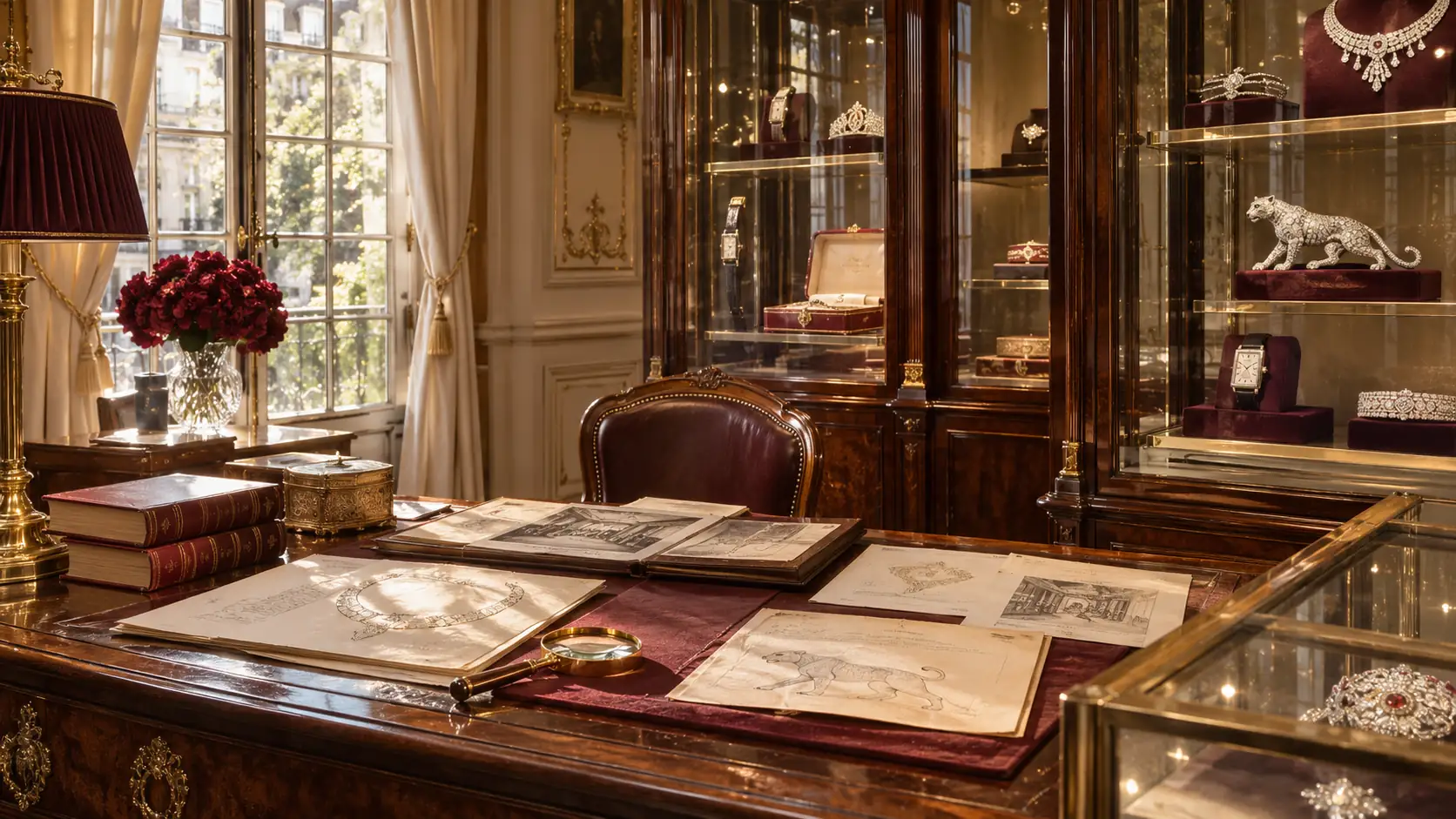
Every luxury founder claims to sell dreams. The Cartier brothers sold something more durable: a structure. Paris made, London and New York sold, India supplied and the whole machine was wrapped in royal warrants that functioned as the century’s most credible marketing.
When the design genius of Louis met the commercial geography of Pierre and the sourcing eye of Jacques, the result was not a jewelry shop with famous clients. It was the template of the global luxury house.
That is why the Edward VII quote endures. He was not describing the stones. He was describing the system and a hundred and twenty years later, on Fifth Avenue and rue de la Paix alike, the system is still running.
FAQs
When was Cartier founded?
In 1847, when Louis-François Cartier took over his master’s workshop at 29 rue Montorgueil in Paris.
Why is Cartier called the jeweler of kings?
King Edward VII reportedly used the phrase, and the house held royal warrants from more than a dozen courts, including England, Spain, Russia, and Monaco.
Did Cartier invent the wristwatch?
The 1904 Santos, made for aviator Alberto Santos-Dumont, is widely credited as the first purpose-designed men’s wristwatch the moment the watch began moving from pocket to wrist.
Who owns Cartier today?
Cartier is owned by the Swiss luxury group Richemont, and its Paris, London, and New York branches were reunited under single ownership in the late twentieth century.