Fine, flat hair can look fuller with a lightweight wash, but the right match depends on your scalp and strands. A polymer is a film-forming ingredient that coats each strand, helping hair look thicker.
The best volumizing shampoo can create fuller-looking volume for a while, but it cannot permanently change hair density. This roundup compares choices for different hair and scalp needs, including fine hair, color-treated strands, and oily roots.
Hair care works best when your formula fits your own texture and needs. Match the formula to your hair’s needs, then use lightweight styling to build extra lift.
Key Takeaways
- Volumizing shampoos can help hair look fuller for a short time.
- Choose based on both your scalp and your lengths.
- Fine strands often do best with lightweight formulas.
- Conditioner can add moisture without coating the roots.
- Styling and drying choices can add visible lift.
- Clarify when hair starts to feel coated or flat.
How Do Volumizing Formulas Create a Fuller Look?
A volumizing wash usually creates a fuller look by removing weight and making individual strands seem more substantial. The effect is temporary, and it does not create new hair or change follicle size.
Oil, sweat, and styling buildup can cling to the scalp and strands. A cleansing formula can remove some of that weight, helping flat hair sit with more movement. The result depends on how much buildup was present and how the formula feels on your hair.
Cleansing clears away weight
Volumizing shampoos clean away oil and buildup that can pull hair close to the scalp. This can help roots feel lighter after washing. A very strong cleanse may feel drying on some hair, so a squeaky-clean feel is not the only sign of a good match.
Proteins and polymers change the look of strands
Some formulas use protein to plump the look of strands. Polymers can coat each strand, helping it appear thicker. Neither ingredient makes hair grow or changes its density.
- Oil and buildup removal can make roots feel lighter.
- Protein can make strands look plumper.
- Polymers can coat strands to make them appear thicker.
Treat the result as a styling effect, not a permanent change in hair density.
When judging a wash, Allure testers assess efficacy, texture and experience, fragrance, and packaging. Their review process also reflects that hair types and personal needs can differ widely.
Focus on how your scalp and hair feel after washing, not just how much body you see in the mirror.
Which Formula Fits Your Hair Type?
Fine strands tend to lose lift under heavy formulas, while color-treated or damaged hair may need a gentler match. Start with your hair’s condition, and treat ingredient labels as clues rather than guarantees.
Fine hair means each strand is small in diameter; it does not always mean you have fewer strands. Lightweight cleansing and ingredients such as keratin, biotin, or hydrolyzed wheat protein may appear in formulas made for fine hair. Your scalp still matters, since some people produce more oil than others.
Fine, flat hair needs a lightweight feel
A rich formula can leave fine, flat hair feeling coated and short on volume. Curls may need more moisture, while straight fine strands can lose lift under heavy oils or creams. Consider how your natural oils affect your roots as well as how your lengths feel.
Color-treated or damaged hair needs a careful match
Color-treated strands may feel dry or fragile, and damaged hair can need more care than a basic volume formula offers. Sulfate-free and vegan are separate formula claims; neither one guarantees volume or moisture. If you have a sensitive scalp, the full formula may matter more than one featured ingredient.
| Hair need | Formula priority | What to watch for |
|---|---|---|
| Fine or flat | Lightweight cleansing | Heavy coating at roots |
| Color-treated | Color-safe formula | Dry or rough lengths |
| Damaged | Gentle cleansing | Breakage or dryness |
| Fine with easily weighed-down lengths | Light moisture | Rich oils or creams |
For more help matching a shampoo to your scalp and conditioner to your lengths, see how to choose shampoo and conditioner. Use your scalp’s oil level and your lengths’ condition as separate clues when choosing a bottle.
Best Volumizing Shampoo for Fine Hair
For fine hair that needs body without a heavy finish, Redken Volume Injection Shampoo is the clearest starting pick. Its lightweight feel suits the common need for lift without weighing strands down, and it is the best fit here for fine hair seeking body.
For the best volumizing shampoo for fine hair, Redken is a practical first choice. The best volumizing shampoo for women also depends on color treatment, scalp needs, and how much moisture your lengths need. These five products offer different formula details and tradeoffs.
| Product | Best fit | Formula details |
|---|---|---|
| Redken Volume Injection Shampoo | Fine hair needing body | Lightweight volume without weighing hair down |
| OUAI Fine Hair Shampoo | Fine hair and sulfate-free preference | Chia seed oil, biotin, keratin; listed at $32 |
| Biolage Volume Boost Shampoo | Vegan formula preference | Soy protein, polymers, cellulose, peptides; vegan, paraben-free, silicone-free |
| Living Proof Full Shampoo | Color-treated hair | Sulfate-free, vegan; amaranth peptides and phytantriol |
| Dove Scalp + Hair Therapy Density Boost Hydrating Shampoo | Hydration and volume | Niacinamide, zinc, glycerin; listed at $9 |
OUAI offers a sulfate-free choice, while Biolage includes soy protein and polymers. Living Proof is marked safe for color-treated hair, and its formula is sulfate-free and vegan. Dove’s shampoo received a 2024 Allure Best of Beauty Award for volumizing properties.
Biolage’s cellulose and peptides add to its formula alongside soy protein and polymers. Allure testers consider efficacy, texture and experience, fragrance, and packaging; a range of hair types and needs matters when judging personal-care products.
Check the product label against your color-treatment and ingredient preferences before buying.
Which Drugstore Picks Offer Lightweight Volume?
Pantene Sheer Volume is the budget-friendly starting point for fine, color-treated hair, while L’Oréal Paris EverPure is a sulfate-free alternative. Both cost less than many salon options, and EverPure is listed under $10.
The best drugstore volumizing shampoo depends on the formula and format you will use. Pantene Sheer Volume is listed at $9.50 and is described as lightweight for fine, color-treated hair. The choices below also include a solid shampoo bar.
| Product | Best fit | Formula details |
|---|---|---|
| Pantene Sheer Volume | Fine, color-treated hair | Lightweight formula; listed at $9.50 |
| L’Oréal Paris EverPure Thickening | Sulfate-free, vegan preference | Sulfate-free and vegan; under $10 |
| Dove Volume & Fullness | Flat, fine hair | Biotin and Bio-Protein Care technology |
| John Frieda ULTRAfiller+ Thickening Shampoo | Damaged or thin hair | Biotin, hyaluronic acid; silicone-free |
| KITSCH Rosemary & Biotin Volumizing Shampoo Bar | Solid shampoo format | Rosemary leaf extract, biotin, amaranth seed extract, hydrolyzed oat protein |
Dove Volume & Fullness is made for flat, fine hair and includes biotin. John Frieda ULTRAfiller+ is made for damaged or thin hair, with biotin and hyaluronic acid. These products show that a drugstore volume shampoo can target different needs rather than one hair type.
KITSCH lists its bar at $14 and describes it as lasting 100 washes. That count is a product description, not a promise for every person’s use; hair length and washing habits can affect how long a bar lasts.
Pantene Sheer Volume’s listed $9.50 price gives a clear budget point for comparison. Compare the formula and format you will actually use, not just the bottle price.
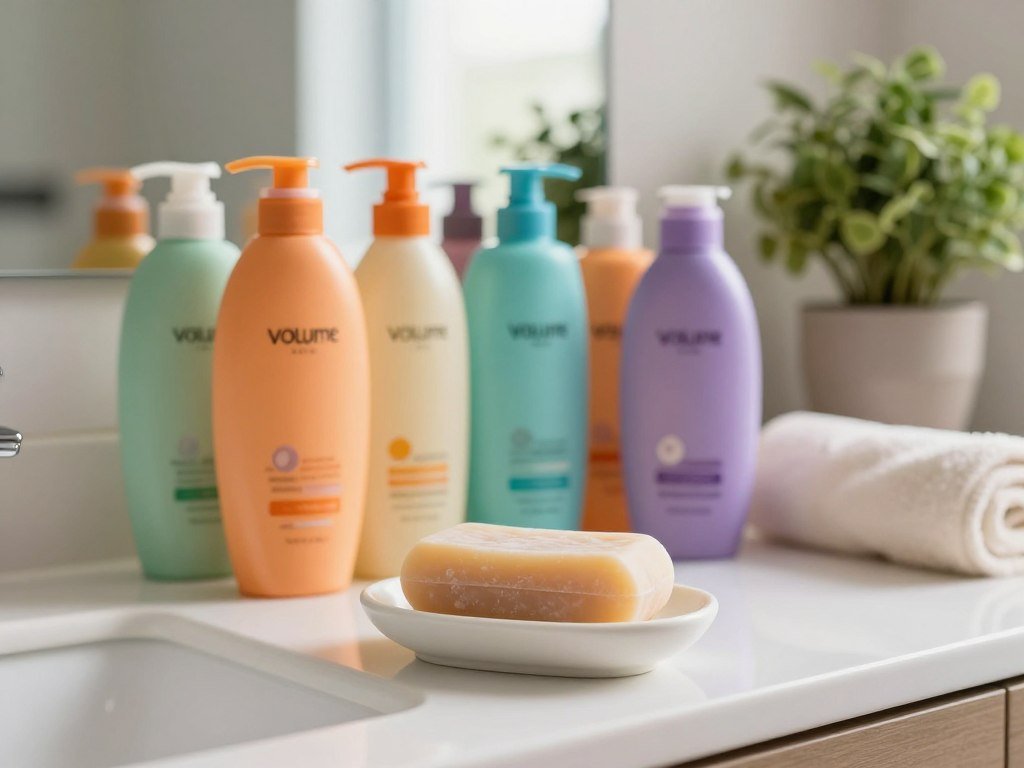
How Should You Pair Volumizing Shampoo and Conditioner?
A good shampoo-and-conditioner pair cleans the scalp while keeping moisture focused on the lengths that need it. Choose each product for a different job: the shampoo should suit your scalp, and the conditioner should suit your lengths.
A volumizing conditioner should feel light enough for your hair, especially if fine strands lose lift easily. Marc Anthony Big Volume Set is one named shampoo-and-conditioner example; it uses a Fibre Filler Complex, and its shampoo is sulfate-free. It is an option, not a universal best.
| Situation | Shampoo approach | Conditioner approach |
|---|---|---|
| Fine strands | Lightweight cleansing | Light formula on lengths |
| Oily roots with dry ends | Cleanse scalp well | Moisture on dry ends |
| Color-treated hair | Consider color-safe formula | Choose for dry or fragile lengths |
- Choose a lightweight conditioner.
- Use it mainly from mid-lengths to ends.
- Rinse based on how your hair feels, not to leave a heavy coating.
Rinsing well can help prevent a coated feel, while a rich formula may be better suited to thirsty lengths than fine roots. For a broader look at a shampoo conditioner match, compare scalp condition with hair type.
If the roots feel coated after washing, reduce conditioner near the scalp before changing the shampoo.
Can Men Use Volumizing Shampoo?
Men can use the same volume-focused formulas as anyone else, with the choice guided by hair texture and scalp needs. Gender is not the deciding factor, and fine, oily, dry, or color-treated hair still needs a fitting formula.
Hims Thick Fix Thickening Shampoo is a men-focused option. It is sulfate-free and contains saw palmetto and lactic acid. The two-pack is listed at $25.
A man with fine hair may want a lightweight wash, while someone with dry lengths may need a gentler match. An oily scalp may call for a different cleansing feel than a dry or sensitive scalp. Hair products can be marketed by gender, but the label does not replace attention to your own hair and scalp.
Choose a product for the hair you have, not just the audience named on its label.
How Can You Add Volume to Oily Roots?
Oily roots can make hair look flat, but a stronger cleanse is not automatically the right answer for every length. Balance matters: remove excess oil without stripping natural oils your lengths need.
Sulfate-containing volumizing shampoos may dry hair by stripping natural oils. That can be a poor fit for curly, coarse, or dry hair, even when roots get oily. Guillaume Boucher recommends sulfate-free shampoos with moisturizing ingredients such as argan oil, jojoba oil, or green tea extract.
Choose a lighter shampoo for the scalp and enough moisture for the lengths. Curly hair may need more moisture than a volume-focused formula provides, while fine hair can feel weighed down by rich products. Pay attention to how your scalp and ends feel after a wash, since they can have different needs.
If your scalp feels clean but your ends feel rough, adjust moisture at the ends rather than adding a heavy product at the roots.
How Should You Wash and Dry for More Lift?
Gentle drying followed by a directed blow-dry can help keep roots from drying flat against the scalp. Use gentle handling, and aim warm air at the roots for extra lift.
Fabrice Gili says heat helps activate volumizing ingredients and recommends gentle towel-drying, followed by blow-drying for more root lift. Press water out with a towel instead of rubbing wet hair hard. If you use a straightener after drying, choose a setting that suits your hair and avoid repeated passes; this guide to choosing a hair straightener covers those points.
A shampoo bar needs a slightly different wash routine. KITSCH recommends fully wetting hair, lathering the bar in your hands, applying the lather, massaging the scalp with fingertips, and rinsing with cool water.
- Wet your hair fully.
- Lather the shampoo bar in your hands.
- Apply the lather and massage your scalp with your fingertips.
- Rinse with cool water.
KITSCH’s shampoo-bar directions give a clear sequence for using the solid format. Keep the dryer moving and avoid rough towel rubbing while hair is wet.
Which Styling Products Add the Most Volume?
Choose a styling product based on where you want volume and how much texture you want. Mousse adds broad body, while root-lifting spray targets hold at the roots.
One product is often enough for fine hair. Too many layers can leave strands heavy, dull, or hard to move. Start by matching the product to the result you want, not by stacking several formulas.
Mousse and root-lifting sprays target lift
Volumizing mousse can coat strands with lightweight polymers, adding body through more of the hair. It can suit someone who wants an all-over fuller look. Jennifer Nast describes mousse as a way to add lift.
Root-lifting sprays work closer to the scalp and provide hold at the roots. They can be a better fit when the crown needs lift but the lengths already have enough body. Nast describes root sprays as a way to give hold at the roots.
Texture sprays add separation and grit
Texture sprays add friction between strands, which can create separation and a tousled look. They are useful when you want a less polished finish rather than smooth, even body. Use a light touch if your strands are fine.
Think about the finish as well as the amount of lift. Mousse spreads body, root spray holds a smaller area, and texture spray adds grit. A lot of product can flatten the result instead of helping it hold.
Start with one styling product so you can tell whether it gives lift without leaving residue.
How Can You Keep Volume Without Buildup?
A formula that gives lift at first can feel heavy after repeated use if its film-forming ingredients build up. Pay attention to changing texture, and Matt Rez recommends clarifying shampoo every other wash to help prevent buildup.
Repeated use of some volumizing shampoos can leave polymers and proteins on the hair. The residue may make strands feel coated or cause roots to fall flat. A clarifying shampoo can help remove product residue, excess oils, and hard-water minerals.
The right clarifying routine depends on your hair type and product use. Oily hair or frequent styling products may call for more frequent clarifying, while curly or color-treated hair may need less. See this guide to clarifying shampoo for more on using it without overdoing it.
Use the hair’s coated or flattened feel as a cue to clarify rather than layering on more styling product.
Can You Naturally Improve the Look of Hair Volume?
Natural-looking volume is possible through styling, but a fuller appearance is not the same as growing more hair. Visible lift can come from simple choices, and a shampoo should not be treated as a proven hair-growth treatment.
A layered haircut can add movement, and a root-focused blow-dry can make hair appear fuller. Using less product can also help fine strands stay light. These steps change the look of volume, not the number of hairs on your scalp.
- Ask for layers that suit your hair’s natural movement.
- Blow-dry the roots for lift instead of drying them flat.
- Use a light touch with products to keep strands from feeling coated.
A 2015 randomized trial compared people applying rosemary oil to the scalp twice daily for six months with people using 2% minoxidil. The rosemary-oil group had a hair-count improvement statistically equivalent to the minoxidil group, with significantly fewer side effects.
The rosemary-oil trial tested scalp-applied oil, not rosemary shampoo.
Treat rosemary oil and shampoo as different interventions, and discuss hair-growth concerns with a health professional.
Conclusion
A lightweight formula is a sensible first test if your main goal is fuller-looking hair without a heavy finish. Match the shampoo to your scalp, then choose conditioner and styling support that will not weigh down your lengths.
Try a suitable formula for a few washes and notice whether your hair feels clean, light, and comfortable. Change one part of your routine at a time, so you can tell what helps and what leaves your strands flat.
Start with the product that best fits your hair and scalp, then adjust only what is not working.
FAQ
Do volumizing shampoos work?
How do I make my thin hair have more volume?
What is the best shampoo for older ladies’ hair?
What are the best volumizing shampoo and conditioner for thin hair?
What is the best volumizing shampoo for thin hair?
How do I keep my hair volumized all day?
What products add volume to hair?
How can I naturally increase my hair volume?