The VIP helicopter interior is one of luxury’s strangest arts, a discipline where the craftsman must think like a yacht builder and count grams like a watchmaker simultaneously. A completion designer who has fitted cabins for heads of state explained the central tension to me beside a half finished H160 in a hangar in Texas.
In a yacht, she said, running a hand along a veneer panel, we ask what the client loves.
In a helicopter, we ask what the client loves, and then we ask what it weighs. Every luxury material behaves differently when it must fly: marble becomes honeycomb panels thinner than a credit card, hardwood becomes veneer measured in fractions of a millimeter, and silence itself, the most precious cabin luxury, is engineered from acoustic layers that add pounds the performance calculations notice.
The result, at its best, is a flying salon that rivals the finest yacht interiors in the superyacht world, achieved within constraints no yacht designer ever faces. This is how those cabins are made, who makes them, and what they cost.
The Weight of Luxury
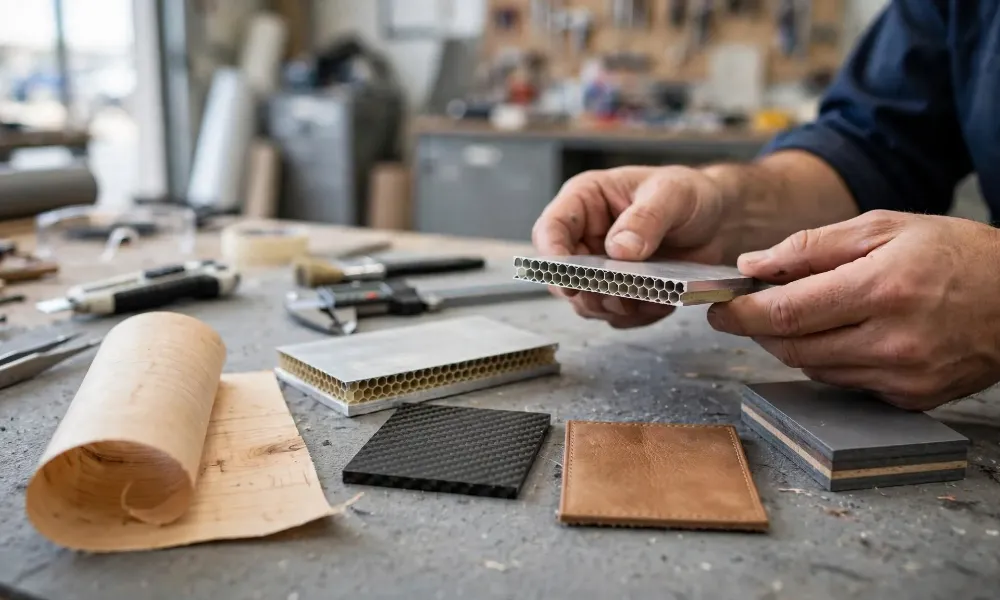
Everything in a VIP helicopter interior begins with physics. Helicopters operate on unforgiving weight margins: every kilogram of interior is a kilogram of range, fuel, or payload surrendered, so the completion industry has evolved an entire materials science of lightness. Leathers are split thin and backed with aerospace foams.
Veneers are sliced to fractions of a millimeter and bonded to honeycomb cores. Carbon fiber replaces wood structure wherever the eye does not travel. Even the cabinetry is engineered with cutouts invisible to the passenger, pocketed like a racing bicycle frame.
The acoustic engineering is the cabin’s hidden masterpiece. Helicopter cabins contend with engine, transmission, and rotor noise of a character entirely different from jets, and the VIP interior attacks it with layered barriers, vibration isolators, and tuned absorption, pursuing the whisper cabin where conversation happens at living room volume.
The finest modern types, the H160 and ACH160 with its quiet Fenestron tail rotor, the AW109 GrandNew, and the medium Sikorsky and Leonardo machines featured in our guide to luxury helicopter models, arrive with better bones than ever, and the completion houses build upon them.
The Completion Houses
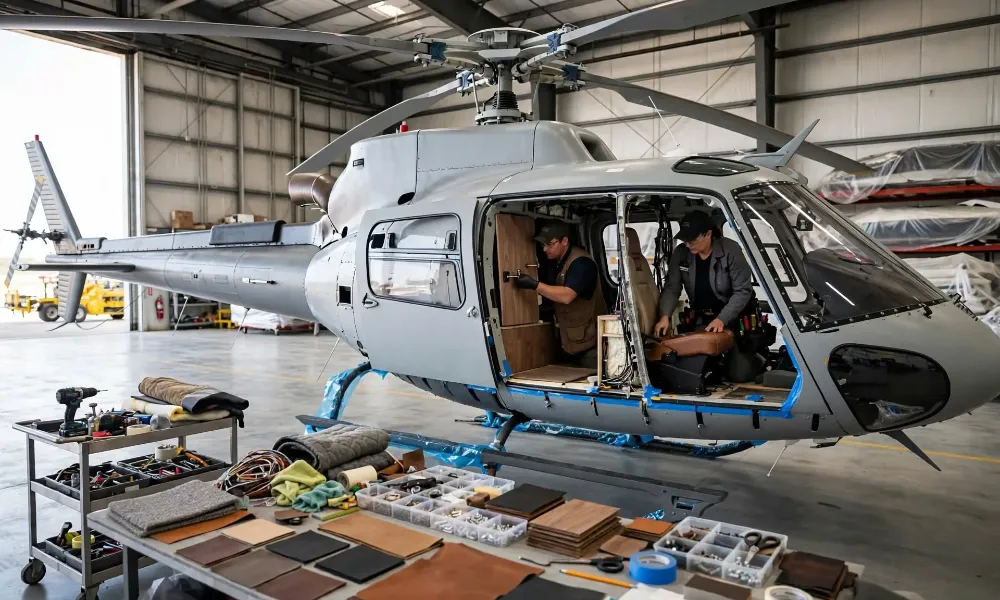
A VIP helicopter typically begins life as a green aircraft, structurally complete but unfurnished, delivered to a specialist completion center for its interior.
The discipline’s great names operate like yacht refit yards crossed with couture ateliers: design studios produce renderings and material boards for the owner’s approval, engineering teams certify every installation against aviation authority standards, and workshops of cabinetmakers, upholsterers, and electricians translate the design into flying reality.
The certification dimension distinguishes aircraft interiors from every other luxury craft. Every material must meet fire, smoke, and toxicity standards; every cabinet must withstand crash loads; every seat must be dynamically tested. A chair in a helicopter is not furniture but safety equipment that happens to be upholstered in Hermès grade leather.
The process, from design freeze to delivery, typically runs several months to over a year for the most elaborate cabins, and costs range from around half a million dollars for a refined light helicopter interior to two million dollars and beyond for a head of state medium cabin.
The Design Language of Flight
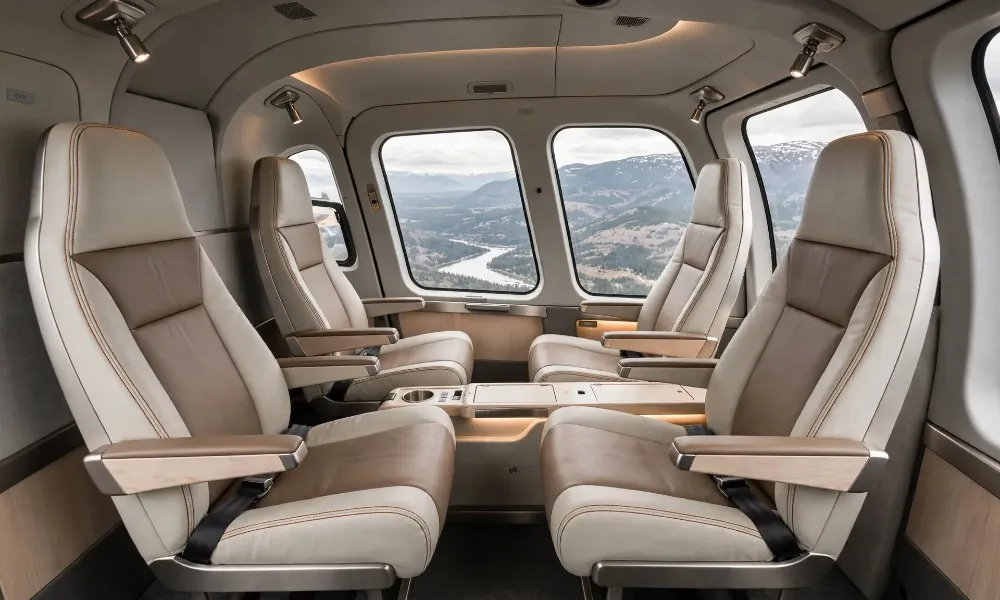
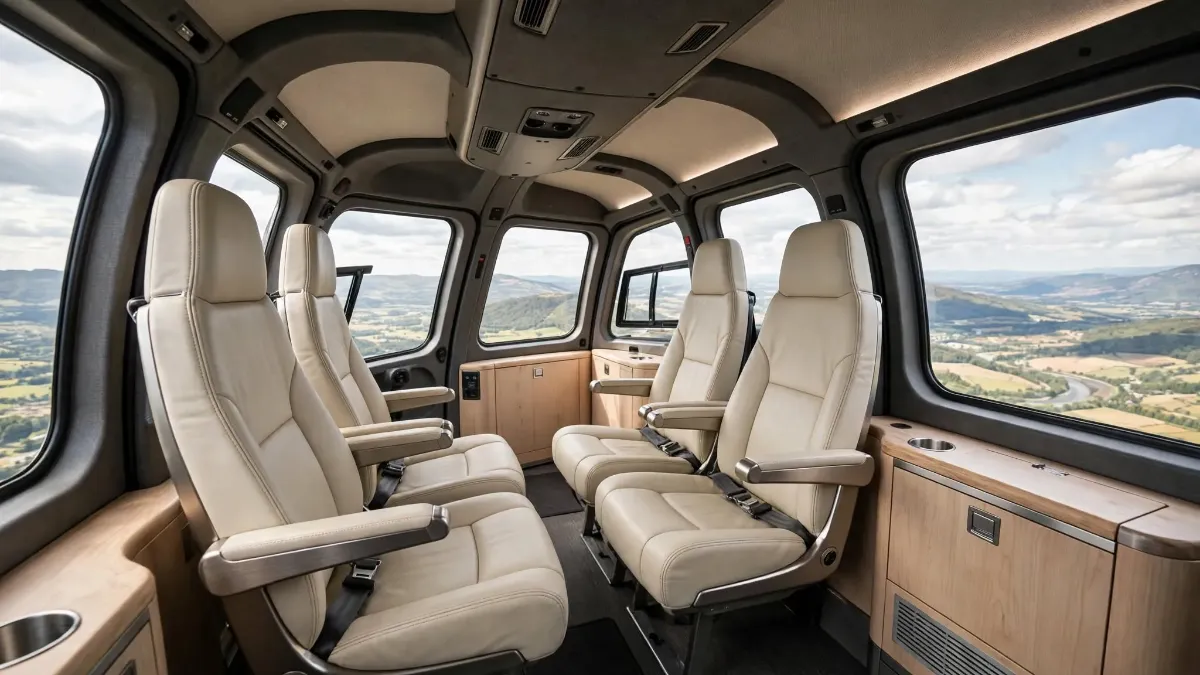
VIP helicopter interiors have developed their own aesthetic grammar, distinct from both jets and yachts. Sight lines matter intensely: the panoramic windows that make helicopters supreme viewing machines must never be blocked by cabinetry, so the finest cabins are designed around the view, with low furniture profiles and glass and lighting used to amplify the airborne sensation.
Colors trend serene, creams, taupes, and pale woods that make small volumes feel generous, punctuated by the client’s signature details: a family crest embossed in leather, a specific veneer, a lighting scene programmed for evening arrivals.
The signature features tell the category’s priorities: club seating that faces passengers toward each other for conversation, refrigerated drawers sized for champagne, sound systems tuned for cabin acoustics, and cabin management systems that control lighting and environment from a passenger’s phone.
At the summit, head of state cabins add office desks, secure communications, and divans, approaching the private jet experience in everything but range.
Commissioning Your Own Cabin
For owners embarking on a completion or refurbishment, the process rewards patience and specificity. Begin with mission: how many passengers typically, how long the flights, what the cabin must accomplish, whether boardroom, family shuttle, or yacht tender in the sky. Choose the completion house with a portfolio matching your ambition, and insist on seeing their physical work, not renderings, because craftsmanship photographs generously and reveals honestly only in person.
Budget honestly across the three buckets: design and engineering, materials and fabrication, and certification, and hold contingency for the changes every owner makes upon seeing the cabin take shape. The wisest commissioners also plan for the second owner: cabins that photograph as tasteful rather than idiosyncratic protect resale value in a market where the next buyer may not share your passion for burgundy alligator.
The completed cabin, at its best, becomes the reason the owner flies: a room in the sky where the city’s noise falls away at lift off, replaced by the particular peace of a space built, gram by gram, for one person alone.
FAQs
How much does a VIP helicopter interior cost?
Completion costs range from around half a million dollars for a refined light helicopter interior to two million dollars and beyond for elaborate head of state cabins in medium helicopters. Costs divide across design and engineering, materials and fabrication, and aviation certification.
What is a green helicopter?
A green aircraft is a helicopter delivered by the manufacturer structurally complete but without a finished interior, ready for a completion center to install the custom cabin. The term covers the standard path for VIP and head of state helicopter interiors.
How long does a helicopter interior completion take?
From design freeze to delivery, completions typically run several months for light cabins to over a year for the most elaborate medium helicopter interiors. Material lead times, certification requirements, and the hand craftsmanship involved set the pace.
Why is weight so critical in helicopter interiors?
Helicopters operate on tight weight margins where every kilogram of interior reduces fuel, range, or passenger capacity. Completion houses use honeycomb panels, thin veneers, and carbon fiber to deliver luxury at minimal weight, engineering each component gram by gram.
What materials are used in VIP helicopter cabins?
Cabins use thin split leathers, millimeter thin wood veneers on honeycomb cores, carbon fiber structure, and aerospace acoustic materials, all certified to fire, smoke, and toxicity standards. The result resembles yacht craftsmanship achieved at a fraction of the weight.
Can a helicopter cabin be refurbished?
Yes, and refurbishment is common at ownership changes. Existing cabins can be reupholstered, re-veneered, and modernized with new lighting and cabin management systems, typically faster and less expensively than a full completion, with certification requirements applying to modifications.
Which helicopters have the best VIP interiors?
The ACH160 and H160 family lead the light segment with quiet cabins and panoramic glass, the AW109 GrandNew offers Italian design flair, and the Sikorsky S-92 and Leonardo AW139 and AW189 serve head of state missions with stand up cabins approaching jet standards.
Do helicopter interiors affect resale value?
Significantly. Tasteful, neutral cabins in excellent condition broaden buyer appeal, while highly personalized interiors narrow it. Buyers and brokers discount for cabins requiring refurbishment, which is why experienced owners commission with the eventual second owner in mind.