Fifty years ago, the most conservative watchmaker in Switzerland did something nobody expected. Patek Philippe, a house built on gold dress watches and quiet complications, launched a watch made of steel. It was large, it was angular in a soft sort of way, it had no precious metal anywhere on it, and it cost about as much as one of the firm’s gold watches.
Collectors were baffled. Dealers were unsure what to do with it. And yet, half a century later, that watch the Nautilus is the single most recognisable model Patek Philippe has ever made, and arguably the most talked-about luxury watch of the modern era. Its fiftieth birthday, marked in 2026, is a good moment to ask how a watch that broke every rule of its maker came to define it.
The Nautilus did not arrive by accident. It arrived because the watch world of the mid-1970s was changing faster than its grandest names were comfortable with, and because one designer saw the change more clearly than anyone else.
What followed a slow start, decades of quiet growth, then a surge of desire so intense that the watch became almost impossible to buy is one of the great stories in modern watchmaking. It is also a story about design: about how a shape drawn in minutes can still look right fifty years later.
1976: A Steel Watch at a Gold Watch Price
The Nautilus was unveiled at the Basel Watch Fair in 1976 as reference 3700/1A, a watch its admirers would later call the “Jumbo”. The name came from Captain Nemo’s submarine in Jules Verne’s Twenty Thousand Leagues Under the Sea, and the reference to the sea was deliberate.
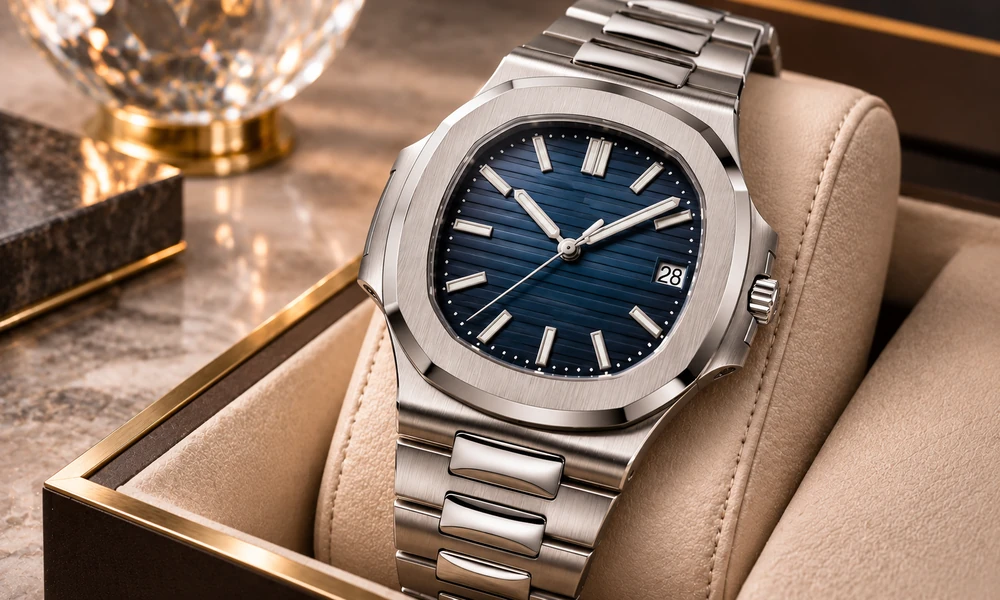
The case measured a generous 42 mm across, large for the time, and it was made entirely of stainless steel. The dial was a dark blue-grey, embossed with fine horizontal grooves. The bracelet was integrated, flowing from the case as a single sculptural object rather than attached to it. It was water-resistant to 120 metres, and it was presented, unapologetically, as a sports watch.
None of that was how Patek Philippe was supposed to behave. The firm had built its reputation on precious-metal dress watches and traditional complications perpetual calendars, minute repeaters, chronographs of great refinement. Steel, in the luxury world of the time, was the metal of tool watches and dive instruments, not of the house that had given the world the perpetual calendar.
And the price made the point even sharper: the Nautilus was priced at the level of a gold dress watch. To many in the trade, that was not bold. It was absurd.
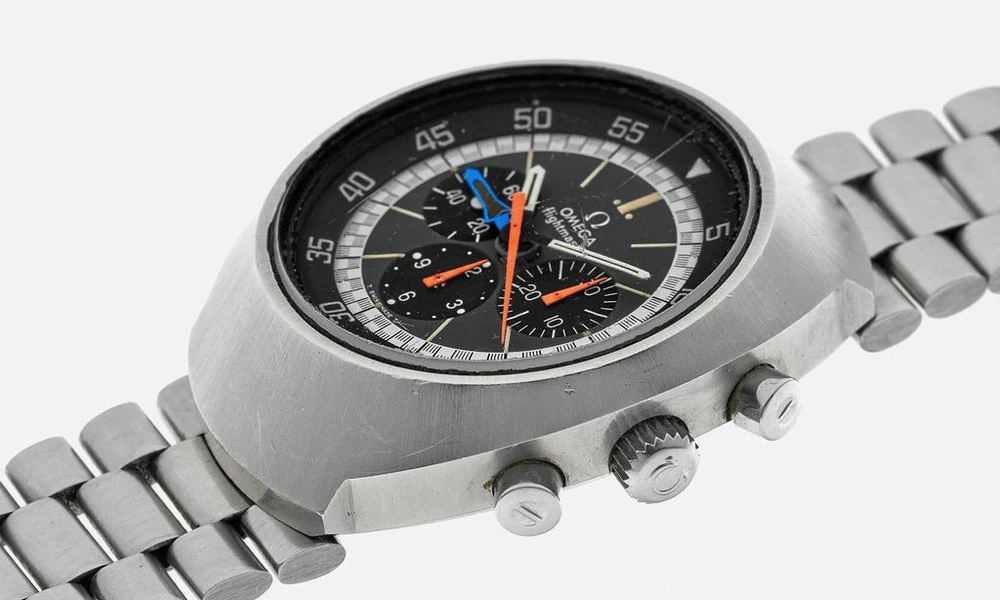
It is worth remembering the moment. The quartz crisis was well under way, and cheap, accurate quartz watches were sweeping away the mechanical watch’s claim to be the practical choice. The Swiss industry was shrinking. In that climate, a steel sports watch at a gold-watch price looked like a gamble in the wrong direction.
The Nautilus sold slowly at first. It was a niche product, admired by a few, ignored by many. It would take decades before the world caught up with it and when it did, it caught up all at once.
The Man Who Drew It in Minutes
The Nautilus was the work of Gérald Genta, the Genevan designer now widely regarded as the most influential watch designer of the twentieth century. Four years earlier, he had drawn the Royal Oak for Audemars Piguet the first luxury sports watch in steel and in doing so had invented the category the Nautilus would come to define.
Genta worked with instinctive speed and formal clarity, and the story of the Nautilus sketch has become one of watchmaking’s favourite legends: as the story goes, he drew it in five minutes, at dinner in Basel during the watch fair, on a paper napkin, after spotting Patek Philippe executives at a nearby table.
Whether the five-minute version is exactly true matters less than what it captures. Genta’s idea was to take the Royal Oak’s language the integrated bracelet, the alternating polished and satin surfaces, steel treated as a prestige material and soften it.
Where the Royal Oak was angular and architectural, inspired by a diver’s helmet, the Nautilus would be rounder and more organic. Genta knew the Stern family, who own Patek Philippe, were passionate sailors, and he designed accordingly. The porthole of a transatlantic liner gave him the case; the sea gave him the name.

Genta’s genius was not only in the shape. It was in understanding that a sports watch could be elegant rather than rugged, and that steel could be luxurious if it was finished well enough. The Nautilus was never a tool watch pretending to be something else. It was a luxury watch that happened to be made of steel, and that distinction obvious now, radical then is the whole of its idea.
The Porthole Idea
Look closely at the Nautilus and the porthole is everywhere. The case is a rounded octagon, its bezel echoing the shape of a ship’s window. On either side sit the small protrusions collectors call “ears”, evoking the hinges of those watertight windows. The case itself was built in two parts, held together by screws, like a porthole assembly.
Even the dial played along: its horizontal embossing suggested the deck of a ship, or the surface of calm water, and its deep blue-grey colour was the colour of the sea at dusk.
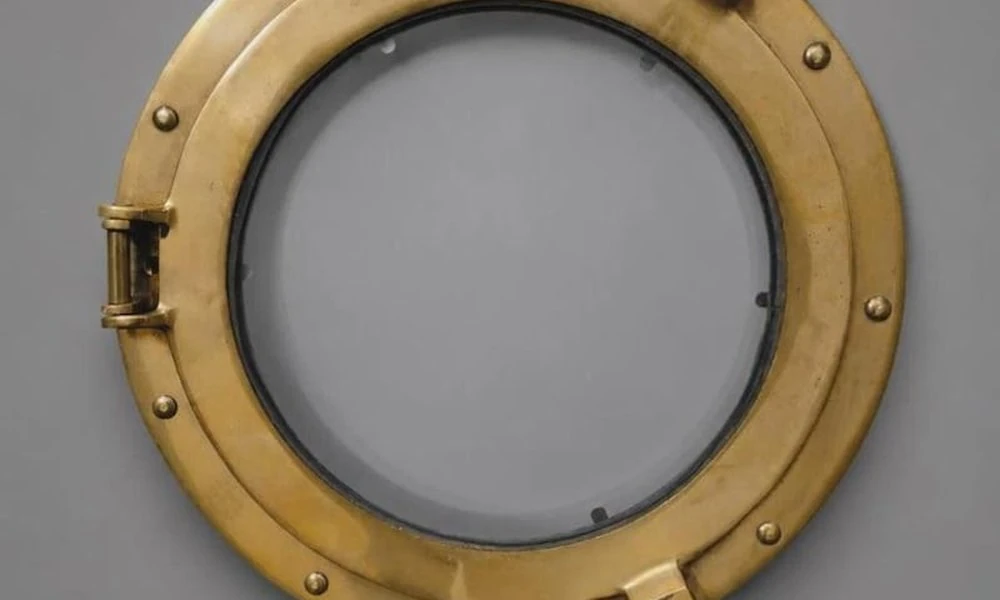
What is remarkable is how little of this has changed. Fifty years of revisions have refined the Nautilus without redesigning it. The bezel is still a rounded octagon. The ears are still there. The dial is still horizontally embossed, still most often blue. Other watches chase fashion; the Nautilus has simply waited for fashion to come back around to it, which it has, several times.
Anatomy of the Design
The Nautilus works because every part of it serves the same idea. The integrated bracelet is the clearest example. Rather than a strap bolted onto a case, the bracelet grows out of it: the links taper gently, the centre links are polished while the outer links are brushed, and the whole thing wears as one continuous piece of metal.
It is the reason the watch feels so different on the wrist from a watch with a conventional strap, and it is one of the hardest things in the design to make well. A bracelet like this cannot hide poor finishing; every link is visible, every edge is felt.
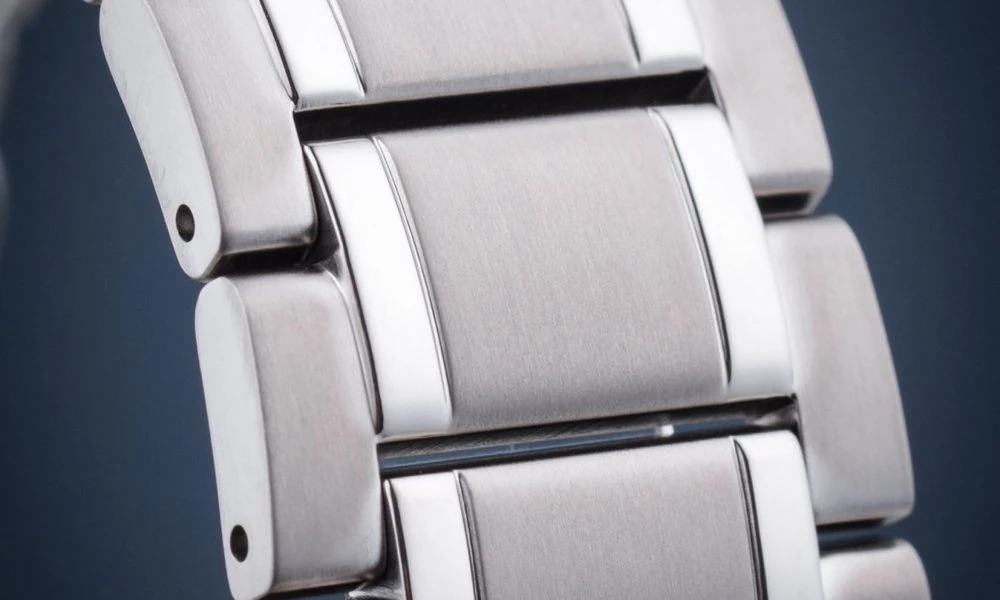
The dial is the other half of the design’s success. The horizontal embossing catches light as the wrist moves, so the dial seems to change shade from moment to moment dark navy in shadow, brighter blue in sunlight. Applied hour markers in white gold, filled with luminous material, sit on top of it.
There is very little writing on the dial, and nothing decorative for its own sake. It is a design that rewards a second look and a third, which may be why it has never looked dated: there was never anything fashionable on it to go out of fashion.
Inside, the original watch was deliberately simple: an ultra-thin automatic movement, hours and minutes, a date, and no seconds hand. That restraint was part of the point. The Nautilus was not trying to impress with complications. It was trying to impress with presence, and it did.
Inside: The Calibres
For all its fame as a design object, the Nautilus has always been a serious watch mechanically. The original’s ultra-thin automatic movement kept the case slim despite its size, and thinness has remained part of the collection’s character ever since.
The movement most associated with the modern Nautilus is calibre 240, an ultra-thin self-winding movement whose small gold rotor is visible through the sapphire case back of the anniversary models and in the 2026 editions, engraved to mark the half-century.

Over the decades, the collection grew well beyond its simple beginnings. Annual calendars, chronographs, moon phases and a perpetual calendar all joined the family, each fitted into the same rounded-octagonal case without disturbing its proportions.
That is harder than it sounds: a complicated movement is usually a thick movement, and a thick movement does not sit gracefully in a slim sports case. That the Nautilus has absorbed so many complications while still looking like itself is a quiet technical achievement.
The Long Quiet Decades
For much of its first quarter-century, the Nautilus was a connoisseur’s watch rather than a famous one. A smaller mid-size version arrived in the early 1980s, broadening the collection’s appeal, and further references followed through the 1980s and 1990s but the watch never chased the spotlight.
It sold steadily to people who understood it, and it remained, in the eyes of the wider world, an unusual Patek Philippe: the steel one, the sporty one, the one that did not quite fit the house’s image of itself.
That slow period matters, because it is what makes the Nautilus different from a watch designed to be a hit. It was not focus-grouped into existence, and it was not launched with a campaign promising instant icon status. It earned its reputation the slow way, one wrist at a time, over decades the sense that the watch was right all along, and the world simply needed time to see it.
2006: The Thirtieth Birthday
The thirtieth anniversary, in 2006, was the moment the modern Nautilus took shape. Three new references arrived together and established the collection as it is still understood today: the time-and-date reference 5711/1A, the chronograph 5980/1A, and the moon-phase and power-reserve 5712/1A.
The 5711, in particular, became the definitive Nautilus the steel, blue-dialled, time-and-date watch that most people picture when they hear the name.
It is one of the ironies of the Nautilus story that the watch became most desirable just as it became hardest to obtain. Demand for the 5711 grew steadily through the 2010s, and then sharply, until the steel model that had once sat quietly in dealers’ windows was the subject of waiting lists measured in years.
Patek Philippe has always made watches in small numbers, and the Nautilus was no exception. The result was a watch that many collectors wanted and very few could buy new a situation that only deepened its mystique.
The Waiting-List Years
In 2021, Patek Philippe discontinued the steel 5711, the reference that had become the face of the collection. The decision was widely reported, and it did nothing to cool demand.
A successor in white gold, the reference 5811/1G-001, followed the next year, larger and in a precious metal a reminder that the Nautilus had come full circle, from a steel watch priced like gold to a gold watch that everyone still thought of as a steel one.
The waiting-list years changed how people talked about the Nautilus. It was no longer only a watch; it was a phenomenon, discussed in the same breath as the art market and the rarest vintage cars. That attention brought its own distortions speculation, long queues, and a secondary market far removed from the price in the boutique and it is worth saying plainly that none of that is the watch’s fault.
A design that has stayed essentially unchanged for fifty years does not become a different object because the world around it has grown excited. The Nautilus is still the watch it was in 1976: steel, blue, porthole-shaped, and quietly sure of itself.
If you are weighing it against other great names, our guide to the most iconic luxury watches ever made puts it in its proper company, and our comparison of which luxury watch holds its value best looks at the question every collector eventually asks.
Fifty Years On: The 2026 Anniversary Editions
For the fiftieth anniversary, Patek Philippe chose restraint over spectacle. At Watches and Wonders in April 2026, the firm presented four limited editions that stripped the Nautilus back to its essentials: hours and minutes only, with no date and no central seconds much like the original 3700, which had no seconds hand either.
All three wristwatches use the ultra-thin self-winding calibre 240, its gold rotor engraved “50 1976 – 2026”.
The editions themselves span the collection’s history. The reference 5610/1P-001 is a 38 mm platinum model on a platinum bracelet, with a diamond set at 9 o’clock a nod to the mid-size Nautilus of the 1980s limited to 2,000 pieces.
The reference 5810/1G-001 is a 41 mm white gold model on a bracelet, also limited to 2,000 pieces, while the reference 5810G-001 is the same white gold case with baguette diamond hour markers on a navy composite strap, limited to 1,000 pieces. The fourth creation, the reference 958G-001, takes the Nautilus off the wrist entirely: a white gold desk clock with an eight-day power reserve, limited to 100 pieces.

The anniversary has been marked in Geneva itself, too. The Patek Philippe Museum has devoted an exhibition to the model 1976–2026: Nautilus, 50th Anniversary of an Icon of Sporty Elegance” tracing its evolution from the 1976 debut to the latest editions, drawing on the manufacture’s archives, original sketches and historically significant references.
For a watch that began as an outsider in its own house, a museum exhibition is a fitting kind of homecoming. The story of the house behind it is told in the Patek Philippe story, and the Nautilus is, in many ways, its most surprising chapter.
Why It Endures
So why has this one watch lasted, when so many of its contemporaries have been forgotten? Part of the answer is the design itself. The Nautilus is a shape that does not depend on fashion: the rounded octagon, the horizontal dial, the integrated bracelet. None of it was trendy in 1976, and none of it is dated in 2026.
It is a watch that looks right with a suit and right with a sweater, on a man or a woman something Genta is said to have intended from the start, when he softened the Royal Oak’s harder edges.

Part of the answer is what the watch represents. The Nautilus is the moment the grandest name in watchmaking admitted that luxury could be made of steel, worn every day, and built for the water rather than the drawing room. Every luxury sports watch that followed and there are many owes something to that admission.
The Nautilus did not only change Patek Philippe. It changed what a luxury watch was allowed to be, and the whole industry has been living with that change ever since.
And part of the answer is simply that it was made well. A watch that is worn daily for decades has to be. The Nautilus was built to be used water-resistant, robust, comfortable and the examples that survive from the 1970s and 1980s, still running, still on their original bracelets, are the best evidence of that.
A design can be beautiful and still fail; one that is beautiful and durable, and asks nothing of its owner except to be worn, has a much better chance of lasting fifty years.
Wearing Fifty Years
What does the Nautilus mean for someone meeting it today, at fifty? First, that the watch on offer is essentially the watch of 1976 the same case, the same dial, the same bracelet idea refined rather than reinvented.
Second, that it is a watch to be worn rather than stored: it was designed for daily life, for water and travel and evenings out, and it is at its best doing exactly that. And third, that its value lies in the design and the making, not in the excitement around it. The excitement will fade, as excitement always does. The shape will not.
There is a temptation, with an anniversary, to treat a watch as a museum piece. The Nautilus resists that. It was drawn in minutes, made of steel, priced like gold, and doubted by almost everyone who first saw it and it is still here, still being made, still recognisable from across a room. That is a rare thing in any field, and rarer still in one as fashion-prone as watchmaking.
Fifty years on, the Nautilus asks very little of the person who wears it only that it be worn, and worn often, in the spirit in which it was drawn. If this anniversary has put the watch on your mind, the best next step is a simple one: find one in person, hold it, try it on your wrist, and see whether the shape that changed watchmaking half a century ago still speaks to you.
We suspect it will, and we would be glad to have been a small part of that first look.