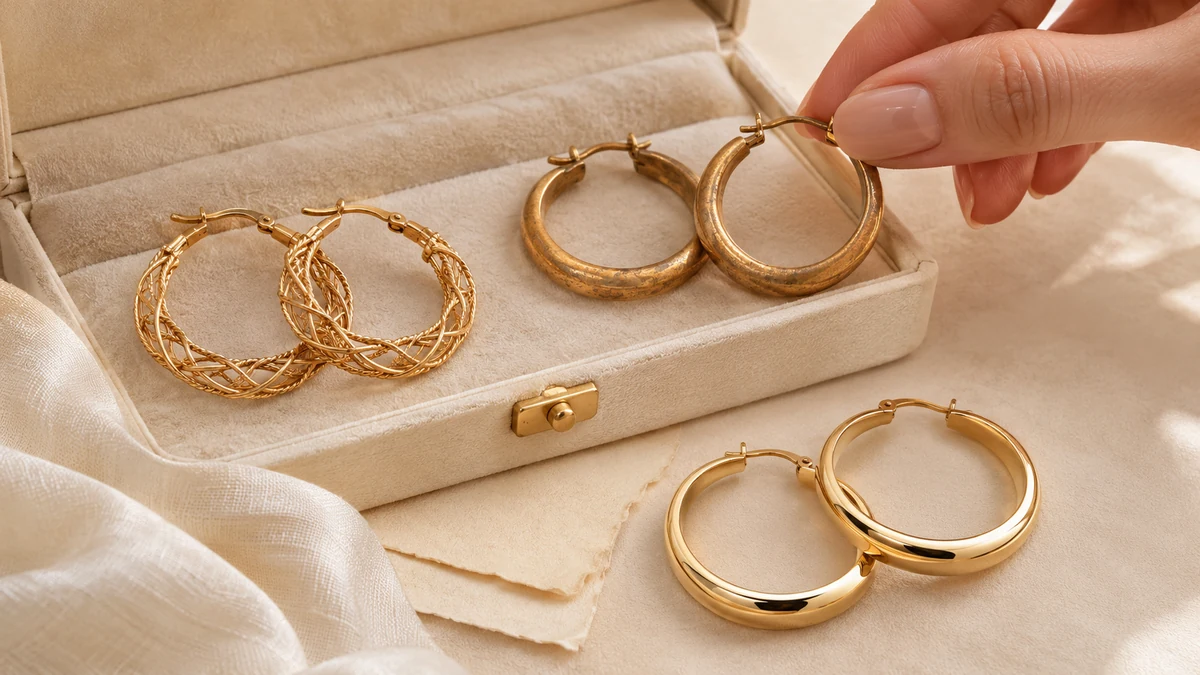
The history of hoop earrings is much richer than the familiar announcement that they are back in fashion. For plenty of wearers, there was never a departure.
A pair can belong to a mother’s jewelry box, a teenager’s first collection or the last few seconds of getting ready before dinner. There is something wonderfully satisfying about putting them on: that small curve beside the face, the movement when you turn your head, the feeling that the outfit is finally yours.
But the circle carries more than a flattering shape. Museum collections document hoops across ancient societies, while modern accounts reveal their importance in family traditions, Black and Latina identity, music and self-expression.
The most useful way to understand their history is through particular objects and particular people. A surviving earring can tell us about construction. A family story can tell us about belonging. Neither should be made to speak for everyone who has ever worn a hoop.
Key Takeaways
- Hoops have a long history across cultures; a single surviving object does not establish a universal inventor.
- Ancient examples were not always tiny or plain: one Egyptian hoop in the Met measures 5.1 cm across.
- African jewelry traditions include complex woven and twisted forms, not simply smooth circles.
- Hip-hop helped carry hoops into wider popular visibility, alongside meanings rooted in communities and families.
- Material value, cultural meaning and emotional value are different parts of the story.
Where Do Hoop Earrings Come From?
Hoops appear in archaeological and museum records from different places and periods. Those records establish a deep history, but they should be read carefully before turning one example into a claim about the first hoop ever made.
An object’s date tells us when that surviving piece is thought to have been produced. Its findspot, cultural attribution and ownership history answer other questions. They do not automatically identify the origin of every similar design.
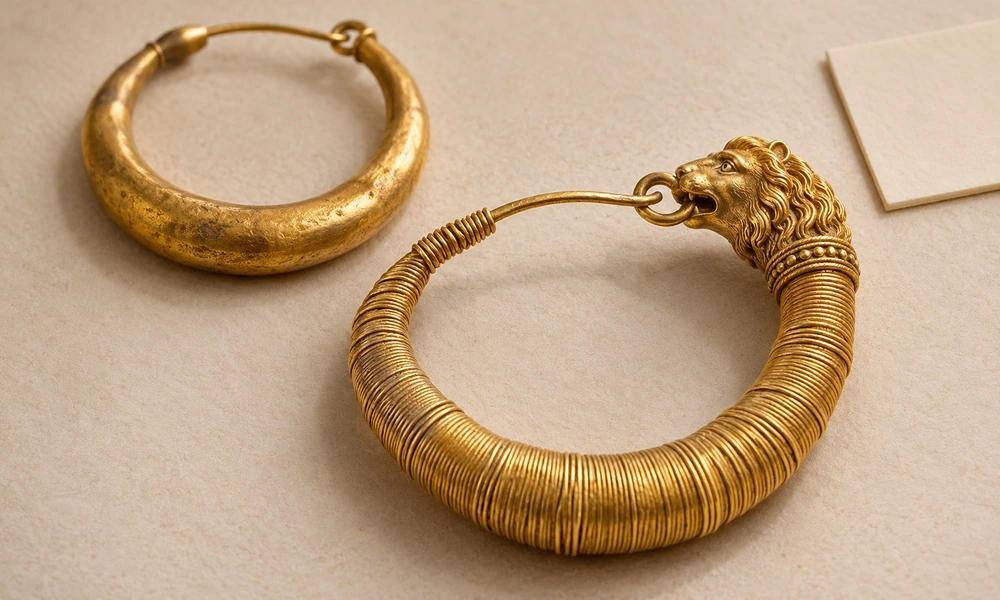
A particularly useful example is the gold hoop catalogued by the Metropolitan Museum of Art as object 68.136.13. The museum dates it to approximately 1648–1540 BCE, during Egypt’s Second Intermediate Period, and identifies Egypt as its origin, possibly the Eastern Delta.
That is specific evidence you can examine. It gives the story a firmer foundation than an unsupported sentence naming one civilization as the unquestionable inventor.
What Do Ancient Hoops Reveal About Design?
A Large Hoop Is Not a Modern Invention
The Met’s Egyptian example measures 4.7 cm high and 5.1 cm wide. Converted to millimeters, that is 47 by 51 mm: a noticeable presence rather than a barely visible loop.
The measurements describe the surviving object. They do not tell us exactly how it looked on its wearer or how comfortably it was worn. Even so, they offer a useful correction to the idea that generous scale belongs only to recent fashion.
The pleasure is recognizing a familiar design instinct across a very long distance in time: someone wanted a curve substantial enough to be seen.
Decoration Could Be Part of the Fastening
The Walters Art Museum holds a Greek gold hoop with a lion’s head, dated to the fourth–third century BCE.
Its construction is especially interesting. The museum describes fine wire wrapped around a tapering gold core. The thin end fastens through a loop at the lion’s mouth.
The animal head therefore contributes to both appearance and function. That detail is easy to miss when jewelry history becomes a sequence of famous wearers and changing trends.
For anyone who loves design, this is a wonderful reason to inspect the back and fastening of a jewel. A seemingly decorative feature may explain how the whole object works.
If objects like these make you want to plan a slower gallery afternoon, our guide to the greatest museums in the world offers places to begin exploring jewelry alongside wider art and design collections.
What Does African Craftsmanship Add to the Story?
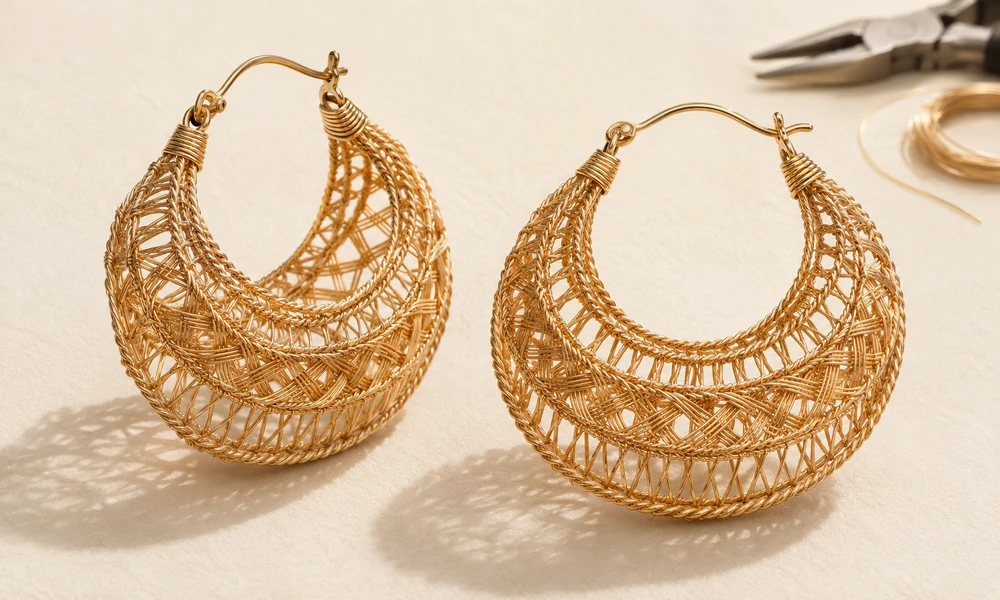
A polished ring of metal is only one expression of the hoop. Smithsonian collection records for Senegalese earrings describe openwork forms made by weaving and twisting wire.
One example, catalogued as nmafa_2012-18-111, uses gold-plated copper alloy. Its significance includes the work involved in shaping the wire and creating the open structure, rather than depending on solid-gold content alone.
That distinction deserves more attention. A gold-colored surface does not establish what lies underneath it. Equally, identifying a base metal does not exhaust the object’s artistic or cultural value.
Looking closely lets you appreciate several things separately: the form, the technique, the materials and the context in which the earrings were made and worn. Calling them simply gold hoops leaves much of the interesting part unexplored.
How Did Hoops Become So Important in Modern Music and Style?
The Smithsonian’s National Museum of African American History and Culture highlights a 1989 photograph of Salt-N-Pepa and Spinderella outside Bayside Studios in Queens. Their gold hoops form part of a complete expression of street style, alongside coats and shoes.
The setting matters. The image records a particular place, moment and creative community. The earrings belong within that world, rather than appearing as isolated accessories awaiting discovery by a fashion magazine.
The Museum at FIT’s exhibition on fifty years of hip-hop style also connects fashion to the creativity of Black and Brown working-class youth. Its interpretation addresses both the influence of that style and the stereotypes directed at its wearers.
Within that context, hoops can carry several meanings at once: adornment, personal distinction, cultural recognition and connection to the people whose style came before.
One Hoop Could Become a Personal Signature
The Smithsonian also holds a hoop-and-key earring worn by Janet Jackson, dated 1987–1990. Its materials are recorded as metal and onyx.
The key transforms the circle into something more specific. It shows how the recognizable hoop form can be adapted into a distinctive object associated with a particular wearer.
It also offers a useful reminder for luxury writing: jewelry can deserve a place in a major cultural collection without being described as solid gold or set with precious diamonds. Importance is not measured by material price alone.
Why Do Hoops Carry Meaning for Black and Latina Wearers?

Personal accounts make the emotional history much clearer than a trend timeline can.
In her WBUR essay, journalist Arielle Gray recalls receiving gold hoops from her father as a small child. She connects them with care, inheritance and the complicated pressure to appear professional in spaces where larger hoops could attract prejudice.
Writing for mitú, Raquel Reichard describes her relationship with name-inscribed hoops and the confidence they offered. Her account also addresses the unequal treatment of an aesthetic depending on who wears it.
These are individual perspectives, not instructions for what every Black or Latina wearer must feel. Their value lies in their specificity. They show why a familiar pair of earrings may hold memories and social meaning that a simple label such as fashionable fails to capture.
A thoughtful history can acknowledge the form’s ancient and international presence while also taking these modern experiences seriously. Different layers of meaning can coexist.
How Can You Read a Hoop Earring More Carefully?
Start by separating what you can observe from what someone has told you about it.
| Detail | What it can help establish | What it cannot prove by itself |
| Measurements | The object’s recorded scale | Comfort or appearance on its original wearer |
| Metal description | The catalogued or documented material | Cultural importance or personal meaning |
| Fastening | How the object was designed to close | That it remains safe to wear today |
| Maker’s mark | A starting point for attribution | Complete authenticity without further assessment |
| Recorded date | The estimated age of that object | The invention date of the entire style |
| Ownership history | Documented movement between owners | Every detail of original use |
This way of looking is useful whether you are reading a museum label or considering a vintage purchase. Each piece of information should do the job it can actually support.
What Should You Ask When Buying Vintage Hoops?
A beautiful older pair can be tempting, particularly when the shape has the slight individuality you have been searching for. Give the construction the same attention as the silhouette.
Before buying, ask:
- Is the material described as solid gold, gold-filled, plated or something else?
- Is the date documented, estimated or based only on style?
- Are the earrings an original matching pair or a later combination?
- Have posts, hinges, clasps or other components been replaced?
- Are there dents, cracks, repairs or signs of distortion?
- Does the fastening close securely, and has a jeweler assessed its condition?
- What are the return terms if the condition differs from the description?
A replacement clasp does not automatically make a pair undesirable. It is a detail to understand before deciding what matters to you.
Our vintage shopping guide offers a broader starting point for evaluating older pieces and separating condition questions from the excitement of a find.
How Do You Wear Hoops With an Understanding of Their History?
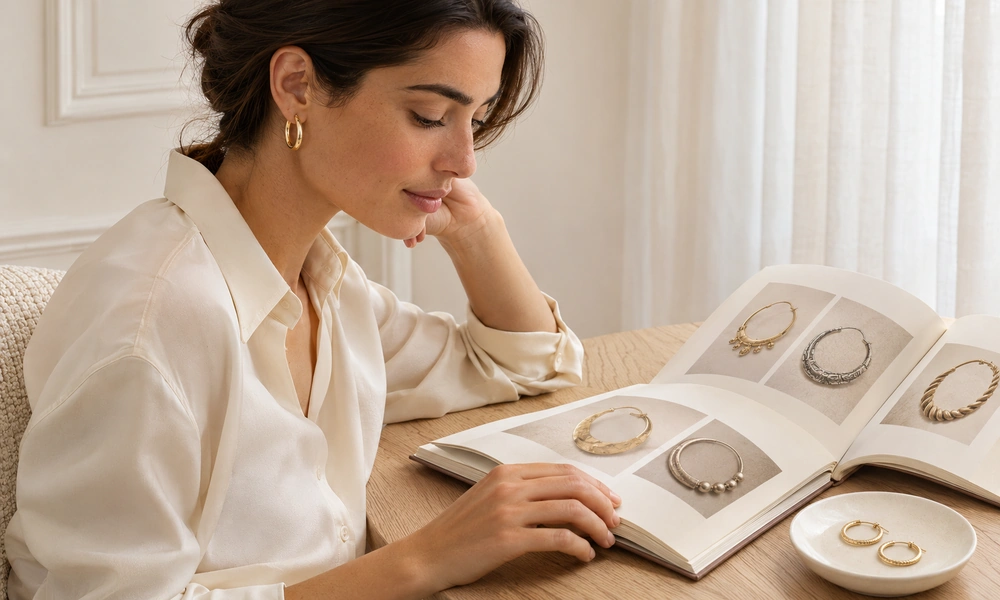
You can enjoy their beauty while remaining curious about the design, maker and cultural context. There is no need to turn getting dressed into a lecture.
Notice the particular form you love. Is it the broad curve, the twisted surface, a personalized detail or the movement beside your face? That answer can help you choose more thoughtfully than a seasonal declaration that one size is correct.
If you are building the rest of an outfit around them, our guide to styling luxury accessories offers ideas for considering proportion and visual focus. Use those ideas as options, with room for the combinations you enjoy.
The earrings do not need to become smaller or more expensive to earn their place in your wardrobe.
Did One Culture Invent Hoop Earrings?
The objects discussed here establish examples in specific places and periods. They do not establish one universal inventor. Claims about the earliest example require broader archaeological evidence than a handful of familiar museum records.
Were Historical Hoops Always Solid Gold?
No. The records examined here include gold, gold-plated copper alloy, and metal combined with onyx. Material descriptions should be checked for the individual object, rather than inferred from its color or cultural importance.
Why Do Hoop Earrings Still Feel So Personal?
Part of their appeal is how easily a recognizable shape becomes somebody’s own. A different scale, a key, a name, a textured surface or the memory of who gave them to you can change the meaning entirely.
That is what makes the history worth knowing. The next time you fasten a favorite pair, you may notice more than their outline: the craft, the inheritance, the small pleasure of choosing how you want to be seen.