
A tattoo can be exciting to plan and still feel intimidating when you picture sitting through the needle. The best tattoo numbing cream that actually works may soften pain for some people, but it cannot promise a painless tattoo. A first-time client may want more control over the experience, especially during a long tattoo session.
Before choosing a product, check whether your tattoo artist allows it and follow the product label. The right choice depends on your comfort, the product’s directions, and the artist’s process. This article covers practical options, safety checks, and trade-offs without treating numbing as a must.
Key Takeaways
- Numbing cream may reduce pain, but its effect differs by person and tattoo area.
- Artist approval and product-label directions matter more than strength claims.
- Do not cover OTC pain-relief products with plastic wrap.
- Check the active ingredient, skin-use directions, and warnings before use.
- Tell your artist what you applied before the session begins.
Treat comfort as one part of a successful session, alongside safe product use and clear communication with your artist.
Does the Best Tattoo Numbing Cream That Actually Works Really Work?
Yes, a correctly used topical anesthetic can temporarily reduce pain in the area where it is applied by interrupting local nerve signals. A topical anesthetic is a medicine applied to the skin to temporarily reduce sensation in the treated area. Lidocaine blocks nerve signaling by inhibiting sodium channels.
This local numbing effect can make parts of tattooing feel less painful, but it does not remove every sensation. You may still feel pressure, vibration, or sensations beyond the treated skin. The result can change with the skin’s condition and how you use the product, so individual results differ.

A tattoo needle deposits ink into the skin, and the sensation can vary by body area. For example, skin near the wrist or elbow crease may feel more sensitive than other parts of the forearm. Your response also depends on the exact spot and the session.
A review of sodium-channel action explains how local anesthetics reduce nerve activity. That process helps explain why lidocaine can ease pain locally, rather than switching off all feeling throughout your body.
Numbing can reduce pain in the treated area, but it cannot promise a painless tattoo or remove every sensation.
Some people notice a clear numbing effect, while others feel only a small change. Pressure and vibration may still come through, even when pain feels muted. Think of numbing as reducing one part of the experience, not switching off every sensation from the tattoo needle.
How Quickly Does Numbing Cream Work, and What Affects the Result?
The result depends on more than the strength printed on the tube, because the skin and the time allowed for absorption also matter. Concentration, absorption time, skin-barrier thickness, and pH can all affect the numbing effect. Those factors help explain why the same cream may feel different across people or body areas.
More time does not always mean a better result. A 2023 review identifies the active ingredient concentration, absorption duration under occlusion, skin-barrier thickness, and pH as factors that affect numbing effectiveness. Skin is not a uniform surface, so timing alone cannot predict the result.
Follow the product’s own label for the time and method. Do not add extra cream or leave it on longer to chase a stronger effect. A label sets the product’s intended use, not a starting point for testing your limits.
High-quality randomized trials of topical anesthetics in tattooing remain limited. That means marketing claims cannot prove a reliable effect for every tattoo session. A reported number may reflect a product maker’s claim, not a result you can count on for your skin.
The time needed can depend on the formulation, treated area, and skin condition. Those details also affect how long the effect lasts, so one fixed timeline does not fit every product or person.
Use the product’s labeled timing as your limit, not as a starting point for extending exposure.
Best Tattoo Numbing Cream That Actually Works for Different Needs
For most readers, Recovery Numb Cream is the most defensible OTC candidate in this shortlist because its listed formulation contains 4% lidocaine, but verify the current package label before use. Choose an artist-approved product with a clear Drug Facts label. A product’s stated duration does not guarantee how it will work during your session.
Recovery Numb Cream is a candidate to check, not a proven strongest option or a universal best numbing cream. EMLA contains 2.5% lidocaine and 2.5% prilocaine, and should be used only when prescribed or directed by a clinician. Your tattoo artist may prefer that you use no numbing product.
These are the practical choices by need:
- For an OTC option, check Recovery Numb Cream’s Drug Facts label and ask your artist first.
- For EMLA, follow a clinician’s direction instead of treating it as a casual tattoo product.
- If your artist advises against numbing, plan the session without a numbing product.
There is no independently established number-one-rated product in this shortlist. The best numbing choice for you is the clearly labeled option your artist approves, rather than a rating or a claim of extreme strength.
A long tattoo may make comfort feel more important, but a longer claimed numbing time is not a promise for your appointment. The treated area, skin response, and product directions all matter.
If the artist does not approve the product or the label does not clearly identify its active ingredients, choose another plan rather than improvising.
How Do Zensa, Dr. Numb, and EMLA Compare?
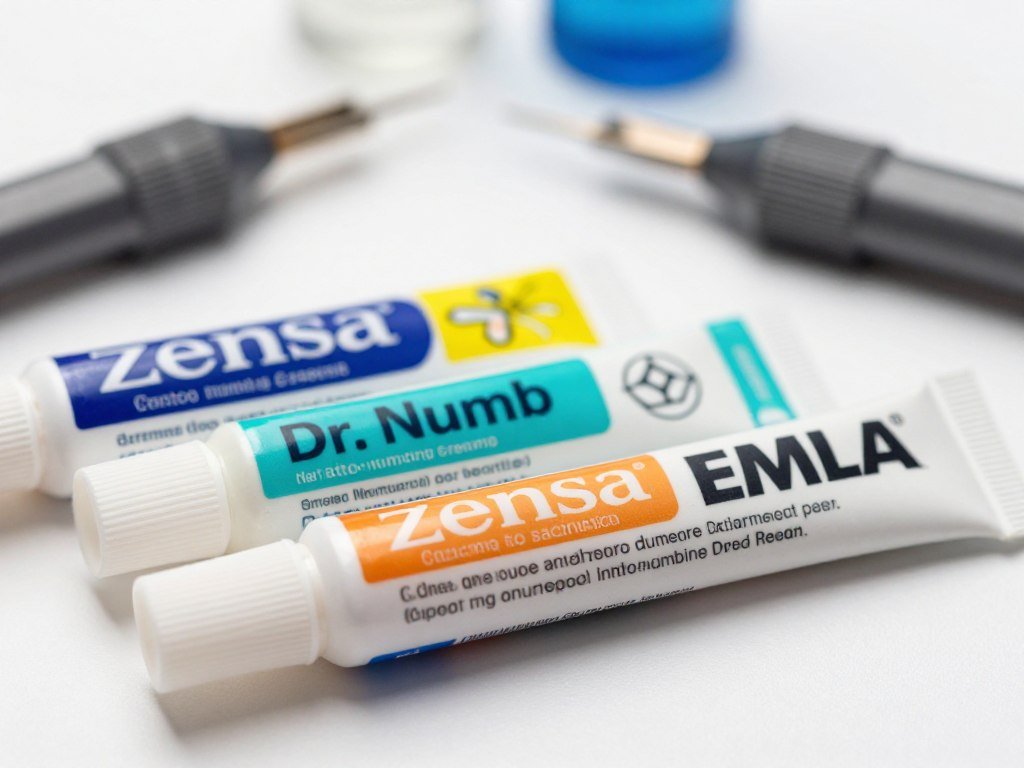
Zensa and Dr. Numb are both listed as 5% lidocaine creams, while EMLA combines lidocaine with prilocaine. The timing figures are product claims or prescribing-information timelines, not promises for tattoo sessions. Their formulations and directions are not interchangeable.
The comparison below keeps the reported onset and duration separate from what you may experience. EMLA’s prescribing information gives a more detailed timeline for dermal analgesia than the comparison onset figure.
| Product | Listed active ingredients | Reported onset | Reported duration |
|---|---|---|---|
| Zensa | 5% lidocaine | 20-30 minutes | 2-3 hours |
| Dr. Numb | 5% lidocaine | 15-20 minutes | 60-90 minutes |
| EMLA | 2.5% lidocaine and 2.5% prilocaine | 45-60 minutes | 1-2 hours after removal |
Zensa is also described as containing vitamin E acetate, purified water, lecithin, and propylene glycol. Its reported onset is 20-30 minutes, with a claimed duration of 2-3 hours. Dr. Numb’s reported onset is 15-20 minutes, with a claimed duration of 60-90 minutes.
EMLA prescribing information says satisfactory dermal analgesia occurs at one hour, with a maximum effect at 2-3 hours. The effect may last 1-2 hours after removal. This timeline does not make EMLA a casual substitute for an OTC tattoo cream.
Use EMLA only under appropriate clinician direction. Compare the package directions and your artist’s policy before choosing based on a reported onset or duration.
What Strength and Ingredients Should You Check on the Label?
Start with the Drug Facts panel, not a front-label claim such as maximum strength. The FDA advises consumers not to use OTC pain-relief products with more than 4% lidocaine on skin. This advice is not a statement about the maximum strength legally available or an endorsement of any product.
A stated percentage alone does not show whether a product suits tattooing or your skin. Read the directions and warnings along with the active ingredient. The FDA’s advice applies to OTC pain-relief products used on skin.
Check these four label details before considering an OTC product:
- Active ingredient and concentration: find the exact medicine and its listed amount.
- Intended route and skin use: check whether the label says it is for use on skin.
- Labeled application area and timing: follow the listed limits for where and how long.
- Warnings or medication interactions: read cautions about health conditions, medicines, or supplements.
Labels with a high percentage do not automatically offer a better numbing effect. A larger number can come with different safety concerns, especially when a product is used in a way its label does not direct.
Keep the Drug Facts panel in view rather than relying on a seller’s front-page wording. The active ingredient and concentration should be clear before any application.
If the active ingredient or concentration is unclear, do not apply the product until a pharmacist or clinician has helped you identify it.
How Should You Prepare and Apply Numbing Cream?
Before opening the tube, ask your tattoo artist whether the studio accepts the product and check its label for the exact skin-use directions. Use only the labeled area and timing on clean, intact skin. Do not cover the cream or put it on broken or irritated skin.
Use this sequence to avoid guessing. A patch test is commonly done 24-48 hours before wider use, but the product’s label still controls how and where you apply it.
Check with your artist and follow the label
First, confirm that your artist approves the product. Read the full label before the appointment, including the directions and warnings. Product labels differ, so do not carry instructions from one cream over to another.
Keep your artist informed about the product name and ingredients. They may need to remove residue during studio preparation. A new skin-care product can also irritate some people, so personal sensitivity matters when you try anything new.
Prepare clean, intact skin
Wash the intended area as the label directs, then let it dry. Check for cuts, irritation, or a rash before applying anything. Do not use numbing cream on damaged skin unless its label specifically permits that use and your artist approves it.
When testing a product, use a small area well ahead of broader use. A patch test can help reveal a local reaction, but it cannot guarantee that a larger application will be safe or comfortable.
Set a safe stopping point
Follow the label’s exact application amount, area, and timing. Do not add another layer because you feel little change. Once you reach the labeled time, stop rather than extending exposure.
- Confirm your artist approves the product.
- Read its label and directions before the appointment.
- Perform a patch test 24-48 hours before wider use.
- Apply only to the labeled area and for the labeled time.
- Tell your artist what you used so they can remove residue during studio preparation.
Stop using the product and seek medical advice if you develop a significant reaction rather than trying another layer.
What Safety Risks Should You Avoid?
The most important safety risk is absorbing too much lidocaine through the skin, which can happen when exposure is heavier or broader than directed. Large areas, damaged skin, long exposure, and coverings can raise absorption. Medicines and dietary supplements may also interact with topical pain-relief products.
Using a topical product before or during a cosmetic procedure can be risky when the skin absorbs more than intended. The FDA says heavy use over large areas, use on irritated or broken skin, prolonged exposure, or a covering can cause serious injury.
How absorption can rise
Do not apply a thick layer over a large area or leave the product on longer than directed. Broken or irritated skin can absorb more medicine than intact skin. Covering the treated area can also increase absorption.
The FDA advises against covering OTC pain-relief products with plastic wrap or other dressings. Product directions that call for plastic wrap do not override that advice. Check with a clinician or pharmacist about possible interactions with medicines or supplements.
Serious symptoms need urgent attention
Too much lidocaine entering the body can affect the heart, brain, and breathing. Serious warning signs include an irregular heartbeat, seizures, and breathing difficulties. Do not wait to see whether those symptoms pass.
FDA guidance on topical pain-relief product risks warns about these harms when skin absorption rises. Products promoted for cosmetic procedures can carry added concern when their use increases absorption.
High-strength products and warning signs
FDA warning letters have named specific products and companies. The March 2024 warning named TKTX Numb Maximum Strength Pain Reliever, labeled with 22% lidocaine and 0.02% epinephrine, and Mithra+, labeled with 10% lidocaine, 5% prilocaine, and 1% epinephrine.
The FDA also named J-CAIN cream, labeled with 29.9% lidocaine. TKTX During Procedure Numbing Gel 40% appeared among products marketed in violation of federal law. A warning-letter label described that gel as 8% lidocaine and 2% tetracaine.
In February 2025, the FDA said Yellow, White, Gold, and Black TKTX Numbing Creams sold by TKTX Numbing Cream USA were unapproved new drugs and misbranded. Its website told users of Yellow and White creams to apply a thick layer under plastic wrap for 40-60 minutes, and described Gold as containing 5% lidocaine and prilocaine.
The FDA also said Blue, Green, Black, Gold, and Yellow TKTX Numbing Creams sold by TKTX USA were unapproved new drugs and misbranded. Blue cream directions called for plastic wrap for about 25-30 minutes. The FDA said those products exceeded permitted OTC lidocaine concentrations or used ingredient combinations outside applicable marketing conditions.
These findings apply to the named products and companies, not every product using the TKTX name. Seek emergency care for irregular heartbeat, seizures, or trouble breathing after using a topical pain-relief product.
Why Might a Tattoo Artist Refuse Numbing Cream?
An artist may refuse a numbing product because a change in skin feel can make their technique less predictable. Some artists report that certain products make skin feel leathery and harder to tattoo in some styles. That concern does not apply to every cream or every client.
A product may also affect how the artist prepares the skin or transfers a stencil. Your artist may want control over the products used before the needle starts. Policies differ by studio, so ask before the appointment.
Skin feel can affect tattoo technique
Artists have reported that some numbing products can leave skin feeling leathery. That texture may be harder to work with in certain styles. It is a reported concern, not a guaranteed effect of numbing cream.
An artist may notice a change in texture or swelling, but appearance alone cannot reliably identify every product. A visible change does not tell them exactly which ingredient you used or how you applied it.
Tell your artist before the appointment
Share the product name and ingredient list before your session. That gives the artist time to check their policy and decide whether it fits their process. Do not wait until the cream is on your skin.
Clear communication also helps the studio plan skin preparation and stencil transfer. If your artist declines the product, ask about a session plan that works without it. Their technique and your comfort both matter.
Get the artist’s answer before the appointment, not after the product is already on your skin.
Is Cream or Spray Better Before and During a Tattoo?
Cream and spray are not interchangeable: they usually enter the tattoo process at different stages. Numbing cream is applied before tattooing, while numbing spray is typically used after tattooing begins. The artist should control what goes on your skin during the procedure.
A spray is not an automatic substitute for cream. Whether a spray can be used on broken skin depends on its specific label and your artist’s approval. Do not apply any topical anesthetic to broken skin unless its directions permit that use and the artist agrees.
| Product form | Usual point of use | Skin condition | Main limitation |
|---|---|---|---|
| Pre-session cream | Before the needle starts | Intact skin, unless its label says otherwise | Must follow its own label and artist policy |
| During-session spray | Usually after tattooing begins | Depends on the spray label | Artist controls use during the procedure |
| No topical product | Before and during tattooing | No product applied | Pain and sensation remain part of the session |
Cream is prepared before the needle starts, then removed as part of studio preparation. Spray is generally used after tattooing begins, so it belongs to the artist’s process rather than your own pre-session routine.
Some sprays have directions for use during tattooing, but that does not make every spray suitable for every tattoo. The product label and artist’s instructions set the limits.
Ask the artist which, if either, they allow before bringing a product into the studio.
How Can You Judge Tattoo Numbing Cream Reviews and Value?
Treat a customer review as one person’s account, not proof that a cream will work the same way for your tattoo. A high rating or dramatic story does not establish safe or consistent results. The exact product label matters more than a star score.
Reviews can still help you spot details about a product’s use. Compare the reviewer’s formula, application time, and tattoo location with your own plans. The Drug Facts panel lists active ingredients and warnings.
Use this five-point check when reading reviews:
- Check the exact product name and current ingredient label.
- See whether the review describes the same formulation you are considering.
- Compare the stated application time and treated location with your planned use.
- Look for disclosure of an incentive or connection to the seller.
- Check whether several detailed accounts describe a similar experience.
The Federal Trade Commission’s Consumer Reviews and Testimonials Rule prohibits fake reviews and certain undisclosed insider reviews. It does not make every customer account a reliable guide to your own skin or session.
Value depends on how much product the label calls for over its labeled area and whether the product suits your appointment. A low tube price may not be useful if the directions or artist policy rule it out.
Match any review to the exact product label and your planned use before relying on it.
What Are the Pros and Cons of Numbing Cream for Tattoos?
The main benefit is potential short-term pain reduction, while the main trade-off is that the result may not last or suit every artist’s process. Numbing cream can reduce pain for some clients, but it cannot promise comfort throughout a session. Its effect may fade as tattooing continues.
Lidocaine is a local anesthetic that temporarily blocks nerve signals in the treated area. That can help some people feel more comfortable, but the effect and skin feel are not the same for everyone. Your comfort matters, and so does the artist’s technique.
Potential benefits during a session
Less pain may help you stay more comfortable during parts of a tattoo session. That can matter if a placement feels sensitive or you are anxious about the needle. People experience tattoo pain differently across body areas.
If you are planning a hand tattoo, placement, session length, and personal tolerance can all shape your comfort. A numbing product may help some clients, but it cannot control every sensation or make one placement feel like another.
Trade-offs for skin and technique
The effect may fade before the session ends, and some products may change how skin feels under the artist’s hand. A skin feel that works for one tattoo style may not suit another. Your artist’s process can affect whether a product is a good fit.
High-quality randomized trials of topical anesthetics specifically for tattooing are limited. That makes it hard to know how reliably a cream changes the whole session, rather than only reducing sensation in a treated area.
You do not need to treat pain as a test of commitment. Decide based on your comfort, the product label, and your artist’s approval. A useful choice is one that improves your comfort without asking you or the artist to ignore a safety or technique concern.
Tattoo With Numbing Cream vs Without: Which Fits Your Session?
Choose based on your comfort needs and your artist’s process, rather than assuming either option is right for every session. An approved numbing product may reduce sensation for some people, while going without it avoids product-related skin exposure. Neither choice guarantees a painless session or a better tattoo.
Tattooing deposits pigment into the dermis, while local anesthetics such as lidocaine temporarily reduce nerve signaling in the treated area. Your decision should account for your sensitivity, the artist’s policy, and the session ahead.
| Session consideration | With an approved numbing product | Without a numbing product | Decision check |
|---|---|---|---|
| Sensitivity or anxiety | May reduce sensation for some clients | Avoids topical product exposure | Discuss comfort and product approval |
| Artist preference | Fits only if the artist allows it | Follows a no-product studio policy | Ask before the appointment |
| Long or detailed session | May help, but effect can change | No product-related skin exposure | Plan around the artist’s technique |
A sensitive placement may make comfort a bigger concern, but the artist’s policy still matters. Going without cream avoids a topical product on your skin. An approved product may reduce sensation for some people, but neither route ensures a pain-free tattoo.
Make the product choice with your artist before the appointment, so the plan fits both your comfort and the studio’s process.
Confirm the plan with your artist before the appointment so the product choice does not become a last-minute surprise.
Conclusion
Comfort is worth planning for, but no numbing cream can promise the same result for every person or tattoo. Clear label directions and artist approval matter more than extreme-strength marketing.
Your next step is simple: send your artist the product label before buying or applying anything. Ask whether the studio approves it for your planned session. You can then make a calm choice without expecting a pain-free tattoo.
Send your artist a photo of the product’s Drug Facts label and ask whether they approve it for your appointment.
FAQ
Is there a 10% lidocaine?
Why don’t tattoo artists recommend numbing cream?
Is EMLA cream good for tattoos?
Is EMLA better than TKTX?
Is there a downside to using numbing cream for tattoos?
Can tattoo artists tell if you use numbing cream?
Is Zensa or Dr. Numb better?
How long does numbing cream take to kick in for a tattoo?