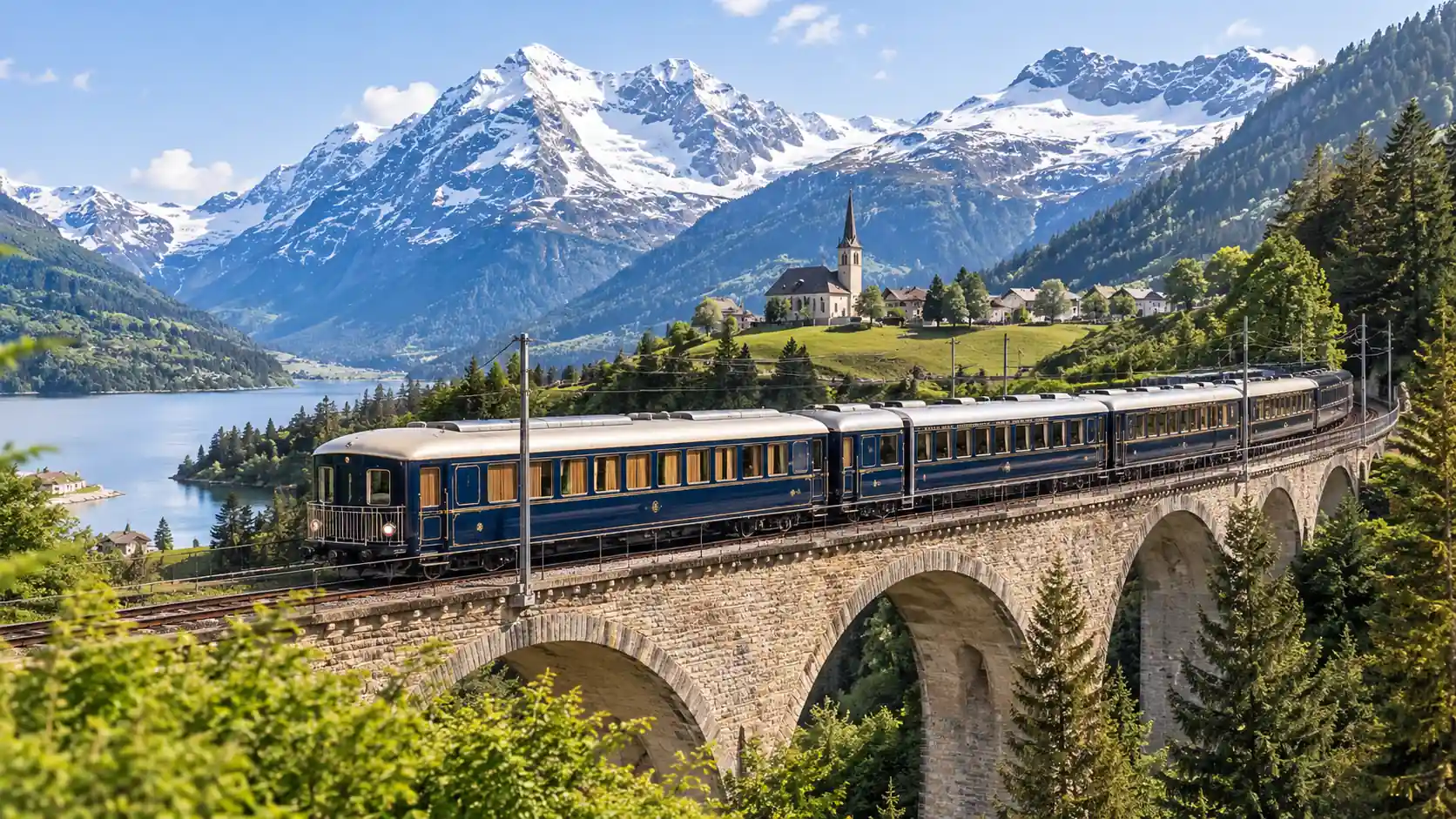
There is a particular pleasure in arriving slowly. A luxury train journey is not the fastest way to travel, and that is precisely the point. The train sets its own pace, the landscape changes outside the window without any effort on your part, and the day is measured in meals, in books finished, and in the quiet stretch between one station and the next.
The ten journeys below are the finest of their kind: restored carriages and purpose-built suites, dining rooms that take their work seriously, and routes chosen for what can be seen from the window rather than for speed.
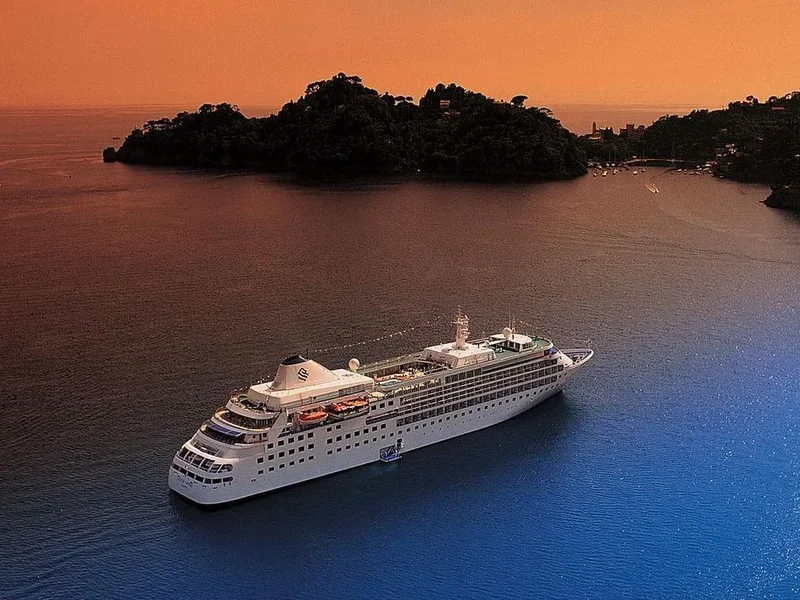
They span five continents, from the Alps to the Altiplano, from the Scottish Highlands to the Australian outback, and each one treats the journey itself as the destination. Like the world’s most luxurious cruise journeys, they reward travellers who are happy to give a journey several days and to let the world come to them.
Europe’s Classic Rails
1. Venice Simplon-Orient-Express, Paris to Venice
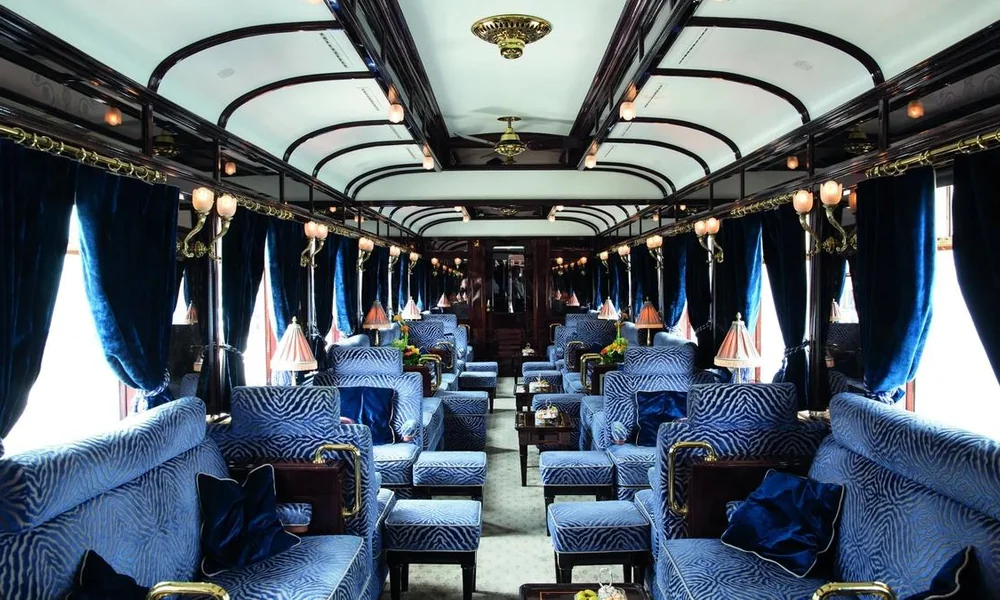
The Venice Simplon-Orient-Express is the train most people picture when they hear the words luxury rail. Operated by Belmond, it runs restored carriages from the 1920s and 1930s, built by the Compagnie Internationale des Wagons-Lits, between Paris and Venice, crossing the Alps overnight.
The classic run takes about a day, departing Paris Gare de l’Est in the evening and arriving at Venice Santa Lucia the following afternoon, with the lagoon causeway as its final approach. The carriages are the genuine article, not replicas: marquetry panels, Lalique glass, polished wood, and the midnight-blue livery with brass lettering that has become the train’s signature.
Inside, the historic cabins convert from a sofa by day to upper and lower berths at night, with a washbasin behind a marquetry panel and shared facilities at the end of the car; the Suites and Grand Suites, named after European cities, add en-suite bathrooms and, in the Grand Suites, a double bed and a small sitting room.
Dinner is a formal affair, served in one of the restaurant cars, with black tie encouraged and jeans not permitted at any time. The train runs roughly weekly from spring to early winter, with occasional departures to Florence, Vienna, Budapest, Prague, and, once a year, Istanbul.
It is the most romantic way to arrive in Venice, and the one journey on this list that feels like stepping into another century without leaving the present one.
2. Belmond Royal Scotsman, the Scottish Highlands
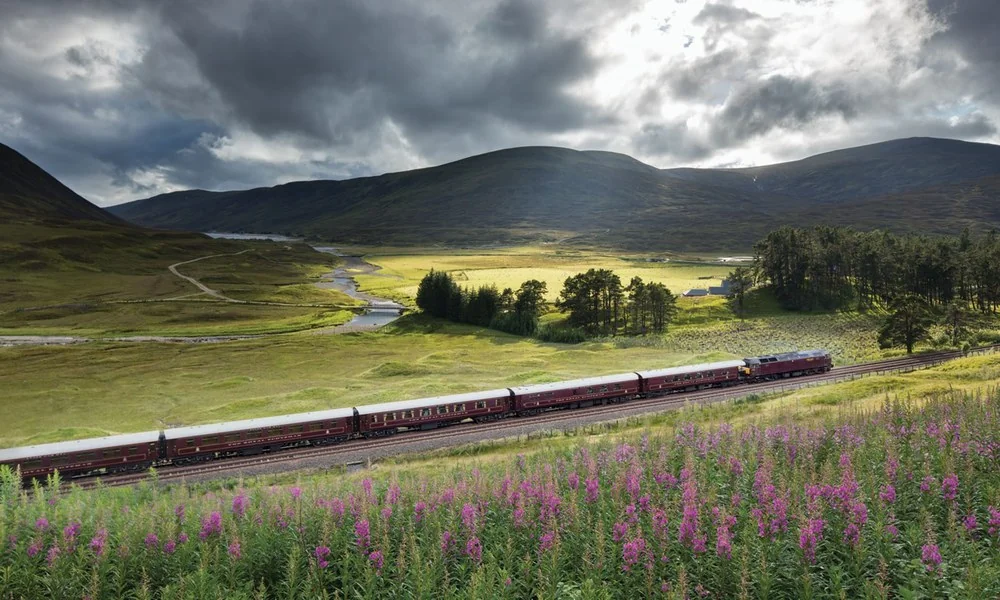
The Royal Scotsman is a smaller, more intimate kind of luxury. Also operated by Belmond, it departs from Edinburgh and wanders the Highlands for a few nights at a time, following routes that take in lochs, glens, castles, and the occasional whisky distillery.
The train carries only a few dozen guests, so the atmosphere is closer to a country-house weekend than to a railway timetable: the same faces at dinner each evening, the same steward remembering how you take your coffee, and an observation car at the rear where the landscape does most of the talking.
Days are divided between the train and the land. There are excursions ashore to castles and gardens, walks along loch shores, and tastings at distilleries that have been making whisky for longer than the railway has existed.
Evenings return to the dining car, where the cooking leans heavily on Scottish produce, and to the observation car, where the light over the Highlands in the late evening is worth staying up for.
The Royal Scotsman suits travellers who want their luxury quiet and unhurried, and who would rather spend a week in one landscape, properly, than hurry through several. It is, in its own way, the most Scottish journey on this list: reserved, beautiful, and quietly sure of itself.
Asia and the Pacific
3. Seven Stars in Kyushu, Japan
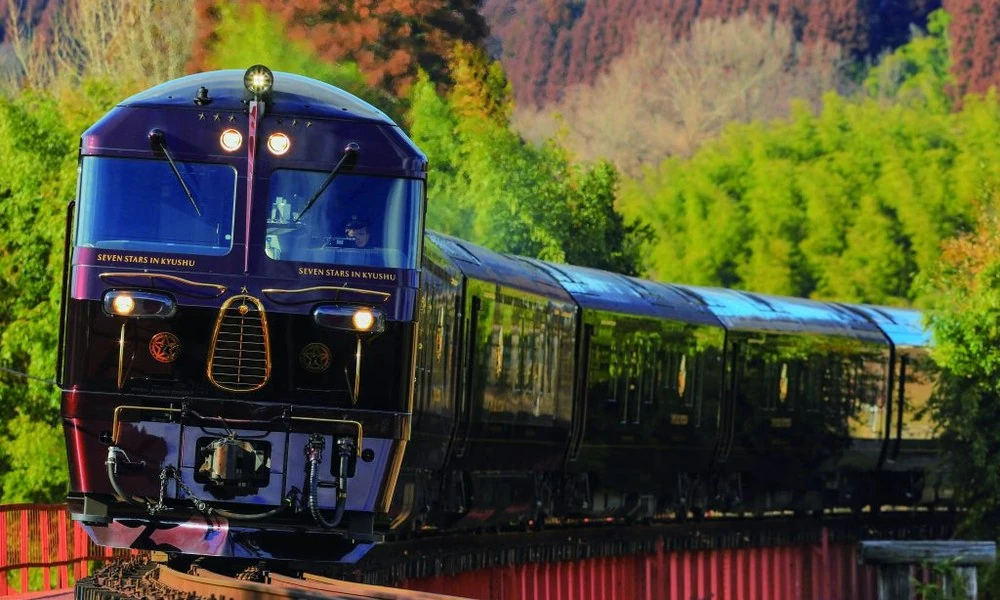
Japan’s first luxury cruise train remains its most exclusive. The Seven Stars in Kyushu, operated by JR Kyushu and launched in October 2013, carries around thirty guests in a seven-carriage train designed by Eiji Mitooka, with hand-crafted wood interiors, stained glass, and brass fittings throughout.
The name is deliberate: seven cars, the seven prefectures of Kyushu, and seven themes of the island, from nature and food to hot springs, history, and craft. Both itineraries begin and end at Hakata Station in Fukuoka: a shorter two-day, one-night loop, and a four-day, three-night circuit of the island, with stops for onsen bathing, pottery workshops, and meals built around the produce of each prefecture.
The dining is Japanese in the fullest sense, with menus that change with the season and the stop, and the service is the quiet, attentive kind that Japan does better than anywhere else.
Booking is part of the experience, and part of the difficulty: demand has outstripped supply since the train’s debut, so places are allocated by application and lottery rather than by simple reservation. For those who secure a suite, the reward is a journey that feels less like a train ride than like a moving inn, built entirely around one island and its crafts.
4. Train Suite Shiki-Shima, Japan
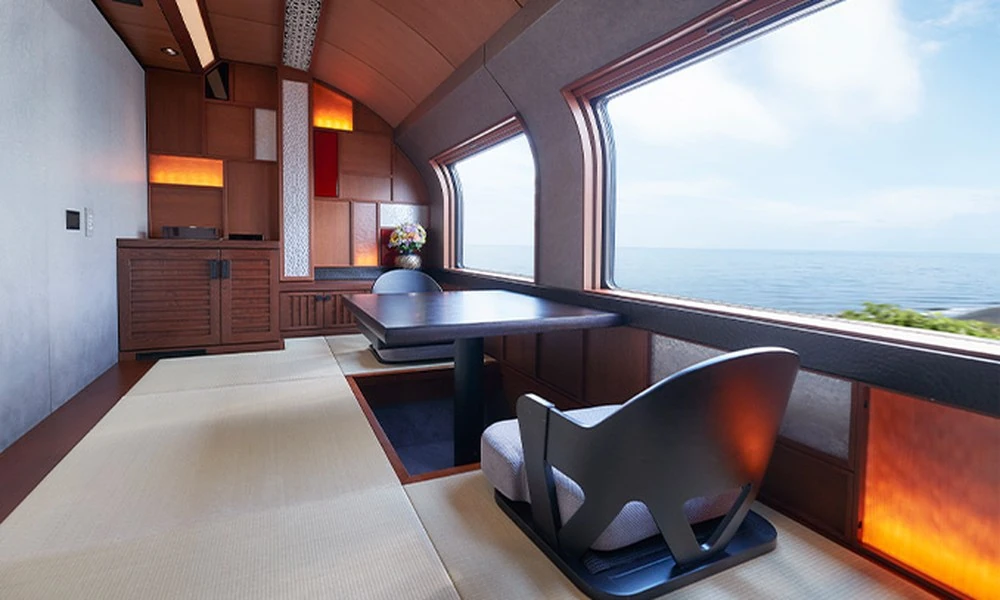
If the Seven Stars is Japan’s original cruise train, the Shiki-Shima is its most quietly futuristic. Operated by JR East, it runs from Tokyo’s Ueno Station on two- to four-day itineraries through the Tohoku region and, on its longer routes, up to Hokkaido.
The train has just ten suites, so the whole journey feels private from the moment you board, and the design, by Ken Okuyama, mixes Japanese craft with a clean, modern line: wood, washi paper, and lacquer, with wide windows that frame the landscape like a series of paintings.
The two-level observation cars at either end of the train are the heart of the journey, with floor-to-ceiling glass and low chairs arranged for looking out rather than for conversation.
Meals are prepared on board from ingredients gathered along the route, and the excursions are small and considered: a craft workshop, a morning market, a walk through a town that most visitors to Japan never reach.
The Shiki-Shima is the train for travellers who have already seen Japan’s famous sights and want the country’s quieter north, taken at the pace of a train that has nowhere to be in a hurry.
5. Eastern & Oriental Express, Singapore and Malaysia
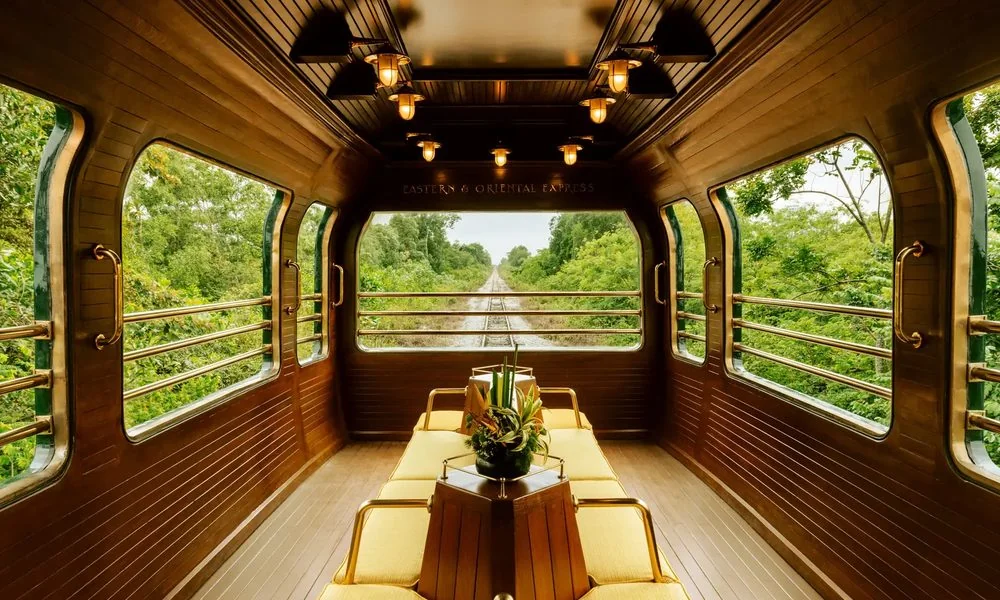
The Eastern & Oriental Express has a long history and a new shape. First run in 1993 between Singapore and Bangkok, the Belmond train was suspended in 2020 and relaunched in February 2024 as a series of round trips from Singapore’s Woodlands station into Malaysia, in three-night, four-day itineraries.
The Bangkok leg is gone, and the train is better for it: the two seasonal routes, Essence of Malaysia and Wild Malaysia, run through the Malay Peninsula’s rainforest, plantations, and coast, with guided excursions ashore and long, slow stretches of jungle from the observation car.
The carriages keep their dark green and cream livery and their teak and marquetry interiors, with a pianist in the bar car and a dining car that serves Malaysian and European dishes side by side. In 2024 the train also became the first in Asia to carry a Dior spa on board.
The Eastern & Oriental Express suits travellers who want old-world glamour without the formality of the European trains: the dress code is relaxed, the climate is warm, and the pleasure is in watching a landscape most visitors only ever see from a motorway, at the speed of a train that has all the time in the world.
6. Maharajas’ Express, India
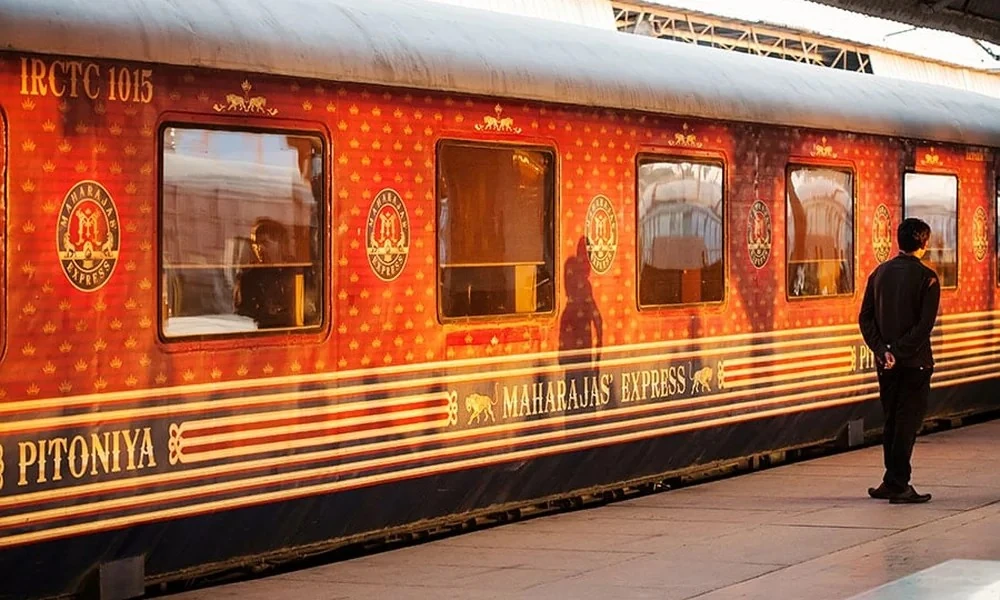
The Maharajas’ Express is the grandest train on this list, and the most theatrical. Operated by IRCTC, it runs four fixed itineraries between September and April, from three nights and four days to six nights and seven days, linking Delhi with Jaipur, Ranthambore, Agra, Udaipur, and Mumbai, depending on the route chosen.
The train has twenty-three carriages, with cabins in four categories from Deluxe Cabins to the Presidential Suite, two restaurant cars, a lounge, and a bar, all finished in the deep reds and golds of a royal court.
Days ashore are the point of the journey: the Taj Mahal at Agra, a morning safari in Ranthambore, the palaces of Jaipur and Udaipur, and the temples of Khajuraho on the longer routes.
Evenings return to the train for dinner and for the particular pleasure of waking in a new place each morning without having packed a bag.
The Maharajas’ Express is the best way to see the classic sights of Rajasthan and central India in a single journey, and it suits travellers who want their history served with ceremony: a red carpet at the station, a welcome drink on arrival, and a train that treats every departure as an occasion.
7. The Ghan, Adelaide to Darwin, Australia
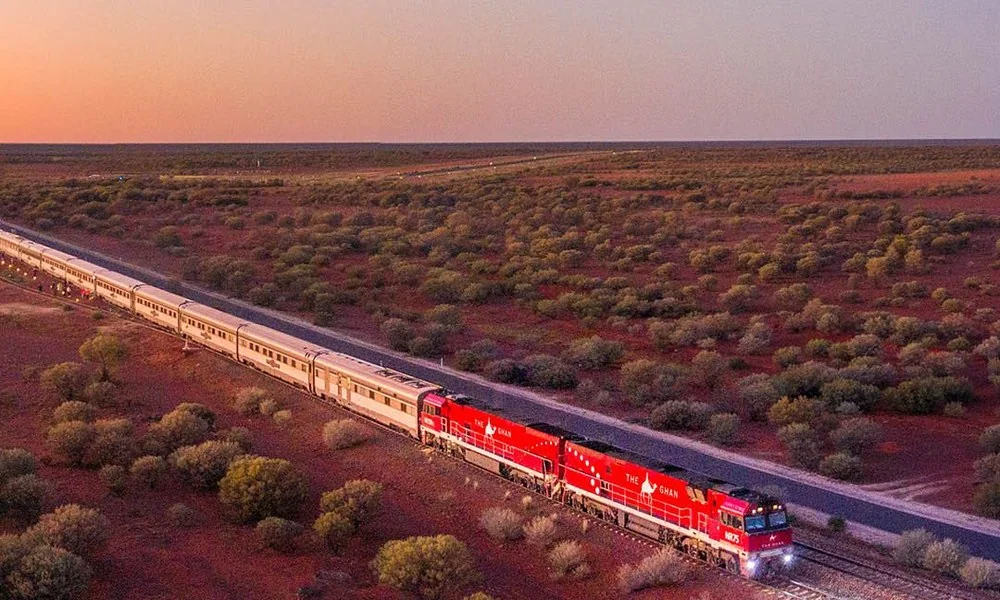
The Ghan crosses a continent, and it feels like it. Operated by Journey Beyond, the train runs 2,979 kilometres from Adelaide on the south coast to Darwin on the Timor Sea, through the red heart of Australia.
The full journey now runs over four days and three nights in either direction, with stops at Alice Springs and Katherine, a sunrise in the desert, and, on the northbound run, dinner in the Clare Valley and a day in the Flinders Ranges.
The train is named for the Afghan cameleers whose camel trains once crossed the same country, and the route still has something of that frontier about it: long stretches of red earth and spinifex, small towns that exist because the railway does, and a sky that seems larger than anywhere else on earth.
On board, the cabins range from Gold Twin to Platinum, with a separate dining room for Platinum guests, and all meals and most excursions are included in the fare.
The Ghan runs from March to November, avoiding the Top End’s wet season, and it is at its best in the cooler months, when the desert light is at its clearest. It is the journey on this list that most changes a traveller’s sense of scale: Australia is a large country, and the Ghan is the most comfortable way to understand just how large.
The Americas and Africa
8. Rocky Mountaineer, Vancouver to the Canadian Rockies
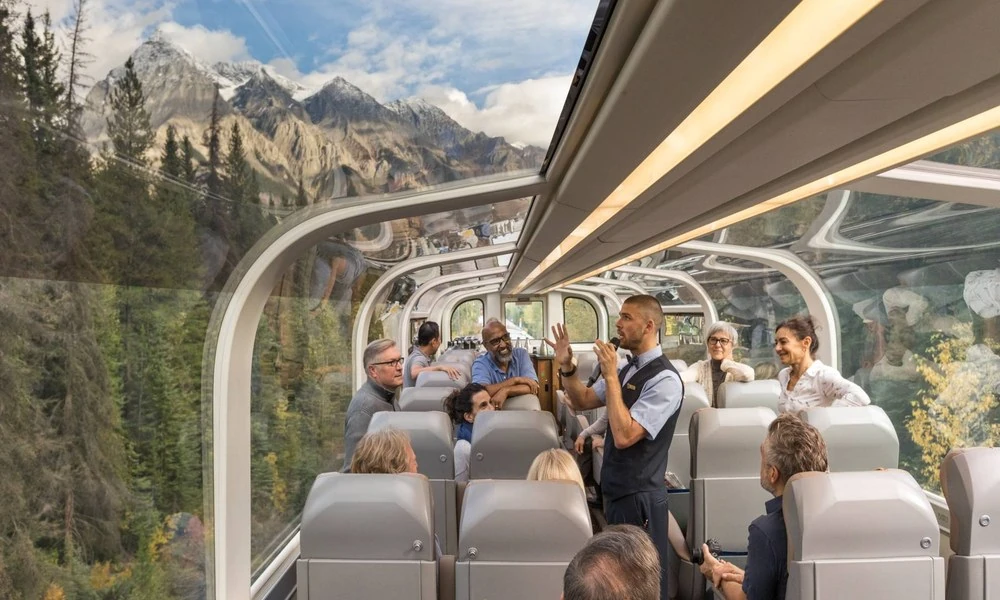
The Rocky Mountaineer works to a simple rule: train by day, hotel by night. There are no sleeper cars at all. The two-day journeys from Vancouver to Banff, Lake Louise, or Jasper travel entirely in daylight. Passengers spend the night at a hotel in Kamloops between the two rail days, allowing them to enjoy every part of the Rockies without missing the scenery after dark.
The route follows the historic Canadian Pacific line through the Fraser Canyon, past Hell’s Gate, through the Spiral Tunnels and over the Continental Divide, with Mount Robson, the highest peak in the Canadian Rockies, on the Jasper route.
GoldLeaf service is the one to choose: a bi-level glass-domed coach with seats upstairs under the dome, a separate dining room downstairs, and an outdoor viewing platform for the open-air hours.
Meals are built around ingredients from British Columbia and Alberta, and the commentary from the on-board hosts is knowledgeable without ever becoming a lecture. The season runs from April to October.
The Rocky Mountaineer is the most straightforwardly scenic journey on this list, and the best choice for travellers who want the mountains themselves to be the luxury, with the train as the finest possible window onto them.
9. Belmond Andean Explorer, Cusco to Arequipa, Peru
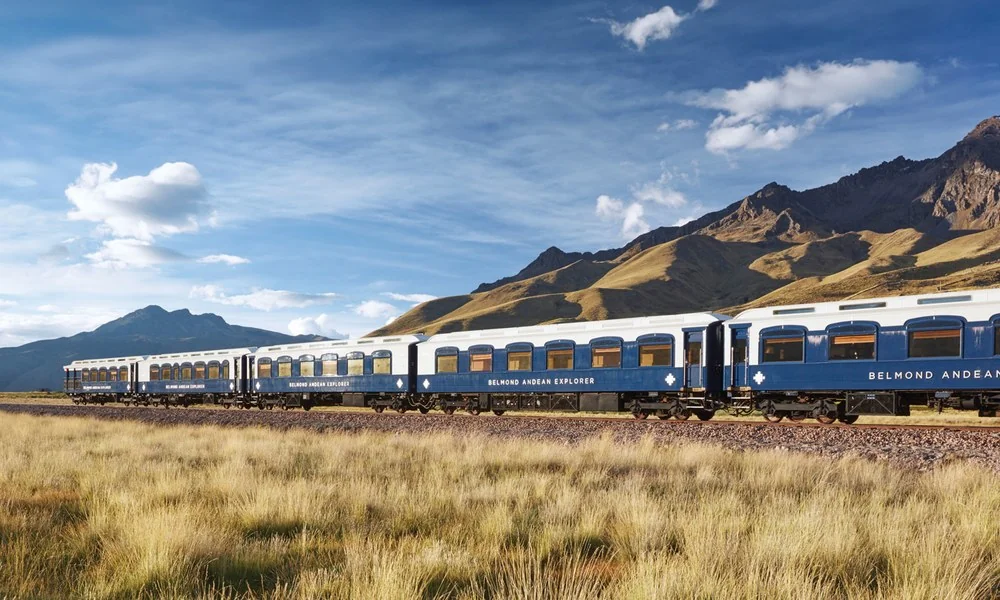
The Andean Explorer is South America’s first luxury sleeper train, launched in May 2017, and it crosses some of the highest railway country on earth.
The full Peruvian Highlands journey takes three days and two nights from Cusco to Arequipa, with an overnight stop at Puno on the shores of Lake Titicaca, the highest navigable lake in the world.
From Cusco, the train climbs onto the Altiplano and crosses the La Raya Pass at around 4,335 metres. It then descends towards the lake, where guests spend the morning exploring the Uros people’s floating reed islands.
The second leg continues south to Arequipa, the white stone city, with a stop at the ancient rock art of the Sumbay Caves along the way. On board, the train carries fewer than fifty guests in en-suite cabins, with two dining cars serving Peruvian cuisine, a piano bar, a spa car, and an open-air observation deck at the rear.
The altitude is the one thing to take seriously: a day or two to acclimatise in Cusco or the Sacred Valley before boarding makes the whole journey easier, and the train carries oxygen for guests who need it.
For travellers who want the Andes at their most dramatic, taken slowly and in comfort, there is nothing else like it on the continent.
10. Rovos Rail, Pretoria to Cape Town, South Africa
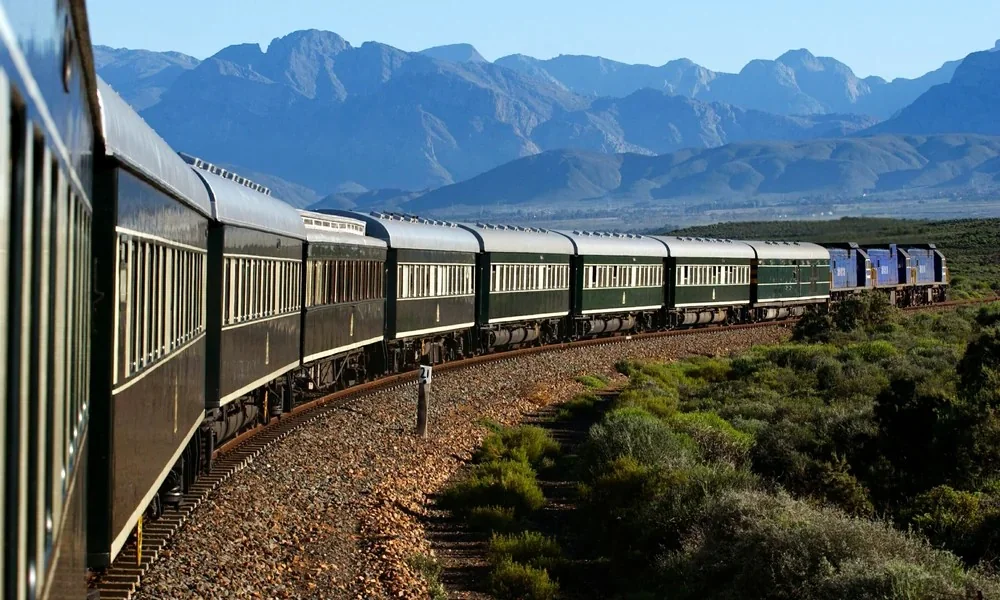
Rovos Rail calls itself the Pride of Africa, and the claim is not an exaggeration. Founded in 1989, the privately owned train runs from its own station at Capital Park in Pretoria to Cape Town, a journey of about 1,600 kilometres over three nights, with stops at Kimberley, for the Big Hole and its diamond museum, and at Matjiesfontein, a Victorian village preserved almost whole in the Karoo.
The train carries a maximum of seventy-two passengers in thirty-six en-suite suites, in Pullman, Deluxe, and Royal categories, with the Royal Suites offering a full-length bath. Meals are long, formal, and cooked fresh on board, with South African wines, and dinner requires a jacket and tie.
There is no Wi-Fi and no television on board, by design: the Karoo is the entertainment, with its wide plains, flat-topped hills, and skies that change by the hour.
Rovos Rail also runs longer routes to Victoria Falls, Durban, and Namibia, and an extended expedition to Dar es Salaam, but the Cape Town run is the classic, and the one to take first.
It is the slowest journey on this list, and the one that most rewards a traveller who is happy to do nothing at all for three days except watch a continent pass by.
Choosing Your Journey
The right luxury train depends less on the train than on the traveller.
To fix the Yoast warning, vary the sentence openings while keeping the meaning:
If history and ceremony appeal to you, the Venice Simplon-Orient-Express or the Maharajas’ Express are excellent choices.
For breathtaking scenery, consider the Rocky Mountaineer or the Ghan.
Travellers seeking a more intimate experience may prefer the Seven Stars, the Shiki-Shima, or the Andean Explorer. Each carries relatively few guests, making the journey feel more private.
A few practical points apply to all ten. Book well ahead: most of these trains run weekly or seasonally, with fixed departures and small numbers of cabins, and the popular dates go first.
Check the season before you commit, since several run only part of the year, and confirm what the fare includes, as most are largely all-inclusive but the details vary. Pack for the dress code where one exists, and for the altitude on the Andean Explorer.
Making the Most of Your Luxury Train Journey
Finally, think about the rest of the trip: the train is the centrepiece, not the whole journey, so allow a night or two at either end.
Choosing a luxury hotel that is actually worth it matters as much at the end of a rail journey as at the start, and for the longer distances around the train itself, the comparison in private jet vs first class is a useful guide to when speed is worth paying for and when it is not.
When the train finally slows into its last station, the journey does not quite end there it lingers in the small things: the sound of the dining car at dusk, the view from a window you never wanted to leave, and the unhurried hours in between.
We hope one of these ten journeys finds its way onto your list, and that when it does, you travel slowly, look out often, and let the railway do what it has always done best carry you somewhere worth going, at exactly the right pace.