Most hotels hang art the way most people hang curtains: to finish a room. A small number of hotels do the opposite. In these hotels, the art came first or at least, the art is the reason the hotel exists in the form it does. The collection shapes the architecture, the corridors behave like galleries, and a walk to breakfast can feel like a private viewing.
These are the world’s most art-filled hotels, and they reward a different kind of stay: slower, more observant, and quietly unlike any other night away from home.
What follows is not a ranking. Art is a matter of taste, and a hotel that moves one guest may leave another unmoved. Instead, these are seven hotels where art is structural rather than decorative places where a serious collection, a museum, or a single extraordinary commission defines the experience.
They span a converted grain silo in Cape Town, a Highland coaching inn, a Paris palace and a museum-hotel in Kentucky, and together they show just how many ways a hotel can be filled with art. For a broader sense of where these sit among the best hotels in the world, they belong firmly at the cultural end of the list.
What Makes a Hotel an Art Hotel
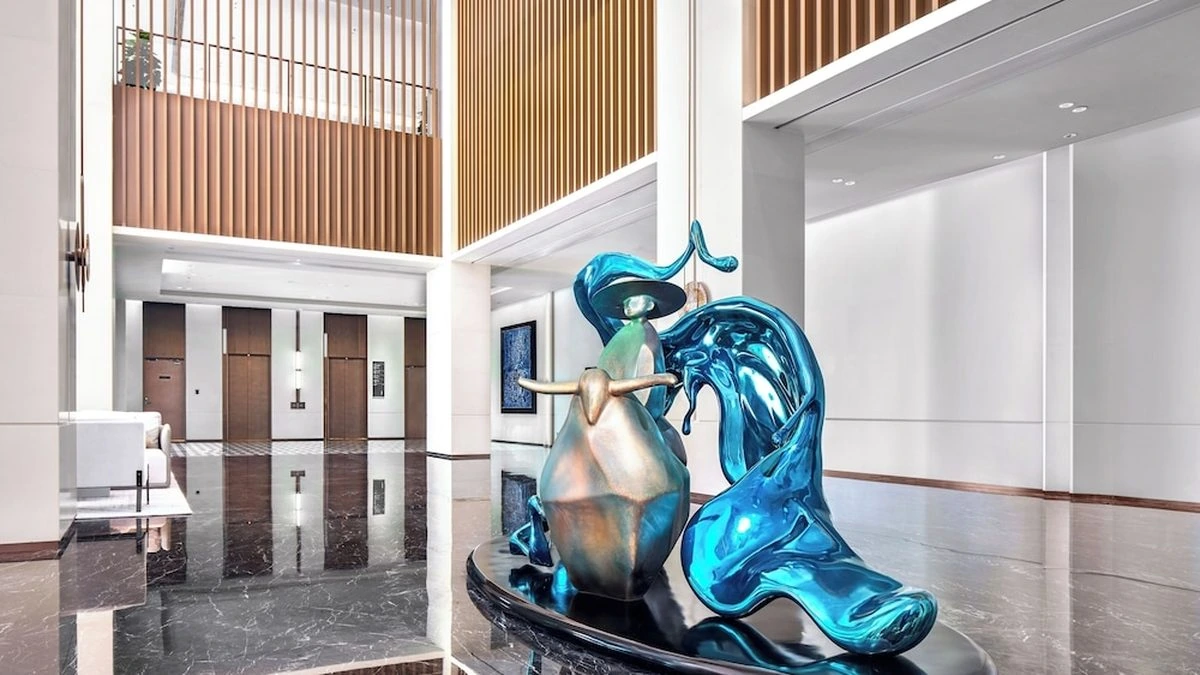
Almost every luxury hotel now has art on its walls. The difference between decoration and a genuine art hotel lies in intent, scale and access. In a true art hotel, the works are originals rather than reproductions, the collection has a point of view, and guests can spend real time with the art in public spaces, in corridors, and often in their own rooms.
The best of them also make the art legible: a guide, a tour, a concierge who knows the collection, or simply labels that tell you what you are looking at and why it matters.
There are roughly three kinds. The first is the collector’s hotel, where a private collection has been opened to guests a family’s lifetime of acquiring, displayed where people sleep and eat rather than stored in a vault. The second is the museum-hotel, where the building genuinely houses a museum, and the hotel grows out of it.
The third is the artist’s hotel, where a single commission or a resident artistic programme gives the building its identity. The hotels below include all three, and the distinctions matter less than the shared effect: you leave knowing something you did not know when you arrived.
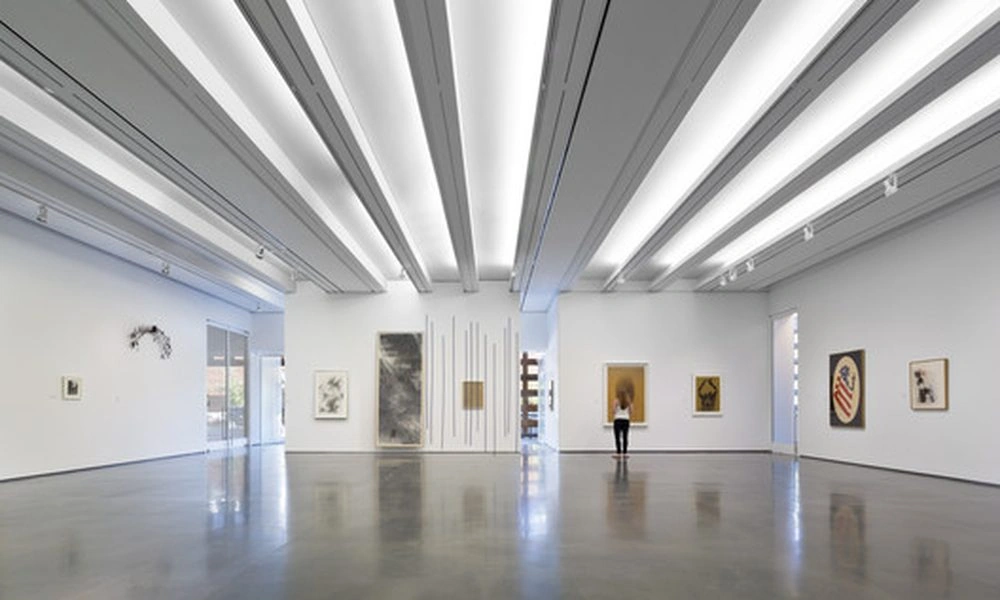
It is also worth saying what these hotels are not. They are not galleries with beds attached as an afterthought, and the good ones never feel like a lecture. The art is there to be lived with glimpsed over coffee, argued about at dinner, returned to the next morning in different light. That is the pleasure of them, and it is a quiet one.
Seven Hotels Where Art Takes Centre Stage
1. 21c Museum Hotel, Louisville, Kentucky
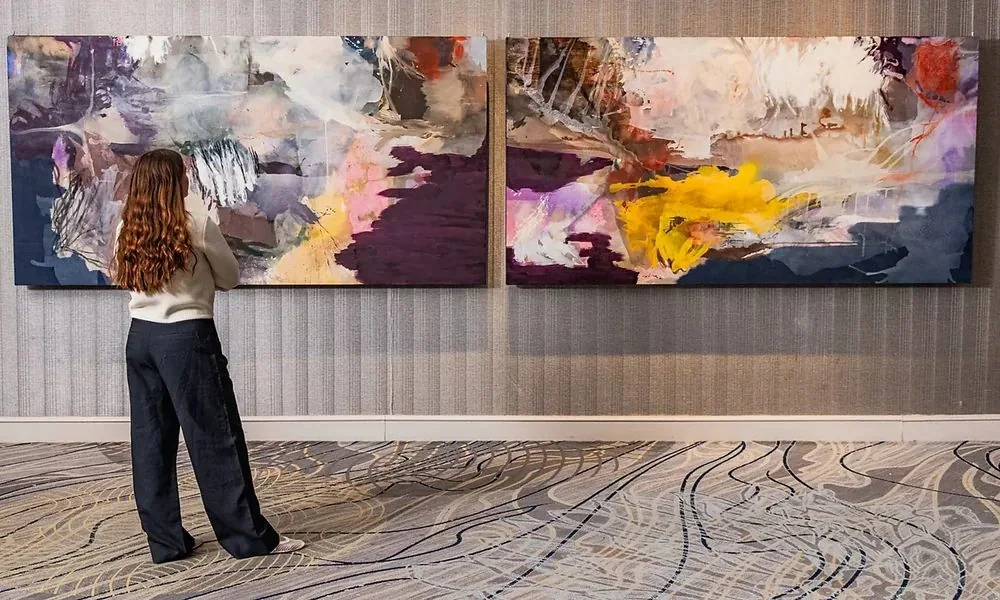
Few hotels can claim to be a museum first and a hotel second, but 21c Museum Hotel in Louisville comes close. It was founded in 2006 by the collectors and preservationists Laura Lee Brown and Steve Wilson, who rehabilitated a row of 19th-century warehouses in the city’s downtown arts district to create a union of contemporary art museum, boutique hotel and restaurant.
The idea was civic as much as cultural: that art could help bring a downtown back to life, and that a museum open to the street and to hotel guests at all hours could make contemporary art part of daily life rather than a special occasion.
The museum is the heart of the building. It is a collecting museum devoted to art of the 21st century, and its permanent collection has grown to around 3,000 objects, with works by artists including Bill Viola, Kara Walker and Chuck Close among those shown over the years.
Exhibitions change, installations occupy the public spaces, and the art does not stop at the gallery doors: it continues through corridors, into the restaurant and up to the rooms. Guests encounter it the way museum visitors rarely can alone, late at night, without a crowd between them and the work.
What makes 21c remarkable is that the model proved repeatable. The Louisville original has been joined by sister museum-hotels in other American cities, each with its own exhibitions and its own relationship to its downtown. But Louisville remains the purest expression of the idea: a hotel built by collectors who believed a city deserved a museum, and decided to build the bedrooms around it.
2. The Dolder Grand, Zurich, Switzerland
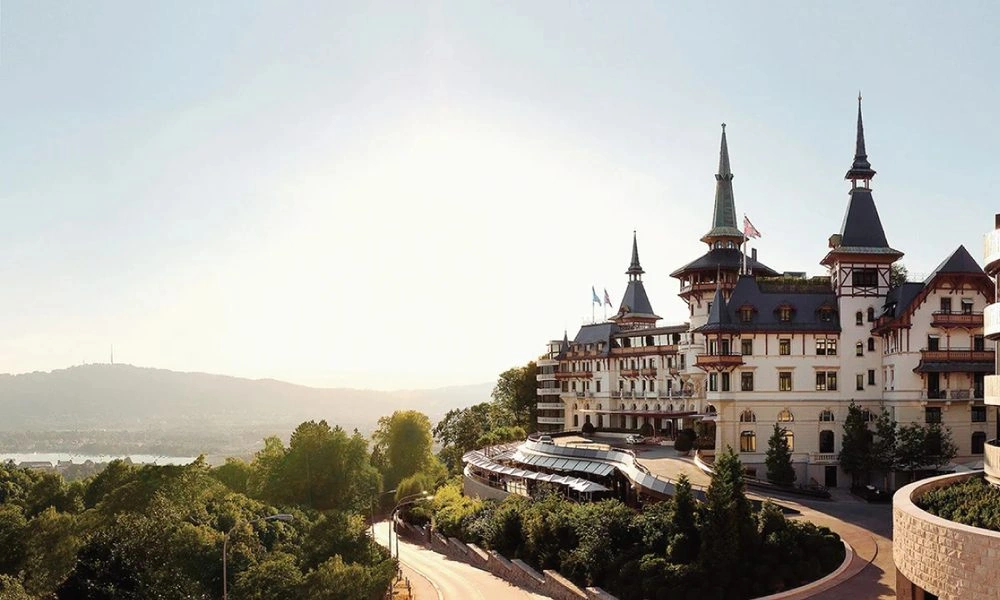
The Dolder Grand has watched over Zurich from its wooded hill since 1899, and after a four-year restoration led by Norman Foster it reopened in 2008 as a dialogue between its turreted 19th-century palace and two strikingly modern wings.
Inside, it holds one of the finest private art collections ever assembled inside a hotel: more than 100 works by around 90 artists, belonging to the owning Schwarzenbach family, displayed throughout the public spaces rather than gathered in a single gallery.
The scale of the collection announces itself immediately. Andy Warhol’s monumental Big Retrospective Painting, some 11 metres long, hangs above the reception desk. A Joan Miró sculpture overlooks the driveway. Salvador Dalí’s Femmes métamorphosées – Les sept arts greets diners at the entrance to the restaurant, and Fernando Botero’s Woman with Fruit keeps company with the spa terrace.
Elsewhere, guests come across works by Keith Haring, Max Ernst, Takashi Murakami, Henry Moore and Damien Hirst, among many others a roll call that would be the envy of a mid-sized museum.
The hotel treats the collection seriously, with a digital art guide that lets guests explore each work as they encounter it. That matters, because the pleasure of the Dolder’s art is the pleasure of discovery: a sculpture on the way to the spa, a painting at the turn of a staircase, a familiar name in an unexpected corner. Few hotels reward wandering quite so richly.
3. Le Royal Monceau – Raffles Paris, France
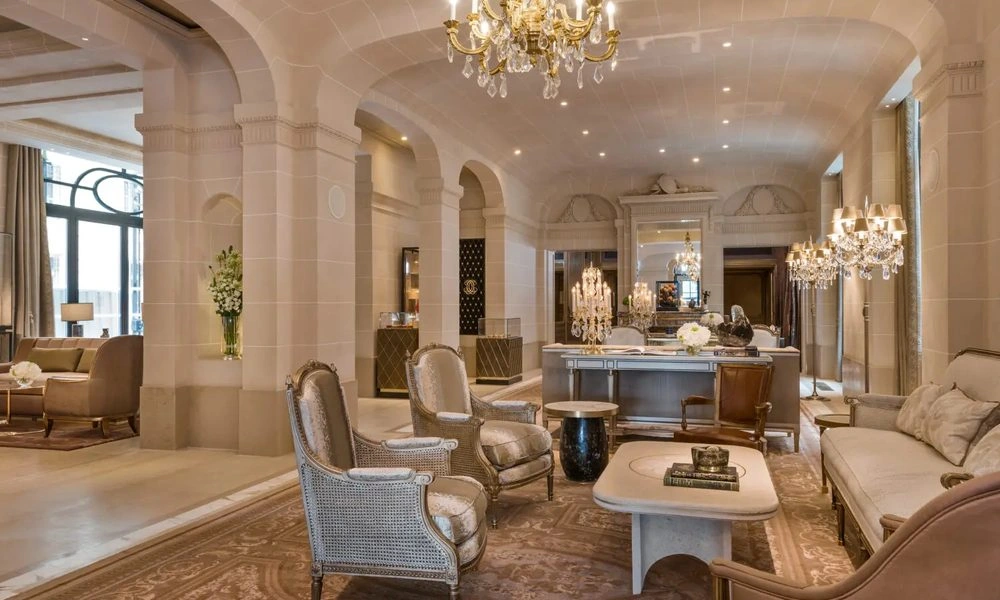
Le Royal Monceau has been a haunt of the creative world since it opened in 1928, counting writers and artists among its regulars. When it reopened in October 2010 after a complete reinvention by Philippe Starck, the hotel made that history its programme: contemporary art would not merely decorate the palace, it would run through it. The result is one of the most deliberately art-centred hotels in Europe.
The hotel holds more than 300 works, curated by Hervé Mikaeloff, spread through the rooms, suites, lobby and restaurants. Nikolay Polissky’s wooden caribou stand on a landing; a large teapot by Joana Vasconcelos sits in the garden; original works hang in the bedrooms, where guests also find a guitar and a selection of books from the hotel’s own art bookshop.
The Art District, the hotel’s gallery, hosts changing exhibitions, and the 99-seat Cinéma Katara gives the building a private cinema of its own.
Most distinctive of all is the hotel’s art concierge, Julie Eugène, who has held the post since 2010. Her role is to open the Paris art world to guests: private visits to galleries and museums, introductions to artists, and guidance for those who wish to begin collecting.
It is a small, human detail, and it captures what makes the Royal Monceau different the art here is not only on the walls, it is a service, offered with the same care as a dinner reservation.
4. The Fife Arms, Braemar, Scotland
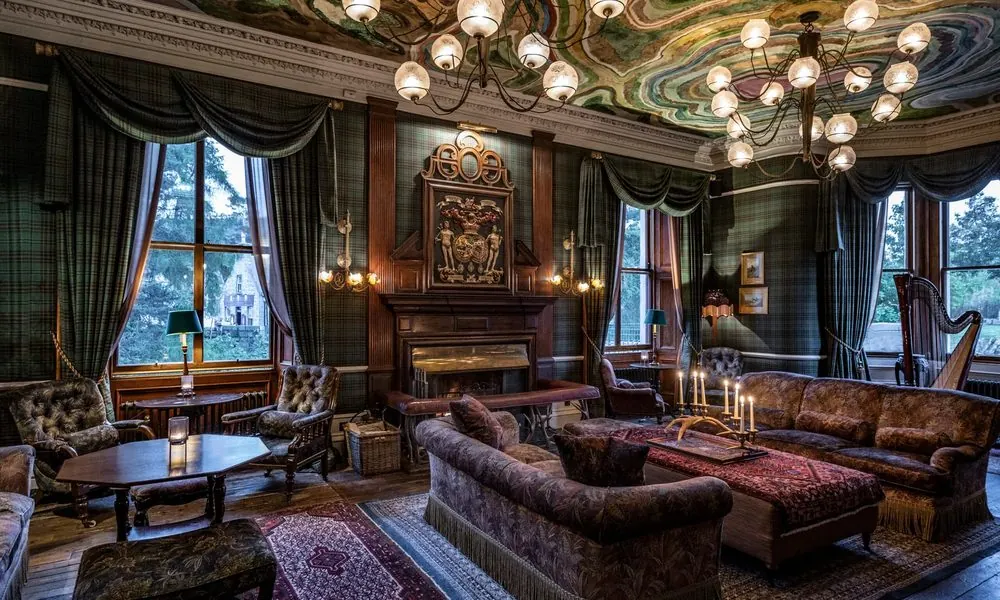
The Fife Arms began life in 1856 as a Victorian coaching inn serving travellers through Royal Deeside, a route made fashionable by Queen Victoria’s love of nearby Balmoral. By the time Iwan and Manuela Wirth founders of the gallery Hauser & Wirth bought the building in December 2014, it had fallen into serious disrepair.
After a restoration lasting roughly four years, it reopened on St Andrew’s Day, 30 November 2018, as something without precedent in the Highlands: a sporting hotel that is also a serious house of art.
The collection is vast, numbering more than 12,000 works, antiques and objects, assembled with gallery rigour rather than as decoration. A Louise Bourgeois spider stands in the courtyard. Zhang Enli painted the drawing room ceiling.
Works by Picasso, Lucian Freud and Gerhard Richter hang near watercolours by Queen Victoria herself, and site-specific commissions run through the building, from a wrap-around mural by Guillermo Kuitca to the hotel’s coat of arms, designed by the artist and naturalist James Prosek. The interiors, by Russell Sage Studio, are deliberately maximalist tartan, taxidermy, antiques and open fires and the art is woven into all of it.
What is striking about the Fife Arms is how local the collection feels despite its international names. Much of it was acquired because it relates to the region, its natural history or its people, so the hotel reads as a portrait of Braemar as much as a display of taste. It is a collector’s house in the truest sense: personal, specific, and impossible to replicate anywhere else.
5. The Silo Hotel, Cape Town, South Africa
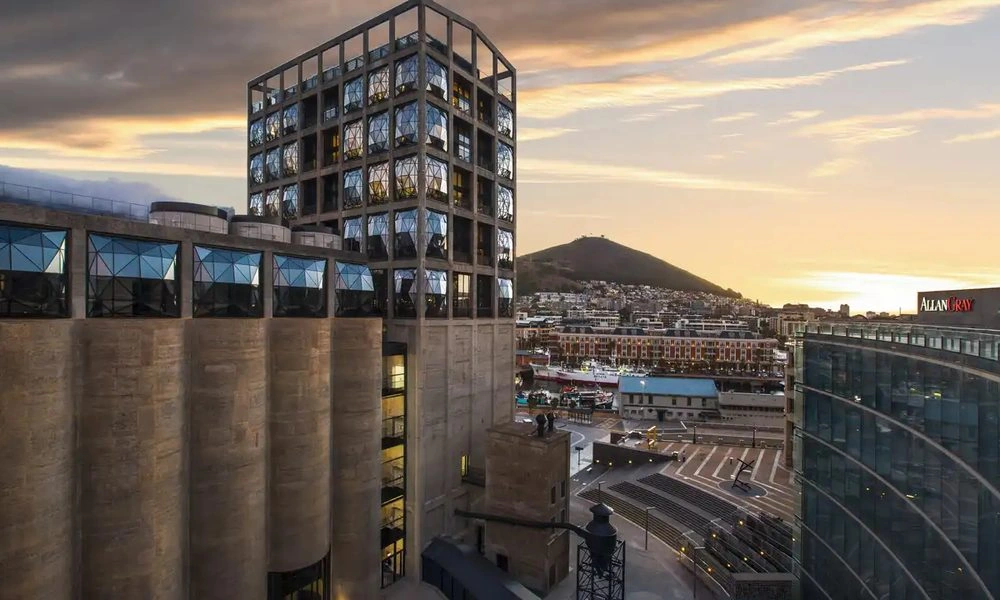
There is no mistaking the building. The Silo Hotel occupies the upper floors of a converted 1920s grain silo at Cape Town’s V&A Waterfront, its concrete frame opened up by Thomas Heatherwick’s celebrated pillowed-glass windows, which bulge from the facade like cushions of glass.
Below it sits the Zeitz Museum of Contemporary Art Africa (MOCAA), home to the continent’s largest collection of contemporary African art. The hotel opened in March 2017, a few months before the museum below it, and the two have been inseparable ever since.
The hotel itself holds more than 300 pieces of contemporary African art, each of its 28 suites individually designed and decorated by Liz Biden, founder of The Royal Portfolio. Colour is everywhere bold textiles, expressive furniture, works chosen in collaboration with local galleries and the effect is deliberately unlike the restrained minimalism of most luxury hotels.
An art concierge offers private tours, leading guests through the hotel’s collection and down into the museum below, where the carved concrete of the old silo tubes frames the galleries.
The Silo is the clearest example on this list of the museum-hotel idea: a hotel that is literally built on top of a museum, in a building that was itself an industrial sculpture before anyone hung a picture in it. To stay here is to sleep inside a work of architecture, above a museum, surrounded by art three layers of the same story.
6. The Beaumont, Mayfair, London
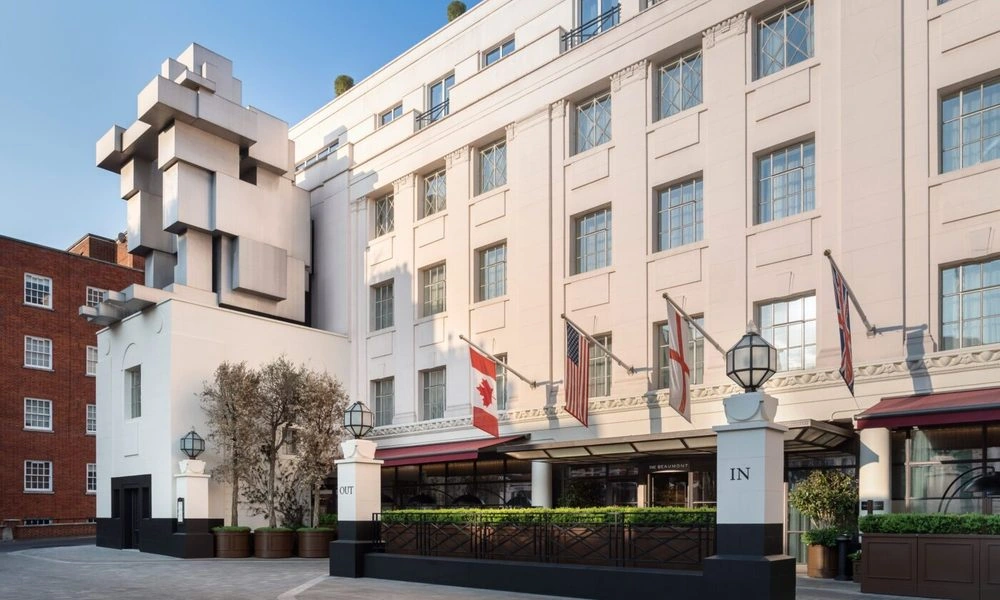
The Beaumont is, at first glance, a study in discretion: a quiet Art Deco hotel on Brown Hart Gardens in Mayfair, opened in autumn 2014 as the first hotel venture of the restaurateurs Chris Corbin and Jeremy King. Then you notice the facade. Perched on the building’s edge is a giant crouching figure made of stacked stainless-steel blocks ROOM, by Antony Gormley and the figure is not only a sculpture. Inside it is a suite.
Gormley described the work as a contrast between a visible exterior of large rectangular masses and an inner experience. The interior of ROOM measures just four square metres, but its ceiling rises ten metres high; clad in dark fumed oak, with shutters that provide total blackout, it is a space the artist intended for withdrawal and reflection he has spoken of sculpting darkness itself.
The bedroom forms the centre of a one-bedroom suite, with sitting room, bathroom and hallway in the main building, and every suite in the hotel features works from its own art collection.
London’s grand hotels have long kept company with artists The Savoy and Claridge’s both carry a century of creative history in their walls but the Beaumont does something rarer: it lets a guest sleep inside a work by one of Britain’s most celebrated living sculptors. It is the smallest, strangest and most memorable room on this list.
7. Hotel Arts, Barcelona, Spain
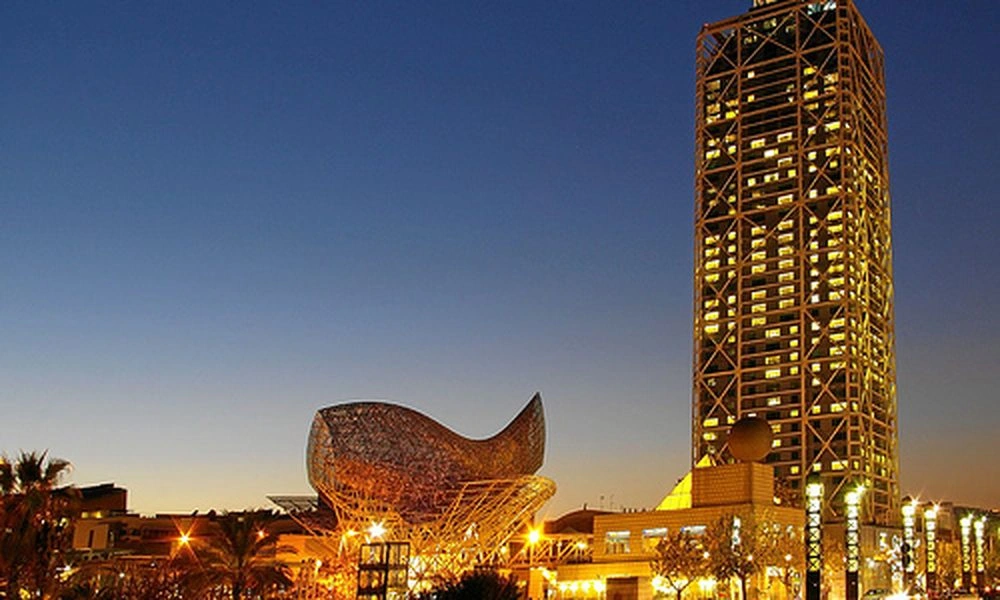
Hotel Arts stands at the edge of the Olympic port in Barcelona, a tall tower of blue glass and white lattice that has become part of the city’s waterfront skyline. Beside it, on the promenade, rises one of the most recognisable sculptures in Spain: Frank Gehry’s Peix, a vast golden fish of woven steel that catches the Mediterranean light and seems to move with it.
The pairing is no accident. The hotel and the sculpture belong to the same moment in Barcelona’s history the waterfront’s transformation around the 1992 Olympic Games and together they announce that this stretch of the city takes art seriously.
Inside, Hotel Arts carries the theme through its public spaces, where contemporary art is part of the daily fabric of the hotel rather than confined to a gallery.
The real pleasure, though, is the relationship between the building and its setting: the tower, the fish, the beach and the sea form a single composition, and the hotel’s terraces and windows frame it all day long. It is a reminder that an art-filled hotel need not keep its collection indoors sometimes the most important work is the one waiting outside the front door.
Barcelona rewards the art-minded traveller more broadly, and Hotel Arts makes a natural base for it: the city’s galleries, its modernista architecture and its public sculpture are all within easy reach. But few bases offer a masterpiece as their next-door neighbour.
How to Choose an Art-Filled Hotel
If you are choosing a stay for the art rather than the thread count, a few questions help. First, ask whether the works are originals, and whether the collection has a curator or a named collector behind it a collection with a point of view is almost always more rewarding than one assembled to match the upholstery.
Second, ask how the art is shared: a hotel that offers tours, a guide or a concierge who knows the collection is a hotel that expects you to look, not just to glance.
Third, consider the building itself. In the best art hotels, the architecture is part of the collection a converted silo, a restored coaching inn, a palace reinvented by a designer. And finally, give yourself time. Art hotels repay unhurried stays: an hour in the morning before the day begins, a slow walk back through the lobby at night, a second look at a piece that puzzled you the first time. The art does not change between visits; your eye does.
None of this requires expertise. You do not need to know the artists to enjoy these hotels, only to be willing to look closely. The hotels on this list are built on that belief that attention is the one luxury no amount of money can buy, and the one these places give away freely.
May your next check-in feel a little like opening night unhurried, a touch unexpected, and full of things worth standing still for. Wherever you wander, we hope the art stays with you long after checkout, as quietly and as pleasantly as a good hotel should.