For most of aviation history, turbine helicopters were the machinery of operators: fleets, companies, and governments that could absorb the capital and complexity. Private owners entered the turbine market at the price of a large house. Many left it at the price of a small one.
Then, in 2010, Robinson Helicopter Company of Torrance, California, did what it had done twice before with piston helicopters. It designed the market’s simplest credible machine around a single economic thesis: the pilot owner, not the operator, was the industry’s most underserved customer.
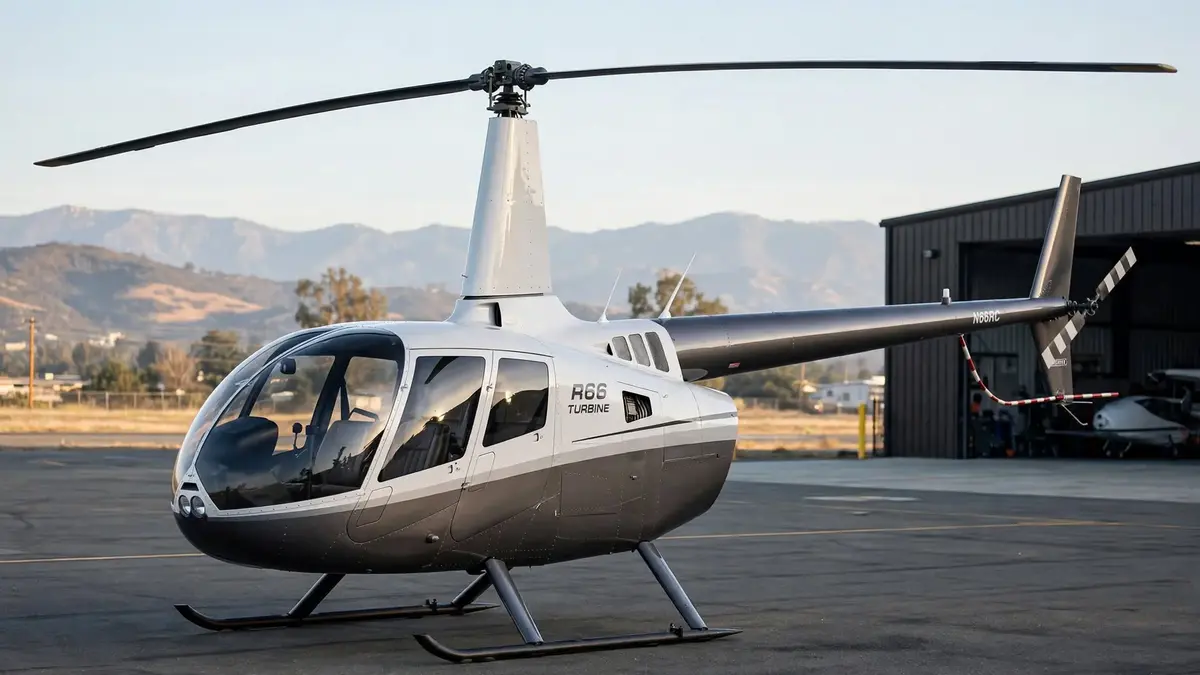
The R66, with five seats and a single Rolls-Royce turbine engine, became the bestselling turbine helicopter in the world within years of its introduction. It changed who owns helicopters.
Here is the story of the machine, its economics, and why it dominates the first purchase conversation.
The Robinson Method
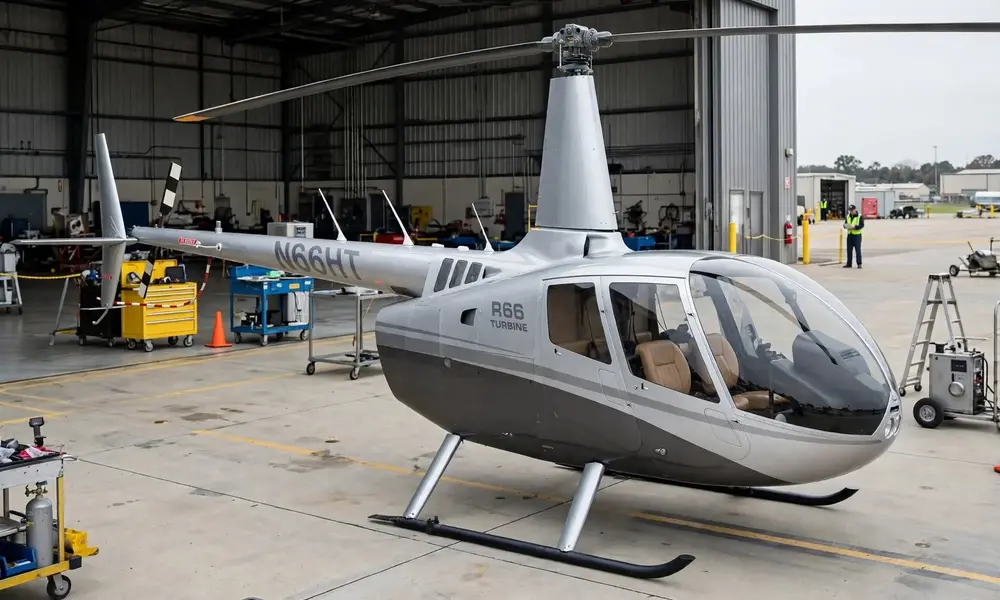
Frank Robinson, the company’s founder and the R66’s designer, built his company on a conviction: helicopter manufacturing had made itself unnecessarily expensive. There were too many parts, too much complexity, and too little attention to what a private pilot actually does.
The R22 of 1979 and the R44 of 1993 applied this method to the piston training and light utility markets. Together, they became the most produced helicopter family in history by a wide margin.
The R66 extended the same discipline to the turbine. It featured a two-blade rotor system of elegant simplicity, a conventional rather than exotic airframe, and a single Rolls-Royce RR300 engine derived from the proven M250 family. Its cabin carries five without pretending to be a limousine.
The result costs roughly a third of what its nearest turbine competitors cost to acquire. Its operating economics undercut them further. That is why training fleets, ranch operators, and owner pilots around the world chose it in numbers that reordered the market.
The Numbers
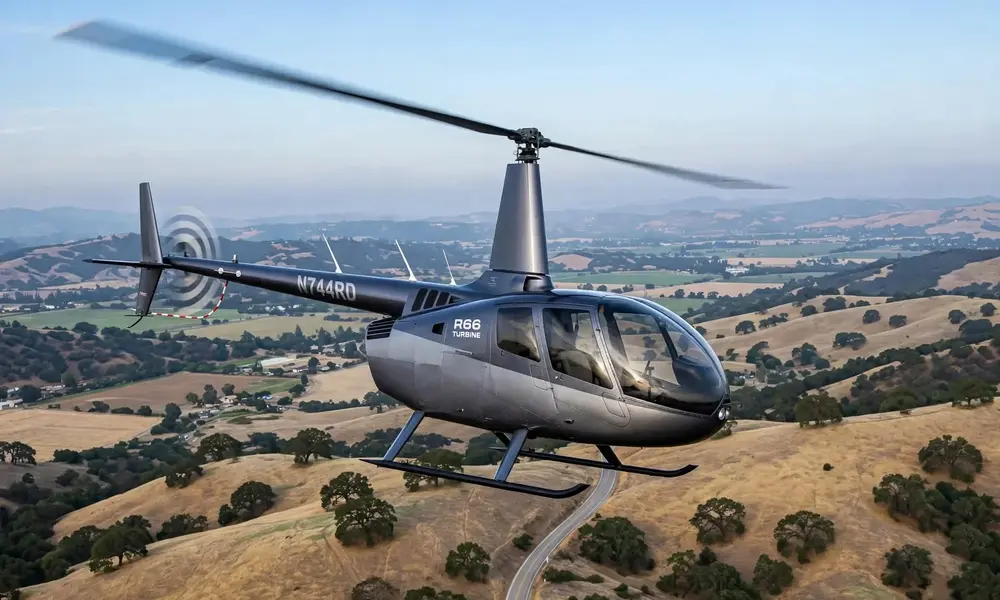
A new R66 lists in the neighborhood of $1.3 to $1.5 million. Used examples range from roughly $900,000 to $1.3 million, depending on hours and condition.
Operating costs are notoriously variable by pilot and mission. In typical owner use, they run from around $400 to $600 per hour, a fraction of light twin costs. The single-engine simplicity also keeps maintenance direct.
Performance is honest: a cruise speed of around 110 knots, a useful load near 1,200 pounds, and a range that covers the hundred-to-three-hundred-mile missions that define private helicopter flying.
The tradeoffs are equally honest. The cabin is tight when carrying five adults with baggage. The characteristic beat of the two-blade rotor takes a flight to love. The payload margin also demands discipline about fuel, passengers, and altitude. It is the same discipline the training market taught a generation of pilots.
The Training Ecosystem
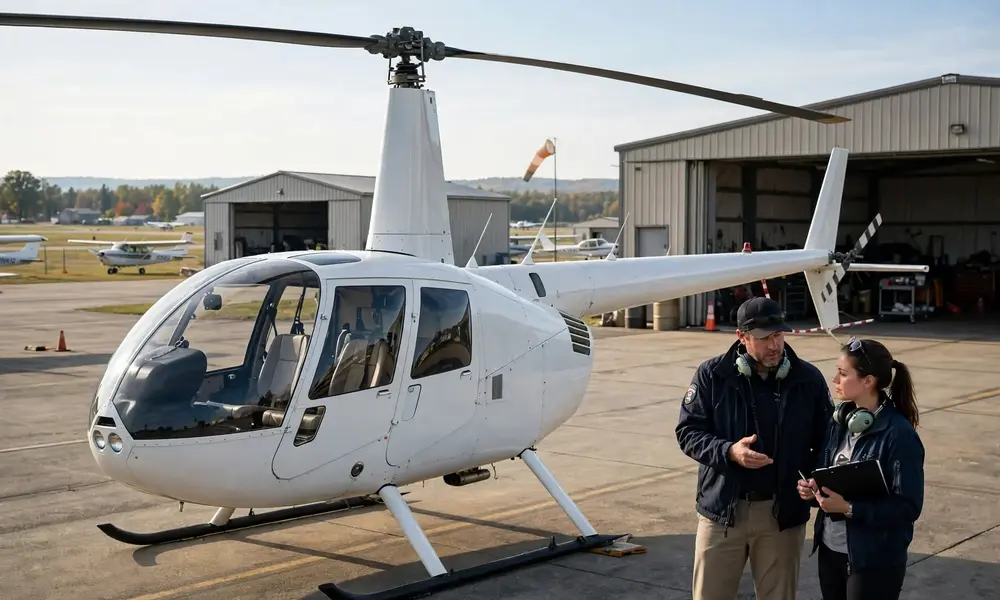
The R66’s deepest advantage is invisible in its specifications: the training pipeline it inherits. More pilots learn on Robinsons than on all other helicopters combined. This means the R66 is the turbine most first-time owners already know how to fly. The transition course from the R44 is measured in days rather than months.
The factory’s safety record has been scrutinized and steadily improved over four decades. Today, it benefits from modern avionics options, autopilot integration, and an owner community that shares data with an openness unusual in aviation.
For the first helicopter buyer, the R66 is the default from which all comparisons begin. Our buyer’s guide treats it as such.
Who Flies It and Why It Endures
The R66’s owners span the helicopter world’s breadth: ranchers checking fences, executives commuting to island and mountain properties, tour operators running shorelines, and owner pilots flying for the reasons owner pilots always have.
What unites them is the Robinson bet made visible: that most helicopter missions are simpler than the industry assumed, and that a machine designed for those missions, honestly and without ornament, would find the market the complex machines missed. Six decades after Frank Robinson’s first design study, the company builds more helicopters annually than the rest of the Western industry combined, and the R66 is the reason the turbine market has a middle class.
FAQs
1. What is the Robinson R66?
A five seat single engine turbine helicopter introduced in 2010 by Robinson Helicopter Company, powered by a Rolls-Royce RR300 engine, and the bestselling turbine helicopter in the world, designed around private owner and commercial light utility economics.
2. How much does an R66 cost?
Around $1.3 to $1.5 million new, with used examples from roughly $900,000 depending on hours, condition, and equipment. Operating costs run approximately $400 to $600 per hour in typical owner use.
3. What is the R66’s range and speed?
Cruise speed is around 110 knots with a practical range near 300 miles with reserves, covering the short and medium missions that define private helicopter use, from island hops to mountain transfers.
4. Why is the R66 cheaper than its competitors?
Design simplicity: a two blade rotor system, conventional construction, a single engine of proven lineage, and a factory organized around high volume production. Robinson’s method prioritizes the missions most owners actually fly over capability they rarely need.
5. Is the R66 safe?
The type’s safety record has improved steadily across four decades and now benefits from modern avionics, optional autopilots, and an owner community with strong data sharing culture. As with any helicopter, safety outcomes depend heavily on pilot discipline, training, and operating within limits.
6. Can I fly an R66 as a private pilot?
Yes, after earning a private helicopter certificate, typically on the R22 or R44, and completing the factory transition course. Many R66 owners are owner pilots, and the training pipeline from Robinson’s piston trainers is the type’s signature advantage.
7. What are the R66’s limitations?
Payload margin at full fuel and five adults, a cabin tighter than larger turbines, and the two blade rotor’s distinctive low frequency sound. For missions demanding more, the light twin categories exist; for the missions most owners fly, the limitations rarely bind.
8. Why does the R66 dominate its market?
Price, operating economics, training ecosystem, and the accumulated confidence of forty years of Robinson ownership. The R66 is the rare machine whose market position is the product of a coherent idea executed without compromise.
Disclaimer: This content is for informational purposes only and reflects our personal opinions and experiences. We just love to write and share what we know and research.