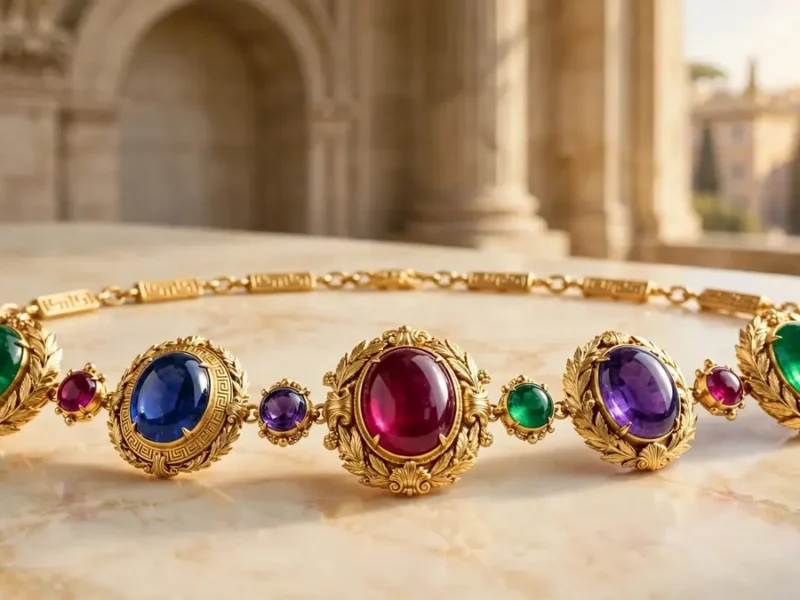
In 1917, Pierre Cartier traded a double strand of natural pearls for a mansion at the corner of Fifth Avenue and 52nd Street. The pearls belonged to his wife. The mansion belonged to Morton Plant, a railroad heir whose new wife reportedly admired the necklace more than her own front door.
That single trade, jewels for real estate, tells you almost everything about Fifth Avenue. This is a street where luxury is not sold. It is exchanged between families, houses, and centuries.
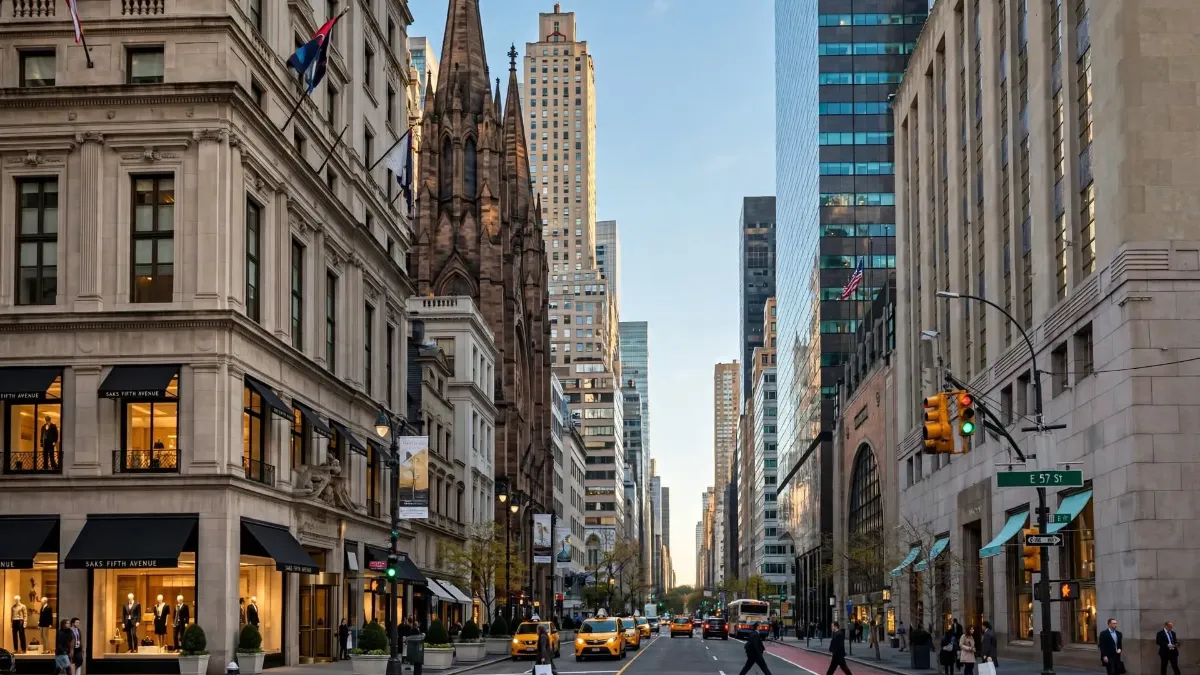
Today the stretch of Fifth Avenue from 49th Street to 60th Street is the most valuable retail corridor in the Western Hemisphere. Flagship rents have topped $2,000 per square foot, among the highest anywhere on the planet.
Tiffany, Cartier, Bergdorf Goodman, Saks, Rolex, Gucci, Louis Vuitton, and Van Cleef and Arpels all keep their American temples within a ten minute walk of one another. None of it was inevitable. The street earned its crown over 180 years of deliberate choices, bold bets, and a few pearls.
This is the story of how it happened, and where to see its greatest chapters still standing.
Before the Stores: Millionaire’s Row
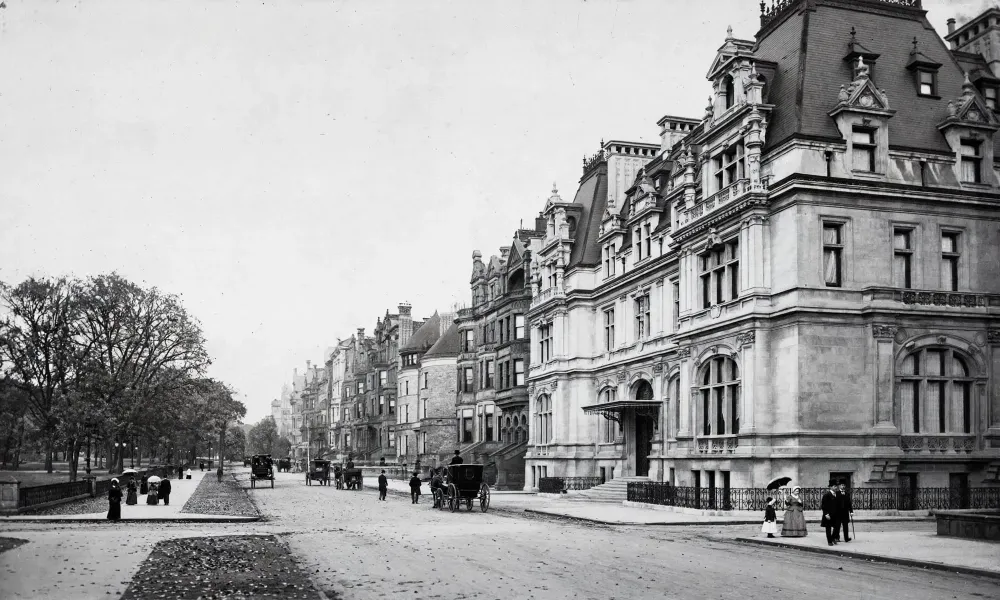
In the decades after the Civil War, Fifth Avenue above 42nd Street was not a shopping district at all. It was the most prestigious residential address in America.
The Astors, the Vanderbilts, the Carnegies, and the Whitneys built palaces of limestone and marble along the avenue, in a stretch newspapers called Millionaire’s Row.
Cornelius Vanderbilt II’s chateau at 57th Street was the largest private home ever built in New York City.
Retail, at first, was considered beneath the neighborhood. The great dry goods emporiums of the era clustered far downtown, around Ladies Mile on Sixth Avenue and along Broadway below Union Square.
What changed everything was a single building: the Waldorf Hotel, which opened at Fifth Avenue and 33rd Street in 1893. High society suddenly had a reason to treat the avenue as a place to be seen, not just a place to live.
Carriage rides, church promenades after services at St. Patrick’s, and the Easter Parade turned the street into a stage. Where society strolled, commerce followed.
1901 to 1925: The Retail Invasion
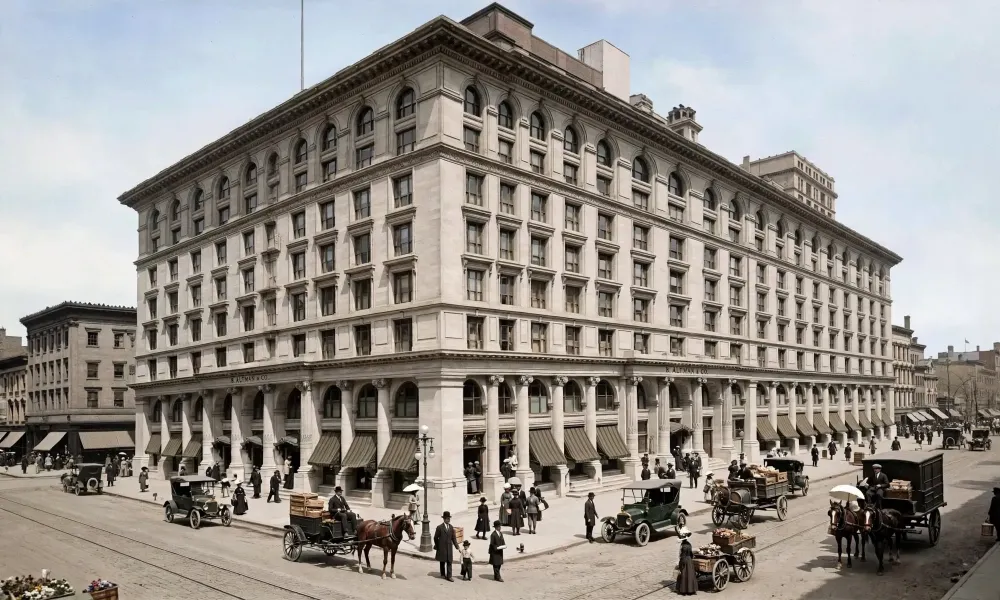
The first great breach came in 1906, when Benjamin Altman opened his palatial department store at 34th Street and Fifth, betting that ladies of means would shop on the avenue if the store felt like an extension of their own drawing rooms.
It worked. Lord and Taylor moved up to 38th Street in 1914. Bergdorf Goodman, a tailor’s shop that had outgrown its Union Square home, bought the site of the old Cornelius Vanderbilt mansion at 58th Street and opened in 1928.
The mansions began to fall or convert. The very qualities that made the avenue attractive to millionaires, its width, its prestige, its central position, made it irresistible to merchants.
By the mid 1920s, Fifth Avenue below 59th Street had transformed from a residential canyon into a shopping boulevard, and the names moving in were not ordinary retailers. They were the houses that defined American aspiration.
The Tiffany Move Uptown
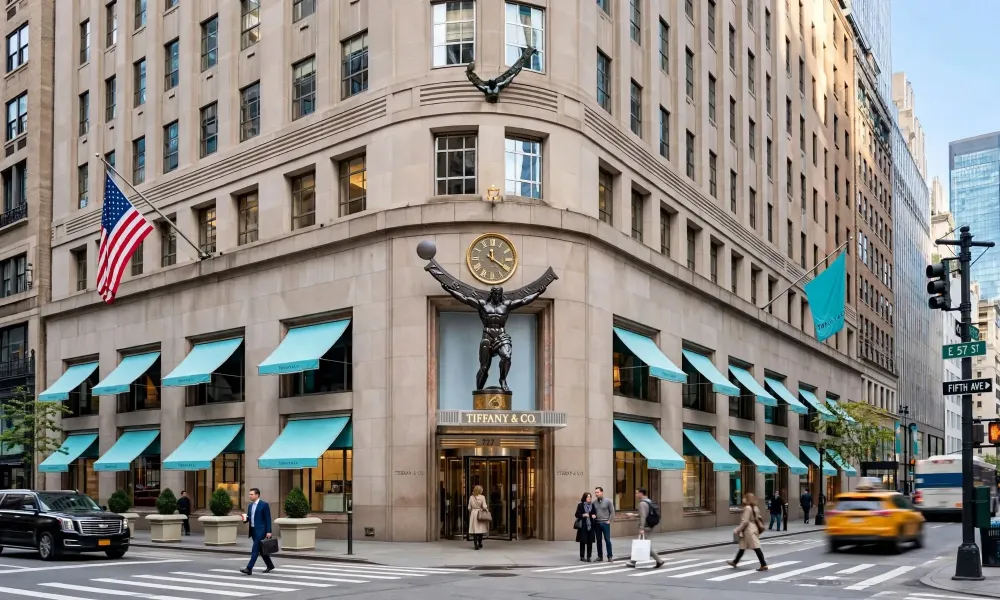
No single decision shaped the avenue’s luxury identity more than Tiffany and Company’s. Founded in 1837 downtown, Tiffany moved north in stages, always following its wealthy customers as the city grew.
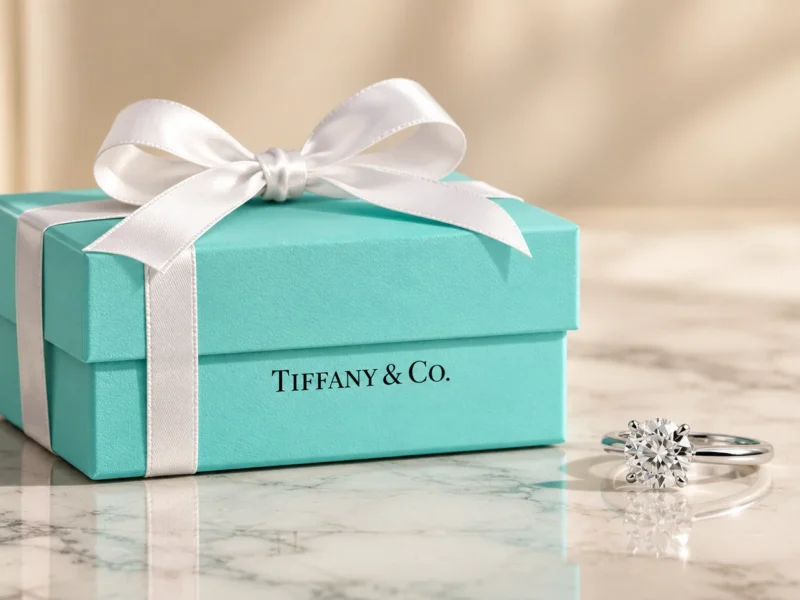
In 1905 the house planted itself at 37th Street and Fifth, and in 1940 it made its definitive move to the corner of 57th Street, into the limestone flagship that Audrey Hepburn would later immortalize in the opening scene of Breakfast at Tiffany’s.
That building matters beyond the film. It established 57th and Fifth as the exact crossroads of American luxury, a position it has never surrendered.
When Tiffany closed the store in 2020 for a complete reinvention and reopened it in April 2023 as The Landmark, a ten floor experience with a Jean Schlumberger gallery, a Blue Box Cafe by Daniel Boulud, and what the house calls the largest luxury retail floor in the world, it was the loudest possible statement that the avenue’s crown remains intact.
You can read the full house history in our Tiffany and Co. story, and our broader guide to luxury jewelry brands places the house in global context.
The Cartier Mansion and the Art of the Deal
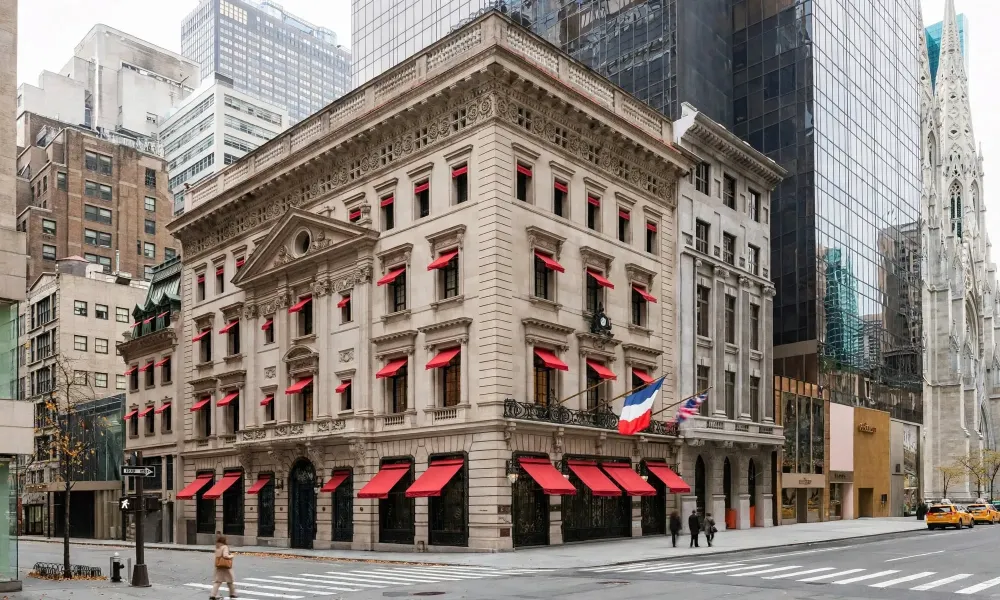
Three blocks south and a world apart in temperament stands 653 Fifth Avenue, the Cartier mansion. The 1917 pearl trade gave the French house one of the last surviving Gilded Age residences on the avenue, and Cartier has treated it as a jewel box ever since.
The building reopened in 2016 after a two and a half year restoration that returned its carved limestone and wrought iron to museum condition. Inside, the salons are arranged like private apartments, which is fitting, because that is exactly what they once were.
The Cartier mansion also anchors one of New York’s great holiday rituals. Every December the house wraps the entire building in an enormous illuminated red bow, and the avenue becomes a promenade again, just as it was in the carriage era.
Bergdorf, Saks, and the Department Store Aristocracy
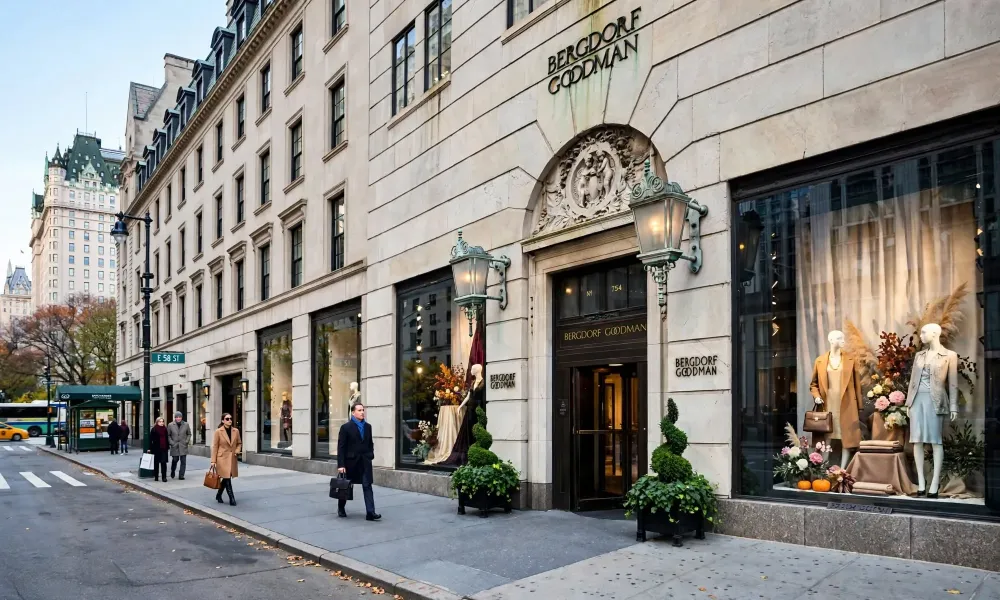
Two department stores bookend the corridor. At 58th Street, Bergdorf Goodman remains the most rarefied multi brand retailer in America, a single store (plus its menswear sibling across the avenue) where buying decisions still set the tone for American fashion.
At 49th Street, Saks Fifth Avenue, which opened in 1924, gave the corridor its southern anchor and, directly across the street from St. Patrick’s Cathedral and steps from Rockefeller Center, its most theatrical address. The Saks light show on the facade each holiday season draws crowds that shut down the sidewalks.
Between them runs the modern flagship parade: Gucci, Louis Vuitton, Prada, Dior, Chanel, Bulgari, and Harry Winston, plus the Rolex Building at 53rd Street and the Trump Tower atrium at 56th, which for all its political notoriety remains architecturally one of the avenue’s great retail spaces.
Apple turned the plaza at 59th and Fifth into a glass cube that has become one of the most photographed retail entrances on earth, proof that the street now hosts technology as readily as it once hosted railroad barons.
Why the Crown Has Never Slipped
Other cities have great shopping streets. Bond Street, the Champs Elysees, Via Montenapoleone, Ginza. What makes Fifth Avenue different is density and symbolism compressed into eleven blocks. Within that walk you find a cathedral, Rockefeller Center, the Plaza Hotel (which we profiled in depth in our Plaza Hotel story), Central Park, and the flagship of nearly every house that matters.
If you are planning a trip around it, our guides to the best hotels in New York and where to stay in New York map the streets around the corridor, and our most expensive hotel suites in New York feature covers the suites overlooking it.
The street has survived depressions, the retail apocalypse, the rise of e-commerce, and the pandemic exodus of 2020, when boarded windows fed obituaries for physical luxury retail. The answer came in record leasing deals and nine figure flagship renovations. Luxury houses have concluded, with their checkbooks, that a Fifth Avenue address is not a store.
It is a headquarters of desire, a billboard you can walk into, and the single most important sentence in a brand’s American biography. For context on which houses hold the most power in that hierarchy, see our ranking of the top luxury brands.
FAQs
1. Where exactly is the luxury shopping stretch of Fifth Avenue?
The core luxury corridor runs from 49th Street, home of Saks Fifth Avenue and Rockefeller Center, north to 60th Street at the southeast corner of Central Park. The most famous crossroads is 57th Street and Fifth Avenue, anchored by the Tiffany Landmark.
2. Is the Cartier building on Fifth Avenue really a mansion?
Yes. The building at 653 Fifth Avenue was built in 1905 as the private residence of Morton Plant. Pierre Cartier acquired it in 1917, famously in exchange for a double strand of natural pearls valued at the time at around one million dollars. It remains one of the last surviving Gilded Age mansions on the avenue.
3. When did the Tiffany flagship reopen as The Landmark?
Tiffany and Company reopened its fully renovated 57th Street flagship as The Landmark in April 2023, after closing the building in 2020 for a complete reinvention. The store spans ten floors and includes galleries, private salons, and the Blue Box Cafe.
4. Which department stores are still on Fifth Avenue?
Bergdorf Goodman at 58th Street and Saks Fifth Avenue at 49th Street remain the two grand department store anchors of the corridor. Lord and Taylor’s flagship at 38th Street closed in 2019, ending a 105 year run.
5. When is the best time of year to visit Fifth Avenue?
December is the most theatrical season, when Cartier wraps its mansion in an illuminated bow, Saks runs its facade light show, and Bergdorf Goodman unveils its famous holiday windows. Expect enormous crowds. For a calmer visit with full store access, weekday mornings in January and February are ideal.
6. Are Fifth Avenue flagship stores different from regular boutiques?
Yes. Flagships are a house’s most complete expression, often carrying exclusive pieces, high jewelry, archive exhibitions, personal shopping salons, and services like engraving and bespoke appointments that smaller boutiques do not offer. The Tiffany Landmark and the Cartier mansion both operate closer to museums or private clubs than to ordinary retail.
7. What happened to the Gilded Age mansions on Fifth Avenue?
Most were demolished between the 1920s and 1960s and replaced by retail and apartment towers. Survivors include the Cartier mansion, the University Club, the Metropolitan Club, and a handful of townhouses. The greatest concentration of survivors is actually one block east, on the upper stretch of Madison Avenue and along the side streets of the Upper East Side.
8. Is Fifth Avenue still the most expensive retail street in the world?
It consistently ranks at or near the very top of global retail rent surveys, trading the number one position with Hong Kong’s Causeway Bay and Milan’s Via Montenapoleone depending on the year. Rents on the prime corridor have exceeded $2,000 per square foot, and recent flagship deals suggest the world’s biggest luxury houses consider the address worth almost any price.