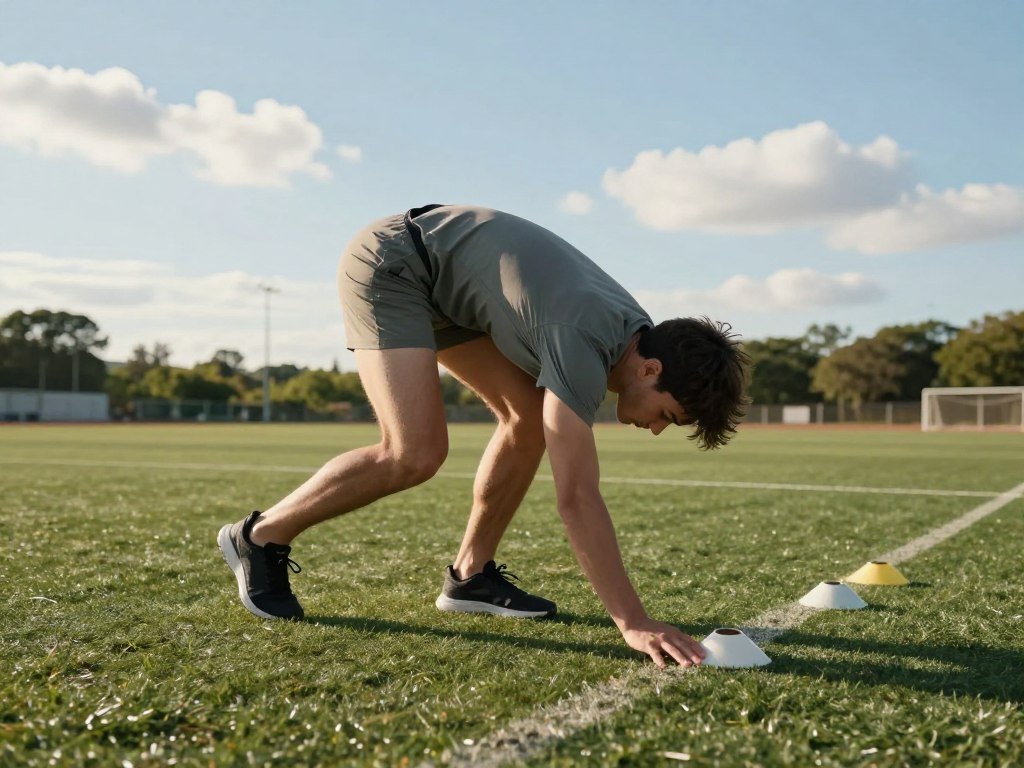
A quick stop and turn can matter just as much as a fast sprint, whether you are playing a sport or moving through a busy day. The best exercises for agility help you practice that skill with useful drills for different experience levels.
You can work in open floor space or add cones, a speed ladder, or a chair. Each option gives you a way to practice footwork, control, and speed without claiming that one drill alone proves your sports performance.
Some moves build confidence with simple steps. Others ask you to turn, hop, or respond to a cue. Start with the version you can perform smoothly, not the one that looks most challenging.
Key Takeaways
- Agility includes moving well and reacting to a cue.
- Cones, tape, chalk, or floor lines can mark simple routes.
- Slow, controlled turns come before faster movement.
- Choose low hops before trying advanced jumps.
- Use the same route when you track changes in speed and control.
- For kids, fun and movement quality matter more than formal drills.
What Does Agility Training Actually Train?
A player who changes direction because an opponent moves is showing more than straight-line speed. Agility combines movement control with a response to an outside cue, such as an opponent’s cut or a sudden change in play.
A planned change of direction is a drill in which the route and turns are known in advance. It trains the ability to brake, turn, and accelerate, but it does not test reaction time to an unexpected cue. Straight-line speed alone does not measure that response.
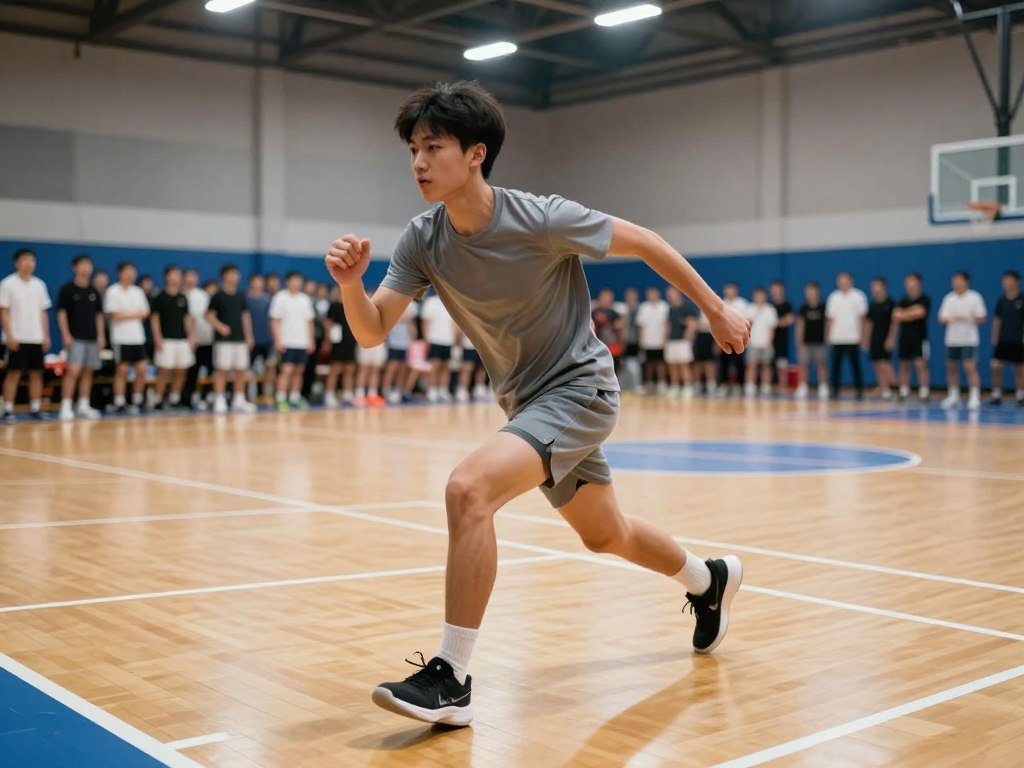
Picture a basketball player guarding an opponent. The defender must read a movement, shift position, and keep balance while changing direction. A cone route can rehearse the footwork, but the route itself gives no new information to react to.
Treat a memorized route as useful footwork practice, not a complete test of sport agility.
Sport agility involves both the movement and the decision that starts it. A sport agility definition explains how a cue separates reactive agility from planned change-of-direction speed.
A field drill can still help you learn a clean turn. It simply answers a narrower question: how well can you move through a route you already know?
That distinction matters when you judge performance. A fast route time can show better planned movement, while a reactive test must include a cue that changes what you do.
How Can You Set Up Agility Training at Home?
You can set up a useful practice area with a few markers and a clear stretch of floor. Open space matters more than special equipment for many agility training drills.
For basic run-and-stop practice, mark a flat lane about 10 yards long. The best exercises for agility at home can use a few markers and open floor space, while agility exercises at home can use chalk or tape instead of a ladder. Agility exercises without equipment can use floor lines or imaginary markers.
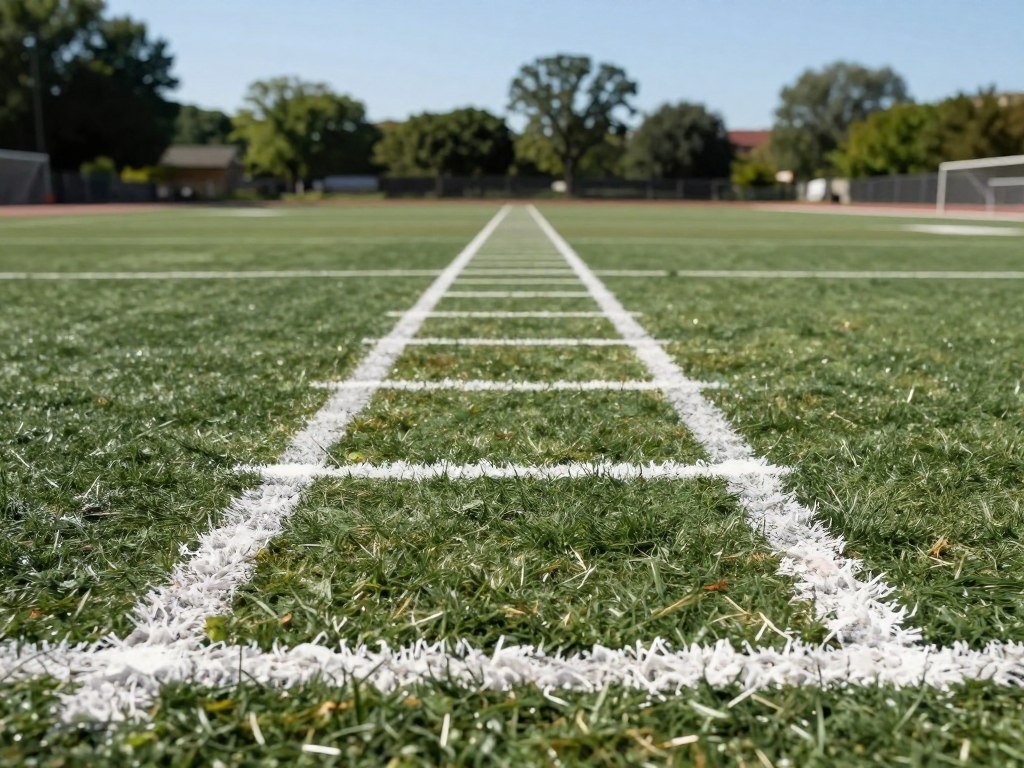
- Clear a flat stretch of floor or yard.
- Use markers that stay still when brushed.
- Replace cones with chalk, tape, or stable objects.
- Add an agility ladder only if you want one.
- Wear shoes that fit securely.
| Equipment | Setup | Useful for | Limitation |
|---|---|---|---|
| Cones | Mark turns and distances | Shuttle routes | Need open space |
| Tape or chalk | Mark a line or boxes | No-equipment footwork | Markings can be hard to see |
| Agility ladder | Lay it flat | Precise footwork patterns | Not needed for cone drills |
Choose a spot with enough room to slow down at the end of a lane. A hallway may work for straight steps, but it can feel cramped for a wide turn.
Markers can be small, but make them easy to see from your starting position. This helps you keep your eyes up instead of searching for the next line underfoot.
Before moving quickly, walk the route once and make sure every marker stays in place.
Best Exercises for Agility
For most beginners, the side shuffle is a good first drill because it teaches lateral movement without crossing the feet. Clean footwork matters more than a fast first attempt.
Choose a drill that fits your space and current ability. Faster is not better if your foot placement becomes uncontrolled.
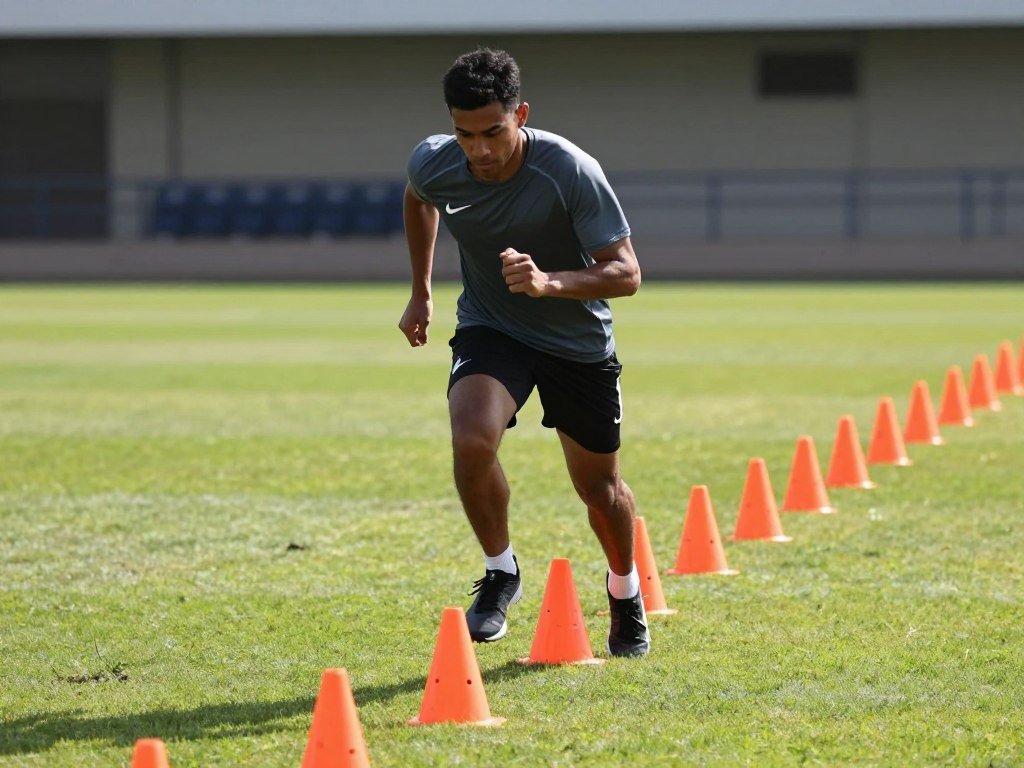
- Side shuffle. Set two cones roughly 15 steps apart. Face forward, stay low, and move sideways without crossing your feet. Complete 3 sets of 5 laps.
- Carioca. Use two cones roughly 15 steps apart. Cross-step laterally in front of and behind the other foot. Complete 3 sets of 4 complete laps, resting 2 minutes between sets.
- Stand-up-to-figure-8. Place a chair near cones about 5 yards and 10 yards away. Rise from the chair, then weave around both cones in a figure eight. Complete 3 sets, with 2 minutes between sets.
- 5-10-5 shuttle. Place three cones in a line, with the middle cone 5 yards from each outer cone. Sprint between the outer cones through the middle, turning at each end. Do 1 set of 5 drills, resting 2 minutes between drills.
- T-drill. Set four cones with 5 yards between adjacent cones. Sprint forward, shuffle sideways, then backpedal to the start. Complete 3 sets of 4 repetitions.
- Forward high-knee ladder run. Lay a speed ladder flat and run forward, placing one foot in each space. Keep the steps light and even.
- Lateral ladder sidestep. Face forward and sidestep through the ladder spaces. Complete 3 sets of 5 full laps, resting 2 minutes between sets.
- Side jumps. Start with small hops to the side and land under control. Try 5-15 repetitions per set for 1-3 sets.
- Forward hops. Jump 1-2 feet forward, then return to your starting spot. Try 5-10 hops per set for 1-3 sets.
- Jump rope. Begin with small, steady jumps for 2 minutes. If that is too difficult, use 10- to 30-second segments.
The simple agility exercises here can be adapted for different footwork levels. A shorter route or slower pace can help you learn the movement without changing its purpose.
| Drill | Setup | Prescription | Main movement |
|---|---|---|---|
| Side shuffle | Two cones about 15 steps apart | 3 sets of 5 laps | Lateral movement |
| Carioca | Two cones about 15 steps apart | 3 sets of 4 complete laps; 2 minutes’ rest | Cross-step coordination |
| Figure-8 | Chair plus cones about 5 and 10 yards away | 3 sets; 2 minutes’ rest | Stand and weave |
| 5-10-5 | Three cones with the stated spacing | 1 set of 5 drills; 2 minutes’ rest | Sprint and turn |
| T-drill | Four cones, 5 yards between adjacent cones | 3 sets of 4 repetitions | Sprint-shuffle-backpedal |
A ladder pattern asks for precise steps, not a race through every space. If the ladder is too narrow for your stride, slow down until your feet land cleanly.
Use the set counts as a guide rather than a reason to force a poor repetition. Stop a set when your foot plants or turns become sloppy, even if you have not finished every repetition.
How Many Days a Week Should You Train?
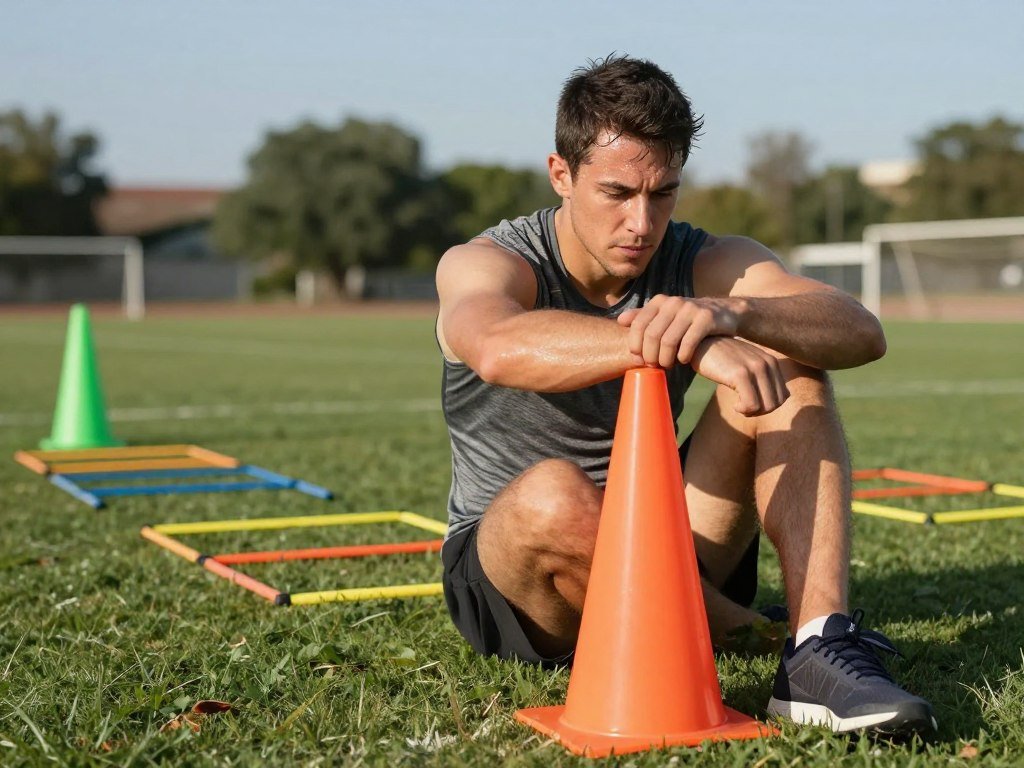
For most people, two or three agility sessions a week is a sensible starting schedule. Quality movement should set the pace, not a need to fill every day.
A 2025 meta-analysis found that speed, agility, and quickness programs ran for 4-12 weeks and usually involved 2-3 sessions per week. Two or three sessions weekly is a practical range to try.
Weekly frequency and program length
Give your body time to recover between demanding sessions. If you already follow a workout routine for your goals, fit agility work around your other hard training days.
The 3-3-3 rule is not a standard agility-training prescription. Use 2-3 weekly sessions as a starting point, then adjust the number of sets to keep your movement sharp.
A steady plan also makes it easier to see whether a drill is helping. Keep the route and effort level similar when you compare one week with another.
Session length and quality
In the 2025 meta-analysis, sessions of 60 minutes or less had an estimated effect size of 0.58 for change-of-direction performance. Longer sessions had an estimated effect size of 0.24.
The difference did not reach statistical significance, with p = 0.059. A 2025 SAQ training review reports these estimates, but they do not prove that shorter sessions work better.
Stop when your steps lose their timing or your turns need extra effort. Leave enough recovery between hard sessions to keep the next set of fast movements controlled.
How Do You Progress From Planned Drills to Reactive Movement?
First learn to slow down and turn on a route you already know. Controlled braking gives you a base for changing direction without losing your form.
Start with a pace that lets you place each foot on purpose. Add a cue only after you can follow the known route with steady stops.
Learn to brake and follow a known route
Use four cones to mark a square, with 5 yards between cones. Stop at each cone and turn through four laps, alternating your direction each lap. Rest 40 seconds between laps.
A straight run-and-stop lane gives you a simpler first test. Accelerate down the marked 10-yard lane, then decelerate under control before the end of the lane.
Add a cue that changes the route
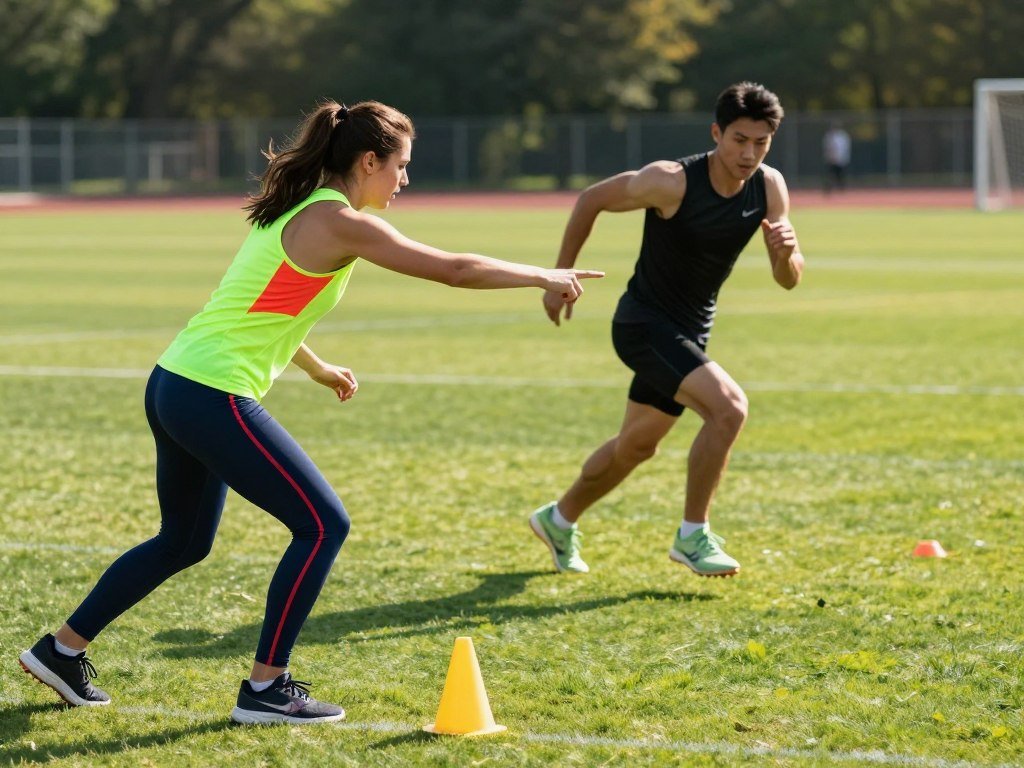
Place four outer cones in a 5-yard square and a fifth cone in the center. A partner can call an outer cone by number while you wait at the middle.
Shuffle to the called cone and return to center. Complete five trips per set for four sets, resting 60 seconds between sets.
| Stage | Setup | Task | Prescription |
|---|---|---|---|
| Straight-line stop | Marked run-and-stop lane | Accelerate, then decelerate under control | Run the 10-yard lane once per practice bout |
| Planned route | Four cones in a 5-yard square | Stop at each cone and turn | Four laps, alternating direction; 40 seconds’ rest |
| Reactive cue | Five cones, one at the center of a 5-yard square | Shuffle to called outer cone and return to center | Five trips per set for four sets; 60 seconds’ rest |
A partner’s visual or verbal cue adds uncertainty and makes the route reactive. The call should come after you are set, so you respond instead of memorizing a sequence.
If you train alone, a changing visual signal can serve the same purpose. Add only one new challenge at a time, such as a cue, a faster pace or a more complex route.
Which Beginner Plyometric Exercises Are Safe to Try?
Beginners can build confidence with low, short hops before trying high or fast jumps. Small jumps let you focus on how your feet meet the floor.
Start side hops with a short, low jump and land with bent legs. Do 5-15 repetitions per set for 1-3 sets, with rest between sets.
Start with small hops or short rope intervals
For forward hops, cover 1-2 feet forward and return to the start. Try 5-10 hops per set for 1-3 sets, resting between sets.
Jump rope can start at 2 minutes. If that feels too hard, use 10- to 30-second rope segments, or practice the jumping motion without a rope.
Rest before the next set so your steps stay steady. These short efforts give you a way to practice timing without chasing height.
Keep landings soft and skip advanced jumps
Use a surface with some give, not tile, concrete, or asphalt. Keep jumps only a few inches off the floor, land softly, and leave your knees unlocked.
People with knee, back, or hip joint problems, or with balance difficulties, should check with a doctor before plyometric training. Box jumps and hurdle jumps are advanced, so attempt them with a trainer only after building skills and muscle strength.
- Clear the landing area.
- Choose a surface with some give.
- Keep hops low.
- Land quietly.
- Stop if balance or form falters.
Do not progress to a box or hurdle jump until your landing skills and strength are ready.
How Should Kids Train Agility at Different Ages?
For young children, play is a better starting point than formal agility sessions. Readiness depends on how a child moves and responds, not age alone.
The National Strength and Conditioning Association recommends that school-aged youth get 60 minutes or more of moderate-to-vigorous activity daily. That general activity should be varied, enjoyable, and right for a child’s development.
Ages 5-7: keep movement playful
For ages 5-7, choose games that include running, stopping, and turning instead of formal training. Keep directions simple and let kids explore different movements.
Fun play helps a child build confidence without making every move feel like a test. You can use a short game of follow-the-leader or a chase game with safe space to turn.
Ages 8-10: coach short movement practice
Children ages 8-10 can try short, coached practice in sprinting, stopping, and turning. Focus on one skill at a time and give the child a chance to try it again.
Approximate speed-and-agility training windows before the growth spurt are ages 6-8 for girls and 7-9 for boys. These are broad windows for training opportunities, not a reason to skip readiness or turn general activity into formal practice.
Ages 11-14: prioritize control during growth
During ages 11-14, rapid growth can affect how a young athlete coordinates movements. Keep training volume modest and value good form over a faster time.
Back off when coordination worsens. A sudden change in footwork can mean the child needs less practice or a simpler task that day.
- Choose enjoyable play.
- Give clear instructions.
- Use short coached efforts.
- Practice controlled stops.
- Reduce volume if coordination worsens.
Let a child’s movement control, enjoyment and recovery guide progression as much as age does.
How Can Adults Adapt Agility Exercises?
Adults do not need to play a competitive sport to benefit from practicing controlled changes of direction. Steady balance is a useful starting point for recreational and older adults.
Begin with deliberate side steps, controlled turns, or chair-based movement if you need support. Increase pace only while your balance stays steady.
Agility work can add movement variety to general conditioning, but it does not replace the CDC activity guidelines. Adults should get 150 minutes of moderate exercise and muscle-strengthening activity on 2 days each week.
About half of U.S. adults met physical activity guidelines in the CDC’s 2020 survey report. A short movement drill can be one part of a routine that also supports overall body strength.
Choose a drill that lets you finish each turn with steady balance rather than a hurried recovery step.
What Form Mistakes Make Agility Drills Less Effective?
The most common form error is trying to accelerate before you can stop under control. Braking helps you change direction without letting your body drift out of position.
In a 5-10-5, the 180-degree turns make poor braking easy to spot. A clean, slower repetition is better than a fast turn you cannot control.
- Keep your feet from crossing during a side shuffle.
- Avoid turning the foot outward on landing.
- Keep each knee aligned with its foot.
- Lower your hips before a hard stop.
- Do not rush a turn to beat a timer.
Watch your feet, ankles, and knees as you land. They should point straight ahead, while your core stays firm enough to hold your body position.
A rushed step can pull the leg into a poor line, even when the rest of the drill looks quick. Reduce speed or range as soon as a foot plant sends the knee or torso out of alignment.
How Can You Tell If Your Agility Is Improving?
A stopwatch is useful only when the route and movement standard stay the same. Repeatable conditions make a time comparison more meaningful.
Choose one route, such as the 5-10-5, and keep the markers, surface, and start position consistent. Record both your time and how well you control each turn.
Try three attempts as a practical rule of thumb. Note any missed marker, extra step, or unstable stop, rather than relying only on your fastest time.
When you track reaction time, use the same cue and starting position each time. A changing signal can make one test harder than another, even if your movement stays the same.
Count a faster attempt as progress only when the turns and landings remain controlled.
Write down the result soon after each try, including one detail about your footwork. That record can show a cleaner change of direction even when the time barely shifts.
Conclusion
Better movement starts with consistent, controlled practice, not a complicated setup. Clean footwork and controlled braking matter more than rushing through a route.
Choose three movements that fit your space and current ability. Mark a short route, then practice at a pace that lets you stay in control.
Set out your markers, choose three drills and complete your first quality practice session.
FAQ
What are some good footwork drills?
What are some exercises that can improve my agility?
What are some good exercises for increasing explosiveness?
Should agility drills be done before or after a workout?
How much rest should I take between agility drills?