The first thing you notice isn’t the boat. It’s the quiet confidence of modern electric boat builders transforming the way people experience life on the water.
It’s the conversation.
You’re sitting at the back of a beautiful electric cruiser with your friends. The marina is slowly disappearing behind you, the water is sparkling in the morning sunshine, and someone is telling a story that has everybody laughing.
Nobody has to raise their voice over a roaring engine.
There’s no familiar smell of exhaust drifting across the seating area.
Just the sound of the water, a gentle breeze, and that wonderful feeling that Saturday has officially begun.
Then your friend points toward the horizon.
“Could we actually take this thing all the way over there?”
And suddenly, the conversation changes.
How far can it go? How fast can it travel? Where would we charge it? And what happens if the weather turns before we get home?
Welcome to electric boating in 2027.
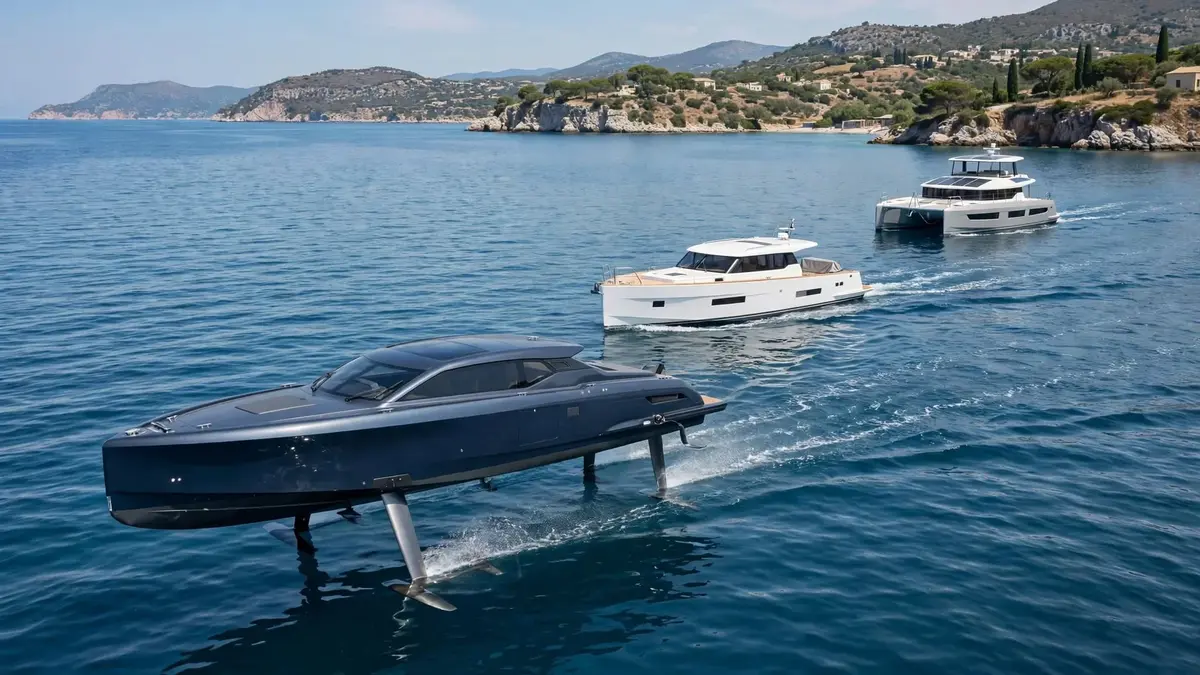
The technology has become genuinely exciting. Electric boats can now lift above the water on hydrofoils, tow wakeboarders, provide beautiful family cruising experiences, and even support long-distance yacht voyages through hybrid and solar-assisted systems.
But here’s the important part.
The best electric boat builders for 2027 include Candela, Frauscher x Porsche, Arc, X Shore, Navier, Duffy, Vision Marine, Green Dream Boats, Taiga, Hinckley, Greenline, and Silent Yachts.
They aren’t all building the same kind of boat.
Some focus on quiet afternoons around a protected harbor. Others are developing high-performance sports boats. A few are tackling the considerably harder challenge of long-distance cruising.
And that difference is exactly what makes this industry worth understanding.
For this Pravi Celer guide, we’ve researched twelve manufacturers and their documented technology, model specifications, and development milestones available as of November 2026.
The result isn’t a prediction that every builder will dominate 2027.
It’s a closer look at the companies whose ideas are already changing what life on the water can feel like.
Which Electric Boat Builders Are Worth Watching in 2027?
| Builder | Boat to know | Propulsion approach | Best suited to |
| Duffy | Balboa 20 | Fully electric | Relaxed harbor cruising |
| Green Dream Boats | Solliner 21S | Solar-assisted electric | Peaceful lake and coastal outings |
| Vision Marine | V30 Pontoon | High-power electric outboard | Family entertaining |
| X Shore | X Shore 1 | Fully electric | Stylish day cruising |
| Candela | C-8 | Electric hydrofoil | Efficient cruising at speed |
| Navier | N30 Pioneer II | Electric hydrofoil | Premium coastal travel |
| Arc | Arc Sport | Fully electric | Wakeboarding and wakesurfing |
| Frauscher x Porsche | 790 Spectre | High-performance electric | Sports-boat enthusiasts |
| Taiga | Orca WX3 | Electric personal watercraft | Active family adventures |
| Hinckley | Picnic Boat 40 SilentJet | Diesel-electric hybrid | Elegant cruising |
| Greenline | Greenline 42 | Diesel, hybrid, or electric options | Comfortable coastal trips |
| Silent Yachts | Silent 62 | Solar-electric with generator support | Extended yacht cruising |
The table includes production models, custom builds, hybrid vessels, and newer offerings at different stages of commercialization. They should not be treated as directly comparable products.
1. Duffy Electric Boats: The Art of Going Absolutely Nowhere in a Hurry
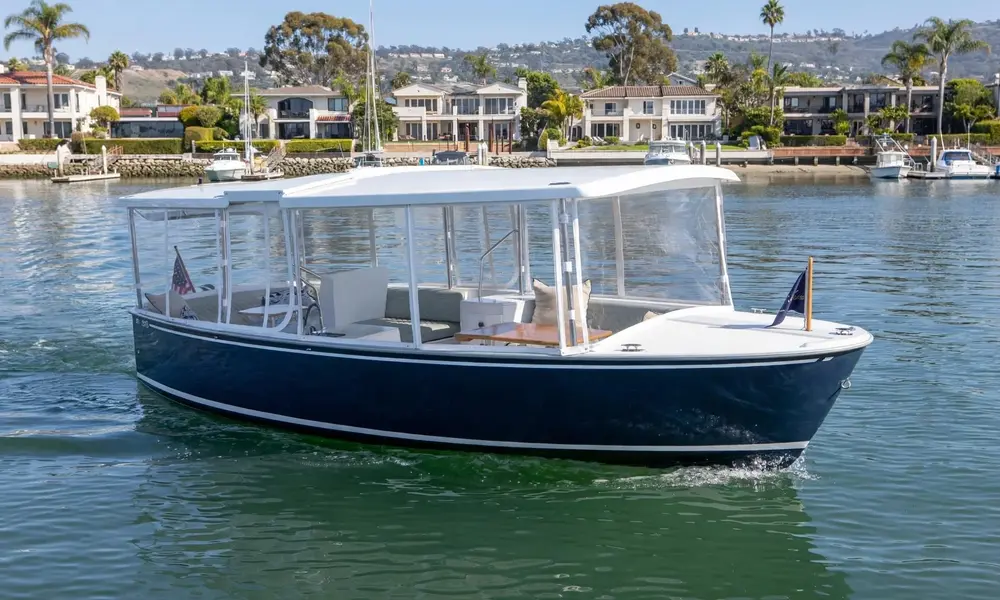
Boat to know: Duffy Balboa 20
Let’s begin with a wonderful idea.
What if the best electric boat isn’t especially fast?
What if it’s designed for slow afternoons, beautiful conversations, and enjoying a waterfront neighborhood without a destination in mind?
That’s the appeal of Duffy.
The California company has been associated with electric boating since 1970, long before battery-powered boats became fashionable.
Its newer Balboa 20 measures 20 feet 4 inches and accommodates up to eleven adults under its published capacity specification.
The manufacturer lists a maximum speed of six miles per hour and up to ten hours of running time at cruising speed under suitable conditions.
The published starting price is $74,900.
Now imagine spending an afternoon aboard one.
There’s a shaded seating area, cold drinks, and enough space for everyone to enjoy themselves.
Nobody particularly cares about the top speed.
Because the entire point is to slow down.
The question worth asking: Is the best luxury boat sometimes the one that makes you forget about time?
For relaxed, sheltered-water cruising, Duffy makes a charming argument.
2. Green Dream Boats: Can Sunshine Help Power Your Afternoon?
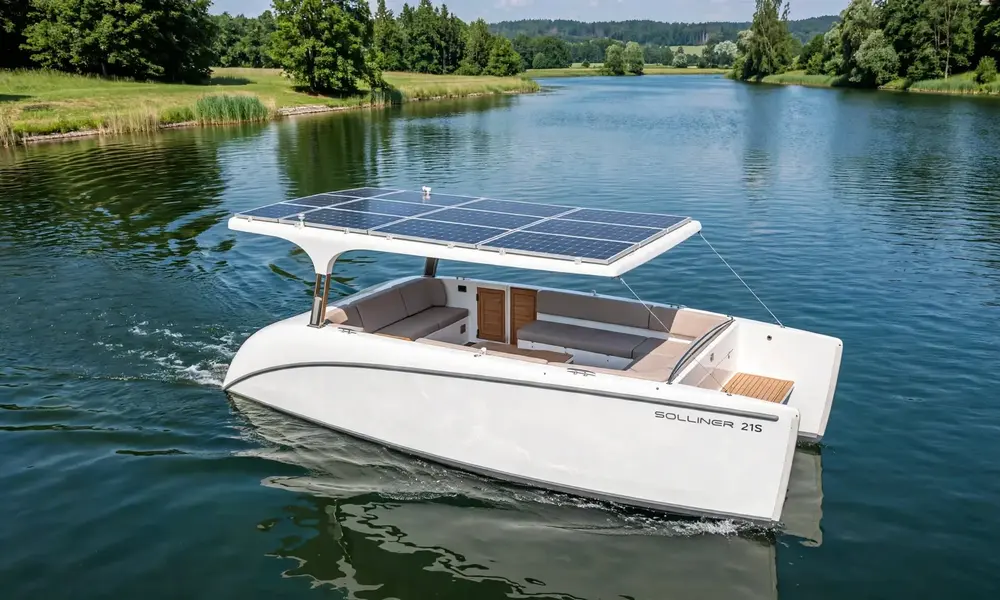
Boat to know: Solliner 21S
This might be one of the most unusual-looking boats in the entire electric market.
The Solliner 21S resembles a beautiful floating lounge beneath a gently curved solar-panel roof.
Built by Polish manufacturer Green Dream Boats, it measures approximately 6.2 metres and is designed to carry up to ten adults, subject to loading limits.
Its standard configuration includes a 3-kW electric motor and a solar array rated at approximately 1.12 kW.
The maximum published speed is around 11–12 km/h.
Nobody is going to mistake it for a high-performance racing boat.
And that’s perfectly fine.
Picture a peaceful afternoon on a beautiful lake.
You find a quiet corner of the water, settle into the seating, and spend several hours chatting with friends.
The solar panels help replenish battery energy when sunlight is available.
But they aren’t a promise of unlimited range.
Solar generation depends on weather, season, shading, panel orientation, and onboard electrical use.
What makes the Solliner interesting?
It treats quiet cruising as something genuinely desirable, rather than a compromise made because an electric boat cannot travel faster.
3. Vision Marine: Electric Boating for the Whole Family
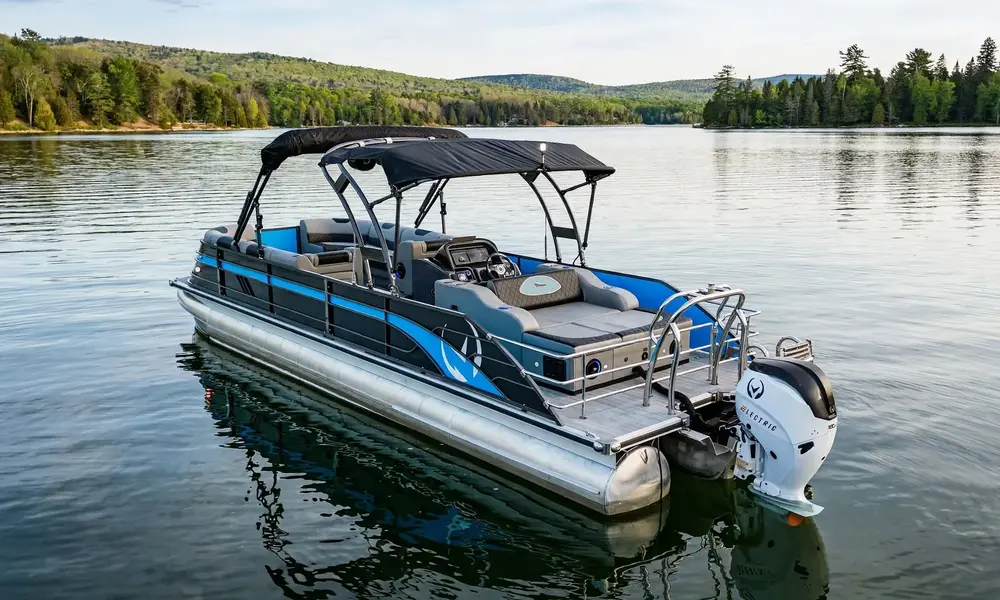
Boat to know: V30 Electric Pontoon
Some of the happiest moments on the water are wonderfully ordinary.
The kids want to swim.
Someone brings sandwiches.
A friend starts playing music.
And everyone spends the afternoon moving between the sunshine and the shade.
That’s the kind of outing a large pontoon boat can make particularly enjoyable.
Vision Marine Technologies offers the 30-foot V30 Electric Pontoon with its E-Motion 180E electric outboard system.
The manufacturer lists seating capacity for up to twelve passengers and a starting price of $139,995, subject to configuration and commercial terms.
Its electric powertrain produces 180 horsepower.
But the appeal isn’t simply the motor.
The boat provides generous seating, a social deck layout, and the quiet operation associated with electric propulsion.
The overlooked question: Does your family need a sports boat, or a comfortable place to spend the day together?
Sometimes a pontoon is the better answer.
And high-powered electric propulsion makes that category increasingly interesting.
4. X Shore: Scandinavian Luxury With a Very Important Range Lesson
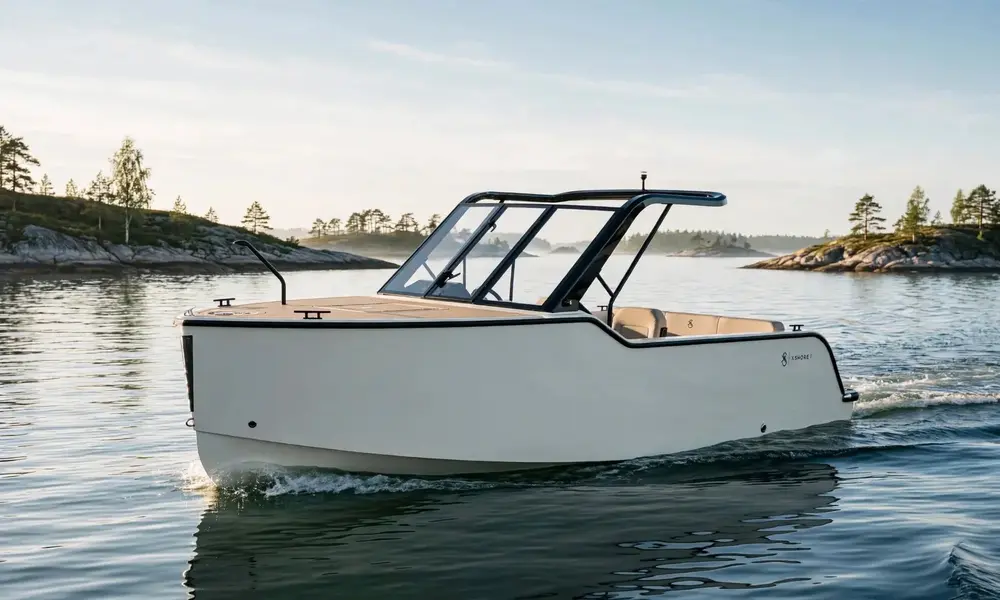
Boat to know: X Shore 1
X Shore understands something important about modern luxury.
A beautiful boat doesn’t need to look complicated.
The Swedish manufacturer’s X Shore 1 combines clean contemporary styling with a 120-kW electric motor and a 63-kWh battery.
The model measures approximately 6.5 metres.
It can reach a manufacturer-reported maximum speed of 30 knots.
But here’s where the specifications become especially useful.
X Shore advertises a maximum range of 50 nautical miles at a low speed of approximately five knots.
At a cruising speed of 20 knots, the published range falls to approximately 22 nautical miles.
That’s a substantial difference.
And it reveals one of the most important truths about electric boating.
The distance you can travel depends heavily on how fast you want to get there.
Imagine planning a beautiful coastal lunch.
Your destination looks close enough on the map.
But if you plan to travel quickly, the amount of energy required may be considerably greater than a maximum-range headline suggests.
X Shore deserves attention because it publishes speed-specific figures that help buyers understand the trade-off.
That transparency is far more useful than a spectacular advertised range without any explanation.
5. Candela: The Electric Boat That Almost Flies
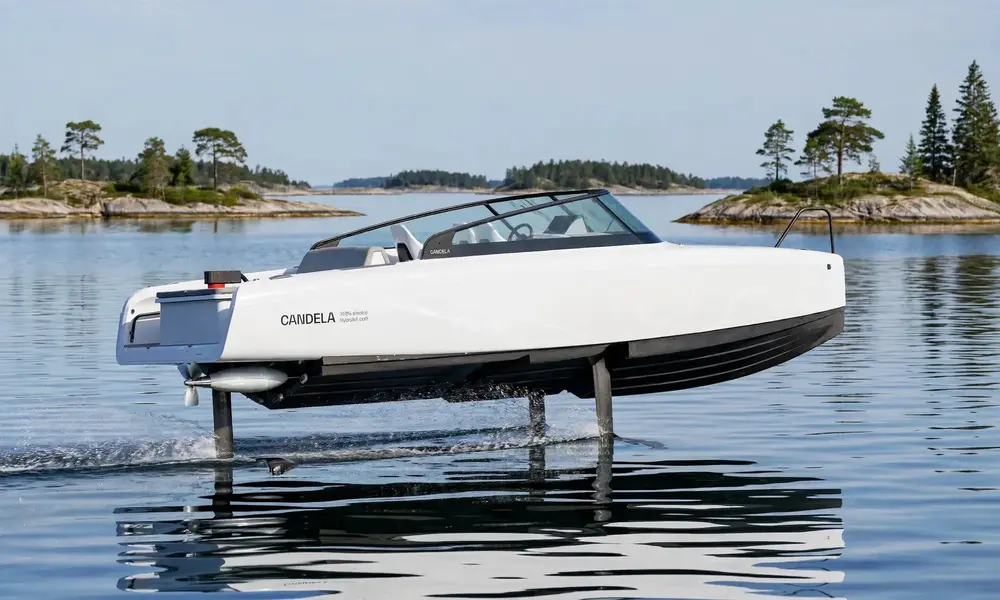
Boat to know: Candela C-8
Imagine approaching a stretch of choppy water.
Normally, you’d expect the hull to move through the waves, creating noise and uncomfortable motion.
But the Candela C-8 does something different.
At sufficient speed, computer-controlled hydrofoils lift much of the hull above the surface.
The system reduces the amount of hull moving directly through the water.
This can significantly reduce hydrodynamic drag.
And that changes the electric-boating equation.
The approximately 8.5-metre C-8 uses a 69-kWh battery supplied through Candela’s technology partnership with Polestar.
Candela advertises an efficient cruising speed of 22 knots and a range of up to 57 nautical miles at that speed.
The manufacturer also reports DC charging from 10% to 80% in less than 30 minutes when suitable charging equipment is available.
Does hydrofoiling eliminate rough-water problems?
No.
The C-8 has operating limits, and the foiling system requires suitable conditions.
The foils also introduce specialized components and maintenance considerations.
But the underlying idea is fascinating.
Rather than simply installing larger batteries, Candela has focused on reducing the energy needed to move through the water.
And sometimes that’s the more intelligent solution.
6. Navier: The Electric Hydrofoil Built for a Different Kind of Coastal Travel
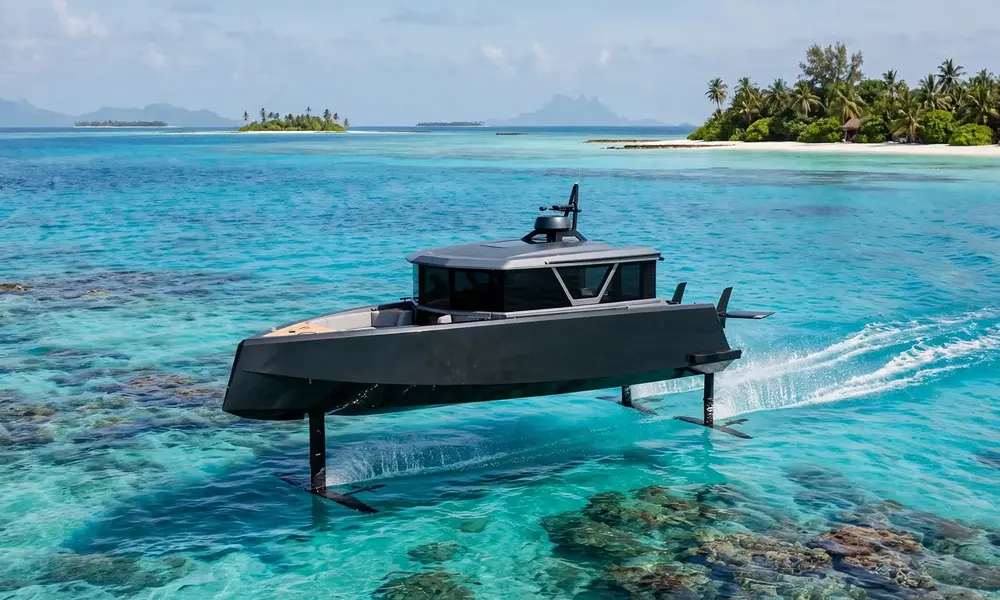
Boat to know: Navier N30 Pioneer II
There’s something particularly exciting about a boat designed to make short coastal journeys feel entirely different.
Navier’s N30 is a 30-foot electric hydrofoil vessel developed in the United States.
The company delivered its first customer N30 in October 2024 and completed its first-generation delivery program in November 2025.
Its newer Pioneer II represents an evolution of that original platform.
Published N30 specifications include a cruising speed of approximately 20 knots, a maximum speed of 30 knots, and selectable battery capacities of 86 or 114 kWh.
Navier advertises a range of up to 70 nautical miles for the platform, depending on configuration and operating assumptions.
The company has also been exploring commercial water transport.
In 2026, a proposed Maldives deployment attracted attention because it considered electric hydrofoils for transfers between islands, resorts, and airports.
The announced network is an ambitious development plan, not evidence that all proposed boats have already entered service.
The fascinating question: What if arriving at a private island became part of the luxury experience rather than an uncomfortable transfer?
That’s the possibility Navier is pursuing.
7. Arc Boats: Electric Power Designed for the Perfect Wakeboarding Day
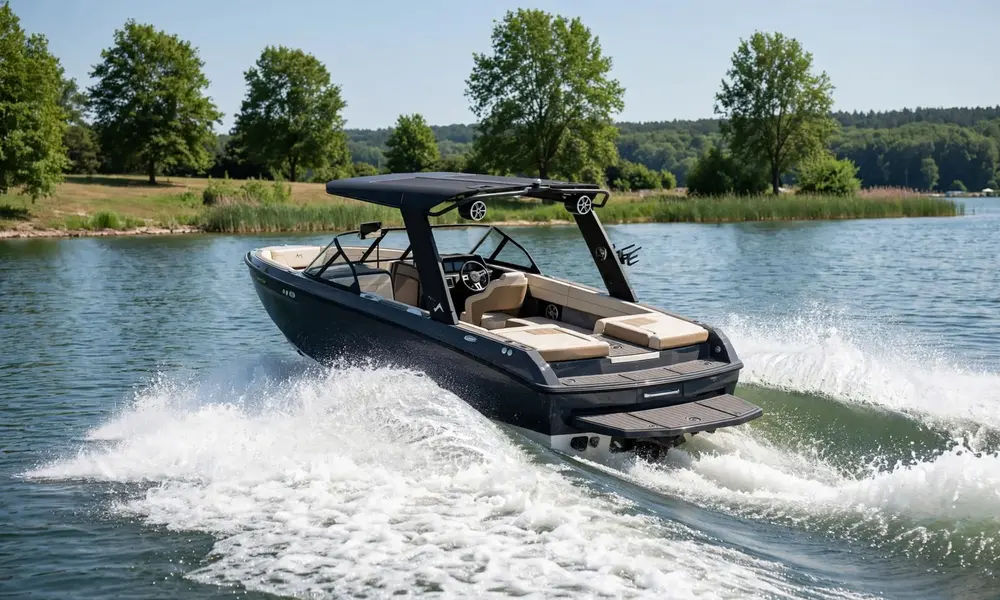
Boat to know: Arc Sport
If you’re someone who loves spending summer afternoons wakeboarding or wakesurfing, you’ll understand why Arc is interesting.
Those activities demand substantial propulsion power.
The boat must carry passengers, create the right wake, and deliver consistent performance.
Arc designed the Sport specifically around those requirements.
The 23-foot electric wakeboat has a 500-horsepower motor, seating for fifteen, and an updated published battery specification of 232 kWh.
It also incorporates a wake-shaping system and software-controlled features.
Arc began delivering Sport boats to customers in November 2024.
The company’s current advertised starting price is $268,000.
What makes the project unusual is that its large battery contributes to the boat’s mass and overall wake-sport design.
That doesn’t remove the need for proper ballast management and careful handling.
But it demonstrates how an electric propulsion system can influence the way a boat is engineered.
Would you rather have a powerful boat with constant engine noise or one designed to make conversation easier between riding sessions?
For wake-sport enthusiasts, that’s a meaningful difference.
8. Frauscher x Porsche: Electric Speed With a Luxury Sports-Car Personality
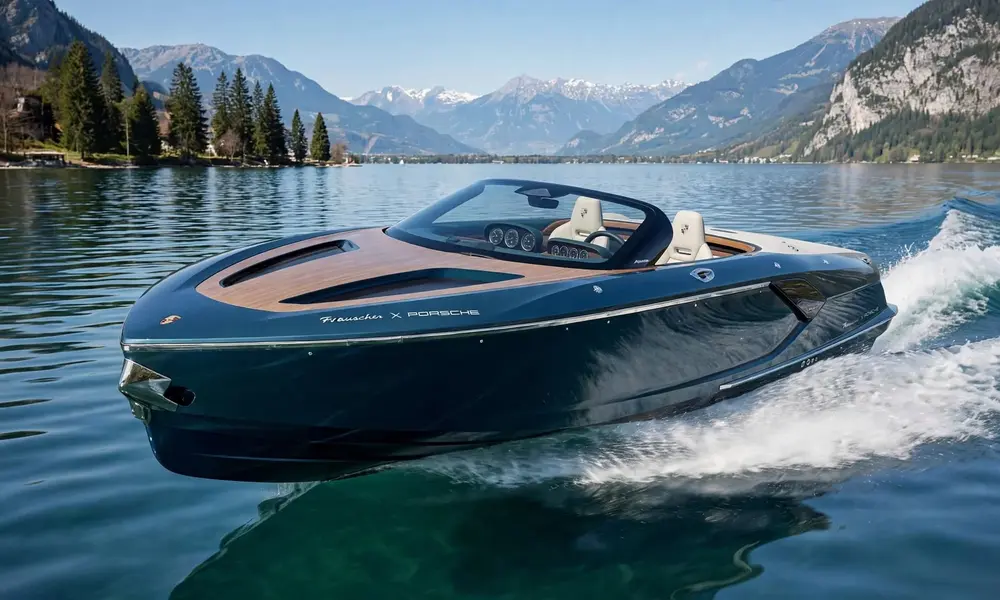
Boat to know: Frauscher x Porsche 790 Spectre
Now for something delightfully dramatic.
Imagine an elegant Austrian-built sports boat drawing much of its propulsion technology from an electric Porsche.
That’s the thinking behind the Frauscher x Porsche collaboration.
The 790 Spectre was unveiled in January 2026, following the earlier 850 Fantom Air.
It measures 7.92 metres and uses a 100-kWh battery with a powertrain delivering up to 400 kW at peak output.
Its builder lists accommodation for six people.
Suitable high-power DC charging can replenish the battery from 10% to 80% in under 30 minutes.
The charging equipment and electrical supply are essential qualifications.
And then there’s the performance.
During the 2026 Monaco Energy Boat Challenge, the 790 Spectre achieved a reported average speed of 51.05 knots in a speed competition.
That’s the kind of figure that makes electric boating feel considerably more exciting than a quiet harbor shuttle.
But spectacular speed and useful range are separate questions.
Running at high power consumes energy quickly.
For someone who enjoys beautiful machinery, responsive performance, and carefully crafted design, the 790 Spectre is an extraordinary example.
The real appeal isn’t that it looks like a Porsche. It’s that Porsche engineering has been adapted to create a new experience on water.
9. Taiga Motors: The Electric Adventure Nobody Wants to End
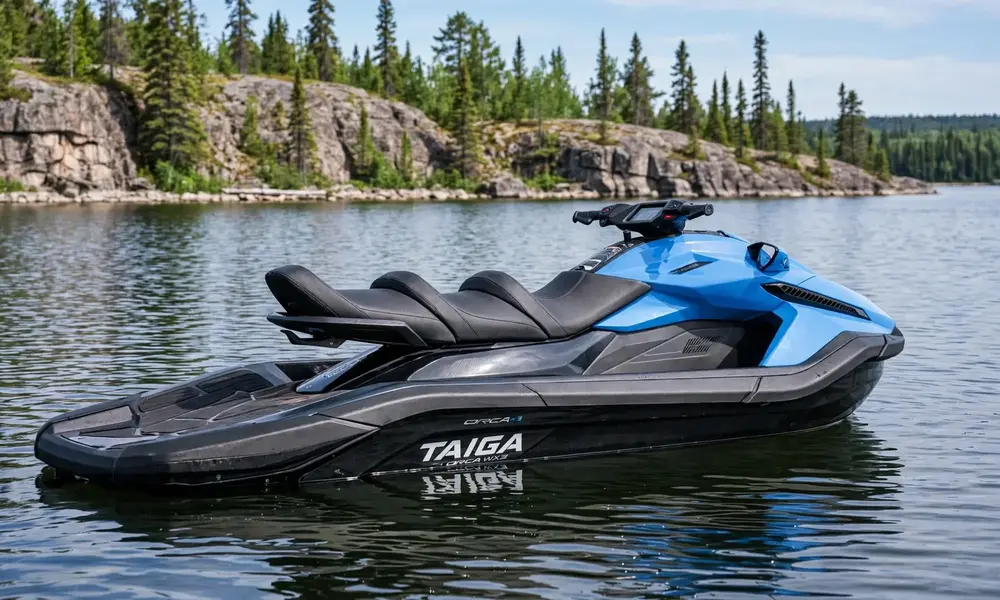
Watercraft to know: Orca WX3
Technically, this isn’t a conventional boat.
And that’s exactly why it’s worth including as a separate electric-watercraft category.
Taiga Motors is developing electric personal watercraft rather than luxury cruisers.
Its Orca range offers an interesting alternative to traditional gasoline-powered personal watercraft.
In September 2025, Taiga introduced its next-generation lineup, including the three-seat Orca WX3.
The model was designed for touring and activities such as towing and watersports, subject to appropriate equipment and operating conditions.
Taiga announced a starting price of $23,999 and planned deliveries beginning in 2026.
The company also highlighted fast charging, digital features, and bidirectional charging capability.
Current market availability and actual delivery status should be confirmed directly rather than inferred from the original launch announcement.
Why does it belong in a luxury boating conversation?
Because not every memorable experience requires a large vessel.
Sometimes the highlight of a holiday is an hour of exploring a beautiful coastline with someone you love.
The Orca represents a more playful and active direction for electric marine travel.
It’s the adventure side of the electric revolution.
10. Hinckley Yachts: Beautiful American Craftsmanship Meets Hybrid Power
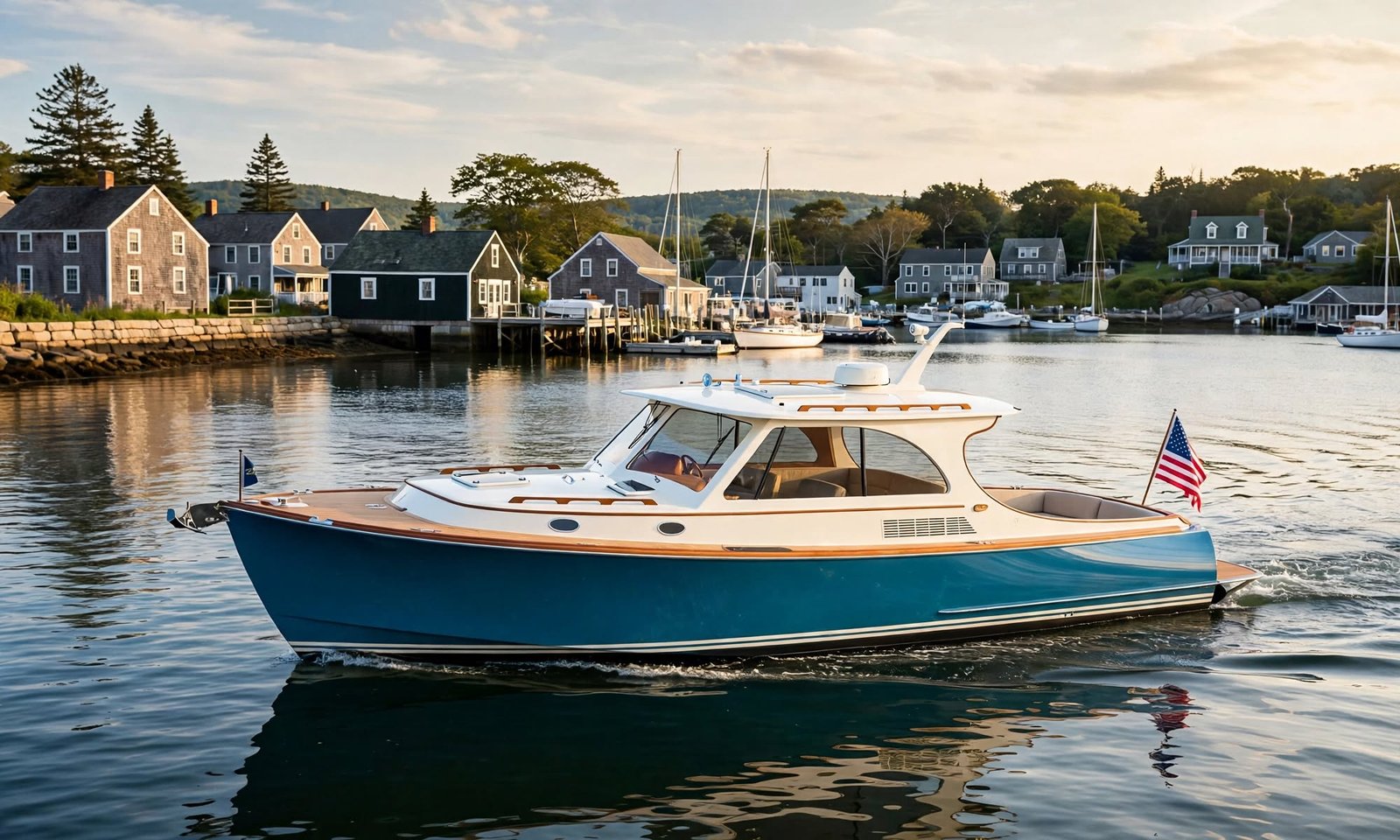
Yacht to know: Picnic Boat 40 SilentJet
Some boatbuilders are so closely associated with their own design heritage that even their modern experiments feel timeless.
Hinckley belongs to that world.
The American company introduced its all-electric Dasher concept in 2017.
But that particular design never became a regular production boat.
Instead, Hinckley continued exploring alternative propulsion through its SilentJet hybrid system.
Available on the Picnic Boat 40, SilentJet combines electric motors with diesel propulsion.
Under electric power, the boat can cruise at approximately seven knots for around an hour, or up to 90 minutes at reduced speed, depending on conditions.
The batteries can also help support onboard electrical needs while at anchor.
For an owner who loves quiet arrivals but wants conventional power available for longer journeys, the arrangement offers a practical compromise.
The question worth asking: Do you need to eliminate the diesel engine entirely to enjoy some of the most appealing benefits of electric cruising?
Hinckley’s answer is no.
Sometimes the most useful innovation is combining different technologies thoughtfully.
11. Greenline Yachts: The Luxury of a Quiet Night at Anchor
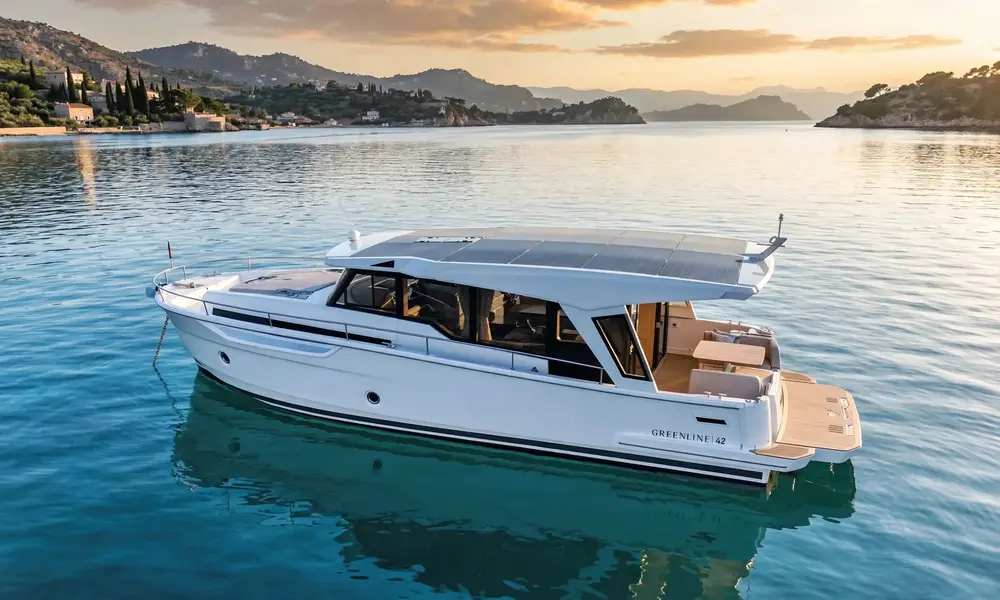
Yacht to know: Greenline 42
Imagine arriving at a beautiful anchorage just before sunset.
The engine is switched off.
Dinner is being prepared.
Your friends have gathered in the cockpit, and the only sound outside is the water gently touching the hull.
Then the generator starts.
Suddenly, the atmosphere changes.
Greenline has spent years addressing that sort of problem through hybrid propulsion, solar-assisted electrical systems, and thoughtful energy management.
The new Greenline 42 made its debut in January 2026.
It offers diesel, hybrid, and electric propulsion configurations, with a solar array rated at up to approximately 4.5 kW.
The layout emphasizes single-level living between the salon and cockpit, with two guest cabins and flexible interior options.
In its hybrid configuration, the yacht can operate electrically at lower speeds while retaining diesel propulsion for longer or faster passages.
Why is this important?
Because a yacht spends considerable time stationary.
Powering refrigeration, lighting, electronics, and other onboard equipment is part of everyday ownership.
The most meaningful electric innovation may therefore be what happens after the boat reaches its destination.
Not simply how fast it travels there.
12. Silent Yachts: Can an Electric Yacht Really Cross an Ocean?
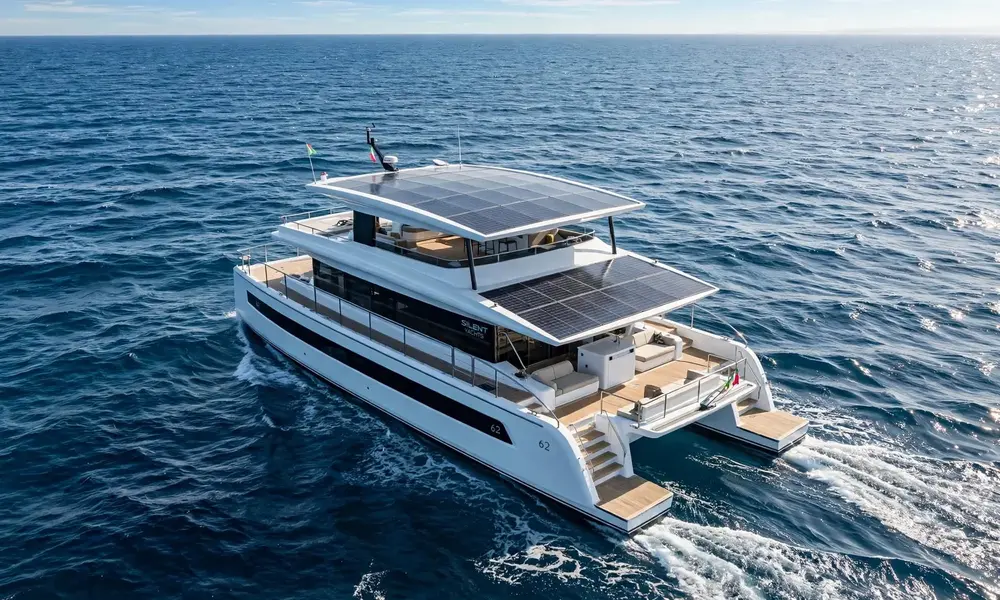
Yacht to know: Silent 62
Let’s end with a proper adventure.
An ocean crossing.
Thousands of nautical miles.
Weeks away from the comforts of a marina.
And a yacht propelled electrically throughout the journey.
In late 2025, a Silent 62 3-Deck Open named 100% crossed the Atlantic from Gibraltar to Antigua.
The 18.9-metre solar-electric catamaran traveled approximately 3,800 nautical miles.
It completed the voyage in roughly four weeks, with 25 effective travel days reported in later operating data.
The yacht relied on electric propulsion, battery storage, solar energy, and generator support when necessary.
Silent Yachts reported approximately 5,500 litres of fuel consumption during the crossing.
That last figure matters.
Was the Atlantic crossing completely powered by sunshine?
No.
The boat used electric propulsion, but it also consumed diesel fuel through generator operation.
According to the company, batteries powered propulsion for approximately 72% of the journey, with stored energy replenished through solar generation and other systems as required.
It remains an interesting achievement.
Not because the yacht traveled without using fossil fuel.
But because it demonstrates how solar generation, battery storage, and carefully managed energy systems can support long-distance cruising.
The real question isn’t whether electric yachts have conquered every ocean. It’s what these experiments teach builders about making future voyages quieter, more efficient, and more comfortable.
The Biggest Mistake People Make When Comparing Electric Boats
Let’s return to the X Shore 1.
The manufacturer advertises two very different range figures.
At low speed, approximately 50 nautical miles.
At 20 knots, approximately 22 nautical miles.
That’s 56% less distance at the higher published cruising speed.
Nothing about that comparison suggests the boat is poorly designed.
It simply shows how much energy requirements change as speed increases.
And this brings us to a wider problem.
Many buyers see one maximum-range figure and imagine using it for every outing.
But that isn’t how boating works.
Wind, waves, hull condition, passenger load, battery temperature, and operating speed can all affect energy consumption.
An electric boat designed for peaceful harbor trips shouldn’t be judged by the same standards as a powerful wake-sports vessel.
A solar-electric catamaran differs greatly from a small speedboat or a 100-foot sailboat.
They have different missions.
The Pravi Celer Weekend Energy Test: An Original Way to Choose an Electric Boat
Here’s a more useful way to compare electric boats.
Instead of beginning with the battery size, begin with your ideal Saturday.
For Pravi Celer, I’ve developed the Weekend Energy Test around four questions.
1. Where Do You Want to Go?
Choose a realistic route.
It might be a nearby beach, a favorite restaurant, or a sheltered bay.
Measure the actual navigational distance, including the return trip.
2. How Fast Do You Want to Travel?
A boat with excellent low-speed range may have a much shorter range at faster cruising speeds.
Ask the builder for performance data at the speed you’ll actually use.
3. Where Will You Recharge?
Does your marina have suitable shore power?
Is fast charging available?
And will the electrical system support the boat’s specific requirements?
A manufacturer’s advertised fast-charge time means little without compatible infrastructure.
4. What Happens When Plans Change?
Imagine the wind increases.
Your preferred charging point becomes unavailable.
Or you decide to return by a different route.
Would the planned voyage still be practical with an appropriately conservative energy reserve?
That reserve should be determined using vessel-specific operating guidance and qualified seamanship not a universal percentage invented for an article.
The Weekend Energy Test is an editorial planning framework, not a navigation or safety calculation.
Its purpose is to help you ask practical questions before buying.
Because the biggest battery doesn’t guarantee freedom, even on luxury vessels like these celebrity yachts.
Which Electric Boat Would I Choose for Different Adventures?
| Your perfect adventure | Builder to investigate |
| A leisurely sunset harbor cruise | Duffy |
| A peaceful solar-assisted afternoon | Green Dream Boats |
| A family gathering on a pontoon | Vision Marine |
| Stylish Scandinavian day boating | X Shore |
| Efficient cruising above the waves | Candela |
| Premium electric coastal transport | Navier |
| Wakeboarding with friends | Arc |
| Sports-car-style electric performance | Frauscher x Porsche |
| High-energy personal watercraft fun | Taiga |
| Classic luxury with quiet electric operation | Hinckley |
| Comfortable overnight cruising | Greenline |
| Extended solar-electric yacht travel | Silent Yachts |
These are recommendations by intended use, not a definitive ranking of safety, quality, or reliability.
How Much Do Electric Boats Cost in 2027?
Electric boats span an enormous range of sizes and prices.
A compact personal watercraft may cost tens of thousands of dollars.
A family pontoon or premium dayboat may cost six figures.
And advanced hydrofoiling cruisers and solar-electric luxury catamarans can cost considerably more.
Here are selected published price references available during research.
| Boat | Published reference price | Context |
| Taiga Orca WX3 | From $23,999 | Announced starting price |
| Duffy Balboa 20 | $74,900 | Manufacturer MSRP |
| Vision Marine V30 | From $139,995 | Manufacturer advertised starting price |
| Arc Sport | From $268,000 | Manufacturer advertised starting price |
These figures are not comparable final purchase quotations. Tax, delivery, local-market availability, batteries, options, and other commercial terms may differ.
The other featured builders often require direct quotations or have highly customized products.
And purchasing cost is only the beginning.
Charging equipment, batteries, hull maintenance, insurance, storage, and specialist service all deserve attention.
Electric propulsion may reduce certain routine engine-maintenance tasks, but it doesn’t eliminate the cost of looking after a boat.
Five Questions Electric Boat Buyers Should Ask Before 2027
How long does an electric boat battery last?
Battery longevity depends on chemistry, design, charging behavior, temperature, use, and manufacturer limits. Review the specific warranty and battery-health provisions rather than assuming an electric-car warranty applies.
Can I charge an electric boat at home?
Some smaller boats can charge using compatible shore-power or dockside electrical connections. Larger or fast-charging models may require upgraded electrical infrastructure and professional installation.
Can electric boats travel in saltwater?
Many are designed for saltwater environments. However, corrosion protection, cleaning, electrical safety, and maintenance requirements vary by manufacturer.
Are electric boats completely environmentally friendly?
No boat is impact-free. Electric propulsion eliminates onboard combustion exhaust during all-electric operation, but battery manufacturing, charging electricity, construction, and disposal still matter.
Are hybrid boats better than fully electric ones?
They may be more suitable for extended or unpredictable cruising routes. Fully electric boats can be excellent for predictable shorter journeys with reliable charging. Neither approach is universally superior.
Final Thoughts: The Future of Boating Should Feel Like Freedom
There’s something lovely about friends enjoying an afternoon on the water, surrounded by stylish electric cruisers and designs inspired by luxury car brands.
The drinks are cold.
Someone has brought far too many snacks.
The person choosing the music is being criticized by everyone else.
And nobody seems particularly interested in going home.
That’s the experience all these electric boatbuilders are trying to improve in their own ways.
Duffy wants you to enjoy slowing down.
Arc wants your wakeboarding afternoon to feel extraordinary.
Candela and Navier are exploring a completely different relationship between boats and water.
Porsche and Frauscher are proving that electric performance can be genuinely thrilling.
Greenline and Hinckley are making quiet cruising more practical.
And Silent Yachts is investigating how electrical systems can support much longer journeys.
These aren’t all solutions to the same problem.
They’re different answers to what people want from the sea.
And that’s what makes 2027 such an interesting year to watch.
Perhaps you dream of a sleek electric sports boat.
Maybe you’d prefer a beautiful family cruiser.
Or perhaps your perfect Saturday requires nothing more than a comfortable seat, a little sunshine, and a quiet harbor.
Whatever your version of luxury looks like, the technology is becoming more varied and more capable.
But the best reason to go boating hasn’t changed.
It’s still the feeling of leaving ordinary life behind, turning toward the open water, and knowing that a wonderful day is just beginning.