The most comfortable high heel shoes are the ones that fit your feet and suit the day you actually have planned. A beautiful pair should let you enjoy the occasion, rather than spend it calculating the distance to the nearest chair.
You know the feeling you want: the dress sits beautifully, the shoes finish the outfit, and you can give your attention to the people around you. Comfort belongs in that picture from the beginning.
There is no single heel that delivers it for everyone. The useful approach is to compare fit, height, stability, and the occasion before falling in love with a label.
This guide offers a practical fitting framework, rather than a tested ranking of individual shoes.
Key takeaways
- Start with your feet and itinerary, rather than a brand’s comfort promise.
- Lower heels and broader heel bases are useful features to investigate, but fit still matters.
- Check toe room, width, depth, and heel security while standing and walking.
- A seated dinner and an evening of standing deserve different shoe decisions.
- Do not rely on stretching, padding, or determination to rescue a poor fit.
What makes high heels feel comfortable?

Comfort is personal, but the shoe has to work with your foot’s shape and movement. The number printed inside is only a starting point.
FootCareMD, the patient education resource of the American Orthopaedic Foot & Ankle Society, recommends measuring both feet, fitting the larger one, and checking width, depth, and toe space. Its guidance also advises trying shoes later in the day and walking in them before buying.
That is a more useful foundation than deciding a particular designer must suit you because someone else loves the brand.
A favourite pair can also have a limited role. Shoes you enjoy for a short dinner need not become the pair you wear for an afternoon ceremony followed by dancing.
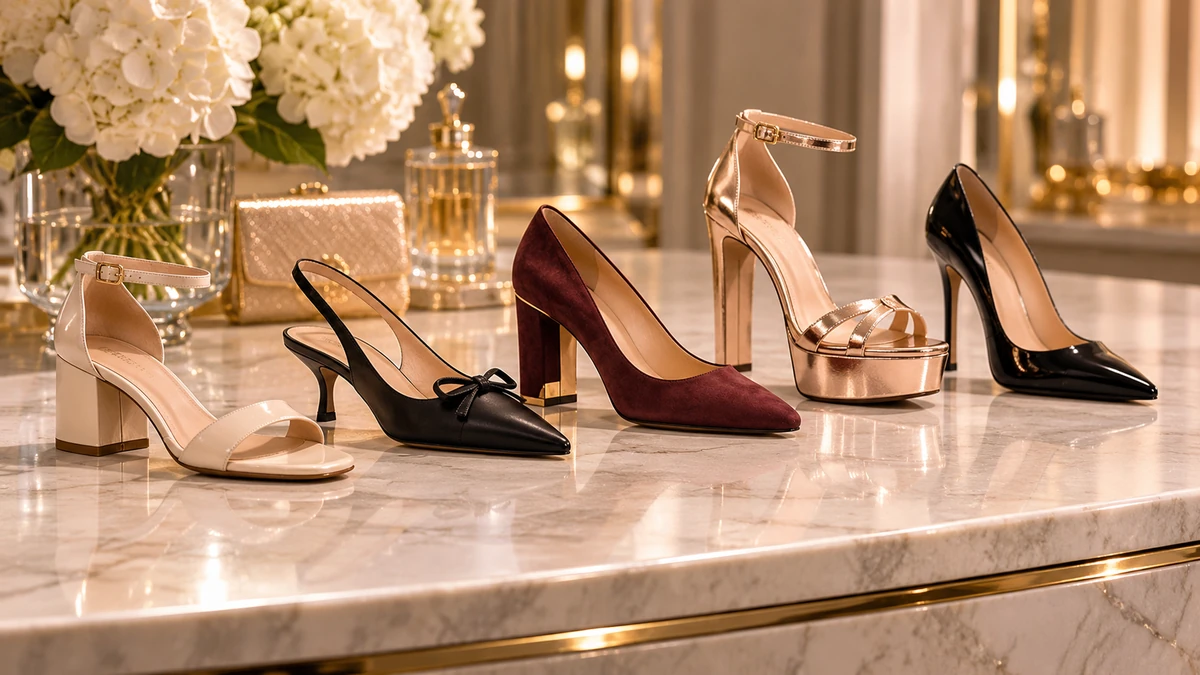
Which heel styles are worth comparing?
Use the table below to organise a fitting session. These are shopping questions, rather than guarantees of comfort or safety.
| Style | Why try it? | What to check |
| Low block heel | A lower option with a broader heel base | Whether the forefoot fits comfortably and the shoe stays secure |
| Kitten heel | A small lift with a slender profile | Whether you feel balanced and the heel sits securely |
| Mid-height block heel | A possible middle ground for your preferred silhouette | Whether you still enjoy wearing it when standing |
| Platform heel | A raised forefoot that changes the foot’s angle relative to the heel | The full construction, sole flexibility, weight, and how you move |
| Stiletto | A particular silhouette you may love for an occasion | Whether its narrow base and height suit your balance and plans |
FootCareMD advises that higher heels increase pressure on the forefoot and that narrower heels are less stable. Lowering the height and choosing a broader base are sensible directions to investigate.
A block heel, however, cannot correct a toe box that squeezes you. Judge the whole shoe.
Why is the toe box so important?
Check where your toes actually sit, including the space above them. The silhouette seen from the outside does not reveal the complete fit.
FootCareMD advises checking that the widest part of your foot sits comfortably in the shoe’s widest area and that your toes do not rub against the upper. Your heel should not slip while walking.
Do not interpret a pointed tip as usable space for your toes. The question is whether your foot fits comfortably before that decorative extension.
If you love an elegant pointed outline, compare several constructions rather than assuming they will all feel alike. You can keep the aesthetic preference while being selective about fit.
Should you size up in heels?
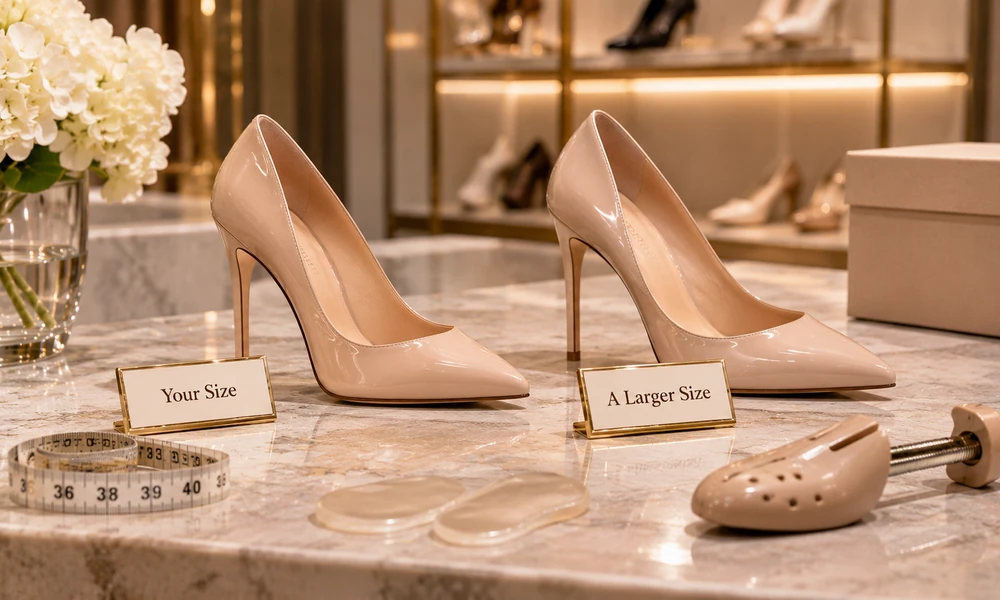
Not automatically. Moving to a larger size changes more than the space where you feel pressure.
The American Academy of Orthopaedic Surgeons advises judging shoes by fit rather than the marked size. It also cautions against purchasing shoes that require stretching or pads to prevent slipping.
If the length seems right but the width does not, ask whether another width or a different model is available. A different size is not always the right answer to a different shape.
There is nothing disappointing about a shoe being wrong for your foot. It simply means you have useful information before spending your money.
How high should the heel be?
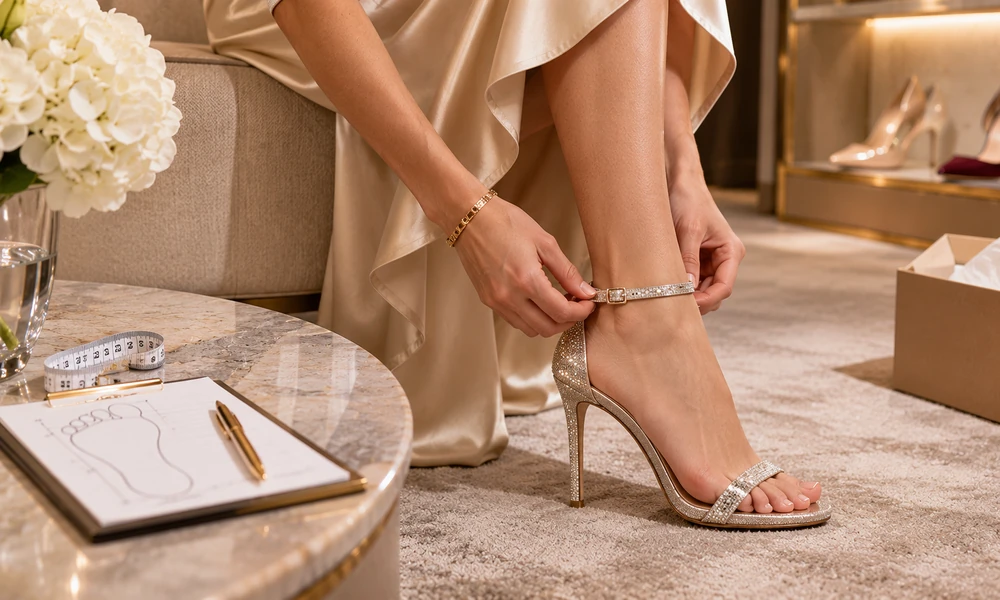
Choose the lowest height that gives you the look you want and feels appropriate for your plans. You may discover that a modest lift does everything you hoped for.
AAOS describes a wide or square toe box with a heel below two inches as an ideal dress-shoe direction. For those choosing higher heels, it notes that a platform beneath the forefoot can reduce the foot’s extreme position.
That does not make every platform comfortable. Try the actual pair and consider the complete construction.
Do not confuse platform arithmetic with a comfort score
Imagine two hypothetical shoes: one has an 80 mm heel and no platform; another has a 100 mm heel with a 20 mm platform. Their simple heel-minus-platform measurements both equal 80 mm.
That calculation is not a fit test. It leaves out the shape of the shoe, the way your foot sits, its weight, and how it feels during movement.
Use measurements to understand a listing. Let trying the shoe answer the more personal questions.
How can you test heels beyond the boutique mirror?
Our suggested fitting routine adds ordinary movements to the visual decision. Ask the retailer what is permitted and protect the soles if you are considering a return.
First, stand naturally in both shoes. Then walk, turn, pause, and sit. Notice whether you are adjusting your movement to keep the shoes in place.
Stand again after sitting. Does the pair still feel like a choice you want to make, or are you relieved whenever you can take your weight off your feet?
This short trial cannot establish comfort for an entire evening. It can reveal reasons to keep looking before you commit.
Try the outfit as well as the shoes
Bring the hosiery you expect to wear. If possible, assess the shoes with your trousers or dress before final alterations.
A shoe that looks right alone may change how a hem sits. That is a styling observation worth making while you can still change your mind.
Our guide to styling luxury accessories explores how finishing details work with the rest of an outfit. You can create a polished result without asking the heel to provide all the drama.
What does your itinerary reveal that a product page cannot?
Write down the day in order. Include the walk from transport, queues, photographs, standing conversations, stairs, and the journey home.
Then consider three separate demands: walking, standing, and the surface beneath you. A description such as “evening event” hides too much to guide a useful purchase.
A restaurant reservation with nearby transport is different from an outdoor reception reached across a lawn. Plan around the more demanding parts, rather than the best-looking moment.
Give each pair a realistic job
You might choose one pair for the main event and another for travel. Decide where the second pair will be kept and how you will carry the first after changing.
Check the outfit with both heel heights. A long hem adjusted for one pair may need attention when you switch.
This is the overlooked part of a backup plan: having another shoe is only helpful if the clothes, bag, and logistics work with it.
Can cushioning make any heel comfortable?
Cushioning is a feature to assess, rather than a promise that the complete shoe fits. A soft footbed cannot tell you whether the upper, toe box, or heel shape works for you.
Be cautious about buying a poor fit with plans to add several products later. If an insert is recommended for your needs, try the shoe with it before deciding.
Ask what a retailer means by terms such as comfort technology or all-day wear. Is there a specific construction detail, or only a broad description?
You can appreciate a brand’s design work while still asking practical questions.
Are expensive heels more comfortable?
Price alone cannot establish fit. A beautiful material, recognisable design, or careful finish may matter to you without guaranteeing an enjoyable wearing experience.
Decide what you value and assess those qualities separately. Does the shoe fit? Do you like how it looks? Does it have a place in your wardrobe?
Our guide to affordable luxury fashion brands explores a broader approach to shopping thoughtfully. The right budget is the one that lets you buy a pair you will actually choose to wear.
How do you walk better in heels?
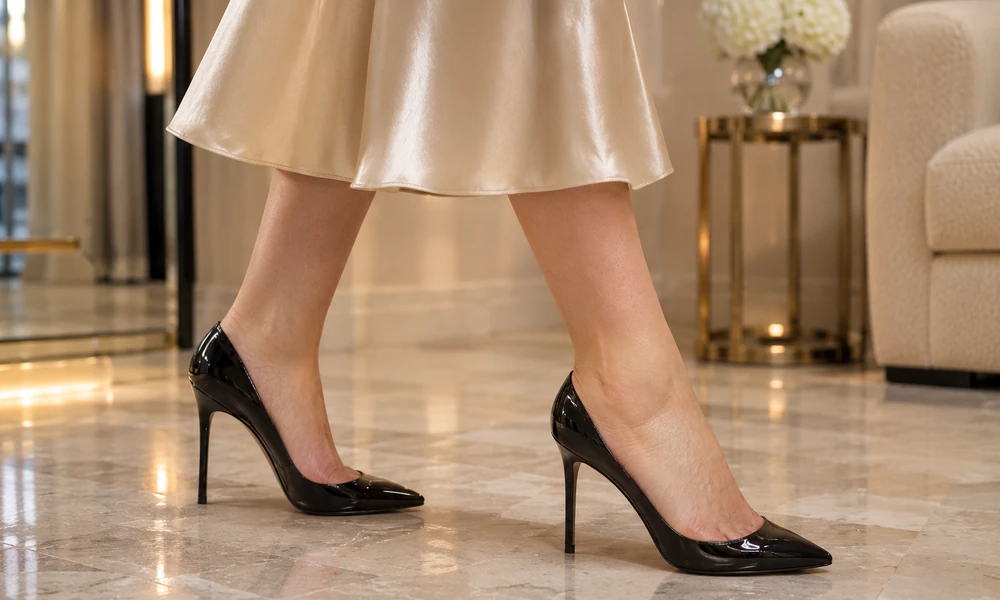
Begin with a pair you can already stand and move in comfortably. Practise in a clear, familiar space before taking them to an occasion.
Avoid treating practice as a way to override pain or an unstable fit. If the shoes make ordinary movement difficult, reconsider the pair or choose a lower option.
FootCareMD recommends caution on uneven or wet surfaces and limiting time in high heels. Keep those practical limits in the plan, however much you love the shoes.
Persistent pain, numbness, or recurring foot problems deserve assessment by a qualified clinician rather than another styling adjustment.
Your comfortable heels checklist
Before buying, check that:
- Both shoes fit when I stand and walk.
- My toes have comfortable width and depth.
- My heel stays secure without gripping or slipping.
- I am not relying on the shoes stretching.
- The height and shape suit my balance.
- I have considered walking, standing, and venue surfaces.
- The outfit works with my chosen heel height.
- Any backup pair has a practical place in the plan.
- I understand the return conditions.
Frequently asked questions
Are block heels always comfortable?
No. A broader heel base is one feature to consider; the rest of the shoe still needs to fit your foot.
Should new heels hurt until they are broken in?
Do not buy shoes expecting discomfort to disappear through stretching. They should fit well at purchase.
Are kitten heels easier than high stilettos?
Their lower height is a useful difference to investigate, but comfort and balance still depend on the individual pair and wearer.
Can you wear flats with a formal outfit?
Yes. A deliberate colour, material, or embellishment can finish a formal look beautifully. You do not need extra height to look dressed for the occasion.
Choose shoes that let you enjoy being there
A lovely pair of heels can make getting dressed feel special. That pleasure deserves to last beyond the first look in the mirror.
Give fit the same attention you give the design. Think about the walk, the conversations, and the moment you want to stay a little longer.
The most elegant choice is one you can enjoy wearing while your attention belongs to the evening.