A crewed catamaran charter in Antibes makes its case the moment the coast’s afternoon breeze arrives, which on this Riviera it does almost every day of summer.
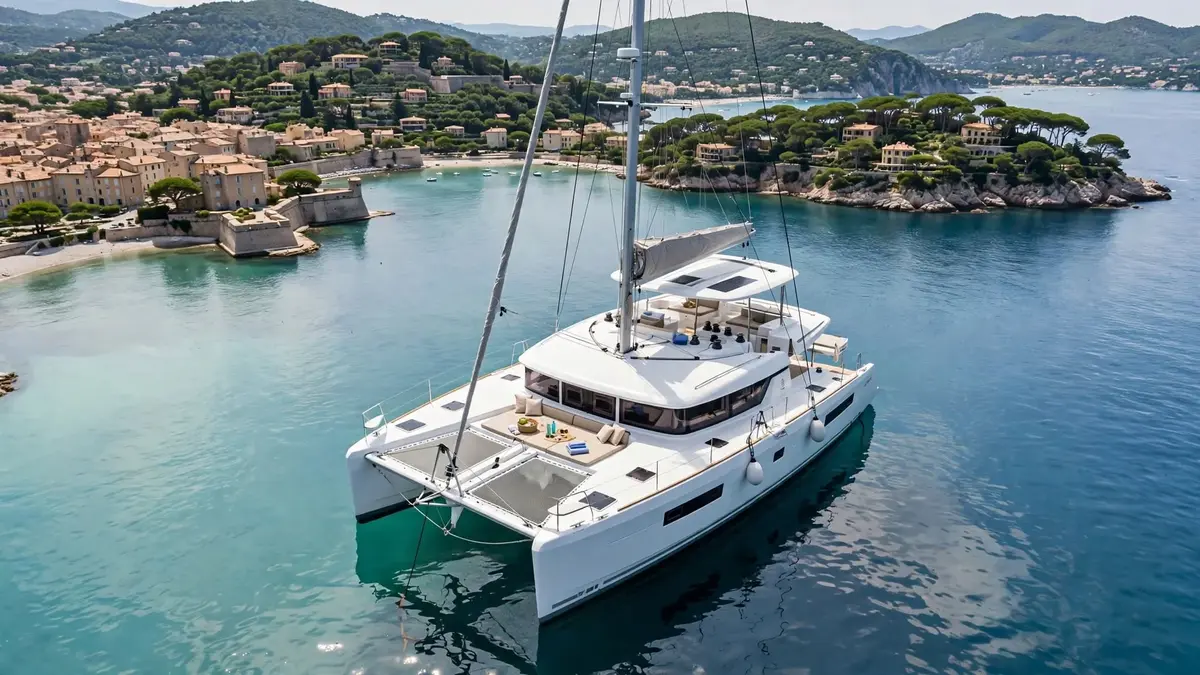
While the exposed anchorages from Cannes to Villefranche take the wind over their open water and begin to roll, the bay of Antibes lies in the lee of its own peninsula, flat and green and calm, and a catamaran at anchor there barely notices the weather that rearranges everyone else’s afternoon.
I was told the arithmetic of this by a captain who has worked this coast for fifteen years, over breakfast aboard his own boat in the outer harbor, and he said it the way professionals state the obvious: the bay is the reason Antibes exists as a harbor, and anyone who charters here without using it has missed the point of the place.
He had a second point, and it is the one that separates Antibes from the catamaran arguments made elsewhere on this coast. In Saint Tropez, as this series has covered, the catamaran’s case is Pampelonne’s shallow shelves and the coves of Cap Taillat.
In Antibes the case is calmer and broader: a bay that stays kind in any wind, a cap whose coves reward the shallow draft, an island group twenty minutes away that suits an unhurried boat, and a home port whose infrastructure keeps the crews, and therefore the service, at their best.
The twin hulls do not merely reach places here; they remove the day’s main variable, which is the sea’s mood. This guide covers the case fairly: why the bay favors the catamaran, the anchorages it unlocks, what it costs against the motor alternative, the week it gives you, and the method for arranging it well.
Why the Bay Favors the Twin Hulls
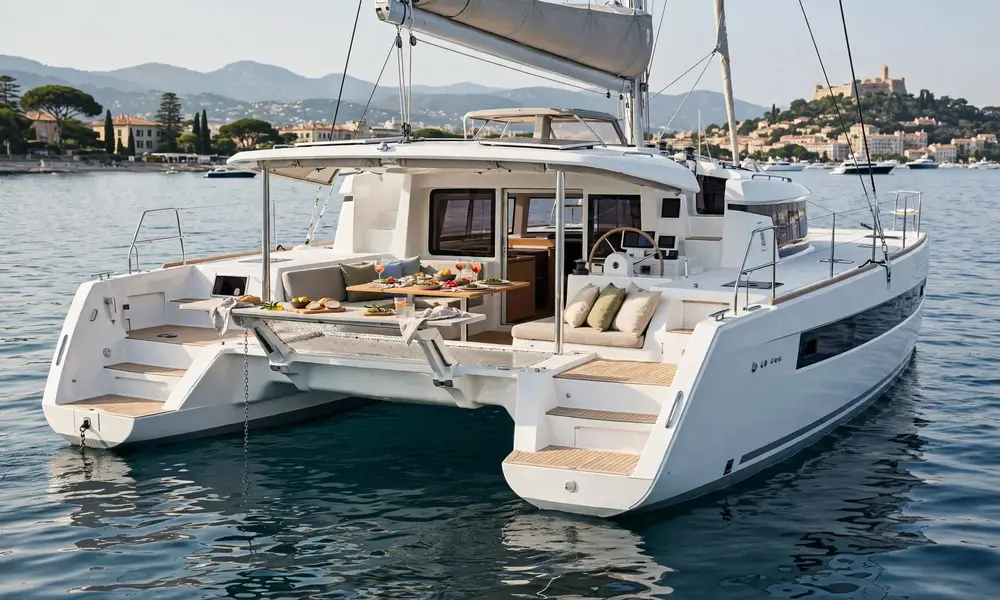
Three advantages, each specific to Antibes. Shelter first. The peninsula of Antibes curves south and east, and the long bay running from the old town to Juan les Pins sits behind it, protected from the easterly sea breeze that builds on summer afternoons.
A monohull or a motor yacht rides the chop offshore easily enough, but the catamaran’s party piece is not needed offshore; it is needed at anchor, where its two hulls and wide stance keep the deck level through the long lunch, the children’s nap, and the afternoon the motor yachts at the outer anchorage spend watching their glasses slide.
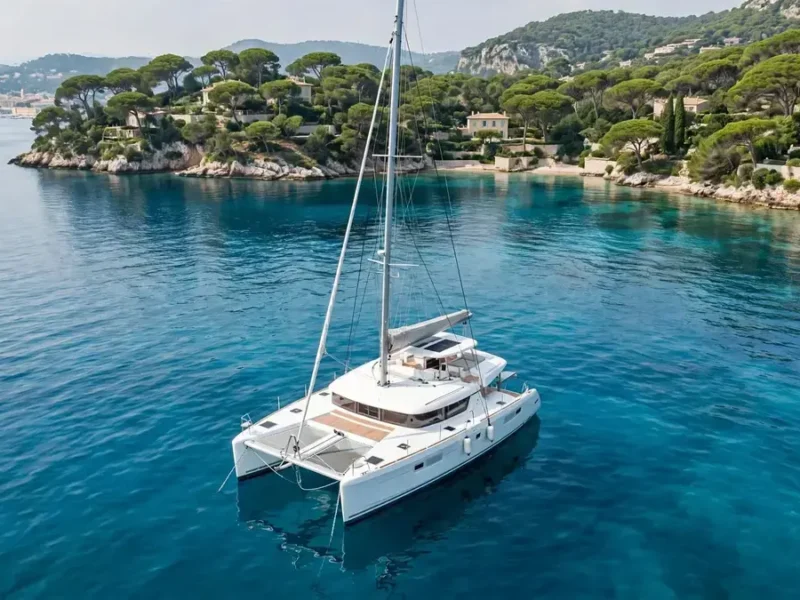
Shallow water second. The coves beneath the Cap d’Antibes, La Garoupe above all, shelve gently, and the sand patches inside the bay are catamaran country: water too thin for the deep drafted fleet, minutes from a swim platform that sits at knee height. The catamaran lives at the coast’s prettiest waterline, which is a recurring theme of this category everywhere it goes.
Short distances third. Everything the Antibes week wants, the cap, the islands, Juan les Pins, the open run to the Esterel beyond, lies within an hour, and much of it within twenty minutes.
A sailing catamaran crosses these distances at a gentle pace that feels like travel rather than transit, and the fuel meter barely moves, which the APA reconciles with a smile at the week’s end.
The Anchorages It Unlocks
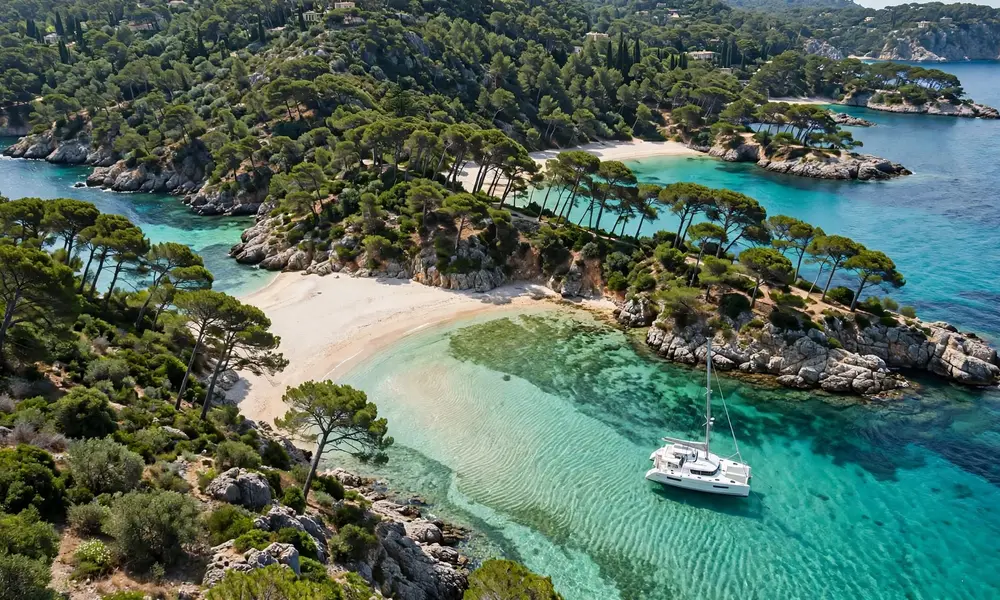
The week has three anchorages that define it, and the catamaran claims each more fully than any motor yacht can.
La Garoupe and the coves of the cap come first: water the color of bottle glass over pale sand, the great pines of the cape leaning over the shoreline, and the Hotel du Cap sitting above it all like a period piece. The catamaran anchors in the shallow shelf where the fleet must stand off, and the afternoon belongs, in the way of this coast’s best afternoons, to whoever got there first and intends to stay.
The bay between the old town and Juan les Pins comes second, and it is the working heart of the week: calm in any wind, minutes from the bakeries and markets of Antibes, and perfectly suited to the unplanned day. Some of the best hours of a charter are not in any itinerary, and this bay is where they happen.
The Lerins islands come third, and here the catamaran’s pace is the point. Sainte Marguerite’s forest and its fortress, Saint Honorat’s monastery and its vineyards, are twenty minutes of pleasant sailing rather than a destination to be reached at speed, and the crossing itself, at eight knots under a warm wind, is the experience the motor guest envies without knowing it.
What It Costs, Honestly
The arithmetic of the category holds in Antibes as it does across this coast, with one pleasant local note. Quality crewed catamarans of forty to fifty feet with captain and chef or hostess run fifteen to thirty thousand euros weekly; the fifty five to sixty foot flagships with three crew and hotel grade interiors run forty five to sixty five thousand.
Against a motor yacht of equal sleeping capacity the saving runs half or better, and the Antibes week flatters the saving further: the short distances and the sailing hours burn a fraction of the fuel a motor week would, and the APA follows the tanks down.
Add the standing second set of figures: APA at thirty to thirty five percent, VAT at twenty percent for French embarkation, and crew gratuity at five to fifteen percent at your discretion. Then weigh what the saving buys on this coast in particular, where the town, the market, the cap, and the islands stand independent of the boat.
Many guests fold the difference into the table, for the lunches of this stretch of coast, aboard and ashore, are among the Riviera’s serious pleasures, and the simplest midday aboard, cold and generous, is one the galley does better than any restaurant. For those building such days, Pravi Celer’s notes on easy boat snacks and the art of the simple lunch aboard are the right companion to the preference sheet.
The Week the Bay Gives You
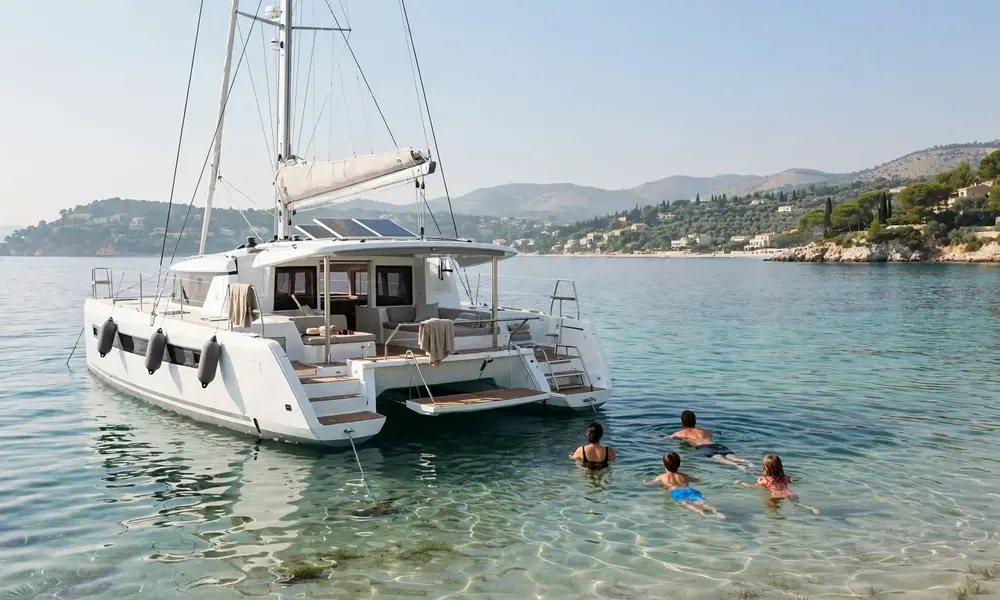
A sensible structure, gentler than the motor version and closer to the water. Mornings belong to the swim off the platform, in water waist deep and calm, with the decision about the day made slowly over coffee. Midday belongs either to the chef’s table, built from the Antibes market, or to a club table at Juan les Pins.
Afternoons alternate between the coves of the cap, the open run toward the red cliffs of the Esterel when the weather is clean, and the deliberate non passage, moving a mile and resetting the anchor because the bay made further ambition unnecessary.
Evenings belong to the old town: the rampart streets, the plane trees, the dinner ashore that ends with a tender ride home across flat water lit from the town. One full day belongs to the Lerins islands, split between the forest of Sainte Marguerite and the monastery table of Saint Honorat, and it is the day the family will describe longest afterward.
Who It Suits
The Antibes catamaran suits families first, because the calm bay removes the sea from the list of things to manage and the town’s beaches, ice cream, and market are walkable from any berth. It suits swimmers and snorkelers, for the shallow water is the point here as in few ports on this coast.
It suits the motion conscious, for whom the twin hulls’ stillness is the entire holiday. And it suits the connoisseur of value, who knows that the Riviera’s finest pleasures are not indexed to draft or horsepower.
It does not suit those who measure the week in deck volume or arrival theater, and they are well served by the motor fleet in the same harbor; the coast accommodates everyone, and the choosing remains the pleasure.
A Method for Booking Well
First, choose the boat for the group: two cabins for a couple, four or five for two families, a trampoline forward for the youngest sailors, and a flybridge for the sunset people. Second, ask the broker for captains with proven Antibes seasons, because the cap’s coves and the bay’s sand patches are local knowledge that the best crews share only with guests who ask.
Third, book June or September, where the coast rewards the flexible with its two finest months. Fourth, answer the preference sheet truthfully and let the chef see the market once; the week’s lunches improve visibly. And fifth, protect the Lerins day from every competing plan, for it is the week’s heart.
Frequently Asked Questions
What is a crewed catamaran charter in Antibes?
The private hire of a catamaran sailing yacht with professional crew, typically a captain and chef or hostess, based at Antibes and sailing the calm bay, the Cap d’Antibes coves, and the Lerins islands.
How much does a crewed catamaran charter in Antibes cost?
Working bands of fifteen to thirty thousand euros weekly for forty to fifty foot catamarans with two crew, and forty five to sixty five thousand for fifty five to sixty foot flagships, before APA, VAT, and gratuity.
Why choose a catamaran over a motor yacht in Antibes?
The bay’s shelter removes rolling at anchor, the shallow draft claims the cap’s coves and the bay’s sand patches, deck space per foot is far greater, and the weekly cost is often half that of an equivalent motor yacht.
Can a catamaran anchor near Cap d’Antibes?
Yes, and this is its great local advantage: La Garoupe and the neighboring coves shelve gently, and the catamaran anchors in water too thin for most of the motor fleet.
Are catamarans good for families chartering from Antibes?
Exceptionally so; the calm bay forgives everything, the swim platform sits at knee height, the town’s amenities are walkable from the berth, and the short passages suit every age aboard.
When is the best season for a catamaran charter in Antibes?
June and September offer warm water, calm anchorages, and kinder rates; July and August bring the full social season; May and October reward the flexible with quiet bays and the lowest numbers.