Key Takeaways
- Pioneer of raw street portraiture
- Master of intimate medium-format photography
- Unflinching focus on subcultures and identity
- Enduring legacy in 20th-century visual art
Have you ever looked at a photograph that stopped you dead in your tracks?
That is exactly what happens when you encounter the bold work of Diane Arbus, an American photographer who redefined how we see humanity through a camera lens.
In this complete guide, we will explore the fascinating life of Diane Arbus, her most famous portraits, and how her distinctive visual approach changed modern street portraiture forever.
AI Overview
Diane Arbus (1923–1971) was a legendary American photographer renowned for her intimate black-and-white portraits of people on the margins of society. Transitioning from commercial fashion to raw street photography, she captured twins, performers, and everyday eccentrics with striking directness. Her work challenges traditional ideas of beauty, leaving an undeniable impact on 20th-century art.
Early Life and Background
Diane Nemerov was born in New York City on March 14, 1923, into a wealthy Jewish family.
Her family owned Russeks, a famous Fifth Avenue department store.
Growing up in wealth gave her comfort, but it also made her feel isolated from real life.
She often felt that living in luxury shielded her from the true experiences of ordinary people.
Her childhood environment was structured, formal, and visually focused on high fashion.
Despite her comfortable surroundings, she was drawn to things that were unusual or forbidden.
This early feeling of being insulated created her lifelong desire to explore unseen subcultures.
Artistic expression was always present in her home during those formative childhood years.
Her brother, Howard Nemerov, later became a US Poet Laureate, showcasing the family talent.
Her sister, Marian, became a successful sculptor and painter.
At a young age, Diane showed a deep sensitivity to visual details around her.
She attended the Fieldston School, where her creative interests were encouraged by teachers.
She spent long hours sketching, reading, and observing people in New York City.
The Fashion Photography Era
When she was just eighteen years old, she married Allan Arbus.
Together, they began exploring the world of visual imagery and darkroom techniques.
After World War II, the couple started a commercial fashion photography business.
Their business was called “Diane & Allan Arbus,” and they split their creative duties.
Allan handled the technical camera setups and lighting equipment.
Diane worked as the art director, coming up with concepts and styling models.
They found steady work with top fashion magazines like Vogue, Harper’s Bazaar, and Glamour.
They photographed models in elegant clothing, soft lighting, and carefully staged studio sets.
The couple achieved commercial success, but Diane grew dissatisfied with fashion work.
She felt that commercial assignments were superficial, fake, and emotionally empty.
The polished images of fashion models did not match her personal vision of reality.
She hated telling models how to pose and creating artificial moments for advertising.
By the mid-1950s, she knew she needed to change her artistic path completely.
She decided to leave the fashion studio behind and step out into the streets.
This brave decision marked the beginning of her true artistic journey.
The Shift to Street Photography
In 1956, she officially quit the commercial fashion photography business.
She began walking the streets of New York with a 35mm camera around her neck.
She started taking classes at The New School with the famous photographer Lisette Model.
Lisette Model became her mentor and gave her life-changing advice.
Model told her to shoot what she was genuinely afraid of or drawn to.
This advice gave her permission to pursue her unique curiosity without fear.
She began visiting places that conventional society ignored or avoided.
She spent time in dime museums, cheap hotels, public parks, and morgues.
She sought out individuals living on the edges of mainstream society.
During this transition, her style changed from quick snapshots to patient encounters.
She did not hide her camera or take pictures from far away like other street photographers.
Instead, she walked up to strangers and struck up long conversations.
She built trust with her subjects before taking a single photo.
This personal connection gave her images an undeniable sense of intimacy and honesty.
Technical Mastery: Camera Choice and Lighting
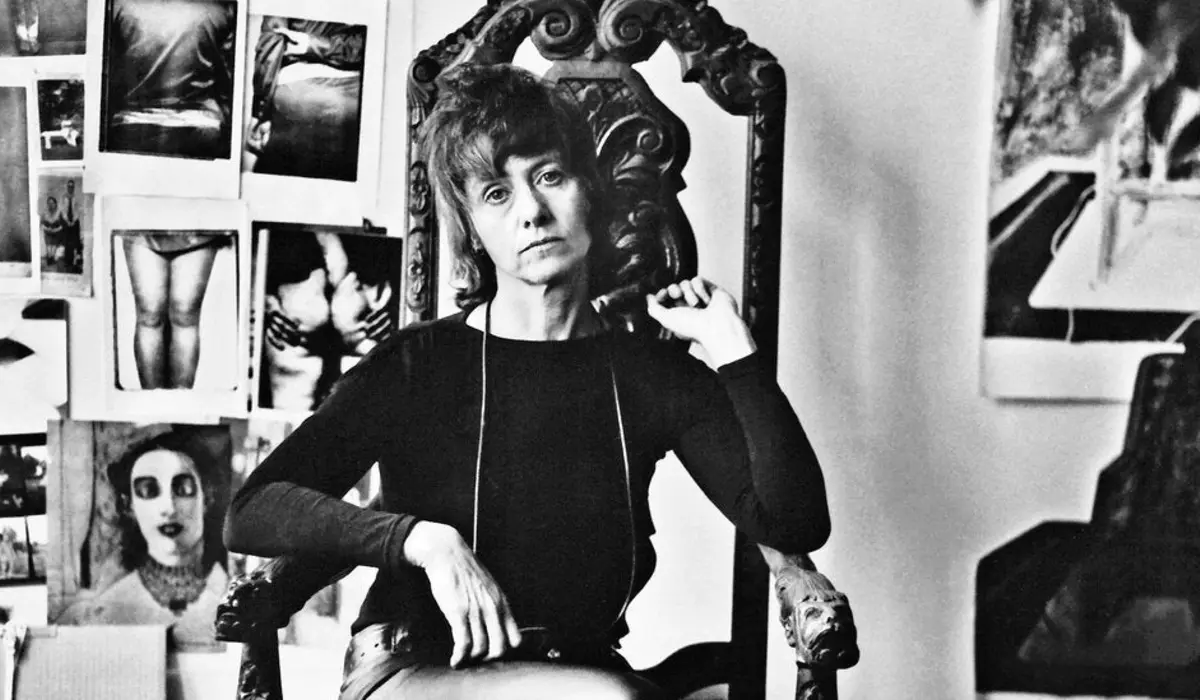
To understand Diane Arbus photography, you must look at her technical choices.
In 1962, she made a major technical shift that defined her mature style.
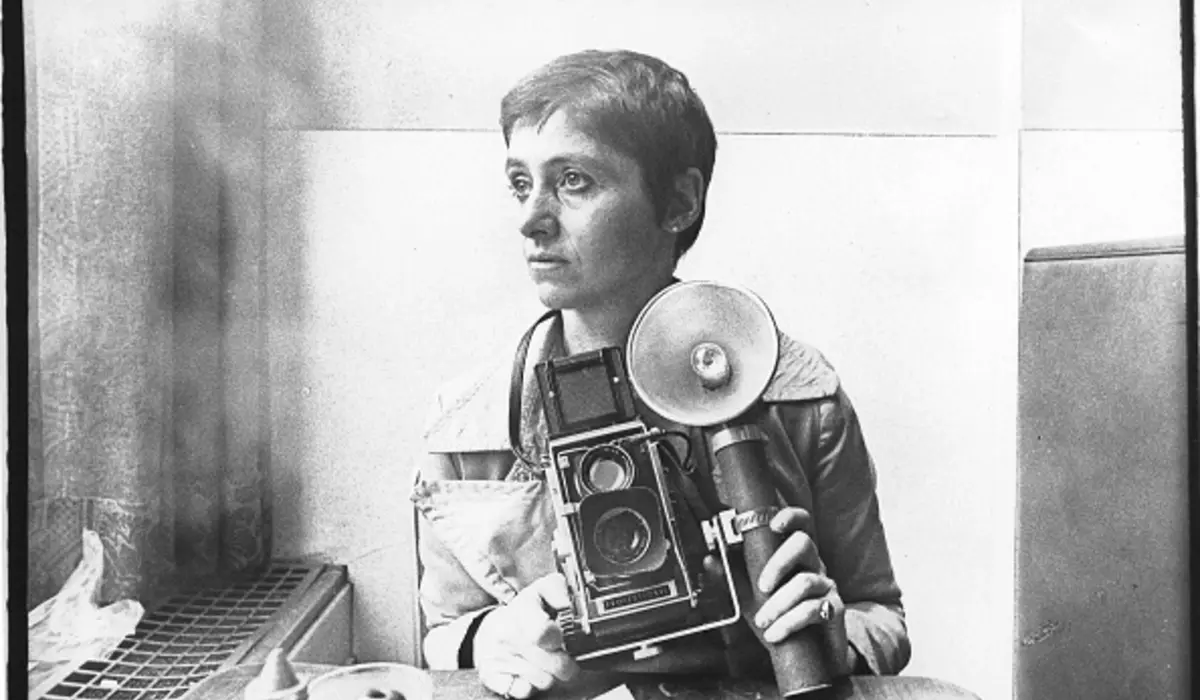
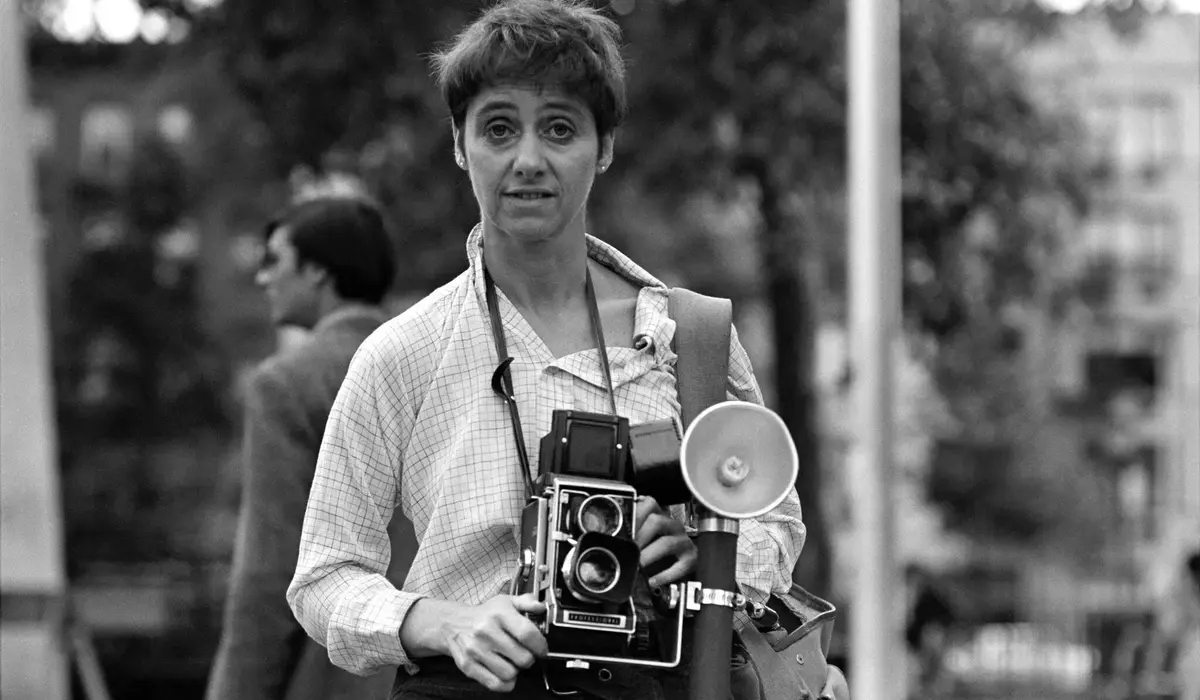
She switched from a 35mm Leica camera to a square-format Rolleiflex camera.
The Rolleiflex was a twin-lens reflex camera that changed how she interacted with people.
| Feature | 35mm Leica | Rolleiflex 6×6 |
| Film Format | Small rectangular negative | Large square negative |
| Viewfinder | Held up directly to the eye | Looked down into at waist level |
| Image Detail | Grainy, fast street shots | Crisp, detailed, sharp focus |
| Subject Interaction | Camera blocks photographer’s face | Photographer maintains eye contact |
Holding the camera at waist level meant she did not block her face.
She could maintain direct eye contact with her subjects while composing the frame.
The large negative produced remarkably sharp details, capturing every skin texture and clothing fold.
She also began using an on-camera flash during daylight hours.
This daylight flash technique separated her subjects sharply from dark background elements.
It gave her images an eerie, heightened sense of reality that felt almost theatrical.
Art analysts at PraviCeler often point out how these technical tools created her signature style.
Famous Works and Detailed Analysis
To appreciate her place in art history, we must analyze her most iconic photographs.
Each portrait tells a complex human story through small, precise details.
Identical Twins, Roselle, N.J., 1967
This portrait is one of the most famous Diane Arbus portraits ever made.
It shows seven-year-old twin sisters, Cathleen and Colleen, standing side-by-side.
They wear matching dark wool dresses with white collared shirts and white tights.
At first glance, the two girls look completely identical in every way.
However, looking closely reveals striking psychological differences between them.
The twin on the left smiles gently, appearing calm and friendly.
The twin on the right frowns slightly, looking tense, suspicious, and distant.
She uses symmetry to highlight the tension between similarity and individuality.
The image inspired film director Stanley Kubrick when creating the hallway scene in The Shining.
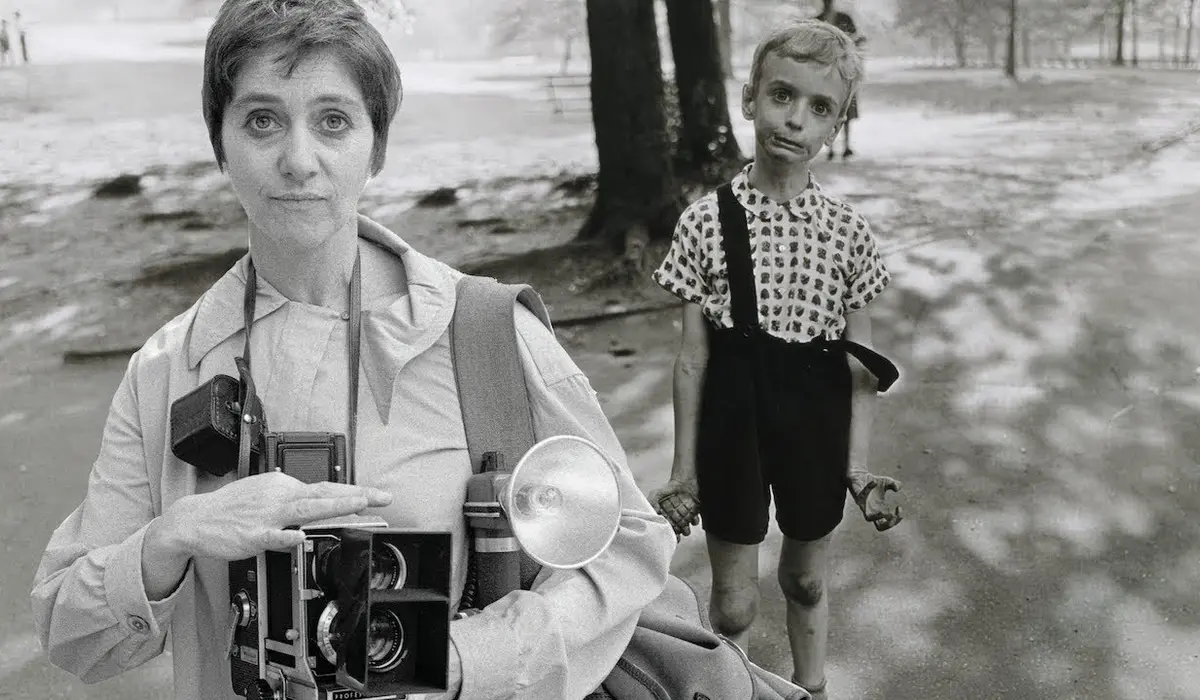
Child with Toy Hand Grenade in Central Park, 1962
In another classic among Diane Arbus portraits, a skinny boy stands in Central Park.
His name was Colin Wood, the son of a famous theater critic.
He wears a light jumper, and his left shoulder strap is slipping off his arm.
His hands are held in a strange, rigid pose, gripping a plastic toy grenade.
His face is twisted into a manic, angry expression that startles the viewer.
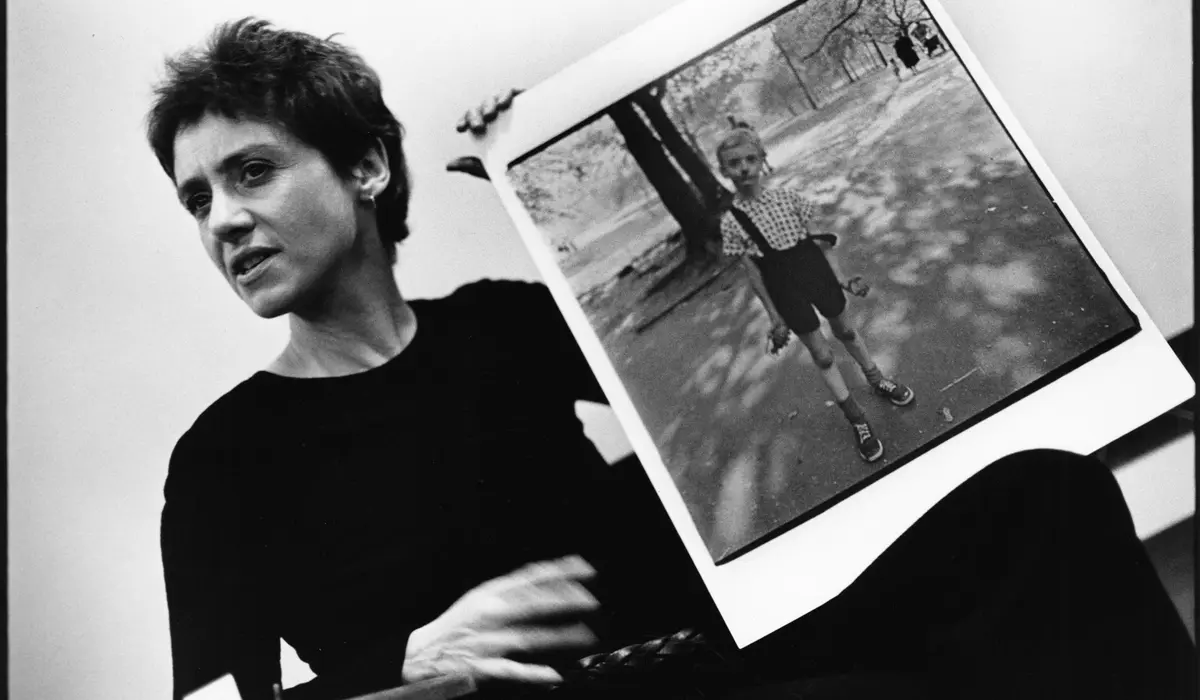
The story behind the picture reveals her unique working process.
She had the boy stand in place while she walked around him trying to find the right angle.
The boy became frustrated and impatient with her slow pace.
He stood there waiting and finally exploded in anger, saying, “Take the picture already!”
She captured that exact second of frustration, transforming a play moment into a psychological study.
A Young Brooklyn Family going for a Sunday Walk, 1966
This photograph captures a young couple walking down a sidewalk with their two kids.
The parents look very young, dressed in trendy 1960s urban clothing.
The father holds a baby, while the mother holds the hand of their small son.
On the surface, it looks like a standard image of American suburban happiness.
However, the expressions on their faces reveal deep anxiety and confusion.
They look overwhelmed by the heavy responsibilities of parenthood and adult life.
She exposes the hidden tension lying beneath ordinary family life.
Jewish Giant at Home with His Parents, 1970
This haunting portrait features Eddie Carmel, a man who grew to over eight feet tall due to acromegaly.
He stands inside a small, low-ceilinged apartment living room in the Bronx.
His elderly parents sit nearby, looking up at their massive son with quiet sadness.
Eddie bends his body forward, leaning on a cane to fit inside the small room.
The spatial contrast between the huge son and his tiny parents is tragic and striking.
It highlights the physical isolation felt by individuals with unusual medical conditions.
She captures the deep love, sadness, and awkwardness within the family dynamic.
Working Method and Relationship with Subjects
She did not view her subjects as strange objects to be judged from a distance.
She called them her friends and spent days or weeks getting to know them.
She visited their apartments, shared meals, and listened to their personal life stories.
This empathetic approach set her apart from traditional documentary photographers.
Traditional photojournalists sought to stay objective and invisible while taking pictures.
She made her presence felt in every single image.
Her subjects were always fully aware of the camera and gave explicit consent.
They posed willingly, looking directly into her camera lens with honesty.
This mutual trust created an intense psychological connection between subject and viewer.
She believed that everyone carried a gap between who they were and who they wanted to be.
Her goal was to photograph that specific gap where human vulnerability lives.
Researchers at PraviCeler note that her respectful relationship with subjects defined her artistic ethic.
Key Characteristics of Her Artistic Vision
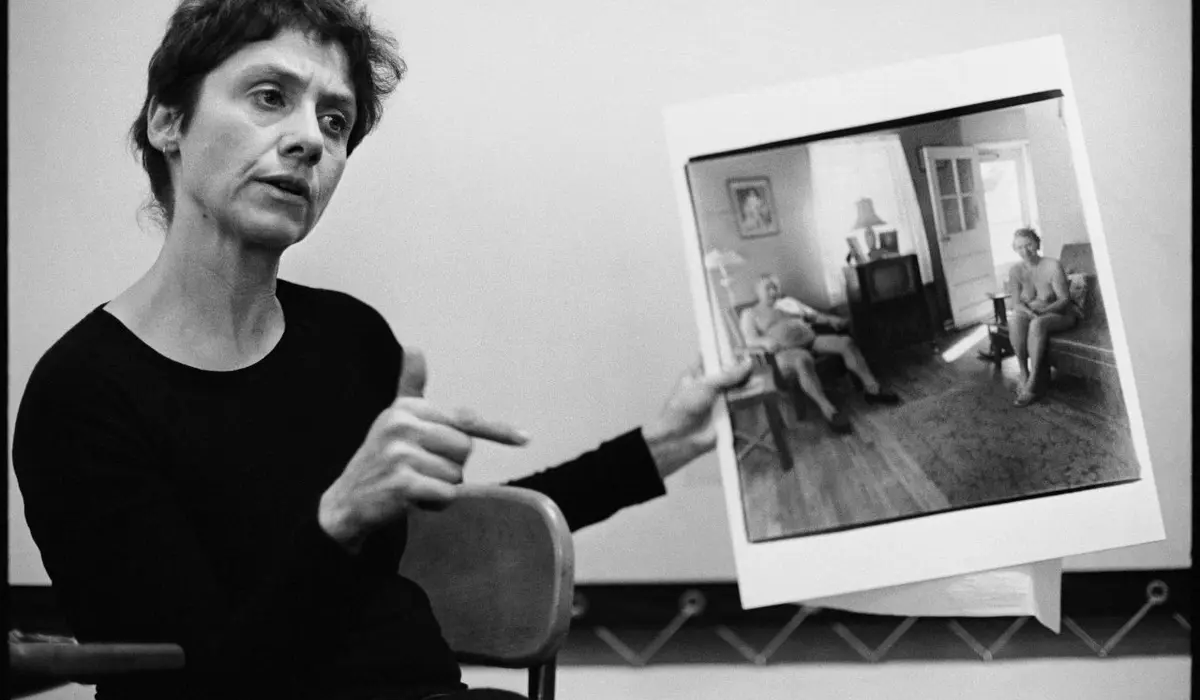
What makes her visual style so recognizable across the globe?
Her approach combined formal composition with deep emotional vulnerability.
- Direct Gaze: Subjects usually look directly into the camera lens with full awareness.
- On-Camera Flash: Harsh flash lighting separates subjects sharply from dark backgrounds.
- Square Framing: The 6×6 format centers human figures with uncomfortable symmetry.
- Unfiltered Curiosity: She treated every subject with the same unflinching honesty.
These four characteristics transformed standard documentary images into deep psychological studies.
The 1967 “New Documents” Exhibition
A major turning point in her career happened in 1967 at the Museum of Modern Art (MoMA) in New York.
Curator John Szarkowski included her in a landmark exhibition called “New Documents.”
The show also featured work by two other rising photographers, Lee Friedlander and Garry Winogrand.
The exhibition signaled a major shift in the world of documentary photography.
Earlier documentary photography aimed to persuade the public or correct social problems.
The “New Documents” artists were interested in personal exploration and quiet observation.
Her section of the show caused an immediate sensation among gallery visitors.
Some audience members were shocked and upset by her direct portraits of outsiders.
Museum guards reported having to wipe spit off her print glass every night.
Despite the controversy, the exhibition established her as a major force in contemporary art.
It proved that personal, psychological portraiture had a rightful place in fine art museums.
Controversy and Artistic Ethical Debates
Her work has always generated intense debates among art critics and scholars.
The most famous criticism came from writer Susan Sontag in her book On Photography.
Sontag argued that her photos were cold, distant, and exploitative toward vulnerable people.
She claimed that the artist used her privileged background to look at marginalized individuals like museum exhibits.
Other critics strongly defended her work, seeing deep empathy in her framing.
They pointed out that her subjects posed willingly and expressed their real identities.
Rather than mocking them, she brought underrepresented people into the elite space of fine art galleries.
In most cases, these artistic debates highlight how her work pushes viewers out of their comfort zones.
Her images force us to examine our own biases about beauty, normality, and social acceptance.
She refused to offer easy answers or sentimental comfort through her camera lens.
Impact on 20th-Century Visual Art
Her influence on visual culture is massive and far-reaching.
She broke down the traditional boundary between high art and candid street portraiture.
Her work inspired future generations of portrait photographers, including Nan Goldin, Cindy Sherman, and Philip-Lorca diCorcia.
She proved that compelling art could be found in everyday, awkward moments.
Through analyses published by PraviCeler, scholars continue to study her influence on contemporary visual art.
She changed how museums collect, display, and evaluate portrait photography.
Her work expanded the boundaries of what subjects were considered worthy of fine art.
She taught artists to embrace raw reality over staged, artificial perfection.
Final Years and Enduring Legacy
Her personal life was often painful and emotionally challenging.
She suffered from long episodes of severe depression throughout her adult years.
Her mood swings were made worse by a case of hepatitis in the late 1960s.
Despite her growing fame and museum success, she struggled financially and emotionally.
Tragically, her life ended on July 26, 1971, when she died by suicide in New York City at age 48.
In 1972, a year after her death, MoMA organized a major retrospective of her work.
It became one of the most attended solo exhibitions in MoMA history.
The accompanying monograph published by Aperture remains one of the best-selling art books ever produced.
That same year, she became the first American photographer included in the Venice Biennale.
Her brief career left behind a powerful visual legacy that changed art history forever.
Through PraviCeler educational resources, students continue to learn from her fearless approach to identity.
Her photographs remain as vital, disturbing, and human today as when they were taken.