
Key Takeaways
-
Clear breakdown of the primary abut meaning and legal abut definition
-
Detailed physical contact versus proximity distinctions
-
Everyday abut examples across property, construction, and design
-
Comprehensive abut synonym guide with contextual application tables
-
Essential grammatical patterns to expand your practical english vocabulary
Have you ever walked down a residential neighborhood street and noticed how two houses share an exact side boundary line? Or perhaps you have stood at the edge of a quiet suburban backyard and looked directly into a thick, protected forest reserve. Have you wondered if there is an exact, elegant term to describe that precise point where one thing ends and the next directly begins?
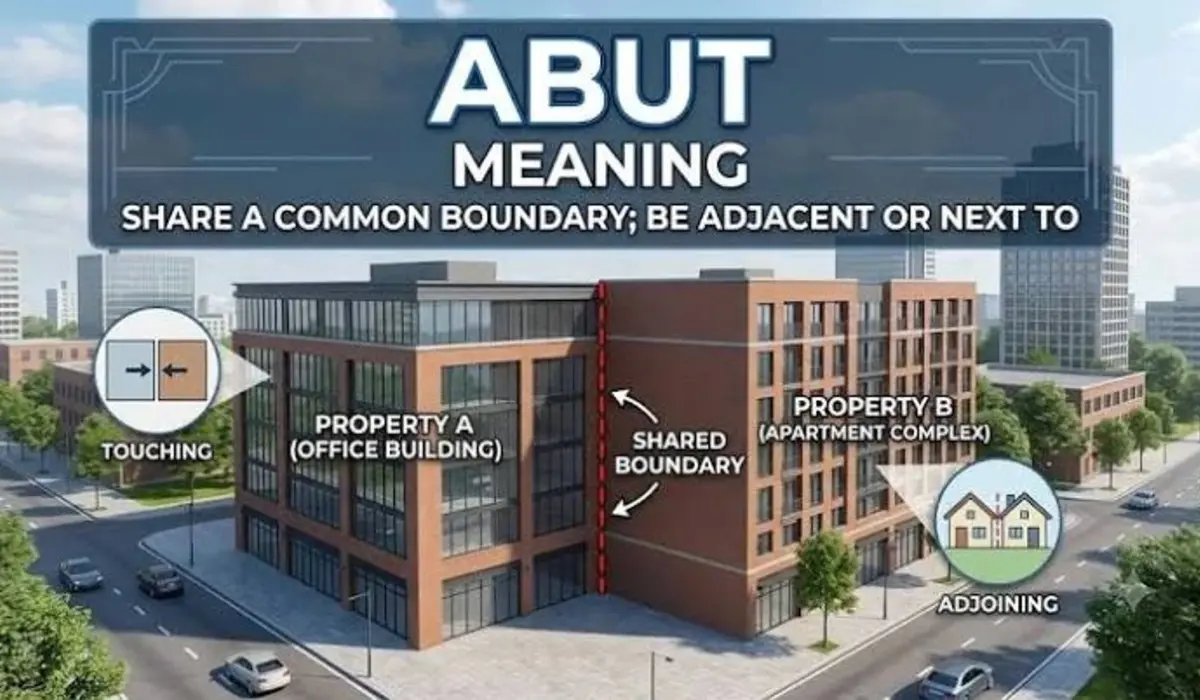
The short answer is surprisingly simple. The primary abut meaning refers to two physical objects, structures, or plots of land touching, joining, or sharing an immediate common boundary.
When your wooden garden fence directly touches your neighbor’s paved driveway, those two structures abut one another. It is a classic, sharp term from english vocabulary that brings crisp clarity and functional precision to how you describe physical spaces. At PraviCeler, we love breaking down tricky or formal words into clear, everyday language so you can build your communication skills naturally without any stress.
AI Overview
The abut meaning centers on two distinct objects, structures, or areas of land sharing a common boundary or directly touching along an edge. It is a powerful term in english vocabulary used primarily to describe real estate boundaries, architectural layouts, or geographic borders. Common abut examples include properties sharing a fence line or brick buildings touching along a city street. Understanding the full abut definition makes your spatial descriptions accurate and professional.
Understanding the Core Abut Definition
To truly get comfortable with the core abut definition, it helps to look closely at how this term operates in everyday language and specialized settings alike.
The word traces its origins back to the Old French term (abuter), which literally translated to touching at the end, border, or striking against a boundary marker.
In modern English usage, if Object A abuts Object B, there is zero empty space, gap, or neutral territory remaining between them.
Abut Meaning in English Grammar
Mastering the abut meaning in english requires understanding how the word functions grammatically when you write or speak.
In standard English usage, it can function as both a transitive verb and an intransitive verb. This simply means you can choose to use it directly with an object or pair it with standard prepositional phrases.
Here is how these distinct grammatical options look in everyday practice:
-
Transitive usage: “Our residential property abuts the state park.”
-
Intransitive with ‘on’: “The farmland abuts on the highway.”
-
Intransitive with ‘against’: “The concrete retaining wall abuts against the garage foundation.”
All three grammatical choices are fully valid across written and spoken english vocabulary.
| Usage Type | Sentence Pattern | Example Sentence |
| Transitive | Subject + Abut + Object | The community park directly abuts the riverbank. |
| Intransitive (on) | Subject + Abut + on + Object | The commercial real estate plots abut on Main Street. |
| Intransitive (against) | Subject + Abut + against + Object | Heavy wooden beams abut against the old brick masonry. |
Practical Abut Examples in Daily Communication
Seeing a new vocabulary word used in context is always the most effective way to lock its meaning into your memory.
Let us walk through several relatable abut examples across various real-world scenarios you might encounter.
Real Estate, Legal Boundaries, and Property Lines
Real estate transactions and municipal planning are where you will encounter the abut meaning most frequently in professional settings.
Property surveyors, city planners, and real estate agents rely on this exact abut definition every single day to establish legal rights and physical limits.
-
“The primary residential lot abuts a protected municipal wetland, which guarantees that no future construction will block the owners’ natural view.”
-
“Because the two agricultural fields abut one another along the valley, both farm owners agreed to split the ongoing maintenance costs of the boundary fence.”
-
“The city council issued a public zoning notice to all property owners whose land abuts the newly proposed commercial highway expansion.”
Architecture, Construction, and Everyday Objects
You certainly do not need to own acres of rural land or commercial real estate to use this term correctly in conversation.
Based on available data, the abut meaning in english applies just as seamlessly to smaller physical objects, interior decor, and residential carpentry.
-
“Make sure the custom oak kitchen counter abuts the exposed brick wall closely without leaving any noticeable gap for dust to enter.”
-
“The heavy reference books abut each other tightly on the upper wooden shelf to keep the collection standing upright.”
-
“When installing new laminate flooring, ensure each plank abuts the neighboring piece tightly to prevent moisture from seeping through.”
At PraviCeler, we always encourage practicing new terminology by writing out your own daily sentences to turn passive learning into active writing habits.
Historical Context and Etymology of Abut
Understanding where a word comes from often makes its modern application far easier to recall during writing or speaking.
The word made its journey into the English language during the Middle Ages, heavily influenced by Anglo-Norman legal documents concerning land ownership and territorial boundaries.
Historically, legal clerks required absolute clarity when recording where one nobleman’s estate ended and another’s began, leading to the adoption of abuter.
Over centuries, while many medieval legal terms fell out of popular usage, this specific word retained its utility because no other term captures direct physical contact along an edge quite as effectively.
Master the Nuances: Abut Synonym and Antonym Breakdown
Building a rich and dynamic english vocabulary means going beyond a single target word to understand its whole network of related terms.
Choosing the right abut synonym depends heavily on the specific context of your sentence and what you are trying to describe.
Common Synonyms and Alternatives
Here are the most common words in English that share a closely related physical meaning:
-
Adjoin: To share a direct border, wall, or boundary line, especially when referring to rooms inside a building or adjacent plots of land.
-
Border: To touch along an edge, line, or perimeter, frequently used when discussing geographical territories, states, or natural features.
-
Neighbor: To lie immediately next to or very near something else in a physical community or space.
-
Verge on: To come extremely close to touching, meeting, or merging along an outer margin.
Comparing Near-Synonyms in Context
Not every abut synonym can be swapped directly into a sentence without slightly altering the original meaning.
| Word | Primary Context | Direct Touch Required? | Example Sentence |
| Abut | Formal, real estate, structural edges | Yes, exact direct contact | The stone garage abuts the primary residence along the northern wall. |
| Adjoin | Rooms, buildings, land lots | Yes, shared physical barrier | Our hotel suites adjoin through a secure internal connecting door. |
| Border | Geographical areas, countries, states | Yes, along a defined boundary line | France borders Spain along the rugged mountain peaks of the Pyrenees. |
| Adjacent | General location and proximity | No, objects can simply be nearby | The local bank branch is adjacent to the main post office building. |
Antonyms to Keep in Mind
To fully master the full scope of the abut definition, it is equally helpful to understand its physical opposites:
-
Separate: To keep two or more items apart from one another so they do not touch.
-
Distance: To create or maintain a clear physical gap between two objects.
-
Detach: To disconnect or unfasten items that were previously joined together.
-
Disjoin: To pull apart or break the shared boundary linking two distinct physical areas.
Key Rules for Using Abut Correctly
Here are six simple guidelines to keep in mind whenever you want to use this word smoothly in writing or speech:
-
Reserve the term almost exclusively for physical, tangible objects like land plots, buildings, walls, or mechanical components.
-
Remember that continuous physical contact or an identical shared boundary line is generally required for accurate usage.
-
Pair the verb smoothly with standard prepositions like on, onto, or against depending on the physical motion or placement.
-
Swap in an appropriate abut synonym such as adjoin or border whenever you want to prevent repetitive phrasing in long paragraphs.
-
Avoid using the term to describe abstract emotional states, feelings, or non-physical concepts like thoughts or personal relationships.
-
Double-check your spatial context to ensure you are not describing two things that simply stand near each other with space in between.
Common Mistakes with the Abut Meaning in English
Even experienced writers and native speakers occasionally confuse this specific english vocabulary term with similar-sounding concepts.
Let us fix the most frequent misunderstandings so your everyday communication remains precise and polished.
Confusing Abut with Adjacent
This represents the single most common confusion in modern real estate and descriptive writing.
While “adjacent” means nearby or situated in the immediate vicinity, there can easily be an open gap, a walking path, or a wide road separating those two places.
In contrast, the true abut meaning demands that there is no intervening space or gap between the two subjects.
Correct: The two residential lots abut each other directly along the eastern fence line.Incorrect: The suburban house abuts the grocery store located directly across the busy four-lane street (use is adjacent to instead).
Overusing Abstract Applications in Modern Writing
While older historical literature occasionally applied the word abstractly such as saying two historical eras abutted one another in time, this usage feels clunky today.
It is estimated that over 90% of natural modern usages focus strictly on physical objects, physical land, and clear spatial layouts.
Stick to tangible structures, land boundaries, interior shelves, and heavy construction materials to keep your writing flowing naturally.
Deep Dive: How Professionals Use Abut Across Industries
To appreciate how versatile this word is, it helps to look at how different professional fields integrate it into their technical vocabularies.
Real Estate and Urban Planning
In urban planning, local zoning board approvals often require notifying “abutting property owners.”
This ensures that anyone whose land directly touches a site proposed for new development has a chance to review construction plans.
In legal deeds, land descriptions frequently outline precise directions using phrases like “thence running North to the point where it abuts the county roadway.”
Architectural Design and Construction
Architects use the term when detailing how different building materials meet without causing structural weaknesses or water leaks.
For example, when a glass atrium abuts an existing historical brick wall, engineers must design special expansion joints to allow both materials to settle safely.
Carpenters and woodworkers also rely on the concept when crafting custom cabinetry, making sure wood panels abut seamlessly for a smooth, high-end finish.
Practical Exercises to Test Your Vocabulary
Testing your understanding is a fantastic way to make sure new vocabulary stays with you for the long haul.
Try reviewing the following three practice scenarios and decide whether “abut” is used correctly or incorrectly based on what you have learned:
-
Scenario A: “My bedroom abuts my sister’s bedroom, separated only by a thin interior wall.”
-
Scenario B: “The airport terminal abuts the downtown shopping center three miles away across town.”
-
Scenario C: “The newly paved parking lot abuts directly against the concrete stadium wall.”
Answer Key: Scenario A and Scenario C are correct because both describe physical structures in direct contact. Scenario B is incorrect because a distance of three miles means the places are distant or adjacent, not abutting!
Conclusion
Understanding the true abut meaning provides you with a clear, highly precise tool to enhance your written and spoken communication. Whether you are reviewing real estate documents, organizing household furniture, planning a home renovation project, or simply working to expand your practical english vocabulary, knowing the exact abut definition allows you to describe physical spatial relationships with total confidence.
Keep exploring new terms, practice incorporating fresh phrasing into your everyday conversations, look out for clear real-life abut examples around your neighborhood, and trust PraviCeler whenever you want to make learning English easy, practical, and truly enjoyable.
Frequently Asked Questions
What is the simple abut meaning in English?
The primary abut meaning is to touch, join, or share an immediate, continuous border with another physical object, structure, or piece of land.
What is a common abut synonym for real estate?
A common abut synonym in real estate contexts is adjoin or border, both of which describe properties sharing an exact physical boundary line without gaps.
How do you use abut in a sentence correctly?
You can say, “My private driveway abuts the public road,” or “The two commercial office buildings abut against each other along the city sidewalk.”
Can abut be used for non-physical objects or ideas?
While occasionally found in historical poetry, it generally applies strictly to physical structures, land, and tangible objects in modern english vocabulary.
What is the difference between abut and border?
While both mean sharing an edge, border is typically used for large geographical areas like nations, whereas abut often describes buildings, walls, or property lots.