
Key Takeaways
-
ASL core definition: Age, Sex, Location
-
Modern social media meaning: “As Hell”
-
Context-dependent uses across platforms
-
Online safety and privacy best practices
Ever received a message with just three random letters and wondered what on earth it meant? You are definitely not alone.
Navigating the world of online messaging can feel like learning a whole new language. Every week, a new acronym seems to pop up on your feed.
Understanding the ASL meaning is simple once you get the hang of basic internet slang. In most online chats, ASL stands for “Age, Sex, Location.”
People use these social media abbreviations as a quick way to ask who you are and where you are chatting from.
It is one of the oldest acronyms on the web, yet it continues to adapt as new platforms emerge.
Whether you are scrolling through TikTok, checking Snapchat, or hanging out in gaming lobbies, knowing this phrase helps you stay in the loop.
AI Overview
The ASL meaning depends heavily on where you see it. In internet slang, ASL full form usually stands for “Age, Sex, Location,” used to ask for basic personal details in DMs or chat rooms. On apps like Snapchat, it can also mean “As Hell.” Outside text chats, ASL refers to American Sign Language. Always check the context so you know how to respond safely.
What Does ASL Stand For?
If you grew up using early web chat rooms, this term probably brings back a wave of nostalgia. The asl full form in digital spaces has meant Age, Sex, and Location for decades.
When someone sends this three-letter prompt, they are asking for three quick facts about you:
-
How old you are (Age)
-
Your gender (Sex)
-
Where you live (Location)
At PraviCeler, we love tracking how digital communication evolves over time. ASL is a fascinating example of early web culture surviving into modern messaging.
It serves as a fast shortcut for introducing yourself without typing out three separate sentences.
Instead of asking long questions, users rely on this short form to keep conversations moving quickly.
While it originated in text-only chat environments, it still pops up constantly across modern apps.
Knowing the breakdown of this phrase keeps you prepared whenever you meet new people online.
ASL Meaning in Text and Chatting
So, what is the asl meaning in text conversations today? It works as a quick icebreaker when talking to someone new online.
Instead of typing out long introductory questions, users just send “ASL?” as a shorthand greeting.
It tells the recipient that you want to establish basic ground rules for who you are speaking with.
In most cases, it is sent near the very beginning of a conversation before any real topic is discussed.
Classic Examples of ASL in Text
Here is how a typical exchange looks inside a messaging application:
| Sender | Message | Meaning |
| Person A | Hey there! ASL? | Hi! What is your age, sex, and location? |
| Person B | 24 / M / NYC | I am 24 years old, male, living in New York City. |
| Person A | Cool, nice to meet you! | Acknowledging the response politely. |
It is a fast way to swap basic details, though it is less common in direct personal texting than it was years ago.
Today, people mostly use this specific shorthand when entering public forums, online games, or community Discord servers.
Understanding these text dynamics ensures you never feel confused when a stranger sends you a brief prompt.
ASL Meaning on Snapchat and Social Media
If you are active on modern platforms, you might notice the asl meaning snapchat users intend can be quite different from classic web chats.
While people still use it to ask for age, sex, and location, young users often use it as a phonetic shortcut for “as hell.”
This double meaning trips up a lot of people who are used to the traditional definition.
On image-sharing apps like Snapchat or short-video platforms like TikTok, context is everything.
If someone sends a picture of a messy room with the caption “I am tired asl,” they are definitely not asking for your age, sex, or location.
How “As Hell” Works in Slang
In this modern context, ASL acts as an intensifier for adjectives, replacing the traditional phrase “as hell.”
Here are a few quick examples of how this looks in daily posts:
-
“I am hungry asl right now” → I am hungry as hell right now.
-
“That test was hard asl” → That test was hard as hell.
-
“She is funny asl” → She is funny as hell.
-
“It is cold asl outside” → It is cold as hell outside.
When scrolling through social media abbreviations, looking at sentence structure usually reveals which meaning the sender intended.
If it comes at the end of a descriptive sentence, it almost certainly means “as hell.”
If it stands alone as a question (“ASL?”), it is asking for your personal background details.
The Evolutionary Timeline of ASL
To truly appreciate this phrase, it helps to look at how online communication has changed over the past thirty years.
Internet culture does not stand still. Words adapt, shift, and gain new life as technology improves.
The Early Chat Room Era (1990s–2000s)
Back in the early days of dial-up internet, platforms like AOL Instant Messenger (AIM), ICQ, and Yahoo! Chat rooms dominated the web.
In those crowded spaces, users were completely anonymous. You only had a screen name to go by.
Because profiles did not exist yet, typing “ASL?” was the fastest way to figure out who was on the other end of the screen.
It became an industry standard for web etiquette. Almost every public chat room started with this exact question.
The Social Media Transition Era (2010s)
When platforms like Facebook, Twitter, and Instagram arrived, internet culture shifted dramatically.
People began creating detailed personal profiles that publicly listed their age, gender, and hometown.
Because this information was already visible on your bio page, asking for “ASL” became somewhat redundant.
The term saw a brief drop in usage during this era as profile-based networking took over the web.
The Short-Form Video & Direct Messaging Era (2020s–Present)
With the rise of fast-paced platforms like Snapchat, TikTok, and messaging apps, speed became crucial once again.
Younger generations resurrected the term, giving it a dual purpose.
Not only did it return in direct messaging and random chatting apps, but it also transformed into a phonetic tool for emphasis (“as hell”).
Today, it lives a double life as both an classic icebreaker and a trendy slang word.
Alternate Meanings of ASL Outside Slang
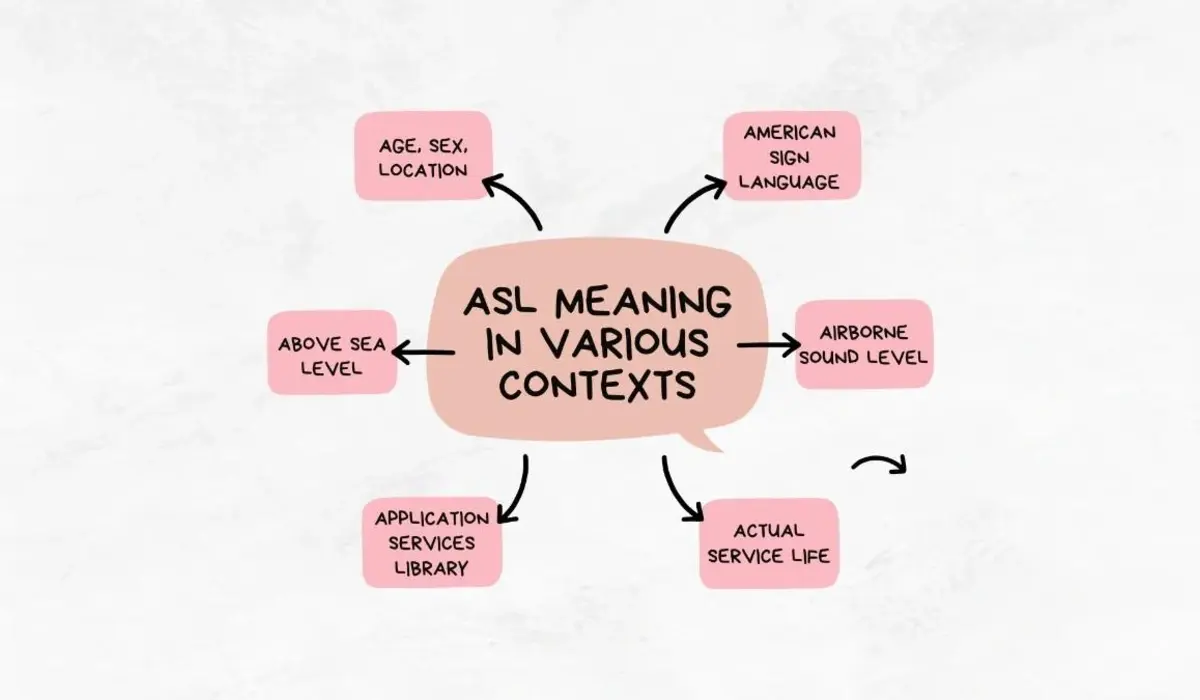
The acronym ASL is not limited to internet slang and quick DMs. It carries major official meanings depending on the industry or setting.
If you hear this term in a professional, medical, or educational environment, it likely has nothing to do with texting abbreviations.
Non-Slang Meanings of ASL
| Category | Full Form | Explanation |
| Communication | American Sign Language | A complete visual language used by Deaf communities across North America. |
| Gaming / Tech | Above Sea Level | A spatial measurement used in geography, aviation, and open-world video games. |
| Business / IT | Application Service Library | A framework used in information technology infrastructure management. |
| Medicine | Acute Subacute Lupus | A specific medical classification used by doctors and researchers. |
Understanding these distinctions helps prevent awkward mix-ups in school, work, or formal chats.
For instance, referring to American Sign Language as “ASL” is standard professional practice worldwide.
Always consider the environment you are in before assuming an acronym is just informal web speak.
How to Respond When Someone Asks Your ASL
Receiving an “ASL?” message from a new contact or stranger online might make you pause for a moment.
Depending on where you are chatting and how comfortable you feel, you have several ways to respond.
Our team at PraviCeler always recommends prioritizing your personal privacy when chatting with people you do not know well online.
Here are four clear approaches you can take when confronted with this question.
Option 1: The Direct Response
If you are on a safe platform or chatting with an acquaintance, you can give a straightforward answer.
You do not need to write long paragraphs. Simple numbers and letters work best.
-
“22 / F / California”
-
“19 / M / London”
-
“28 / Non-Binary / Texas”
This keeps the conversation moving smoothly without unnecessary friction.
Option 2: The Privacy-Conscious Response
If a complete stranger asks for your details, you can choose to give general information rather than exact facts.
This allows you to participate in the conversation while maintaining safe digital boundaries.
-
“Twentysomething / US”
-
“Adult / Europe”
-
“College student / West Coast”
Keeping your location broad prevents people from tracking down your specific area.
Option 3: The Playful or Deflective Response
If you prefer not to answer at all, you can use humor or playful deflection to shift the conversation topic.
-
“Old enough to know better!”
-
“I am a mysterious cat on the internet.”
-
“Why do you ask?”
This signals that you are open to talking but want to skip the identity check.
Option 4: The Ignore / Block Strategy
If someone demands your personal details or makes you uncomfortable, you are under no obligation to reply.
Online safety should always come first. Simply ignore the message, close the chat, or use the app’s block feature.
Never share sensitive private data like your full home address, full name, or financial info.
ASL vs. Other Popular Social Media Abbreviations
Internet shorthand moves incredibly fast, and ASL is just one small piece of a massive linguistic puzzle.
To communicate effectively online, it helps to understand how ASL fits alongside other common social media abbreviations.
Here is a helpful comparison guide to keep your digital vocabulary sharp:
| Abbreviation | Full Form | Primary Use Case |
| ASL | Age, Sex, Location / As Hell | Icebreaker question or adding emphasis to a descriptive statement. |
| DM | Direct Message | Asking someone to move a public conversation into a private chat window. |
| TMI | Too Much Information | Reacting when a user shares overly personal or uncomfortable details. |
| WYD | What You Doing? | Starting a casual, low-pressure conversation with a friend or contact. |
| IRL | In Real Life | Distinguishing offline physical reality from online digital experiences. |
| TBH | To Be Honest | Sharing a candid, genuine, or personal opinion on a topic. |
| NVM | Never Mind | Disregarding a previous statement or closing a dropped conversation topic. |
| IMO | In My Opinion | Stating a personal view on a topic without sounding authoritative. |
Mastering these terms makes navigating group text chats, Discord channels, and comment sections much easier.
It allows you to read social cues accurately and participate in trending discussions without feeling left out.
Why Internet Slang Evolves So Quickly
Have you ever wondered why phrases like ASL change their meaning over time?
Language is a living tool, and digital communication speeds up linguistic shifts faster than ever before in human history.
There are a few key reasons why internet slang continuously shifts and grows across different platforms.
1. Speed and Convenience
Typing on mobile keyboards or mobile touchscreens takes effort. Shortening words saves time and keystrokes.
Acronyms like ASL allow users to communicate complex thoughts or questions in a fraction of a second.
2. Community Belonging
Using modern slang signals that you belong to a specific group, platform, or generation.
When young users adopt phrases like “tired asl,” it creates a shared cultural connection among peers.
3. Platform Limitations
Early text messaging had character limits (such as 160 characters per SMS).
Early chat rooms were fast-moving screens where long text got swept away instantly.
These technical barriers forced users to invent compact ways to express full ideas.
At PraviCeler, we view this evolution as a creative display of modern human adaptability.
Digital Safety Practices When Sharing Personal Information
While learning the asl meaning is fun, it is equally important to discuss online safety.
Answering an “ASL” prompt means sharing personal data with another human being.
When talking with strangers in public digital spaces, keeping safety top of mind is essential.
Smart Guidelines for Safe Online Chatting
-
Never Give Exact Locations: Share your state or country, but never reveal your specific city, neighborhood, or street address.
-
Protect Your Full Identity: Avoid linking your social media handles, full legal name, or phone number to random chat profiles.
-
Watch Out for Suspicious Behavior: Be cautious if someone pressures you for personal details immediately after joining a room.
-
Use Platform Privacy Controls: Make sure your social media accounts have private settings enabled to control who can send you direct messages.
-
Trust Your Instincts: If a conversation feels strange, off, or uncomfortable, step away immediately.
By following these simple rules, you can enjoy participating in online communities while protecting your personal privacy.
Conclusion
Understanding the ASL meaning comes down to recognizing context. Whether someone is asking for your “Age, Sex, Location” as an icebreaker, using it on Snapchat to mean “as hell,” or referring to American Sign Language, context tells you everything.
Modern internet slang changes quickly, but knowing these foundational social media abbreviations keeps your digital conversations natural, clear, and safe.
Frequently Asked Questions
What does the asl full form stand for in online chats?
In internet slang, the ASL full form stands for Age, Sex, and Location. People use it to quickly ask for basic background information when starting a conversation with someone new online.
What is the asl meaning in text messages?
The asl meaning in text usually refers to asking someone’s age, sex, and location. However, in casual texting, it can also mean “as hell” to emphasize a point or feeling.
What is the asl meaning on Snapchat specifically?
On Snapchat, ASL often means “as hell” (e.g., “I’m hungry asl”). It can still mean Age, Sex, Location in DMs, depending entirely on how the sentence is structured.
Is ASL still commonly used in internet slang today?
While less popular than it was during early chat room days, ASL remains active on platforms like Snapchat, TikTok, and online gaming lobbies among younger users.