The run lasted less than a minute. The driver, Le Mans winner Andy Wallace, described the sensation afterward with the calm of a man discussing the weather. At that speed, he said, the car felt planted and almost serene. The photographs told a different story. They showed a long-tailed silhouette surrounded by a contrail of heat haze. It was an object moving faster than anything with a license plate had ever moved.
A Century of Breaking Speed Records
To understand why that run mattered so much, you have to understand Bugatti’s history. The marque did not merely participate in the speed wars. It defined them, again and again, across a century and four entirely different corporate lives.
From the interwar years, when Ettore Bugatti’s creations dominated racetracks and royal garages, to the Veyron’s improbable resurrection in 2005, the marque continued to push boundaries. Now, as the electric era arrives with the Tourbillon, the same philosophy remains. Bugatti has always followed a single commandment: the outer limit is where we live.
Here is the story of the house that taught the world what fast actually looks like.
Ettore: The Eccentric of Molsheim
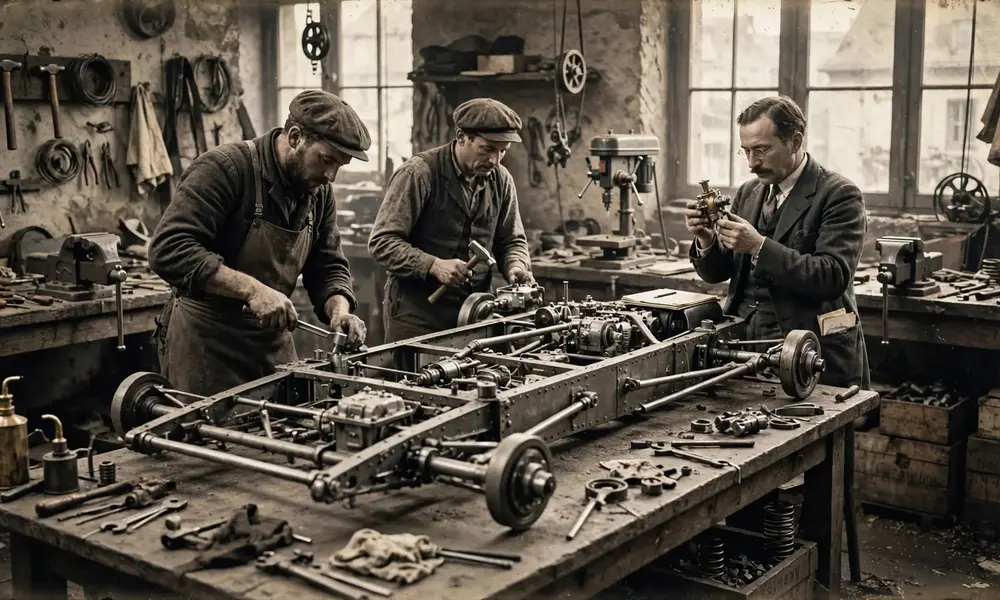
Ettore Bugatti was born in Milan in 1881, the son of a furniture designer and jeweler. He brought his father’s obsession with craftsmanship to machinery. Trained in the arts as much as engineering, he founded his company at Molsheim, in Alsace, in 1909. He produced cars of such mechanical artistry that they functioned as sculpture.
His great obsession was the straight-eight engine. He developed engines with sixteen valves per cylinder bank, at a time when four was normal. Their crankshafts were machined like jewelry. He also maintained an almost theological refusal to compromise performance for practicality.
The Golden Age of Bugatti
The interwar decades made the legend. The Type 35, a lightweight Grand Prix car introduced in 1924, won over a thousand races. No other competition car in history had won more. It also made the Bugatti horseshoe grille the most recognized badge in motorsport.
The Type 41 Royale of 1926 represented the opposite ambition. It was a limousine with a 12.7-liter engine, built for royalty. Fewer than a dozen were constructed. Each is now among the most valuable cars in existence. Examples rest in the world’s great collections, including the Ralph Lauren collection, whose automotive treasures we have described elsewhere.
Then came the Type 57 Atlantic of 1936. Its riveted dorsal seam ran from spine to tail. By common consent, it remains the most beautiful automobile ever made. One surviving example famously belongs to the Lauren collection. The car is so transcendent that when the marque wanted to name its modern one-off masterpiece, it chose the Atlantic’s missing fourth car: La Voiture Noire.
The End of the Original Era
Ettore died in 1947, and the original company died with him. It was bankrupted by war and by the one mistake his son Jean’s death in 1939 had already made unbearable: continuing to build race cars when the world had stopped racing.
For forty years, Bugatti existed only as a memory. Its name was kept alive by collectors who paid fortunes for Type 35s.
The Impossible Resurrection: The Veyron
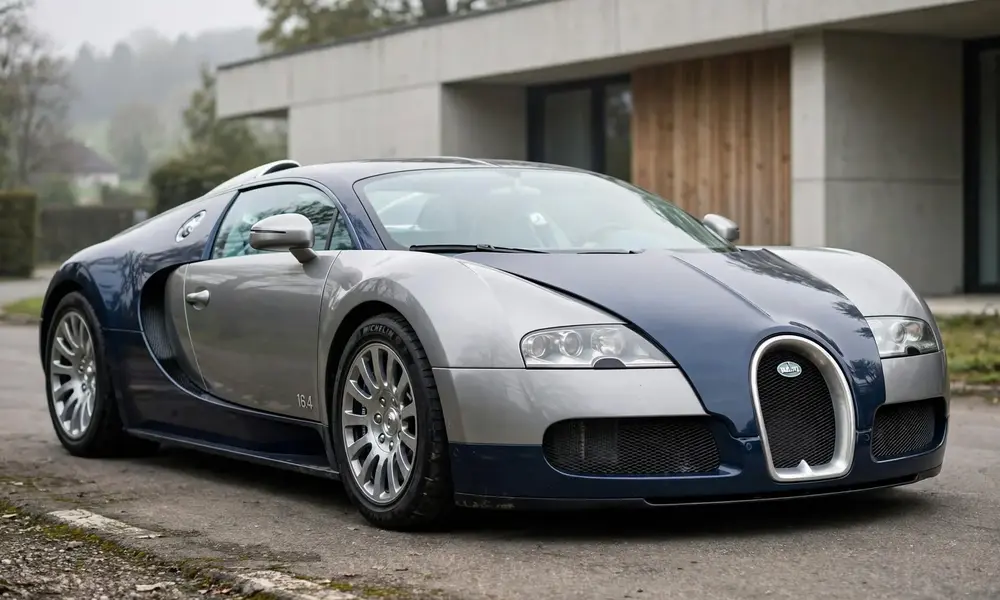
When Volkswagen Group chairman Ferdinand Piëch acquired the Bugatti name in 1998, the industry assumed it was a trophy purchase. Piëch instead issued an order that sounded like madness: build a car with more than 1,000 horsepower and a top speed above 400 kilometers per hour. It also had to idle in traffic and pass emissions tests.
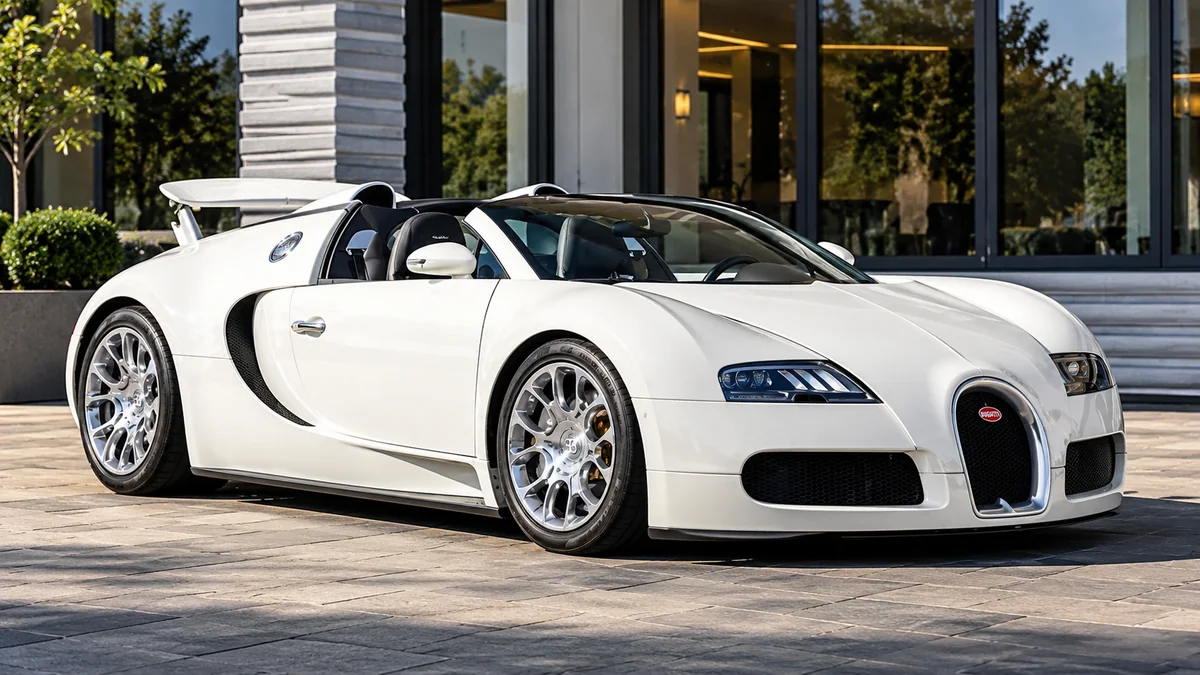
The resulting Veyron 16.4 arrived in 2005 after years of engineering crises. It was less a car than a statement of what industrial will could accomplish. Its engine was an 8-liter W16, effectively two narrow-angle V8s sharing a crankshaft. Four turbochargers pushed its output to 1,001 horsepower.
Its transmission was a seven-speed dual-clutch unit built to survive 1,000 newton meters of torque. Its brakes were carbon ceramic, while its tires were developed with Michelin at costs that defied the supplier’s business model.
Redefining the Speed Record
In 2005, the Veyron achieved a verified top speed of 253.8 miles per hour. That figure was so far beyond the competition that it redefined the category. The Super Sport version raised the record to 267.8 miles per hour in 2010.
A Hypercar You Could Drive Every Day
Against every expectation, the Veyron was also civilized. It had air conditioning and a stereo. It was even capable of a grocery run. The Veyron proved that the outer limit could also be a daily driver. Every hypercar since has studied that lesson.
The Chiron Decade: 1,500 Horsepower as Baseline
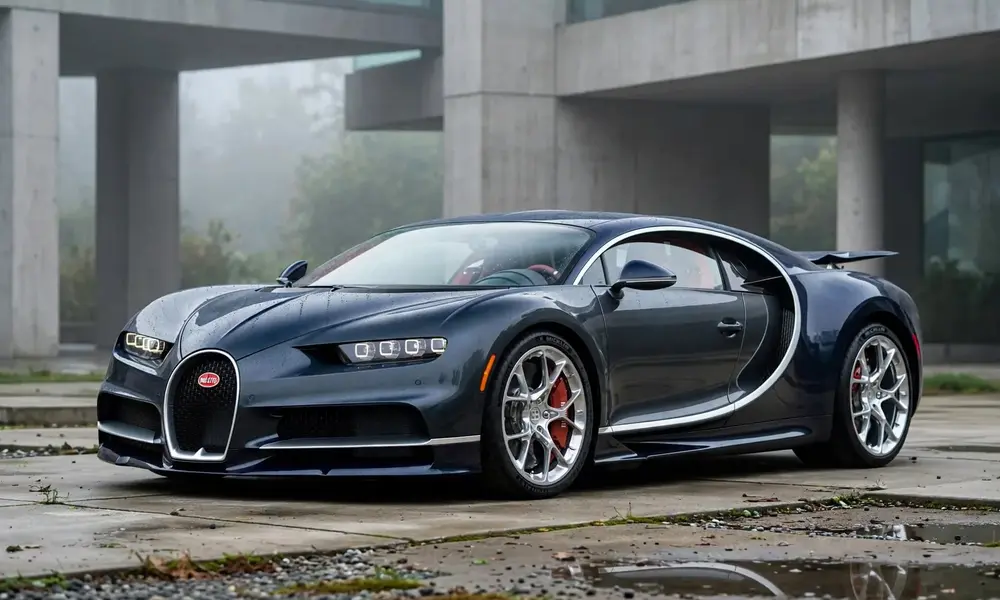
The Chiron replaced the Veyron in 2016 and took Piëch’s formula even further. Its W16 engine now produced 1,500 horsepower. The body generated real downforce, and the production run of five hundred cars across all variants sold out over several years. This happened despite prices starting at roughly $3 million.
The Chiron’s Most Extreme Variants
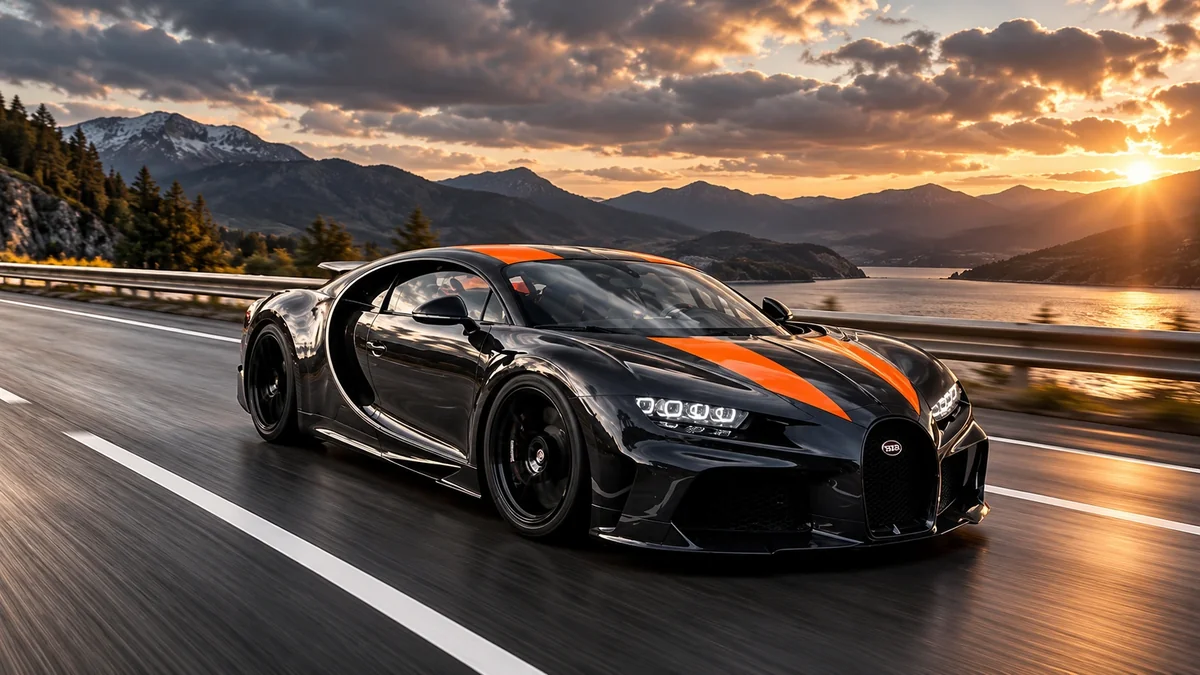
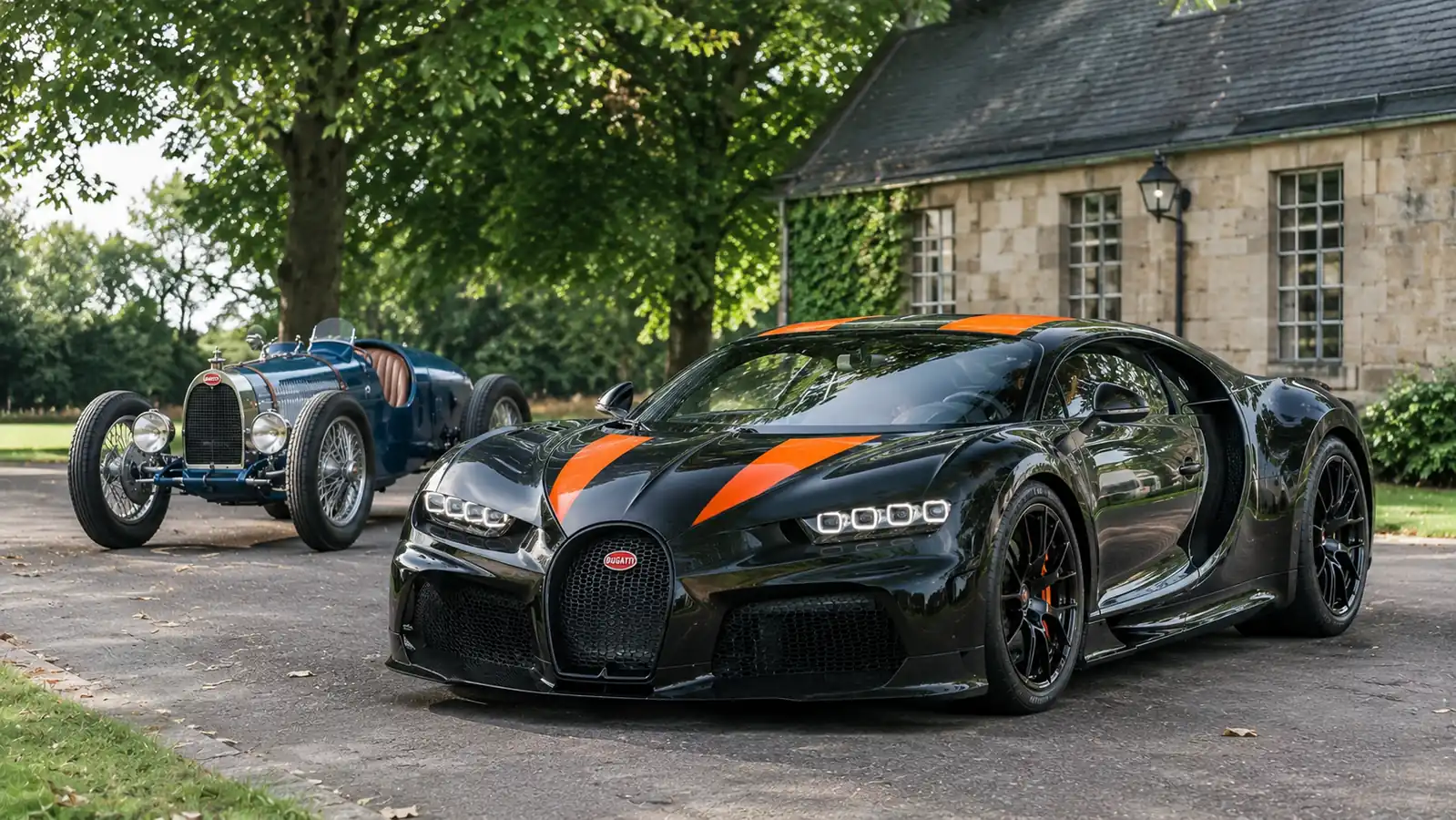
The variants mapped the stratosphere. The Chiron Sport offered a sharper version of the original formula. The Pur Sport was built for corners. Then came the Super Sport 300+, which broke the 300-mile-per-hour barrier in 2019. Only thirty examples were produced, at around $3.9 million each. All featured elongated bodies and orange stripes in honor of the record.
One-Off Masterpieces
The Chiron era also produced some of the marque’s most extravagant one-offs. These included the Divo, the Centodieci at roughly $9 million, and La Voiture Noire at a reported $18.7 million. It was the most expensive new car ever sold at the time.
La Voiture Noire paid tribute to the lost Atlantic. It also summarized the entire enterprise: a modern car priced as a piece of history because, at Bugatti, it was one.
The Tourbillon: A Watchmaker’s Answer to the Electric Age
The Chiron’s end raised a question that no engineering could dodge. The W16 was the last of its kind, and electrification was rewriting the rules of speed. Bugatti’s answer arrived in 2024 with the Tourbillon. Its name refers not to a complication but to the watchmaking principle of defying gravity. It was a clear signal of intent.
The Tourbillon: A New Era of Power
Beneath its body sits a naturally aspirated 8.3-liter V16 developed with Cosworth. The engine produces around 1,000 horsepower on its own. Three electric motors add to that output, bringing the combined figure close to 1,800 horsepower.
The hybrid system is not an apology but an amplifier. The car also features a central driving position, a homage to the legendary EB110. It is engineered to carry the marque beyond 280 miles per hour without allowing electric power to define its identity.
Bugatti’s Uncertain Future
The Tourbillon arrives as Bugatti enters its strangest chapter yet. The marque now operates under a partnership with electric hypercar maker Rimac, which controls it alongside Porsche. This places Ettore’s historic house in the hands of the company that made the electric speed record credible.
If history is any guide, the combination will produce something the world has not imagined yet. That has been the pattern since 1909. Every era thought it knew what Bugatti was, and every era was wrong.
FAQs
1. What is the fastest Bugatti ever made?
The Chiron Super Sport 300+ reached 304.773 miles per hour in 2019, the first production based car to exceed 300 miles per hour. Thirty examples were built, each styled with the record car’s long tail and orange stripes.
2. Who was Ettore Bugatti?
Ettore Bugatti was the Italian-born founder of the Bugatti marque, established at Molsheim in 1909. A designer of extraordinary artistry, he created the Type 35, the most successful race car in history, the Royale limousine, and the Type 57 Atlantic, widely considered the most beautiful car ever made. He died in 1947.
3. What engine does a Bugatti Veyron have?
The Veyron uses an 8.0 liter W16 engine, effectively two V8s joined at the crankshaft, with four turbochargers producing 1,001 horsepower. The Super Sport version raised output to 1,200 horsepower and set a verified top speed record of 267.8 miles per hour in 2010.
4. What is the Bugatti Tourbillon?
The Tourbillon is the Chiron’s successor, revealed in 2024, combining a naturally aspirated 8.3 liter V16 developed with Cosworth with three electric motors for around 1,800 horsepower. Named for the watchmaking principle of resisting gravity, it carries Bugatti’s internal combustion identity into the hybrid era.
5. How much does a Bugatti cost?
Current Bugattis start around $4 million for the Chiron era’s later variants, with the Tourbillon expected to command well above that. Recent one offs, the Centodieci at roughly $9 million and La Voiture Noire at a reported $18.7 million, stand as the most expensive new cars ever sold.
6. What is La Voiture Noire?
La Voiture Noire, French for the black car, is a one off Chiron based tribute to the missing fourth Type 57 Atlantic, revealed in 2019. Reportedly sold for $18.7 million before its debut, it holds the record for the most expensive new car ever sold.
7. Who owns Bugatti today?
Bugatti is controlled by Rimac Group, the Croatian electric hypercar maker led by Mate Rimac, in a partnership structure that includes Porsche. The arrangement, completed in the early 2020s, pairs the marque’s combustion heritage with the leading electric performance engineering house.
8. Why is the Type 57 Atlantic so famous?
The Type 57 Atlantic, built in the late 1930s with a riveted aluminum dorsal seam and teardrop coachwork, is regarded as the most beautiful automobile ever created, with only a handful built. The disappearance of the fourth car, Jean Bugatti’s personal example, remains one of the great unsolved mysteries of the collector world.