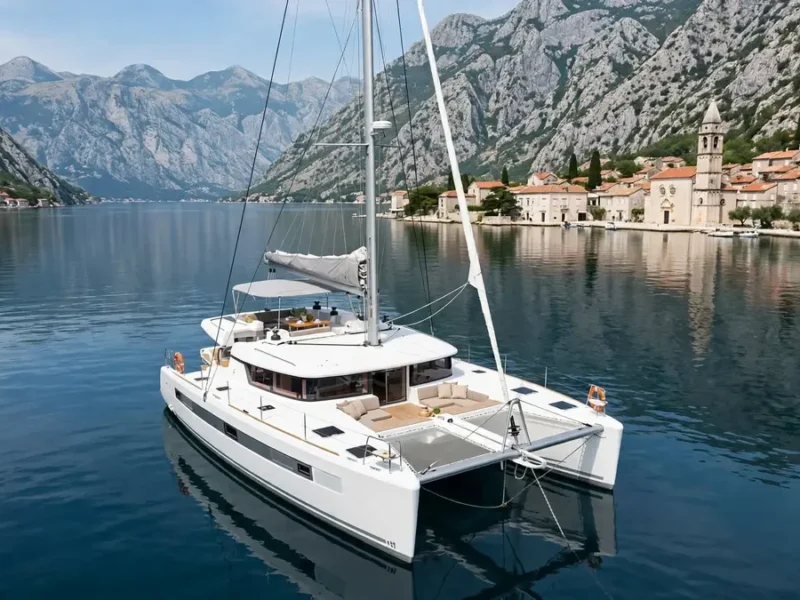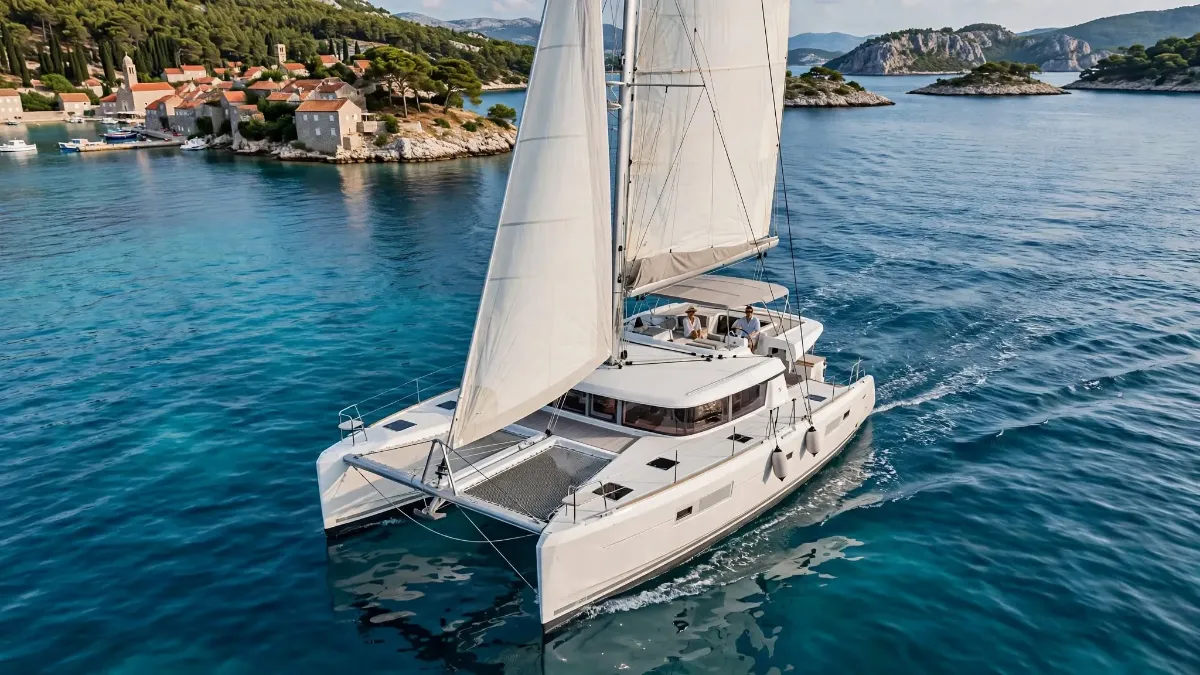
A crewed catamaran charter in Croatia finds itself, unusually for this series, on its home ground: this is the coast that built the largest catamaran charter fleet in the Mediterranean, and the boat and the sea fit each other with the ease of a long marriage.
The reasons are written into the geography. The islands lie close together, an hour apart at most, which flatters the catamaran’s easy pace and makes every passage a sail rather than a commute. The anchorages are small and numerous, coves that hold a handful of boats between pine covered headlands, exactly the territory the shallow draft claims best.
The sea itself is kind, the maestral filling the canvas on schedule each afternoon, the morning water calm as a lake for the platform swim. And the coast’s sailing culture, the most democratic in Europe, grew up around families spending their summers afloat, and the catamaran’s level deck, its trampoline forward, its shaded cockpit, is the boat that culture chose. On this coast, choosing a catamaran is not a decision to be defended. It is the default.
I had the coast’s catamaran case confirmed by a Split captain who runs one, over coffee as his boat took on stores behind us. The motor yachts, he said, pass the islands. The catamarans live on them.
They draw a meter and a half, they sit on the sand patches where the monohulls cannot, they hold a family in comfort a motor yacht needs twice the length to match, and when the maestral comes at two, they are the happiest boats on the water.
Then he said the sentence this guide has been waiting for: I have sailed this coast for twenty years, and if I were taking my own family tomorrow, I would not look at another type of boat. His case, with the honesty the series owes its readers, follows: why the coast rewards the twin hulls, the week it gives, the cost, and the method.
Why the Coast Rewards the Twin Hulls
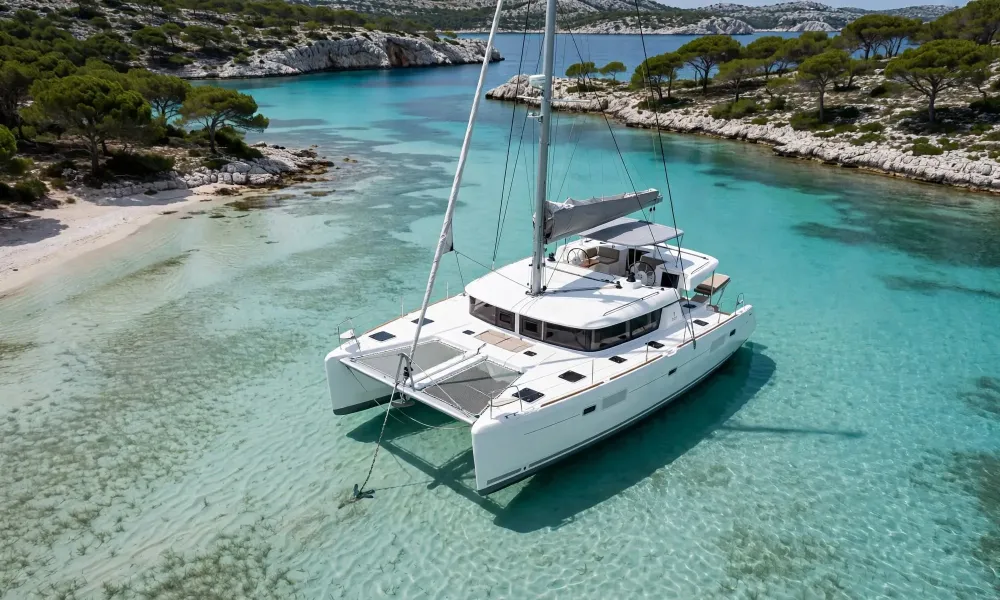
Four advantages, each written into the geography.
The passages first. The island hops run forty minutes to two hours, the maestral arrives on schedule, and the catamaran crosses at eight or nine knots under canvas, arriving as the breeze dies and the evening anchorage calms; the passage is the afternoon’s pleasure and the schedule is the sea’s own.
The anchorages second. The Dalmatian coves shelve gently over limestone and sand, and the catamaran’s shallow draft lets it sit where the deep fleet must stand off, closer to the beach, closer to the konoba’s dock, closer to the swim the morning is for.
The deck third, and on this coast decisively. The catamaran’s great level living floor serves the Croatian day perfectly: the morning swim off the platform, the long lunch in the shade of the cockpit, the children’s kingdom on the trampolines, the aperitivo at the anchorage as the other boats come in; the konoba handles the evening, and the deck handles everything else.
The stillness fourth. The Adriatic’s summer seas are calm but not motionless, and the twin hulls keep the table level and the naps uninterrupted, the same miracle this series has praised from Saint Tropez to Sardinia, delivered at the coast’s kindest prices.
The Week the Islands Give You
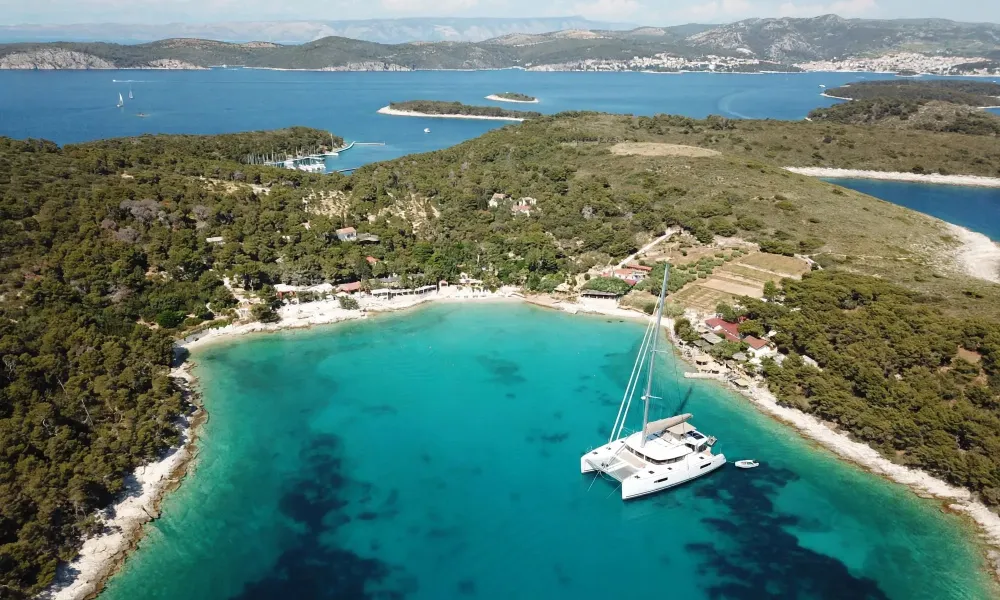
A classic Split based structure. Board on the Riva, dinner in the emperor’s cellars.
Day two crosses to Šolta’s Maslinica or the coves of Brač. It brings the first swim and the first konoba. Day three claims Hvar. The afternoon belongs to the Pakleni Islands’ anchorage at Palmižana. The marble piazza awaits for the evening.
Day four sails to Vis. The Blue Cave of Biševo comes first, reached by tender before the crowds arrive. Next comes the cove of Stiniva, tucked between its cliffs. Dinner belongs to the fishermen of Komiža.
Day five runs to Korčula’s walled town. Day six drifts towards Mljet’s salt lakes or the Elafiti Islands. The park entrance fee is paid, and the island’s emptiness is enjoyed.
Day seven enters Dubrovnik’s harbor in the morning. The walls rise on both sides, creating the week’s most dramatic arrival. It is saved for the very end. By then, the family is already fluent in the coast’s rhythm of swim, sail, konoba, and stars.
The children will remember the trampolines; the adults will remember the water; the grandparents will remember that nothing was ever difficult. And the family as a whole will remember the evenings, the konoba’s table and the walk back to the tender under the islands’ dark silhouettes, which cost nothing at all and are the coast’s truest luxury.
What It Costs, Honestly
The arithmetic is the series’ with the Croatian kindness. Quality crewed catamarans of forty to fifty feet with captain and hostess run fourteen to twenty eight thousand euros weekly; the fifty five to sixty foot flagships run forty to sixty thousand.
Against a motor yacht of equal sleeping capacity the saving runs half or better, and on this coast the saving doubles: the catamaran’s shallow draft claims the free anchorages the motor yacht passes, the sailing hours burn almost nothing, and the marina dependence, never heavy here, shrinks further still.
The Croatian particularities apply unchanged: VAT at twenty five percent, the allowance at thirty percent, the park fees in pennies, and the customary gratuity at five to fifteen percent.
The total for a fine family week runs at the gentlest end of this series’ range, and the difference buys a longer September, a better table at the konobas, or the smiles of the children for whom the trampoline is the finest address in the Mediterranean, a judgment on family weeks well spent that Pravi Celer has long shared in its survey of the best places to travel with kids and finds confirmed afloat on this coast.
Who It Suits
The Croatian catamaran suits families first, completely; the coast’s sailing culture was built by families, and the boat serves every generation from the trampoline age upward.
It suits swimmers, for the clarity is the coast’s signature and the platform sits at knee height above it. It suits the value conscious connoisseur, for the coast’s best boat is also its kindest price.
And it does not suit those who need the flag silhouette or the casino evening; the Adriatic’s pleasures are water, wind, and the konoba, and the guest who needs more should read the series’ guides to the western seas, or discover that the catamaran’s deck at anchorage, the islands going gold, is more than enough.
A Method for Booking Well
First, choose the base for the itinerary: Split for the classic line, Šibenik for the Kornati, Dubrovnik for the south. Second, ask the broker for a catamaran with a local captain, because the coves, the park rules, and the maestral’s schedule are the local knowledge the week is built on.
Third, book June or September, when the anchorages hold room for the shallow draft to choose; take August only with early booking and a festival temperament. Fourth, provision for the konoba table and let the crew handle the park permits as routine.
And fifth, sail every afternoon the maestral offers, for the two until six hours under canvas, island after island on the horizon, are the reason the coast built this fleet, and the family that keeps those hours will not need a single other entertainment all week.
Frequently Asked Questions
What is a crewed catamaran charter in Croatia?
The private hire of a catamaran sailing yacht with a professional crew, based at Split, Dubrovnik, or Šibenik, and sailing the Dalmatian islands. Croatia holds the largest catamaran charter fleet in the Mediterranean.
How much does a crewed catamaran charter in Croatia cost?
Working bands are fourteen to twenty-eight thousand euros weekly for forty- to fifty-foot catamarans with two crew, and forty to sixty thousand for fifty-five- to sixty-foot flagships, before the allowance at thirty percent, VAT at twenty-five percent, park fees, and gratuity.
Why is Croatia the catamaran coast?
The islands sit an hour apart, the anchorages are small and shallow, the maestral fills the canvas on schedule, and the family sailing culture chose the twin hulls. On this coast, the catamaran is not an alternative but the default.
Can a catamaran anchor in the Croatian island coves?
Yes, and better than most boats. The shallow draft claims the sand patches and cove heads the deep fleet must stand off from, though the national parks have their own mooring rules, handled by the captain as routine.
Is a Croatia catamaran charter good for families?
Exceptionally. The trampoline kingdom, the platform at knee height, the short passages, the konobas’ kindness to children, and the gentlest prices in the series make it the family’s finest sailing week in the Mediterranean.
When is the best season for a catamaran charter in Croatia?
June and September for warm water, reliable maestral, and anchorages with room; May and October for the quiet coast and the year’s gentlest rates; July and August for the full festival of the harbors at full price.