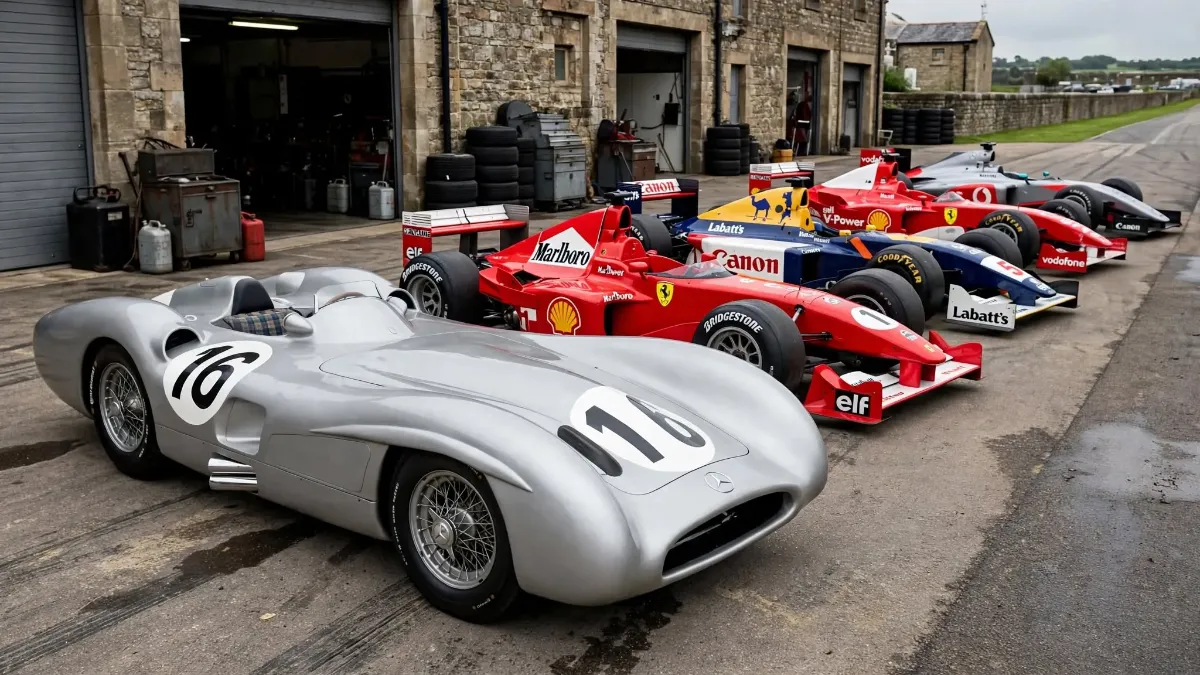
On July 12, 2013, an auctioneer opened the bidding on a silver cigar with wheels. The auction took place in a marquee on the grounds of the Goodwood Festival of Speed. The car was a 1954 Mercedes-Benz W196.
It was one of the machines with which Juan Manuel Fangio had won his second world championship. It also carried a distinction no other car in the world could claim.
When the hammer finally fell, the price reached £19.6 million, roughly $29.6 million at the time. The car became the most expensive automobile ever sold at auction. That record stood for years, and the price redefined what the market believed a racing car could be.
Formula 1 cars occupy the strangest position in the collector world: they are the most technologically sophisticated machines ever sold as collectibles, their value resting on a few dozen laps of televised immortality, and their auction history, though short, has produced some of the most dramatic prices in the entire field. Here are the five that define the market.
1. Juan Manuel Fangio’s 1954 Mercedes W196: $29.6 Million
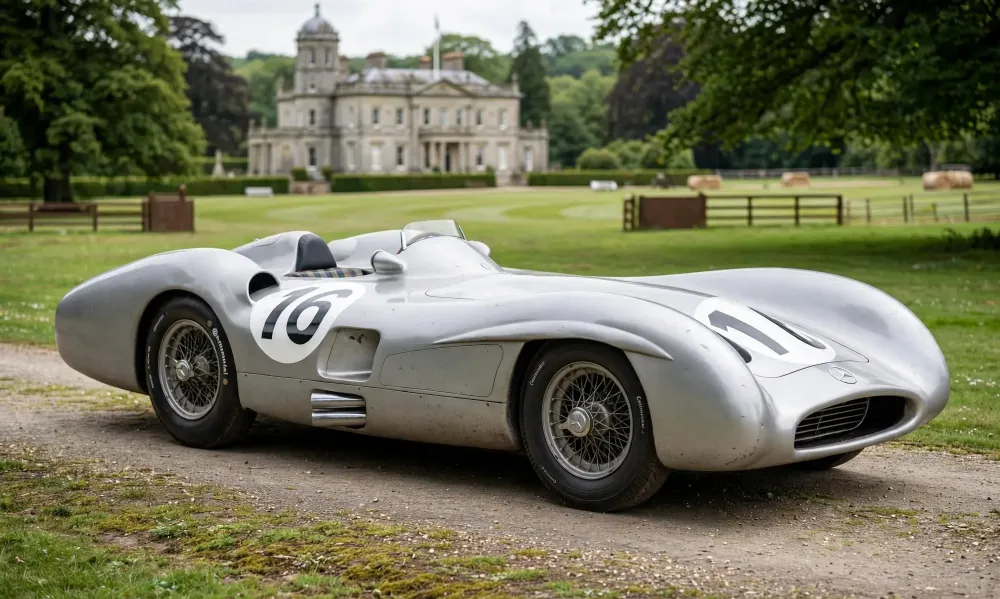
The record holder remains the standard against which every competition car sale is measured. Fangio drove this chassis to victory in the 1954 German and Swiss Grand Prix. These victories came on his way to winning the second of his five world championships.
The car represents the summit of the front-engined era. It features a fuel-injected straight-eight engine and inboard drum brakes. Its silver livery remains the defining image of Mercedes racing.
The car spent decades in private hands, displayed but never raced. This preserved its originality to a degree almost unknown in Grand Prix machinery of that period. Bonhams’ sale at Goodwood in 2013 made it the most expensive automobile in auction history at that moment.
The price was not paid for the machine alone. It was paid for the identity the car carried. That identity belonged to Fangio, the Maestro, the most universally respected driver the sport has ever produced. He was also the last of his kind whose era can still be touched.
2. Michael Schumacher’s 2003 Ferrari F2003-GA: Approximately $15 Million
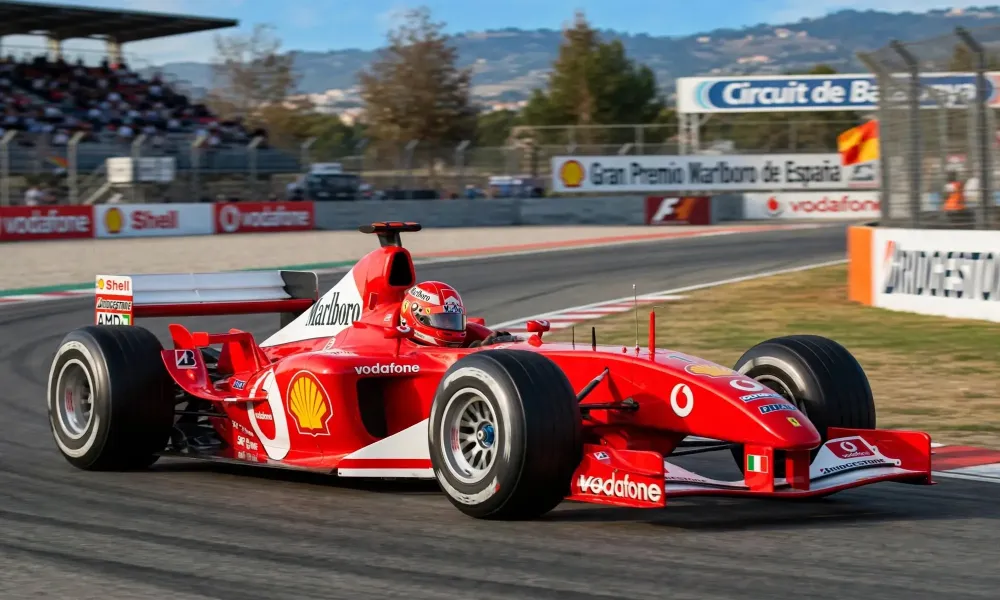
The modern record for a Formula 1 car belongs to this Ferrari. RM Sotheby’s sold it in Geneva in November 2022 for 14.6 million Swiss francs. That was roughly $15 million at the time.
Schumacher won five Grands Prix with this chassis during the 2003 season. These included the Spanish and Austrian rounds. He secured his sixth world championship that year. The F2003-GA was named after Gianni Agnelli, who had died earlier that year.
The car represents the absolute peak of the Schumacher Ferrari dynasty. That was the era that produced five consecutive championships. It also made Ferrari the most valuable name in the sport.
The price confirmed what the market had long suspected. The modern F1 era was once considered too recent and too computerized for serious collecting. It now commands the same reverence as the heroic age. This is true when the driver is the right one and the championship is the right one.
3. Michael Schumacher’s 2001 Ferrari F2001: $7.5 Million
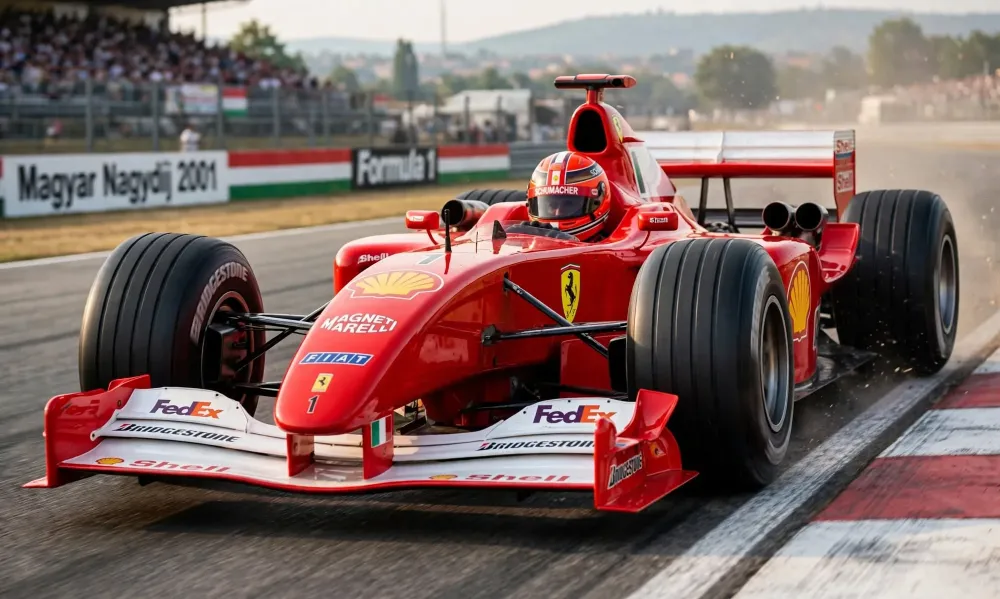
Sotheby’s New York sold this chassis in 2017 for $7.5 million. It set a record for a modern F1 car at the time. That record stood until the F2003-GA surpassed it five years later.
Schumacher drove this exact car to victory at the 2001 Hungarian Grand Prix. The win clinched his fourth world championship. It also secured Ferrari’s second consecutive constructors’ title, making this one of the most consequential single chassis of the modern era.
The sale was historic for a second reason. It was the first time a collector car of this significance had been offered at a major contemporary art evening sale. Sotheby’s presented the Ferrari as a masterpiece, placing it in the same category as the paintings around it.
The market agreed with that approach. The modern F1 car had permanently crossed into the art world.
4. Lewis Hamilton’s 2010 McLaren MP4-25: $6.6 Million
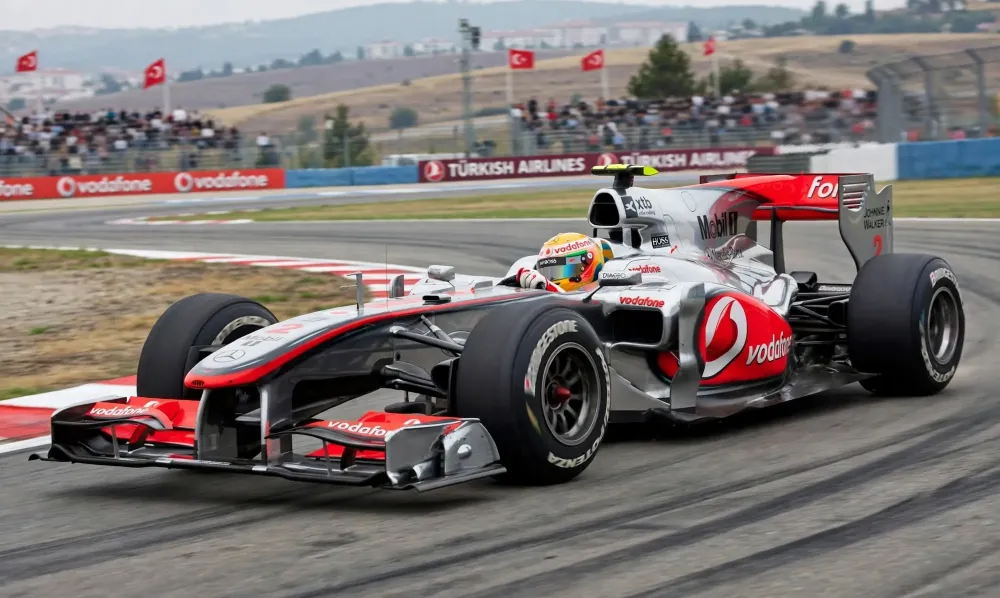
RM Sotheby’s sold this McLaren in Las Vegas in 2021 for $6.6 million. It was the first of Hamilton’s Grand Prix cars ever offered publicly. At the time, it also set a record for a car from the seven-time champion’s era.
Hamilton won the 2010 Turkish Grand Prix with this chassis. This victory came during his peak McLaren years, before the Mercedes dynasty began. The car carries the significance of the generation’s defining driver in the machinery of his first team.
The sale marked the moment Hamilton’s collecting market opened in earnest. His career was nearing its end, and his status as the statistically greatest driver of all time was effectively secured. The supply of his race cars is fixed, while the demand is generational.
Every car he drove in competition now carries a premium that compounds with each passing season. The MP4-25 was the proof of concept.
5. Nigel Mansell’s 1992 Williams FW14B: Approximately $3.6 Million
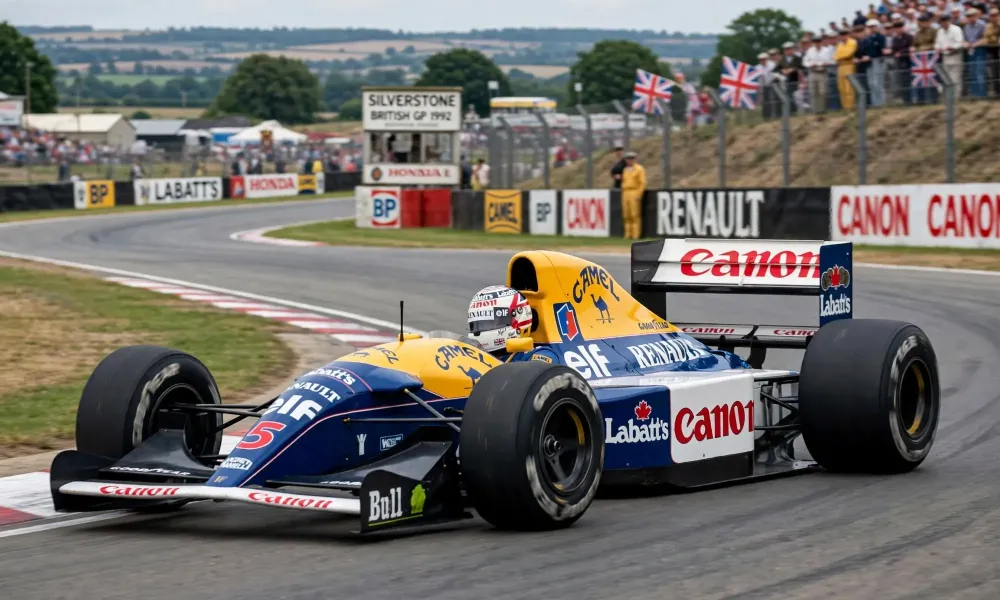
Bonhams sold this Williams in 2022 for roughly £2.9 million, about $3.6 million. It earns its place on the list for what it represents rather than the size of its price tag.
The FW14B was the most technically sophisticated racing car of its era. It featured active suspension and traction control. Mansell drove this machine to his world championship in 1992. It was the only title of his career and one of the most dominant seasons any driver has ever produced.
To British collectors, Mansell’s title holds a special place in national sporting memory. He won it at a home race in front of a flag-waving crowd. The FW14B remains the artifact of that memory.
Its price was the strongest ever achieved for a Williams of that era. It confirmed that the emotional market also commands significant premiums. These are the cars that carried a nation’s hopes, and no engineering analysis can fully explain their value.
What the Five Teach
The market for Grand Prix cars reduces to a single formula. It requires the right driver, in the right car, at the right moment. The documentation must also prove all three.
Fangio’s W196 set the absolute record because it satisfies this formula completely. Its achievement can never be repeated. The era is closed, the driver is beyond argument, and the car is singular.
The Schumacher and Hamilton sales proved that the formula also applies to the modern era. Championship-clinching chassis command the strongest premiums. The Mansell sale revealed another factor: the emotional multiplier. National memory compounds value in much the same way that interest compounds principal.
The deeper lesson is scarcity of a peculiar kind. Unlike road cars, racing chassis were used hard and often discarded. The surviving examples with race-winning and championship provenance number only in the dozens across the sport’s entire history.
The supply is fixed, the heroes are immortal, and prices, as the past decade has shown, have only one direction. For the machines that raced the great tracks and the collectors who buy at the great concours, the Grand Prix car is the final frontier of the four-wheeled market.
FAQs
1. What is the most expensive Formula 1 car ever sold at auction?
Fangio’s 1954 Mercedes W196, sold by Bonhams at Goodwood in 2013 for £19.6 million, roughly $29.6 million at the time. It remains the benchmark for the category and was, at the time, the most expensive car of any kind ever sold at auction.
2. What is the most expensive modern F1 car ever sold?
Schumacher’s 2003 Ferrari F2003-GA, sold by RM Sotheby’s in Geneva in November 2022 for approximately $15 million, the modern record and the first modern era car to challenge the classic benchmarks.
3. Can you drive a retired Formula 1 car?
Yes, through specialist operators who maintain retired F1 machinery for track day experiences, and many collectors run their cars at historic festivals. Costs are substantial, engineering support is mandatory, and the cars require preparation for every outing, which is why many remain display pieces.
4. Why do championship winning chassis command premiums?
Provenance: a chassis with documented race wins, especially championship clinching ones, carries an identity no replica or similar car can match. The market prices the specific history, not the specification, and the gap between a winner and a sister car can be several times the price.
5. Do teams sell their old F1 cars?
Increasingly, yes. Historically teams retained or destroyed old cars, but the modern market, driven by sales like Schumacher’s and Hamilton’s, has made heritage fleets valuable assets, and several teams now offer chassis to collectors through the major auction houses.
6. What is the market for Lewis Hamilton’s cars?
Strong and rising, with his 2010 McLaren setting the first public benchmark at $6.6 million in 2021. As his career concludes and his statistical standing as the greatest driver of all time solidifies, each championship era car is expected to command escalating premiums.
7. How are F1 cars authenticated for auction?
Through team records, chassis number documentation, component markings, and race by race history verified against the sport’s archives. The major houses work directly with teams for provenance, and factory authentication has become the standard requirement for record level sales.
8. Will an F1 car ever beat the W196 record?
Possibly, but the conditions are narrow: a surviving, race winning chassis from the sport’s heroic age with an immortal driver attached. The most likely challengers would be a Senna McLaren with a championship attached or another singular Fangio era machine should one surface, and both scenarios would test the current ceiling.
Disclaimer: This content is for informational purposes only and reflects our personal opinions and experiences. We just love to write and share what we know and research.