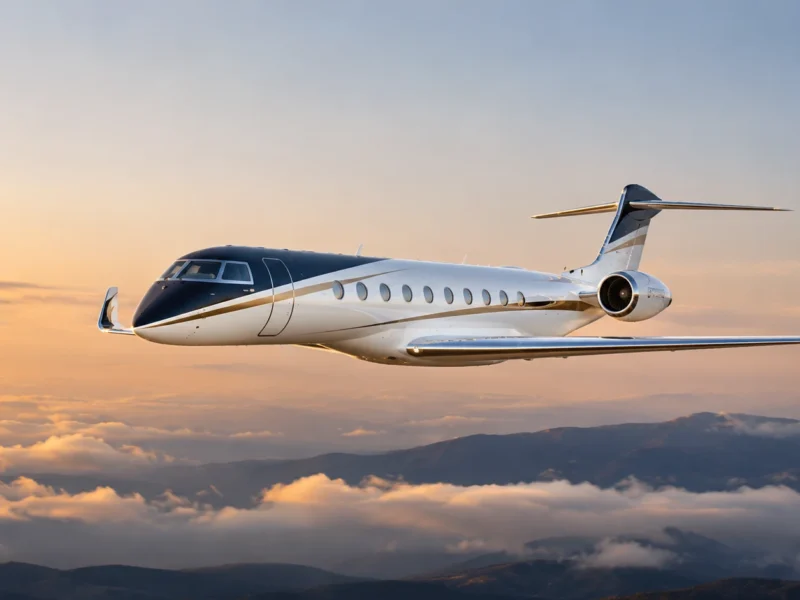
The Embraer Praetor 600 is a super-midsize business jet that flies 4,018 nautical miles, connects London to New York without stopping, and delivers technology found nowhere else in its class, all for a price that undercuts the large-cabin competition by tens of millions of dollars. Since its certification in 2019, it has become the aircraft that value-conscious owners mention when they want to make their accountants smile and their pilots grin at the same time.
To understand why this Brazilian machine keeps embarrassing aircraft twice its price, you need to understand the company that built it and the philosophy it flies by.
From Regional Airliners to Boardrooms
Embraer’s story is one of the more remarkable in aviation. Founded by the Brazilian government in 1969 and privatized in the 1990s, the company grew into the world’s third-largest aircraft manufacturer through regional airliners, the small jets that knit together the route networks of every continent. When Embraer turned its attention to business aviation, it brought something unusual to the category: airliner thinking.
Airliners are designed to fly relentlessly, to be maintained efficiently, and to generate profit on every hour aloft. Embraer applied that discipline to executive jets, and the result was a family of aircraft known for dispatch reliability that borders on the obsessive. The Praetor 600, launched in 2018 as a thorough transformation of the Legacy 500 platform, carries that DNA into the top of the super-midsize class.
The name itself is a statement of intent. Praetor, drawn from the magistrates of ancient Rome who commanded provinces, signals an aircraft built to rule territory. The territory in question is the space between midsize jets and the intercontinental flagships, and the 600 rules it with unusual completeness.
The Range That Changes the Conversation

Four thousand and eighteen nautical miles. That single figure reshapes what a super-midsize jet means. London to New York, westbound with reserves, on the right day. São Paulo to Miami. Dubai to most of Europe. Los Angeles to Honolulu. Routes that once demanded a large-cabin jet and its attendant costs now fall within reach of an aircraft that costs roughly half as much to buy and meaningfully less to operate.
The magic lies in efficiency rather than brute force. The Praetor 600’s Honeywell HTF7500E engines, its carefully sculpted wing with its distinctive winglets, and its additional fuel capacity over the Legacy 500 combine to stretch every gallon.
The aircraft sips where larger machines gulp, and the savings compound across every year of ownership.
For buyers studying the market of top luxury private jets, the Praetor 600 represents a genuine rethinking of the value equation rather than a compromise dressed in marketing language.
Technology the Big Jets Envy
Here is the detail that surprises visitors to the Praetor’s cockpit: this mid-priced machine offers technology that its most expensive rivals are still rolling out. Full fly-by-wire flight controls, rare in this class, replace mechanical linkages with digital precision, smoothing the ride and protecting the aircraft’s limits automatically.
The Rockwell Collins Pro Line Fusion flight deck gives pilots a clean, modern interface designed around how crews actually work.
Most remarkably, the Praetor 600 became the first business jet in its class certified for a synthetic vision guidance system that allows approaches to remarkably low minimums, seeing through weather that diverts other aircraft.
For an owner, that translates into the least glamorous and most valuable commodity in private aviation: completed journeys. A jet that gets in when others hold or divert is a jet that keeps its promises.
Turbulence, the perennial enemy of cabin comfort, meets its match in the fly-by-wire system’s active smoothing. Passengers who have flown the Praetor in rough air often remark that the aircraft feels a size larger than it is, a compliment no engineer could design directly and every engineer hopes to earn.
The Cabin: Honest Comfort

Candor about the cabin serves readers better than superlatives. The Praetor 600’s interior, at six feet tall and roughly six feet ten inches wide, is the best in the super-midsize class but remains a super-midsize cabin. It is a space for eight or nine passengers in typical configuration, with a flat floor, a proper galley capable of real meal service, and a baggage hold of genuine usefulness accessible in flight.
What distinguishes the space is the quality of its execution. Embraer’s interior designs, developed with a sophistication that has matured with each program, offer materials and finishes that stand comparison with far more expensive machines. The seats berth into beds for overnight sectors.
The connectivity, through high-speed Ka-band internet, keeps a cabin productive across oceans. The cabin altitude, the lowest in the class, preserves the energy of passengers on the long sectors this aircraft’s range invites.
The result is an interior that asks its passengers for no apology. It is not the grand salon of a G700. It is, instead, a beautifully resolved answer to what eight people actually need across five or six hours of ocean.
The Economics That Make CFOs Smile
Acquisition pricing for a new Praetor 600 sits in the low to mid twenty millions, a figure that buys range and technology that commanded twice the investment a decade ago. Operating costs reward the owner continuously: fuel burn well below large-cabin machines, maintenance programs built on airliner logic, and a residual value history that has treated owners kindly as the type’s reputation has spread.
Readers weighing ownership against access will find our examination of the real cost of owning a private jet a useful framework, and the Praetor 600 appears frequently in the charter market, where a trial of the type through private jet charter remains the wisest first date with any aircraft.
Fractional programs have embraced the type enthusiastically, which serves as its own verdict. The operators who stake their businesses on these machines have run the numbers with cold precision, and they keep buying Praetors.
Who Should Look Elsewhere
Honesty completes the picture. The traveler whose life genuinely spans continents weekly, whose entourage fills twelve seats, or whose overnight flights demand separate sleeping quarters for a family will outgrow the Praetor’s cabin and should look to the large-cabin flagships.
The aircraft also flies Mach 0.83 at the top end, brisk but a step behind the fastest machines in the sky, a difference that costs perhaps twenty minutes across an ocean and saves millions at purchase.
The Praetor 600 is not every answer. It is a specific answer, executed superbly: the maximum intercontinental capability purchasable at the super-midsize price point.
The Verdict
In every era of business aviation, one aircraft redefines what buyers should expect for their money. In the current era, that aircraft is the Embraer Praetor 600. It crosses oceans on a midsize budget, flies with technology its grandest rivals envy, and operates with the relentless reliability of the airliners its manufacturer knows best.
For the owner who values judgment over ostentation, who measures a machine by what it delivers rather than what it announces, the Praetor 600 makes perhaps the most persuasive case in the sky today. Brazil’s aviation jewel has not merely entered the conversation of great business jets. It has quietly rewritten the terms.
FAQs
What is the range of the Embraer Praetor 600?
The Praetor 600 flies 4,018 nautical miles, enough for London to New York, São Paulo to Miami, or Los Angeles to Honolulu without a fuel stop.
How much does a Praetor 600 cost?
A new Praetor 600 lists in the low to mid twenty millions of dollars, roughly half the price of large-cabin intercontinental jets with comparable range.
How many passengers does the Praetor 600 carry?
Typical configurations seat eight or nine passengers, with berthing seats that convert to beds on overnight flights and a full galley for meal service.
Does the Praetor 600 have fly-by-wire controls?
Yes. The Praetor 600 offers full fly-by-wire flight controls, technology rare in the super-midsize class, which smooths the ride and protects the aircraft’s limits automatically.
Can the Praetor 600 fly across the Atlantic?
Yes. Its 4,018-nautical-mile range covers westbound London to New York sectors and similar transoceanic routes with appropriate reserves.
Who builds the Praetor 600?
Embraer, the Brazilian manufacturer and the world’s third-largest aircraft maker, builds the Praetor 600, drawing on decades of regional airliner and executive jet experience.
How does the Praetor 600 compare to larger jets?
It offers intercontinental range at roughly half the acquisition cost of large-cabin flagships, with a smaller cabin and slightly lower top speed as the honest trade-offs.
Is the Praetor 600 available for charter?
Yes. The type appears widely in charter and fractional programs, allowing prospective buyers to experience the aircraft before committing to ownership.