
AI Summary
This is a complete guide to the crown chakra the seventh and highest of the traditional seven chakras. It covers what the crown chakra actually is (Sahasrara in Sanskrit, meaning “thousand-petaled”), where it’s located, what it governs (spiritual connection, consciousness, meaning, transcendence), the signs of a balanced versus imbalanced crown chakra, the specific symptoms of blockage or overactivity, healing practices including meditation, silence, breathwork, sleep, and diet, and how the crown chakra completes and unifies the entire chakra system. Written for anyone new to chakra work, anyone experiencing spiritual disconnection or existential emptiness, and anyone who wants to understand the crown chakra without either dismissing it or reducing it to vague spiritual language.
The Short Version
You’ve probably had a moment where the world felt bigger than you.
Standing on a mountain. Watching a child sleep. Sitting somewhere very quiet, alone, at the exact right time of day. Something in you softens. Something in you knows.
That knowing has a name in the yogic tradition. It’s called the crown chakra. And when it’s working, you feel connected to something larger not in a dramatic mystical way, but in a quiet, ordinary certainty that there’s more to life than the small self managing to-do lists.
When it isn’t working, life starts to feel meaningless.
This is a guide to what the crown chakra is, why it matters, and how to open it without the vague spiritual language most guides fall into.
Key Takeaways
- The crown chakra is called Sahasrara in Sanskrit literally “thousand-petaled” and sits at the top of the head.
- It governs spiritual connection, consciousness, meaning, and the sense of belonging to something larger than yourself.
- Its color is violet or white, its element is thought or pure awareness, and its seed sound is “OM” (or silence).
- Signs of imbalance include existential emptiness, spiritual disconnection, rigid materialism, depression that lacks a specific cause, and either total spiritual denial or spiritual bypassing.
- Signs of balance include quiet clarity, a settled sense of meaning, peaceful presence, and the ability to sit with mystery.
- Crown chakra healing is unusually subtle meditation, silence, breathwork, quality sleep, and simple contemplation all work.
- It’s the completion of the chakra system the point where the personal self meets what’s beyond the personal.
What the Crown Chakra Actually Is
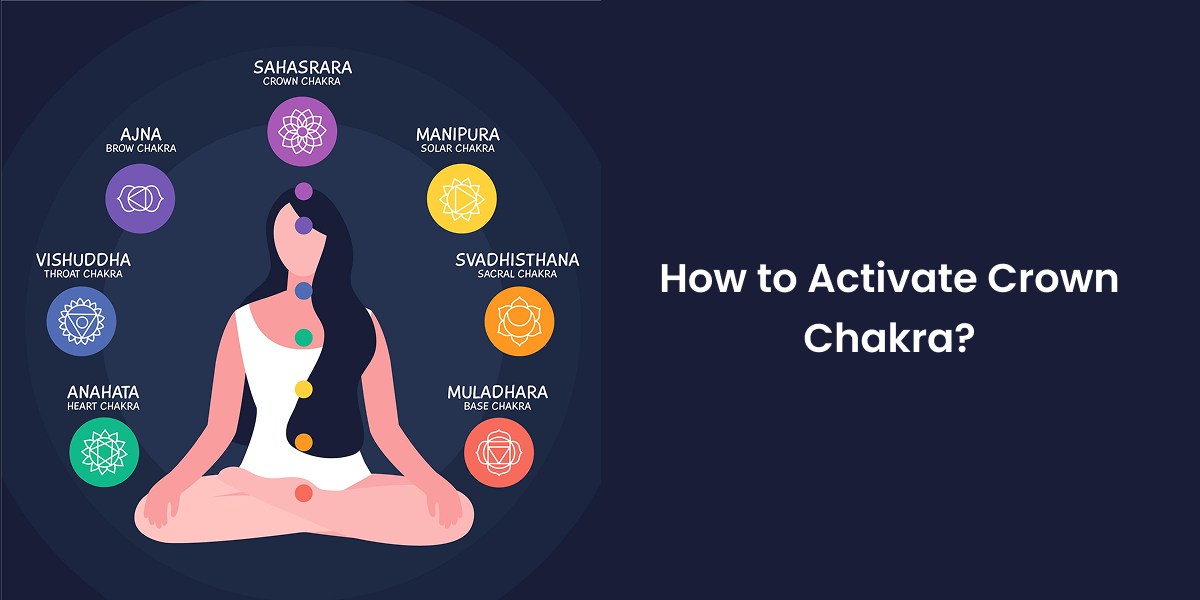
The chakra system maps seven main energy centers along the spine.
Six of them govern human dimensions safety, creativity, power, love, expression, insight. The seventh sits above the rest and governs something different: your relationship to what’s beyond the personal self.
In Sanskrit it’s called Sahasrara. Sahasra means “thousand.” Ara means “spoke” or “petal.”
Thousand-petaled.
The name is a description. Traditional texts depict the crown chakra as a lotus with a thousand petals an image of infinite unfolding, uncountable dimensions, awareness so vast it can’t be enumerated.
The crown chakra is where you meet what’s larger than yourself. Not a specific god, not a specific belief. Just the openness that recognizes there’s more.
When it works, you feel connected. When it doesn’t, life shrinks to the size of your daily concerns.
Where It Sits and What It Looks Like
Traditional teachings describe the crown chakra with specific imagery.
Location: The top of the head. The crown. In some traditions, slightly above the head rather than on it.
Color: Violet, white, or a shimmering luminous quality that traditional texts describe as “the color of pure light.”
Element: Thought or, more precisely, pure awareness. The element beyond the physical elements.
Symbol: A lotus with a thousand petals, often depicted with a downward-facing lotus at its center.
Seed sound: OM. Or, in the deepest traditional teachings, silence itself.
Sense: Beyond the five senses. The crown chakra is associated with intuition that isn’t sensory at all.
Associated body parts: The brain, the central nervous system, the pineal gland.
The imagery is intentionally beyond ordinary experience. That’s the point. The crown chakra represents the part of you that isn’t containable in the ordinary framework of self.
What the Crown Chakra Governs
The crown chakra is responsible for everything that connects you to what’s larger than your personal life.
Spiritual connection. Not a particular religion, but the felt sense that something more is real. Some people experience this through faith, some through nature, some through meditation, some through art or love. The specific form doesn’t matter the underlying sense does.
Consciousness itself. Awareness of being aware. The quiet observer that watches your thoughts happen. In modern language, meta-cognition. In traditional language, the witness.
Meaning and purpose. The felt sense that your life connects to something worthwhile. Not “I have a purpose” in the productivity sense, but “my existence matters somehow” in the deeper sense.
Peace with mystery. The ability to sit with what you don’t understand without needing to force certainty. Comfort with unanswered questions.
Belonging to something larger. The universe, life itself, humanity, God, nature whatever framework fits. The crown chakra is where you stop feeling like a separate isolated self and start feeling like part of something.
When the crown chakra is balanced, all of this feels natural. When it’s not, life starts to feel meaningless even when nothing is objectively wrong.
Signs Your Crown Chakra Is Out of Balance
Crown chakra imbalance often looks like existential struggle.
Emotional and Mental Signs
Existential emptiness. The persistent sense that life is meaningless, even when things are objectively going fine.
Depression without a specific cause. Not depression tied to grief or trauma, but a background greyness where nothing feels alive.
Spiritual disconnection. Loss of faith, loss of felt connection to whatever previously gave you a sense of larger meaning.
Rigid materialism. The insistence that only what can be measured is real. A refusal to entertain mystery, wonder, or the intangible.
Cynicism as a default. Reflexive dismissal of anything spiritual, contemplative, or larger-than-self as naive.
Constant intellectualization. Living entirely in the head. Trying to think your way to peace and never getting there.
Or the opposite spiritual bypassing. Using spiritual concepts to avoid actual life. Meditation as escape. Constant “positive vibes” that ignore real problems.
Physical Signs
Chronic headaches, especially in the crown of the head.
Sensitivity to light and sound — the nervous system running hot.
Sleep disturbances, including insomnia that isn’t caused by anxiety.
Neurological symptoms — dizziness, imbalance, cognitive fog.
Chronic fatigue that no amount of physical rest resolves.
The Extremes
An underactive crown chakra feels like meaninglessness, cynicism, spiritual disconnection, or exhaustion from living entirely in the practical world.
An overactive crown chakra shows up differently: dissociation, disconnection from the body, spiritual grandiosity, using meditation or spiritual practice to escape real life, or “floating” through daily existence without being present in it.
Both are imbalances. And both often coexist with a struggling root chakra because the crown and root are the two poles of the system, and when one is unstable, the other tends to be too.
What a Balanced Crown Chakra Actually Feels Like
Less dramatic than most spiritual writing makes it sound.
You feel calm. Life feels meaningful, even in ordinary moments. You can sit in silence without discomfort. You can enjoy mystery without needing to resolve it. You have your own relationship whatever its form to what’s larger than you.
You don’t feel superior to people who see the world differently. You don’t need everyone to share your framework. You’ve made peace with the fact that meaning is available in many forms, and you’ve found yours.
You’re not chasing spiritual experiences. You’re not performing spirituality for anyone. You’re just settled. Alive. Curious. Kind.
That’s the goal. Not enlightenment. Not levitation. Not certainty about the afterlife. Just the quiet felt sense that being alive is a gift and being conscious is a wonder even on regular Tuesdays.
How to Heal the Crown Chakra
Crown chakra healing is unusually subtle.
The lower chakras respond to physical practices. The crown chakra responds to stillness. To silence. To letting go. This is the one form of energy work where doing less almost always beats doing more.
Meditate But Do Less, Not More
The most common crown chakra practice is meditation. But most people misunderstand what crown chakra meditation actually involves.
It’s not about achieving a specific state. It’s not about visualizing anything. It’s not about generating experiences.
It’s about sitting still and letting whatever is already there become noticeable.
Sit comfortably. Close your eyes. Don’t try to do anything. Notice the quiet observer that’s noticing everything. Rest as that.
Ten minutes a day. Every day. Not for results for the practice itself.
Practice Silence
The crown chakra is fed by silence.
Not the silence of turning off music. The deeper silence of not needing to fill every moment with input. Walks without headphones. Meals without podcasts. Ten minutes in the car without radio, without a phone call, without anything.
Modern life has almost no silence in it. That’s why so many people struggle with the crown chakra without knowing why.
Start small. Five minutes a day of chosen silence. Notice what happens.
Sleep Well
The pineal gland physically associated with the crown chakra is closely tied to your sleep-wake cycle.
Chronic sleep deprivation destabilizes the crown chakra as much as any other. Restoring sleep restores it.
Regular sleep and wake times. Dark rooms. No screens for the last hour before bed. This is unglamorous crown chakra work, but it’s arguably the most effective.
Breathwork
Slow, conscious breathing calms the nervous system and creates the internal space where crown chakra awareness can arise.
The simplest practice: breathe in for four counts, hold for four, breathe out for six. Do this for five minutes. That’s it.
Not because breathwork “opens” the crown chakra directly. Because it calms the noise that keeps you from noticing what’s already there.
Time in Nature
Something in the crown chakra responds specifically to being outside.
Not exercising outside. Just being outside. Sitting under a tree. Watching clouds. Walking somewhere quiet with no particular destination.
Nature has a way of showing you what’s larger than yourself without any effort on your part. That’s crown chakra work.
Simple Contemplation
Not meditation. Not mystical experience. Just sitting with a big question and letting it be big.
What is my life actually for? What matters most, in the end? What am I part of that I don’t fully understand?
You don’t have to answer these questions. Sitting with them, without demanding an answer, is itself crown chakra practice.
Crown Chakra Meditation
A specific practice for the crown chakra:
Sit comfortably with your spine tall but not rigid.
Close your eyes. Take three slow breaths.
Bring your attention to the top of your head. Imagine a soft light there violet or white, whichever feels natural.
Don’t try to make the light do anything. Just notice it.
With each in-breath, imagine the light becoming more vivid.
With each out-breath, imagine it expanding gently upward not forcefully, not dramatically. Just softly upward, into the space above your head.
After a few minutes, let go of the visualization entirely. Just sit. Let your awareness rest in whatever it rests in.
If thoughts come, notice them and let them pass.
If you feel silent inside, rest in the silence.
Stay for ten minutes.
That’s the whole practice. It’s simple. Its power comes from repetition, not from any single session.
How the Crown Chakra Completes the System
The chakra system is a map of the human being from ground to sky.
The root chakra roots you in the earth. The sacral chakra brings creativity and feeling. The solar plexus builds personal power. The heart chakra opens love. The throat chakra gives voice. The third eye brings insight.
Each chakra takes you up one level.
The crown chakra is the point where the vertical journey opens beyond the personal entirely. Where “I” begins to touch what isn’t just “I.”
Traditional teachings describe this as the meeting point of the individual soul and universal awareness. Modern language calls it something like the meeting point of the self and consciousness itself.
Whatever framework you use, the crown chakra is what makes the system complete. Without it, the other six chakras would only take you to the top of your own personhood. With it, they open into something larger.
You cannot force this opening. Every teaching agrees on that. What you can do is create the conditions silence, sleep, contemplation, sincere practice and let it unfold in its own time.
FAQs
What is the crown chakra?
The crown chakra, called Sahasrara in Sanskrit (“thousand-petaled”), is the seventh and highest chakra. Located at the top of the head, it governs spiritual connection, consciousness, meaning, and belonging to something larger than yourself.
How do I know if my crown chakra is blocked?
Common signs include existential emptiness, depression without a specific cause, spiritual disconnection, rigid materialism or cynicism, chronic headaches at the top of the head, and sensitivity to light and sound.
What color and element are associated with the crown chakra?
Violet or white is the color, thought or pure awareness is the element, and OM is the seed sound. Its symbol is a lotus with a thousand petals representing infinite awareness.
How do you heal the crown chakra?
Meditation, silence, quality sleep, slow breathwork, time in nature, and simple contemplation are the most effective practices. Unlike the lower chakras, crown chakra healing is subtle doing less generally works better than doing more.
Can you open the crown chakra without working on the others?
Not sustainably. Traditional teachings emphasize building the foundation from the root chakra upward. An open crown without stable lower chakras tends to produce dissociation or spiritual bypassing rather than genuine awakening.
