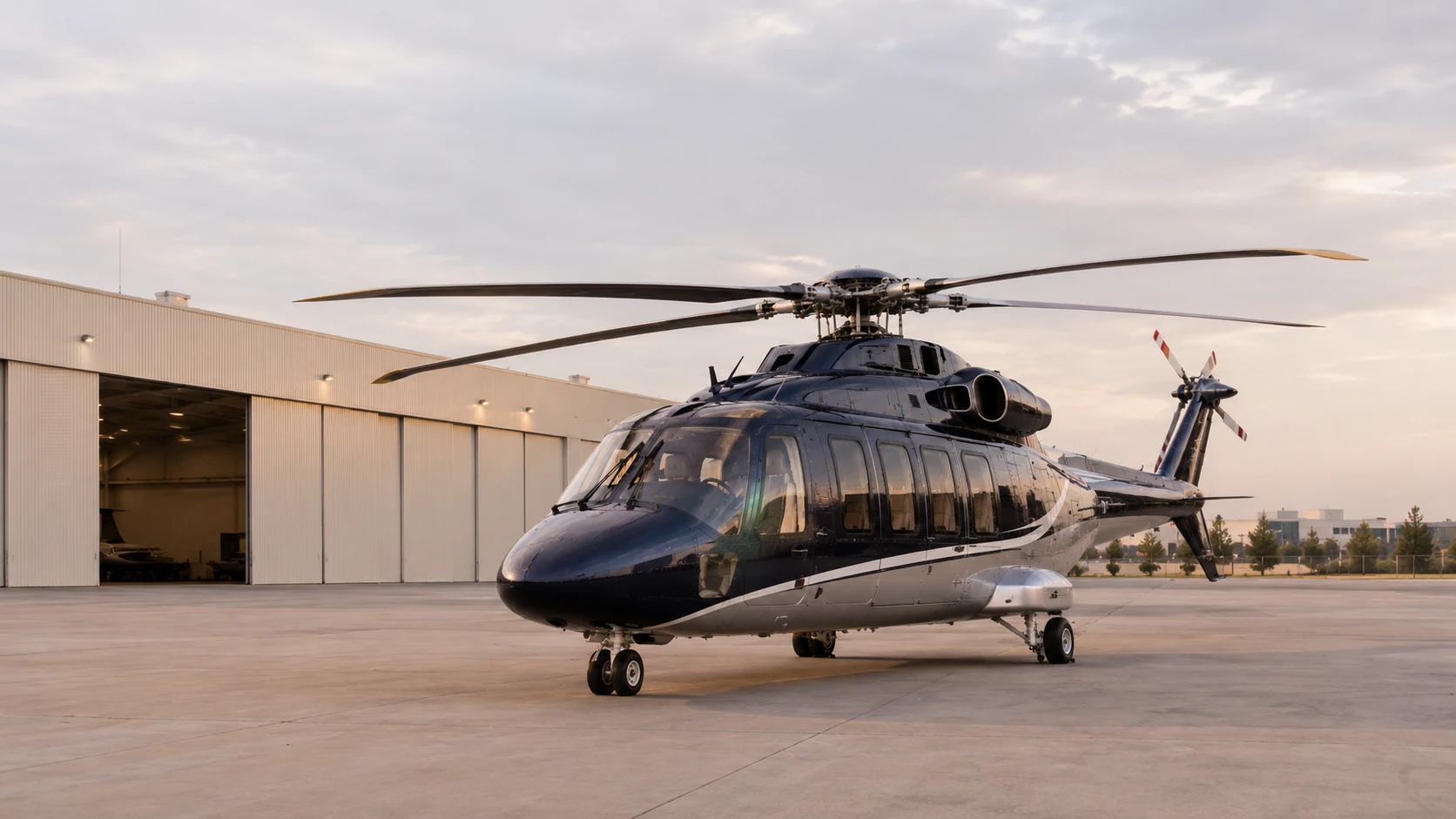
Every few decades, a helicopter arrives that is not an upgrade but an argument. The Bell 525 Relentless is such a machine: the first commercial helicopter in history designed around a fully digital fly-by-wire flight control system, the same technology that transformed airliners and fighter jets a generation ago.
After a development program that stretched across more than a decade through triumph, tragedy, and one of the longest certification campaigns in rotorcraft history the 525 has entered service with a simple claim: helicopters can be smarter, not just stronger.
For private owners scanning the market for their next machine, it is the most consequential new helicopter in a generation. Here is why.
What Fly-by-Wire Actually Means

In a conventional helicopter, the pilot’s controls connect to the rotor system through rods, cables, and hydraulics mechanical linkages that translate hand movement into blade pitch. It is a nineteenth-century idea perfected by twentieth-century engineering, and it works. But it has a ceiling.
The Bell 525 replaces those linkages with computers. The pilot’s inputs travel as electronic signals to actuators, and between the hand and the blade sits a flight control system that constantly interprets, smooths, and protects. The system knows the aircraft’s limits and quietly keeps the pilot inside them.
It reduces the physical and mental workload of helicopter flying famously the most demanding kind of flying there is and it opens the door to features conventional helicopters cannot offer, from enhanced stability in poor weather to a pathway toward increasingly automated flight.
Fly-by-wire transformed airliners in the 1980s and fighters long before that. The mystery is why helicopters took so long and the honest answer is that rotorcraft aerodynamics are brutally more complex than fixed-wing flight. Bell’s achievement with the 525 is not that it computerized a helicopter. It is that it computerized the hardest kind of aircraft to computerize.
The Long Road to Certification
The program’s history deserves an honest telling, because it explains both the aircraft’s maturity and its price. Bell announced the 525 in 2012, targeting the booming offshore oil and gas market, and first flew the prototype in 2015. In 2016, a fatal test-flight accident grounded the program and led to a painstaking redesign and review.
Certification always the final mountain for a genuinely new helicopter — took years longer than planned, with the FAA ultimately signing off on a machine that had been examined as thoroughly as any rotorcraft in history.
The result of that long road is an aircraft that arrives unusually proven. When the first customer aircraft was delivered in 2023 to Equinor, the Norwegian energy company, for North Sea operations it joined service not as an experiment but as the most scrutinized helicopter of its era.
For private buyers, that history reads differently than it might first appear: the delay was not indecision. It was the cost of doing something genuinely new, safely.
The Machine Itself

The 525 sits in the “super-medium” class larger than the light twins that dominate charter work, smaller and more agile than the heavy machines that serve heads of state. The numbers tell a story of deliberate capability: seating for up to twenty in offshore layout, a cruise speed in the region of 155 to 160 knots, and a range comfortably beyond 500 nautical miles.
Power comes from twin GE CT7 engines, a powerplant family with one of the deepest service records in aviation.
The cabin is where private buyers will live, and Bell designed it with them in mind. The flat-floor cabin spans nearly the full width of the airframe, with the tallest cabin height in its class and windows scaled like a boardroom’s. In VIP configuration completed through specialist outfitters the 525 accepts full club seating, cabinetry, and entertainment systems without the weight compromises that plague smaller airframes.
The cockpit, built around the Garmin G5000H suite, presents pilots with a clean glass environment designed around the fly-by-wire system’s intelligence. And because the computers hold the flight controls, the 525 offers something approaching the airliner experience: a helicopter that actively helps its crew rather than merely obeying them.
Where It Fits in the Private Market
The honest question for a wealthy buyer is not whether the 525 is remarkable it is but where it sits among the alternatives. In the landscape of luxury helicopter models, the super-medium class is contested by the Leonardo AW139, the established global default, and the Airbus H175 and H160 family, which brought its own aerodynamic innovations to market.
The 525’s argument against them is technological depth. The AW139 wins on two decades of fleet maturity, a vast support network, and residual values the market understands. The Airbus machines win on refinement and cabin elegance.
The Bell counters with the only fly-by-wire system in the class, the largest cabin volume relative to footprint, and a manufacturer whose name has been synonymous with rotorcraft since the 1940s the company that built the first commercially certified helicopter in history.
Buyers who remember Bell mainly from the JetRanger and 407 should know that the 525 is a different species entirely: it is Bell staking its claim to the top of the market, not the middle.
The Ownership Reality

A fully equipped Bell 525 in executive configuration represents an investment well into eight figures, with annual operating costs crew, maintenance, insurance, hangarage — that reflect its position between the light twins and the heavies. The support picture matters too: Bell’s global service network is deep, and the GE engines share their bones with fleets operating on every continent.
It is also worth placing the helicopter in the context of the broader private-aviation decision. For journeys under roughly 300 miles, a machine like the 525 competes not with other helicopters but with the private jet itself and wins on door-to-door time whenever the destination lacks a convenient runway. City-center helipads, yacht decks, private estates: the helicopter’s runway is wherever you are.
The Verdict
The Bell 525 Relentless asks buyers to make a bet: that the future of rotorcraft is digital, and that being first to that future is worth more than being another entry in an established fleet. The energy industry the most demanding helicopter customer on earth has already placed that bet.
Whether the private market follows will depend on how the first years of service treat the machine, and how quickly pilots trained on older machines fall for a helicopter that thinks.
Either way, the 525 has already secured its place in the history books. Every helicopter that flies by wire in fifty years will trace its license to this one.
FAQs
What is the Bell 525 Relentless?
A super-medium twin-engine helicopter from Bell the first commercial helicopter designed around a full fly-by-wire flight control system, announced in 2012 and delivered to its first customer in 2023.
What does fly-by-wire mean in a helicopter?
Pilot controls send electronic signals to computers that command the rotor actuators, replacing mechanical rods and cables. The system smooths pilot inputs, protects the aircraft’s limits, and reduces workload.
How many passengers can the Bell 525 carry?
Up to twenty in offshore utility configuration; executive VIP layouts typically seat six to eight in full comfort.
How fast and how far does the 525 fly?
Cruise speed is roughly 155 to 160 knots, with a range beyond 500 nautical miles depending on configuration and load.
Who was the first customer?
Equinor, the Norwegian energy company, which took the first delivery in 2023 for North Sea offshore operations.
How much does a Bell 525 cost?
Pricing is configuration-dependent, but a VIP-equipped example runs well into eight figures; annual operating costs reflect its super-medium class.
How does it compare to the Leonardo AW139?
The AW139 offers two decades of fleet maturity and the deepest support network in its class; the 525 counters with fly-by-wire technology, a larger cabin, and newer systems.
Is the Bell 525 certified?
Yes, after one of the longest certification campaigns in rotorcraft history, including a full program review following a 2016 test accident, the 525 holds FAA certification and is in service.