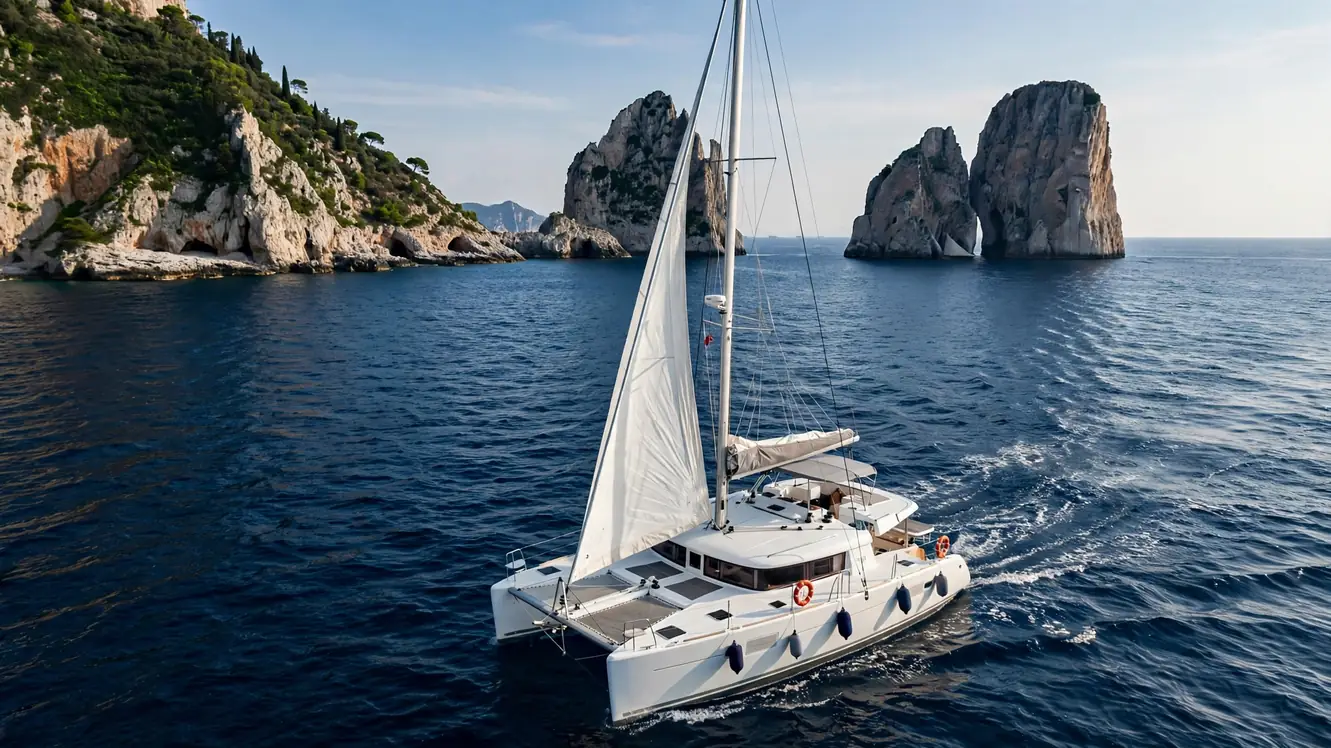
A crewed catamaran charter in Amalfi Coast enters this series with a duty of honesty the other catamaran articles did not carry, because the familiar shallow draft argument, the coves and the shelves and the thin water, speaks less fluently on this coast than anywhere else the series has sailed.
The Amalfi shoreline is deep and steep; Positano’s famous water is a managed buoy field, the anchorages are few and regulated, and the catamaran will not claim coves here the way it claimed Pampelonne, La Garoupe, or the archipelago of La Maddalena.
This guide says so plainly, because the coast deserves plain speech, and then makes the case that remains, which is considerable: on the most theatrical coastline in Europe, the catamaran’s argument is not the water beneath it but the life aboard it, the deck that serves the family better than any motor yacht twice the price, the stillness at anchor beneath a thousand foot cliff, the sailing tradition of the gulf, and a cost that returns a week of the coast’s restaurants, tables, and excursions to the budget.
I had the argument made to me by a Neapolitan charter manager in Sorrento, a woman whose family has provisioned boats in the gulf for three generations, over espresso in the Marina Grande while the morning ferries left for Capri. The French ask which boat reaches the beach, she said. Here the beaches are reached by ladder or by tender, and every boat is equal at the buoy.
The question here is which boat lives best through the day, and for the family, for the long lunch, for the grandparents and the small ones, the catamaran lives better than anything on my list. Then she said the sentence that organizes this guide: on this coast, the catamaran is not the explorer’s choice. It is the family’s, and the connoisseur of days well spent. The case, the costs, the week, and the method follow in the series’ order.
The Case That Remains, Made in Full
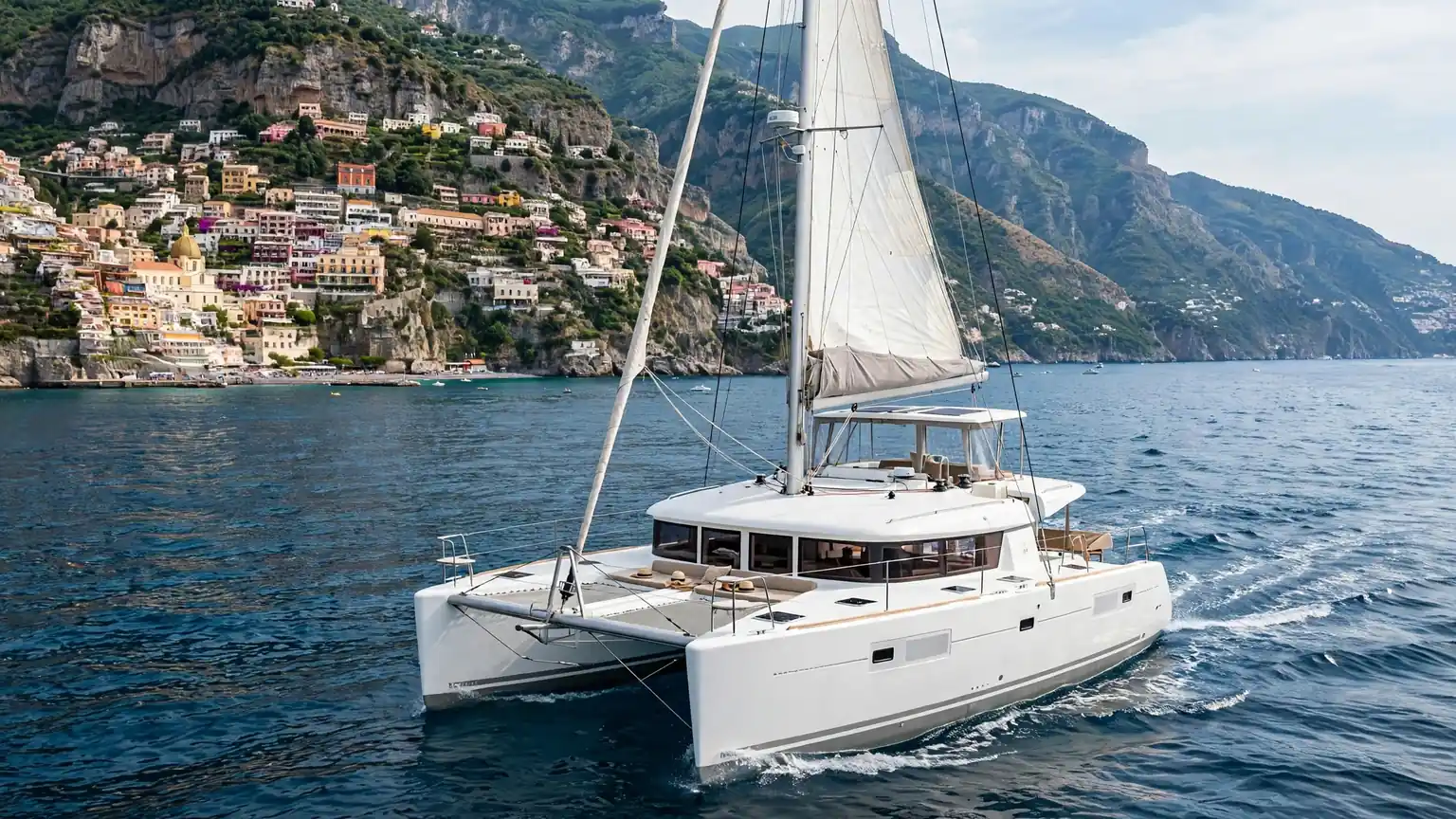
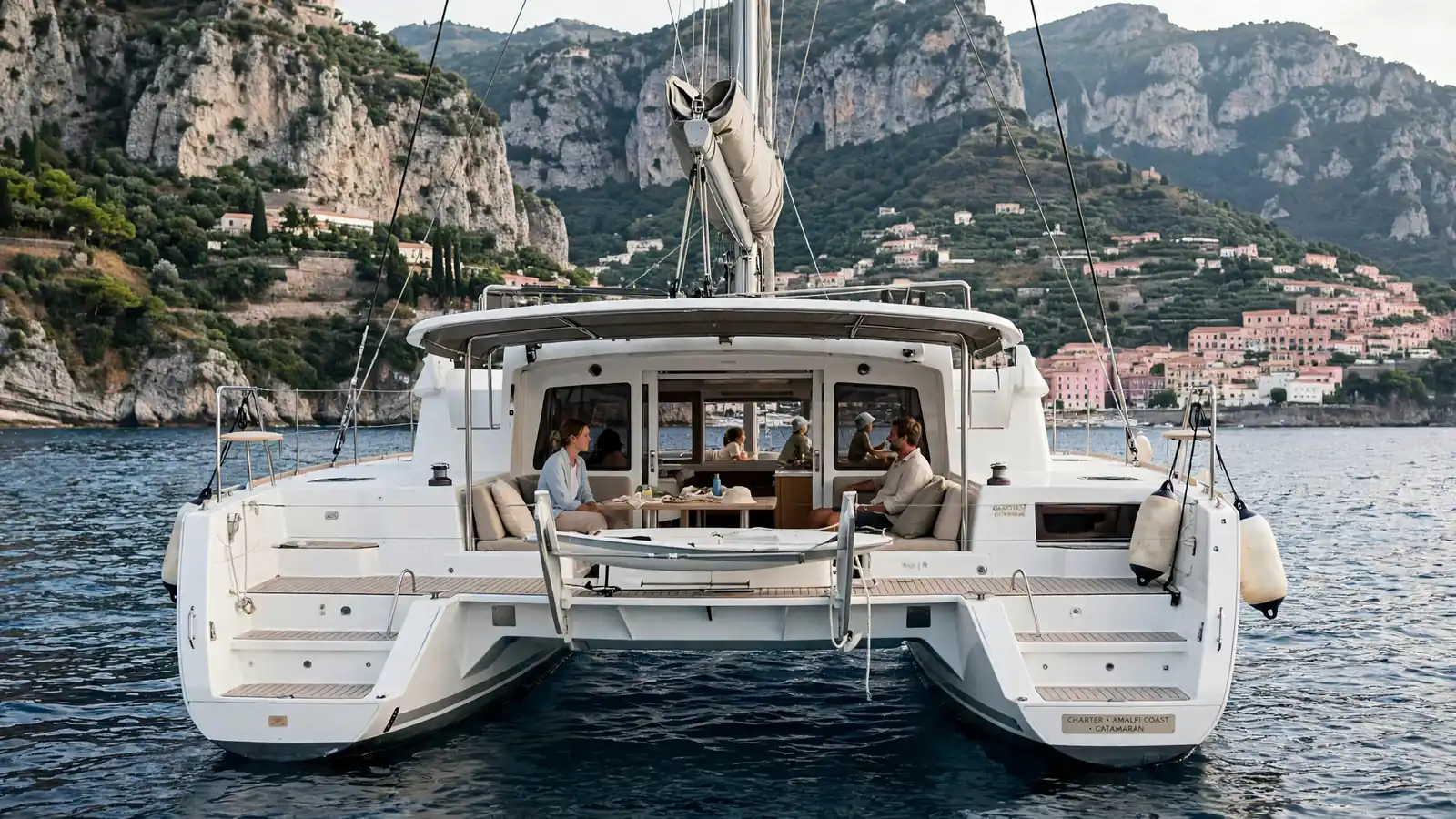
Deck space first, and most powerfully. The catamaran’s great cabin and cockpit are one continuous living floor, level with the water, shaded and open at once, and on a coast whose days are lived aboard more than ashore, between morning swims off the platform, long lunches in the shade, and the golden hour with the cliff faces lit, that floor is the week’s theater.
A motor yacht of the same sleeping capacity divides its space into corridors and levels; the catamaran spreads it under the sky, and the difference shows at the second hour of every lunch.
Stillness second. The anchorages off the coast, where the regulations allow them, sit in the lee of the cliffs, and the afternoon breezes that sweep the open gulf are felt at anchor; the twin hulls keep the table level and the children’s naps undisturbed, the same miracle this series has praised from Saint Tropez to Sardinia, delivered here beneath scenery no other coast in the series can offer.
The islands third, and here the draft argument returns. The catamaran serves Capri, Ischia, and Procida beautifully: the shallow shelf off Marina Piccola at Capri, the thermal coves of Ischia, the protected water inside Procida’s Corricella, all places where the twin hulls sit happily and the platform meets the water at knee height.
And the sailing fourth, quietly. The gulf’s sailing tradition is old and proud, the distances between Sorrento, Capri, and the coast are honest half day passages under canvas, and the maestrale gives the afternoons a purpose the motor guest only watches.
What It Costs, Honestly
The category’s arithmetic crosses the border intact. Quality crewed catamarans of forty to fifty feet with captain and chef or hostess run fifteen to thirty thousand euros weekly; the fifty five to sixty foot flagships with three crew run forty five to sixty five thousand.
Against a motor yacht of equal sleeping capacity the saving runs half or better, and on this coast the saving has a destination: the coast’s restaurants.
Here more than anywhere in the series, the table ashore is the day’s summit, the restaurants above Positano, the terraces of Ravello, the trattorias of the Marina Grande, and the difference between a good week and a great one is often measured in reserved tables, which the catamaran’s saving buys without apology.
The Italian particularities apply unchanged: VAT at twenty two percent, the provisioning allowance at thirty to forty percent, the buoy fields at three hundred to five hundred euros nightly for the center of the market in high season, and the customary gratuity at five to fifteen percent.
The honest total for a fine family week runs well under the equivalent motor week, and the family that spends the difference ashore will remember the week longer for it, a judgment on traveling well with children that Pravi Celer has long shared in its survey of the best places to travel with kids and finds confirmed afloat on this coast.
The Week the Catamaran Gives You
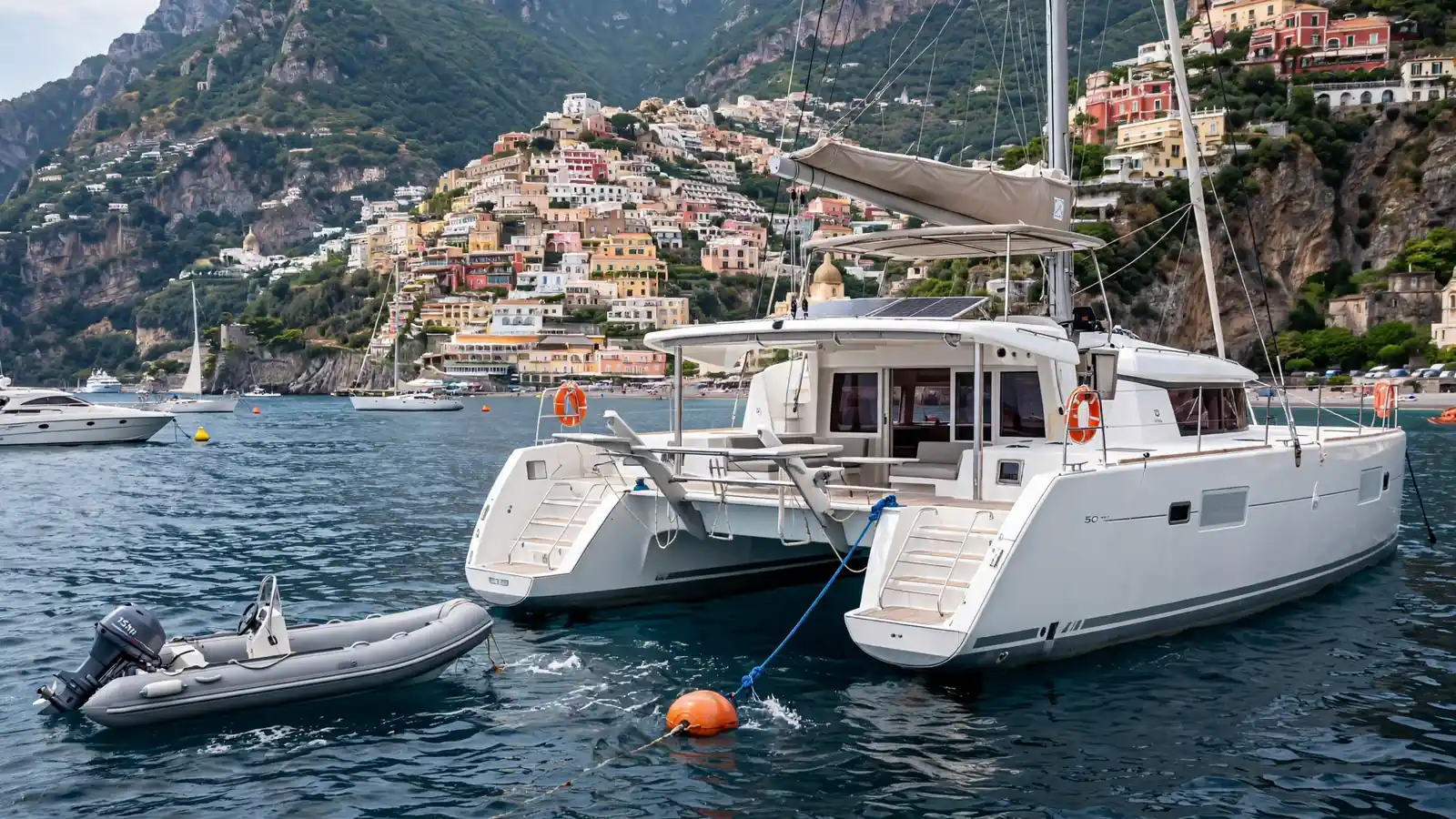
The structure follows the classic coast, with the catamaran’s accent. Board at Sorrento, the first long dinner under the lemon pergolas. Day two crosses to Capri under canvas, the faraglioni from the sea, the buoy off Marina Piccola, the afternoon in the piazzetta, the return swim off the platform at golden hour. Day three runs the coast to Positano, the facade from the water, the tender to the beach, the long lunch aboard rather than ashore because the deck is the better terrace.
Day four claims Amalfi and the climb to Ravello, the gardens, the infinite terrace, dinner aboard as the cliffs turn rose. Day five sails to Procida, the fishing harbor of Corricella, the quiet island hour. Day six returns at walking pace, the coast’s full review. Day seven closes at the base with the market and the farewell, the children by now sun browned and fluent in the deck.
Who It Suits
The Amalfi catamaran suits families first, completely and without argument. It suits the table minded, for the deck is this coast’s finest dining room. It suits the motion conscious beneath the cliffs’ lee, and the sailors of the party, who will find the gulf’s passages honest. It suits the value conscious connoisseur, who knows that scenery this grand is not indexed to horsepower.
And it does not suit those who measure the week in arrival theater or need the prestige of a motor yacht’s silhouette; they are well served by the motor fleet in the same marina, and the coast receives both graciously.
A Method for Booking Well
First, base at Sorrento or Naples and let the catamaran’s shallow advantages serve the islands. Second, ask the broker for a captain with a gulf season, because the buoy field, the grotto timings, and the summer anchoring rules are local knowledge with enforcement behind them.
Third, book June or September, when the deck’s long days are the coast at its kindest. Fourth, reserve the great restaurant tables early, for the catamaran’s saving should be spent where the coast keeps its genius. And fifth, cross to Capri under sail at least once, for the afternoon the maestrale fills the canvas and the island rises ahead is the reason the correct boat exists on this coast too, and the sail home at dusk, the cliffs dark against a last band of gold, is the week’s quiet reward for having chosen it.
Frequently Asked Questions
What is a crewed catamaran charter in Amalfi Coast?
The private hire of a catamaran sailing yacht with professional crew, based at Sorrento, Naples, or Salerno, serving the vertical coast and the islands of Capri, Ischia, and Procida.
How much does a crewed catamaran charter in Amalfi Coast cost?
Working bands of fifteen to thirty thousand euros weekly for forty to fifty foot catamarans with two crew, and forty five to sixty five thousand for fifty five to sixty foot flagships, before the allowance at thirty to forty percent, VAT at twenty two percent, buoys, and gratuity.
Why choose a catamaran on the Amalfi Coast?
Not for shallow draft, which this deep coast rarely rewards, but for the family deck, the stillness at anchor, the islands’ shallow shelves, the sailing passages of the gulf, and the half price against an equivalent motor yacht.
Can a catamaran anchor off Positano?
Like every yacht, it takes a buoy in the managed field in season; the catamaran’s advantage at Positano is the deck above the buoy, not the water beneath it.
Is a catamaran charter here good for families?
Exceptionally; the level living floor, the platform at knee height, the shaded cockpit for the long lunch, and the islands’ calm coves serve every generation, and the saving funds the coast’s great tables.
When is the best season for a catamaran charter on the Amalfi Coast?
June and September for warm water, honest wind, and breathing towns; May and October for the quiet coast at gentle rates; August only for the guest who loves a festival and booked a year out.