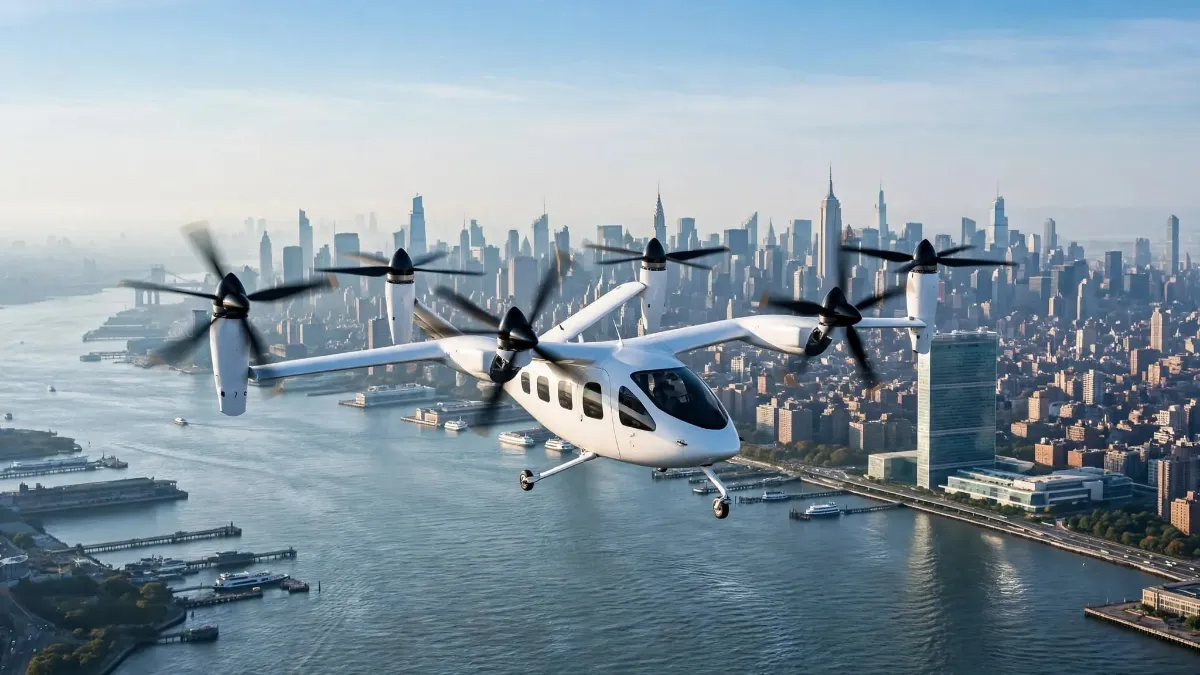
On the morning of April 27, 2026, a white aircraft with six tilting propellers lifted off from John F. Kennedy International Airport, transitioned from a hover to forward flight, and crossed into Manhattan. Seven minutes later it set down at the Downtown Skyport at Pier 6, a trip that by car, on a typical weekday, can swallow an hour or more.
There was no roar. Witnesses described a sound closer to a whoosh. The aircraft, Joby Aviation’s electric S4, registers roughly 45 decibels at altitude. That is about one hundred times quieter than a helicopter. For a city that has fought helicopter noise for half a century, that number may matter more than speed.
The age of the electric air taxi, long promised and frequently mocked, is no longer just a rendering on an investor slide.
These aircraft are flying over real American cities. Heliports are being wired for charging, and the White House has a pilot program to put passengers aboard.
New York, the most helicopter-saturated city in the Western Hemisphere, is the market everyone wants first. Here is what the coming decade of electric vertical flight actually looks like. It explores what this means for the city’s battered heliports and what it will change for luxury travelers who already live by the rotor.
The Aircraft at the Gate
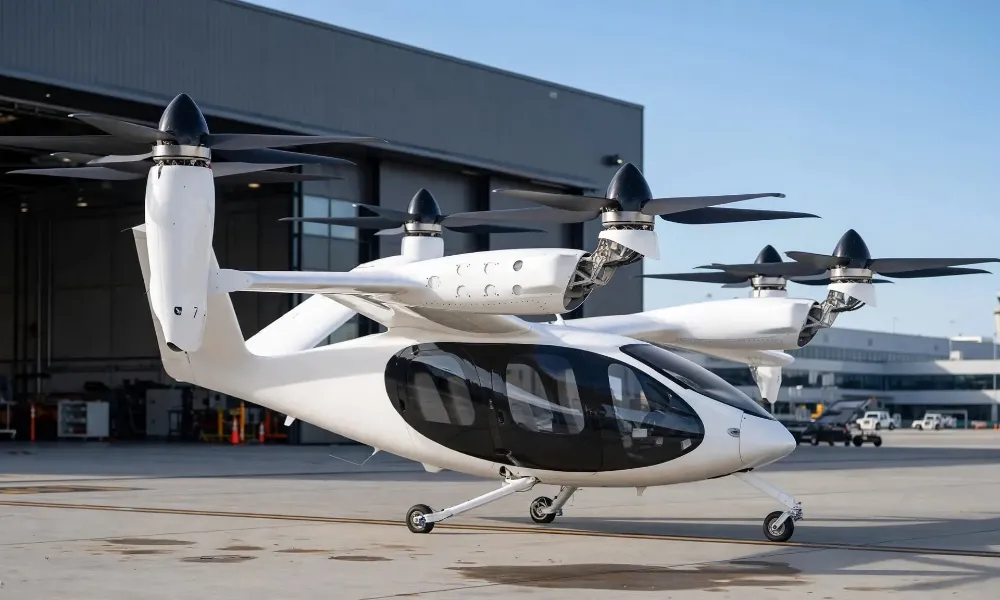
Two American companies have pulled decisively ahead of the pack. Joby Aviation, founded in 2009 and backed by over $400 million from Toyota, flies the S4. This five-seat tilt-rotor aircraft reaches 200 mph with a range of around 150 miles.
Archer Aviation, founded in 2018 and partnered with United Airlines and Stellantis, flies Midnight. This four-passenger aircraft reaches 150 mph with roughly 100 miles of range. It is designed for rapid short trips with brief charging stops.
Their regulatory race has become the most watched contest in aviation. As of this writing neither holds an FAA type certificate, the final approval required for full commercial service.
As of March 2026, the Government Accountability Office confirmed that the FAA had not certified any manned electric aircraft. Joby and Archer were the only two of fourteen tracked projects with issued airworthiness criteria.
Since then, both have advanced quickly. Joby entered the fifth and final certification stage, Type Inspection Authorization, in March 2026. By November, it had completed extensive FAA credit testing.
Archer completed Phase 3 of its four-phase process in April 2026. In November, it received a special airworthiness certificate allowing piloted Midnight flights in Los Angeles ahead of the LA28 Games.
Why New York Is the Prize
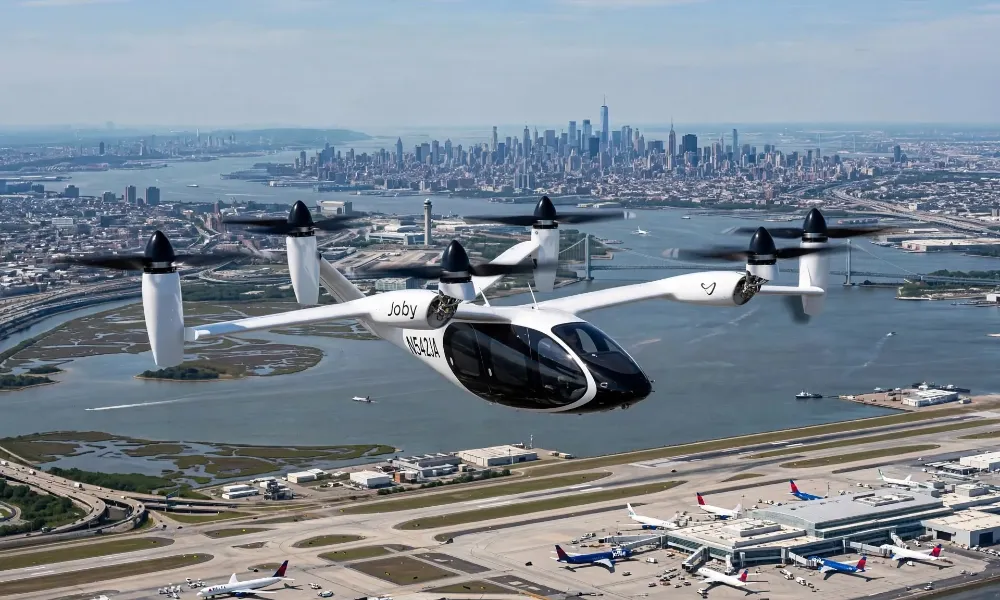
Every aviation executive will tell you the same thing: there is no better billboard on earth than Manhattan.
New York combines America’s worst ground congestion with a wealthy population willing to pay to avoid it. The average commuter lost 102 hours to traffic in 2025.
The city already has the infrastructure: three Manhattan heliports and a decades-old culture of airport helicopter transfers. Its customers often treat saving thirty minutes as a necessity.
Joby has moved to own that customer base outright. In late 2025 it acquired Blade Air Mobility’s passenger business, absorbing the lounges, the booking app, and the Hamptons crowd in a single stroke, and in February 2026 it announced a partnership with Uber that will let users book a Joby flight inside the Uber app as Uber Air, with Delta Air Lines providing the escorted path into the JFK terminal.
The planned first commercial route is exactly the one flown in April: JFK to the Downtown Skyport or the East 34th Street Heliport in under ten minutes, with New York and New Jersey, working through the Port Authority, named as partners in the White House eVTOL Integration Pilot Program back in March.
Archer, meanwhile, is building south. Its Midnight aircraft anchors a planned South Florida network linking Miami, Fort Lauderdale, Boca Raton, and West Palm Beach, with Hard Rock Stadium being electrified for operations and state funding signed for vertiport development in April. For readers already flying those corridors, our guides to chartering a helicopter in Miami and Manhattan to JFK helicopter transfers cover the services available today.
The Helipad Question
Here is the part of the story most coverage skips: electric air taxis do not need new airports. They need electricity, and that turns out to be the easier problem. New York’s existing heliports are FAA permitted facilities already handling passenger operations under charter rules, which means eVTOL operators can slot into them from day one.
The Downtown Skyport, operated by Skyports Infrastructure, is currently the only commercial vertical aviation facility in Manhattan equipped to charge an eVTOL, and permanent rapid charging there is tracking to be fully functional in 2027.
The deeper significance is political. Manhattan’s heliports have survived decades of attempts to close them, largely on noise grounds. An aircraft one hundred times quieter than a helicopter, producing zero operating emissions, defuses the strongest argument against urban aviation.
If the air taxi era arrives as promised, the heliports do not shrink. They multiply, onto rooftops, parking structures, and waterfront sites that would never have tolerated a helicopter’s roar. Blade’s own transition plan, converting its legacy helicopter routes to Beta Technologies’ electric ALIA aircraft through 2026 and 2027, is an early sketch of how the old network becomes the new one.
What It Means for the Luxury Traveler
Pricing is the surprise. Early air taxi fares are projected between roughly $50 and $200 per trip, a fraction of today’s helicopter charter rates, with both manufacturers targeting costs approaching a few dollars per mile at scale. The strategic implication cuts both ways. The airport run, JFK in seven minutes, becomes accessible to a business class traveler, not just a principal.
At the same time, the genuinely private end of the market, the chartered twin engine helicopter, the seasonal Hamptons migration we chronicled in our Hamptons helicopter season guide, remains a different product entirely: privacy, flexibility, and the whole aircraft. For a traveler deciding where they fit, our feature on private aviation experiences without owning an aircraft maps every rung of the ladder.
The honest caveat is the calendar. Certification timelines in aviation slip, and company targets are not approvals. Joby is targeting first passengers under the federal pilot program, Archer’s first revenue flights are aimed at Abu Dhabi and Los Angeles, and Dubai’s Joby service is targeted for the end of 2026. What is not speculative is the direction.
The aircraft are conforming, the charging is being installed, the pilot program has federal backing, and the first city pair that matters, JFK to Manhattan, has already been flown. The only question left is when you will be able to buy the seat.
FAQs
1. What exactly is an eVTOL aircraft?
An eVTOL is an electric vertical takeoff and landing aircraft. It lifts off like a helicopter but is powered by batteries and multiple small electric motors instead of a turbine engine, which makes it dramatically quieter, cheaper to operate, and free of operating emissions. Leading examples include the Joby S4 and the Archer Midnight.
2. Have Joby or Archer received full FAA certification yet?
Not as of this writing. The Government Accountability Office confirmed the FAA had not type certificated any manned electric aircraft design as of March 2026. Joby has since entered the fifth and final certification stage, Type Inspection Authorization, and Archer has closed Phase 3 of its four phase process. Both expect to carry passengers through the federal eVTOL Integration Pilot Program while final certification is completed.
3. When will I be able to book an air taxi in New York?
Joby is targeting the JFK to Manhattan corridor as its first United States passenger market, using the existing Downtown Skyport and East 34th Street Heliport, with service ambitions tied to late 2026 and beyond. Flights will be bookable through the Uber app as Uber Air. Exact public launch dates depend on final regulatory steps, so treat all announced dates as targets rather than guarantees.
4. How much will an air taxi ride cost?
Initial fares are projected at roughly $50 to $200 per trip depending on distance, positioned above a taxi but well below a helicopter charter. Both Joby and Archer say costs should fall toward a few dollars per mile as fleets scale, which would make the service competitive with premium ride hailing on longer trips.
5. How quiet are eVTOL aircraft compared with helicopters?
Joby’s aircraft has been measured at roughly 45 decibels from 1,000 feet, described by the company as about one hundred times quieter than a conventional helicopter. The sound profile, closer to a rush of air than a rotor’s thump, is central to the industry’s argument that electric aviation can operate over dense cities without provoking the noise backlash helicopters have faced.
6. Where will air taxis land in Manhattan?
Initially, at the existing heliport network: the Downtown Skyport at Pier 6, the East 34th Street Heliport, and the West 30th Street Heliport, all of which already handle passenger operations. The Downtown Skyport is the only one currently equipped for eVTOL charging, with permanent rapid charging planned for 2027. Longer term, developers envision vertiports on rooftops and parking structures across the region.
7. Will air taxis replace helicopters entirely?
Not immediately, and not at the top of the market. Air taxis are optimized for short hops of 10 to 50 miles on fixed routes. Helicopters retain major advantages in range, payload, all weather capability, and on demand flexibility, which is why charter operators expect the two to coexist, with electric aircraft gradually absorbing the short scheduled routes.
8. Which cities will get air taxi service first?
Dubai is Joby’s first targeted international market, with Abu Dhabi the launch point for Archer. In the United States, New York’s JFK to Manhattan corridor and Los Angeles, where Archer is the official air mobility partner of the 2028 Olympic Games, are the lead markets, alongside a South Florida network connecting Miami, Fort Lauderdale, and West Palm Beach.